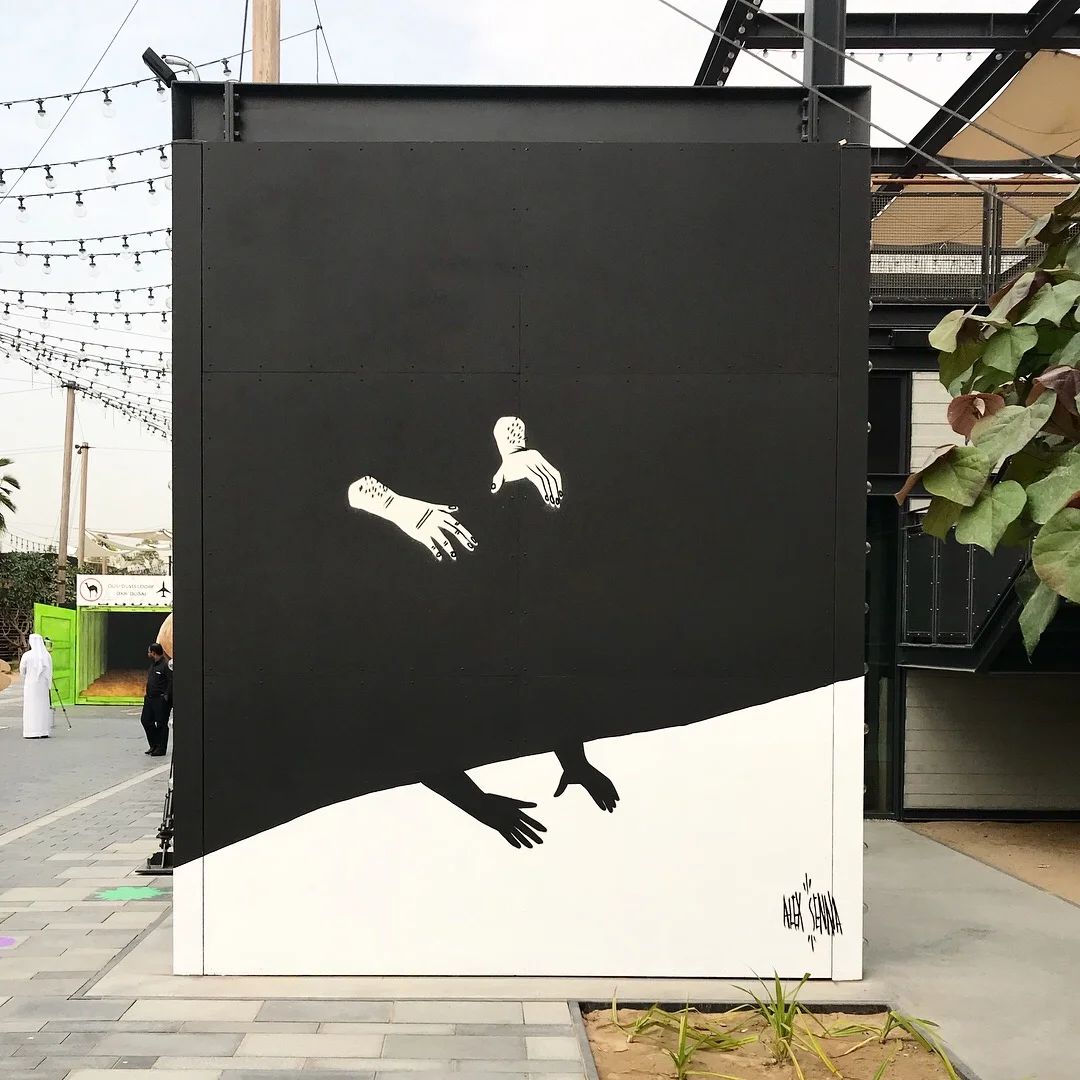
These murals at the La Mer beachfront in Jumeirah are by the Brazilian street artist Alex Senna, and were among five works from the Dubai Canvas 3D Art Festival selected to remain as permanent fixtures at the seaside destination after the festival ended.
Senna, born in Sao Paulo, is self-taught and works entirely in black and white — he is colour-blind — building his images from simplified, silhouette-like characters. His work focuses on human relationships and makes heavy, deliberate use of shadow and light. Two of his pieces were chosen for permanent display at La Mer; the first, typical of his style, shows two hands stretching out of the shadows toward the light.
Against the bright, colour-saturated, marine-themed decor of La Mer — a Meraas beachfront development where even the parking walls are painted with sea creatures — Senna's restrained monochrome figures stand apart, offering a quieter, more contemplative counterpoint amid the promenade's playful holiday atmosphere.
Exhibo editorial
Alex Senna can't see colour, so he stopped trying — everything he paints is black, white and the shadow in between. Dropped into La Mer, which is about as colour-saturated as a beachfront gets, his monochrome figures do something the rest of the promenade can't: they slow you down.
The one people remember is a pair of hands reaching out of the dark toward the light, which is more or less his whole subject in a single image — people straining toward one another, toward something better. Five festival murals were kept when the Dubai Canvas event packed up; two of them are his. On a beach full of selfie walls, his are the ones that are actually about something.
Gallery

How to find it
Alex Senna's murals are at the La Mer beachfront development in Jumeirah, among the promenade's shops, walls and public spaces. Walk the La Mer North and South strips to find them; the black-and-white figures stand out sharply against the colourful marine-themed murals elsewhere on site, including the sea-creature paintings in the parking areas. Free to access; combine with the beach and food trucks.
Similar places
All places
News by Exhibo
Editorial coverage on Exhibo
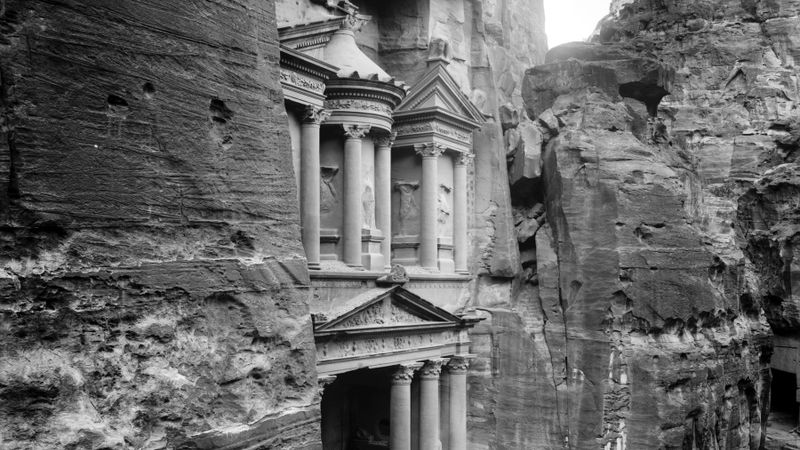
Filmed, but Not Recorded: The Arab World’s Missing Film Locations
Wikidata knows Gladiator was filmed in Morocco. It doesn’t know where.
Ouarzazate is the second most filmed place in the Middle East and North Africa, yet 25 of its 27 productions are recorded only in Wikipedia prose. We compared filming records worldwide and found that in the Arab world, Wikidata usually knows the country but not the place.
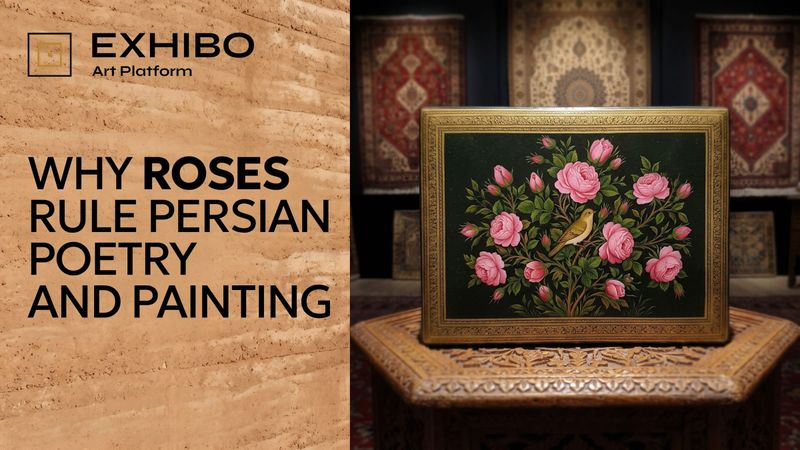
The Flower That Was Never Only Beautiful
The rose rules Persian poetry and painting — but under the sweetness sits a thorn, a bleeding bird, and a national emblem quietly assembled out of Chinese, European and Persian parts. A history of gol o bolbol, from a medieval still to a Dubai gallery.
Gol o bolbol — the rose and the nightingale — is among the most beautiful images in a thousand years of Persian art, and in modern Persian it also means sweet, empty talk. Under the tile, the picture is darker: a bird singing in blood for a flower that will not answer and will not last.
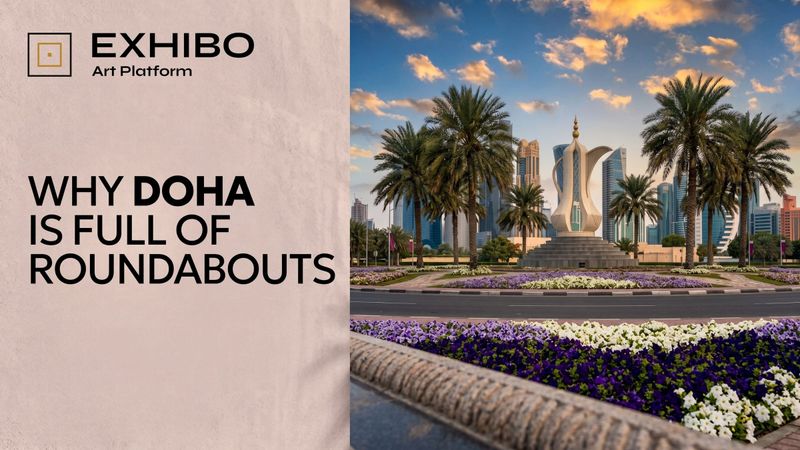
Why Doha Is Full of Roundabouts
An old circle at a crossroads, sharpened by British road engineering, became the way an Arabian city found its way and remembered itself — and it took the bulldozers to reveal it.
In a city where a landmark was more useful than an address, Doha's roundabouts became its navigation, its landscaping and its national image all at once. Now they're being torn out for signalled junctions — and the affection for them arrived, as one scholar put it, only posthumously.