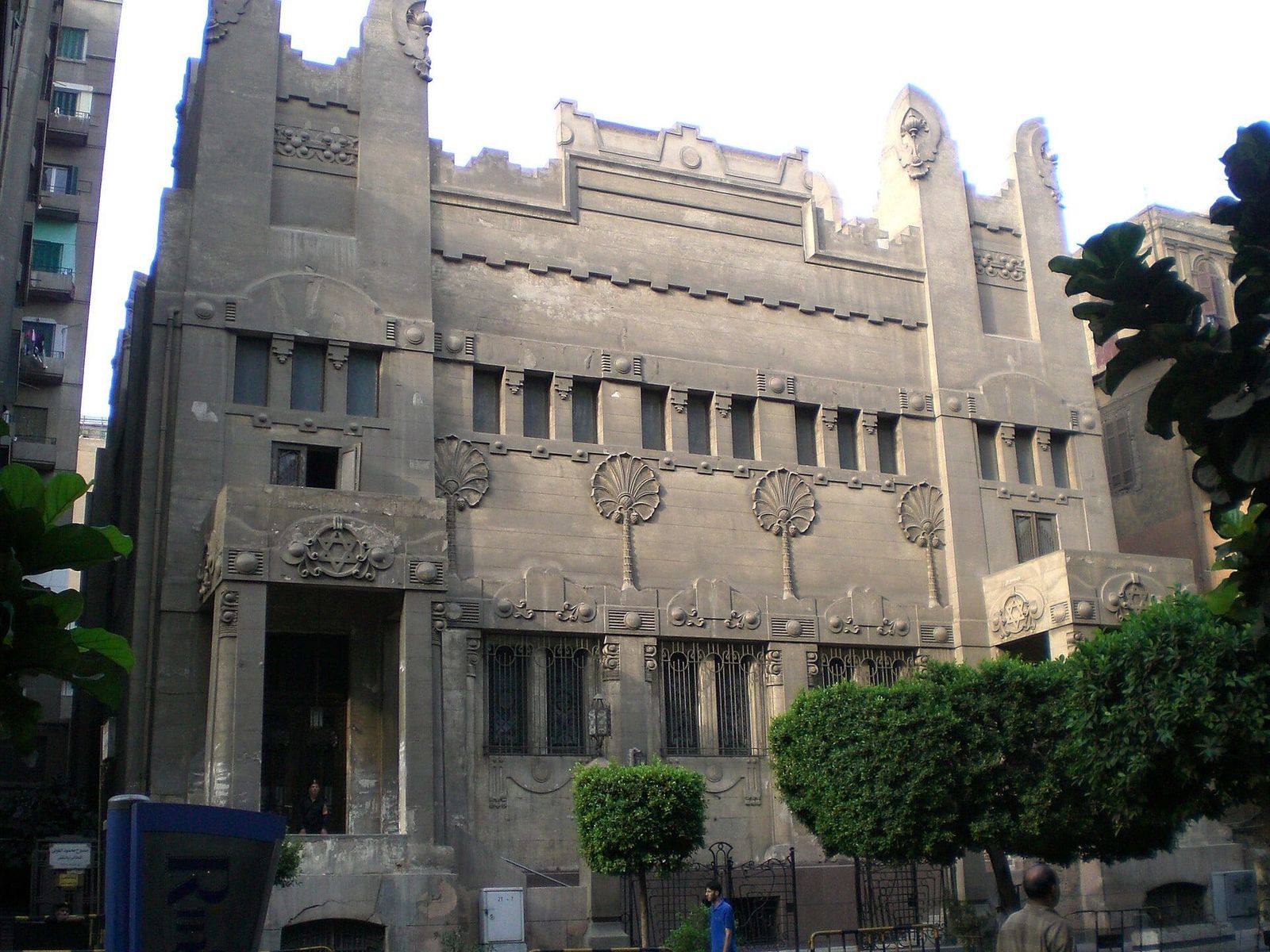
Sha'ar Hashamayim Synagogue (Adly Street Synagogue)
A pharaonic-revival synagogue of 1899–1908 on Adly Street, once the grand temple of Cairo's Jewish community.
Gate of Heaven
Sha'ar Hashamayim, "Gate of Heaven" in Hebrew, is the principal surviving synagogue of downtown Cairo, standing at 17 Adly Street. Known until the 1940s as Temple Ismailia and today usually called the Adly Street Synagogue, it was begun in 1899 and inaugurated in 1908, at a time when Cairo's Jewish community was large, prosperous and closely involved in the city's economic and cultural life. Part of the land is said to have been donated by members of the Mosseri and Cattaui families, among the wealthiest Jewish families in Egypt and the synagogue was the scene of many of their weddings and funerals. Its long-time spiritual leader was Chief Rabbi Haim Nahum.
Architecture
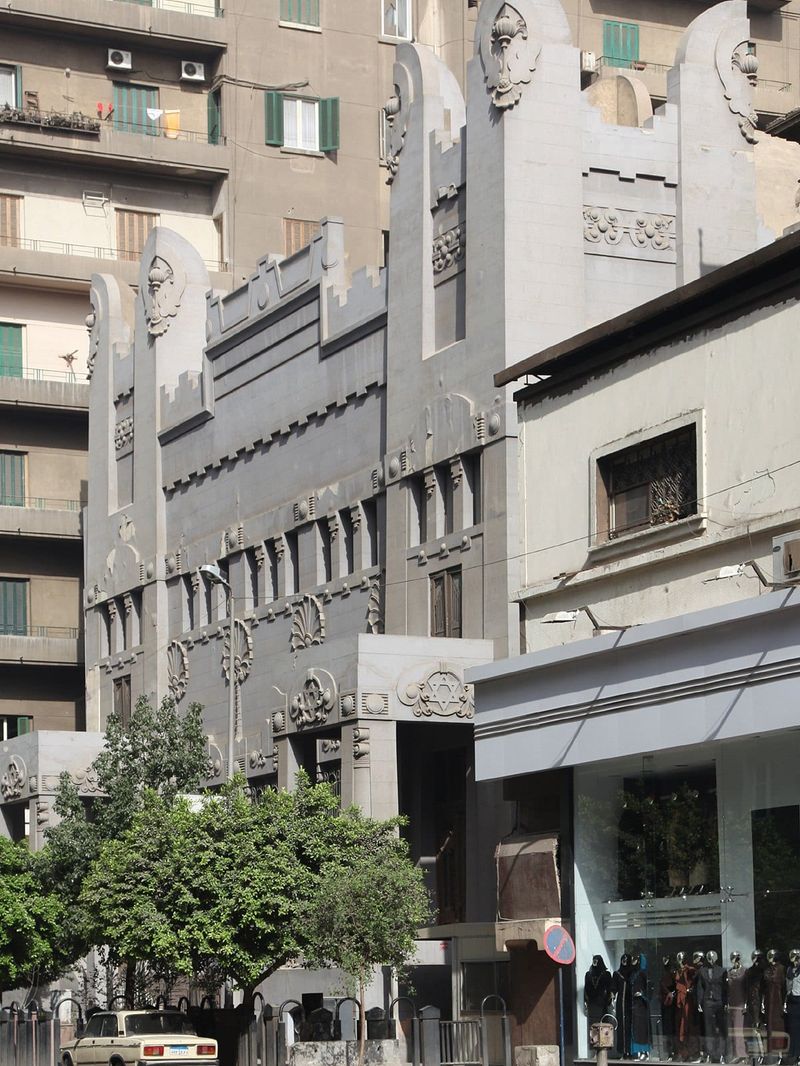
The synagogue was designed by the architects Maurice Youssef Cattaui and Eduard Matasek in a style that evokes ancient Egyptian temples: its stone façade is decorated with stylised palm columns, lotus capitals and other pharaonic motifs mixed with Art Nouveau elements and it was once the largest building on the boulevard. Inside, the prayer hall is a lofty space with galleries for women, stained glass and fine marble and woodwork. The building also houses a library of several hundred books on the history of the Jews in Egypt.
Today
Egypt's Jewish community, which numbered tens of thousands in the first half of the twentieth century, declined after 1948 and especially after 1956; only a handful of members remain. The synagogue, which marked its centenary in 2008, is maintained under the care of the community and the Egyptian authorities and is guarded by police. Visits are possible with identification and, often, by prior arrangement.
Exhibo editorial
Adly Street is a canyon of banks and office blocks. In the middle of it stands a building that looks as if Karnak had been redesigned in 1900 by an Art Nouveau architect: palm columns, lotus capitals, a pharaonic gateway leading into a Jewish house of prayer. It is one of the strangest and most beautiful façades in Cairo.
It is also a monument to a community that has almost entirely disappeared from the city it helped to shape. If you can arrange a visit, go in: the hall, the galleries and the light through the stained glass tell a story of cosmopolitan Cairo that the street outside has forgotten.
Gallery
How to find it
On Adly Street in Downtown Cairo, between Talaat Harb Street and Mohamed Farid Street. The nearest metro station is Mohamed Naguib.
Similar places
All places
News by Exhibo
Editorial coverage on Exhibo
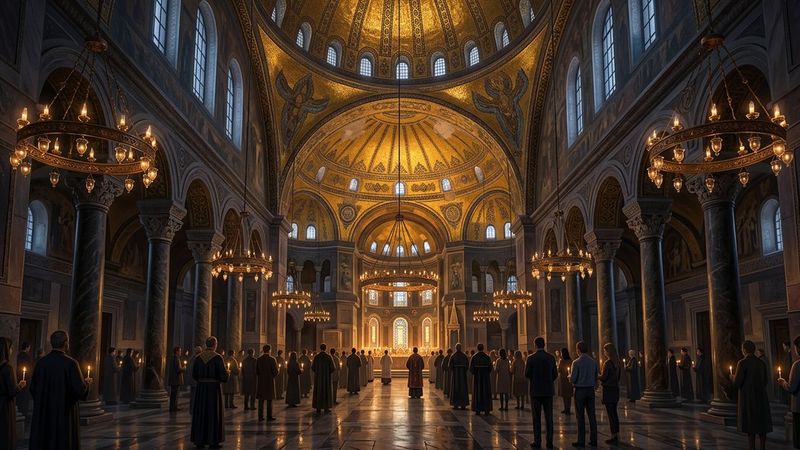
Byzantine Art, Explained
Constantinople to Ravenna: gold mosaics, icons and court craft that shaped Christian imagery for nearly a millennium.
Byzantine art was the Christian visual culture of the Eastern Roman Empire. This guide explains how mosaics and icons worked in liturgy and empire, follows the tradition from Constantinople across the Mediterranean, and points to works that still define the style after empire, conquest and modern museum display.

Agatha Christie's Egypt: Three Abu Simbels, a Pharaoh and a Murder on the Nile
Christie set one famous murder on the Nile and two lesser-known stories in ancient Egypt. The temples, letters and film sets behind all three.
The Abu Simbel of Death on the Nile has since moved up a hill. Christie's two other Egyptian stories lead to a pharaoh's dismantled temples at Karnak and a farmer's 4,000-year-old letters now in New York.
The Real Oasis of The Alchemist: Al-Fayoum and the Dream Coelho Borrowed
Paulo Coelho sent his shepherd to a real place in Egypt. What Santiago would have found there and where the story of the treasure at home came from.
Santiago's oasis is real. Al-Fayoum lies 100 km from Cairo, with Roman-era painted portraits, a temple on the caravan road and a dream story centuries older than Coelho.