
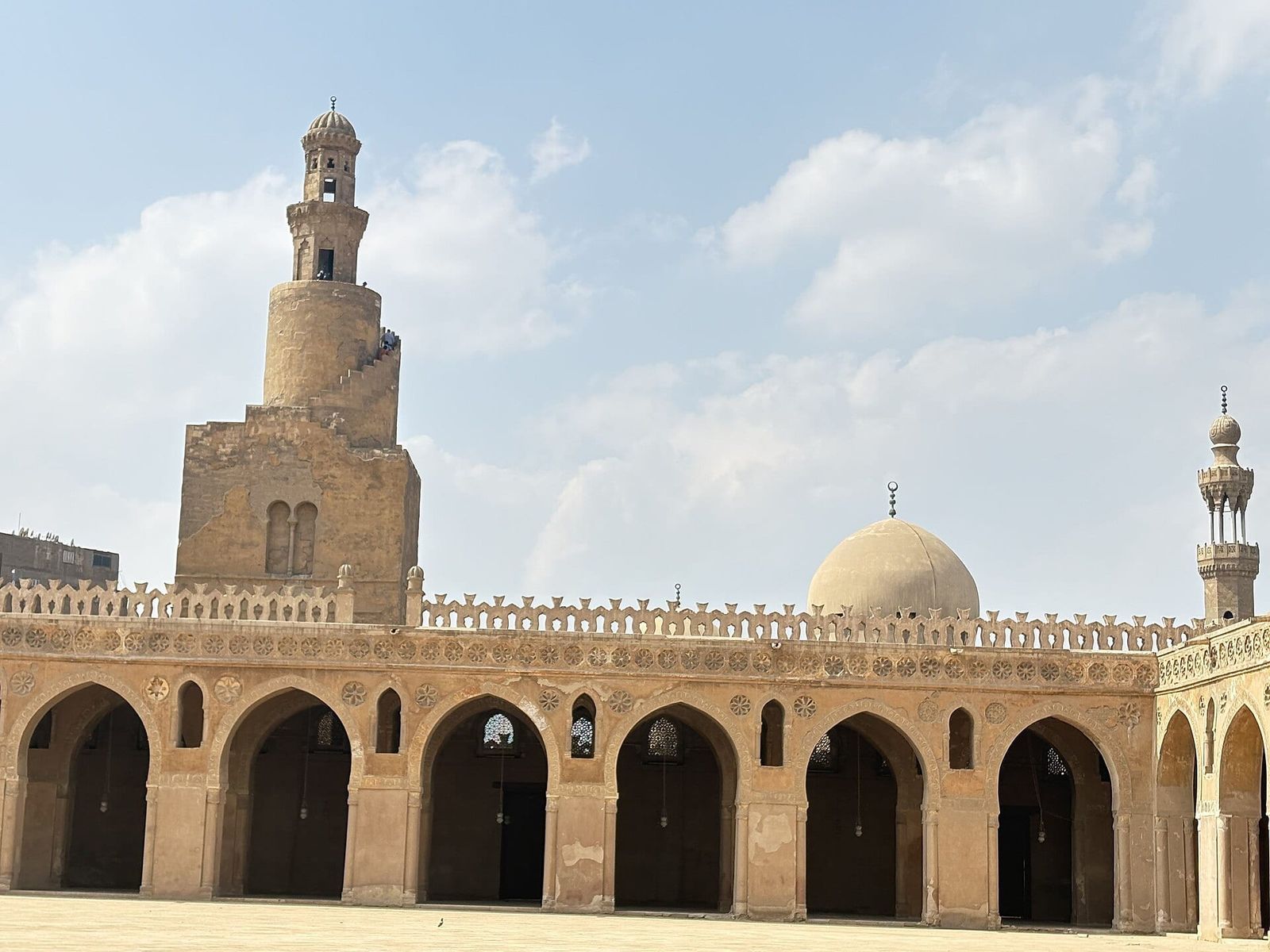
Mosque of Ibn Tulun
Cairo's oldest intact mosque, a vast ninth-century courtyard of brick arcades, ringed by a spiral minaret you can climb.
Cairo's oldest intact mosque
The Mosque of Ibn Tulun is the oldest mosque in Egypt to survive largely in its original form and, at around 26,300 square metres including its outer enclosures, the largest in Cairo by area. It was built between 876 and 879 by Ahmad ibn Tulun, the son of a Turkic slave-soldier of the Abbasid caliph al-Ma'mun, who was sent to govern Egypt and went on to found the Tulunid dynasty that ruled the country until 905. The mosque was the congregational centre of al-Qata'i, the new capital he laid out north-east of Fustat because the old Mosque of Amr could no longer hold his army at Friday prayer. His palace, the Dar al-Imara, stood against the qibla wall and a private door let the governor step directly to the minbar.
Architecture from Samarra
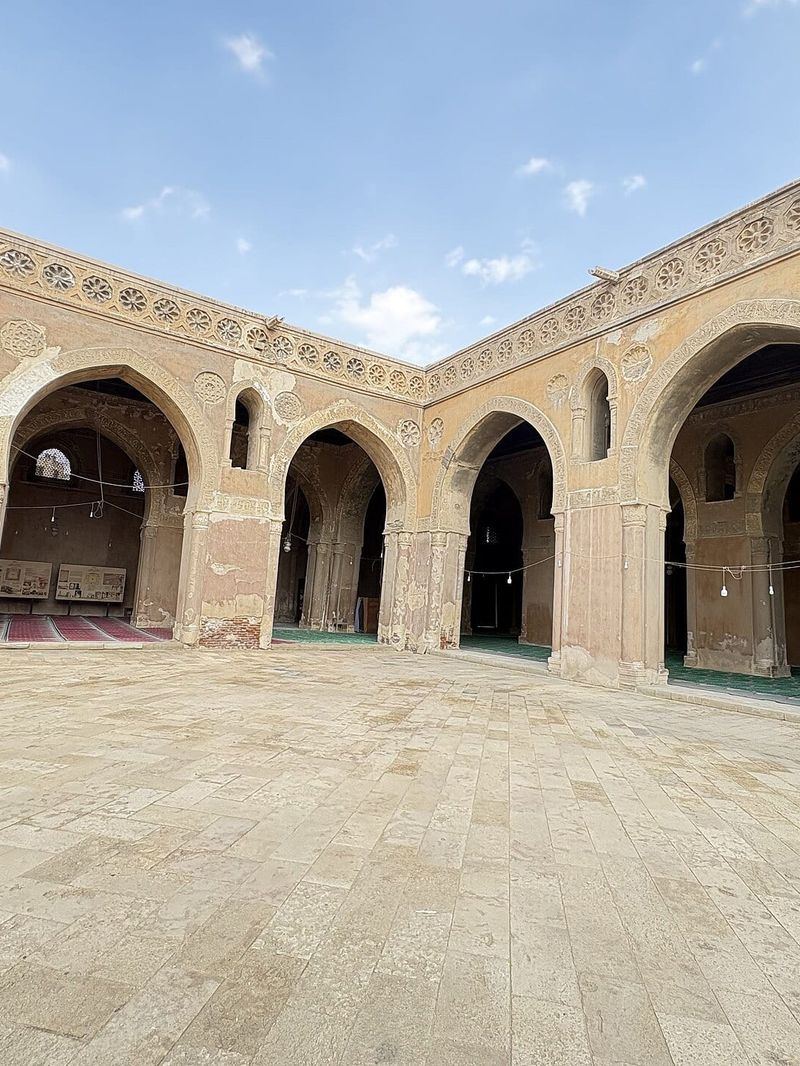
Ibn Tulun had trained in Samarra, the Abbasid capital on the Tigris and his mosque is the clearest expression of Samarran architecture outside Iraq. Like the great mosques of Samarra and Abu Dulaf, it is built of red brick faced with stucco and set inside a double enclosure: the mosque proper is wrapped on three sides by a ziyada, an outer courtyard that isolates the sanctuary from the noise of the city. Inside, the vast open courtyard is surrounded by arcades of pointed arches carried on massive brick piers with engaged corner columns. The prayer hall on the qibla side is five aisles deep. Running beneath the flat wooden ceiling is a carved sycamore frieze inscribed with about a fifth of the Qur'an and the soffits of the arches, the window grilles and the crenellated parapet carry some of the earliest surviving stucco ornament in Egypt, in the bevelled style developed at Samarra.
The Mamluk restoration and the minaret
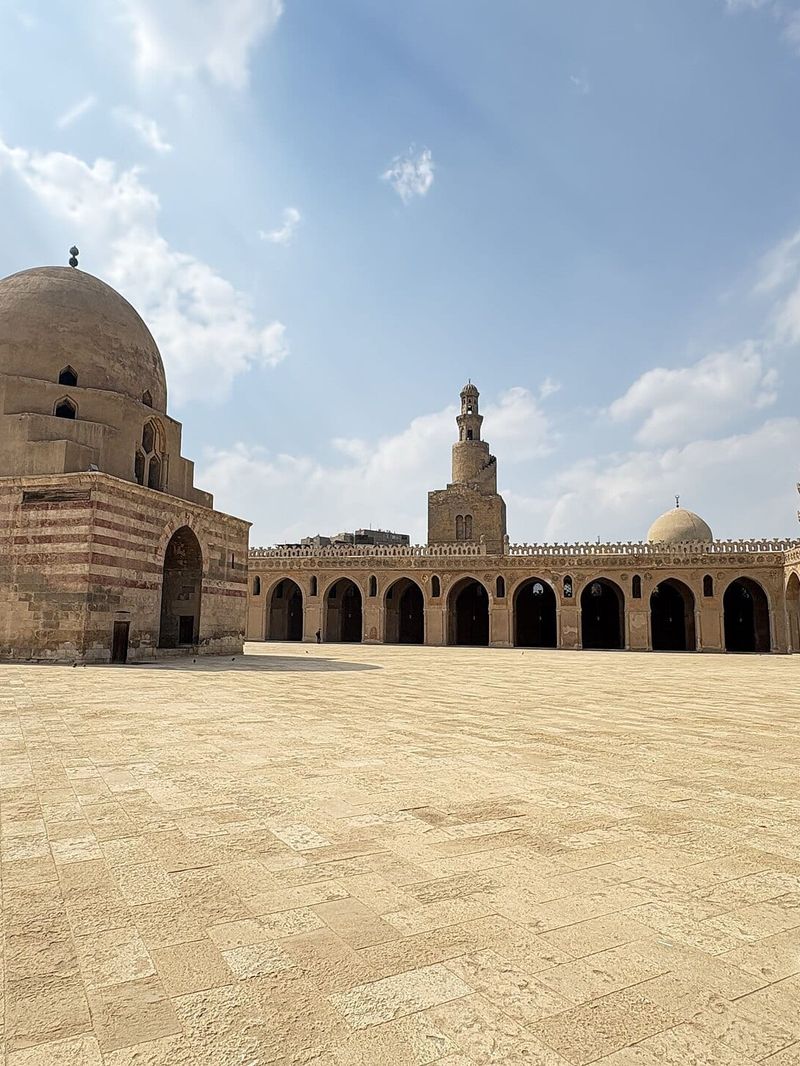
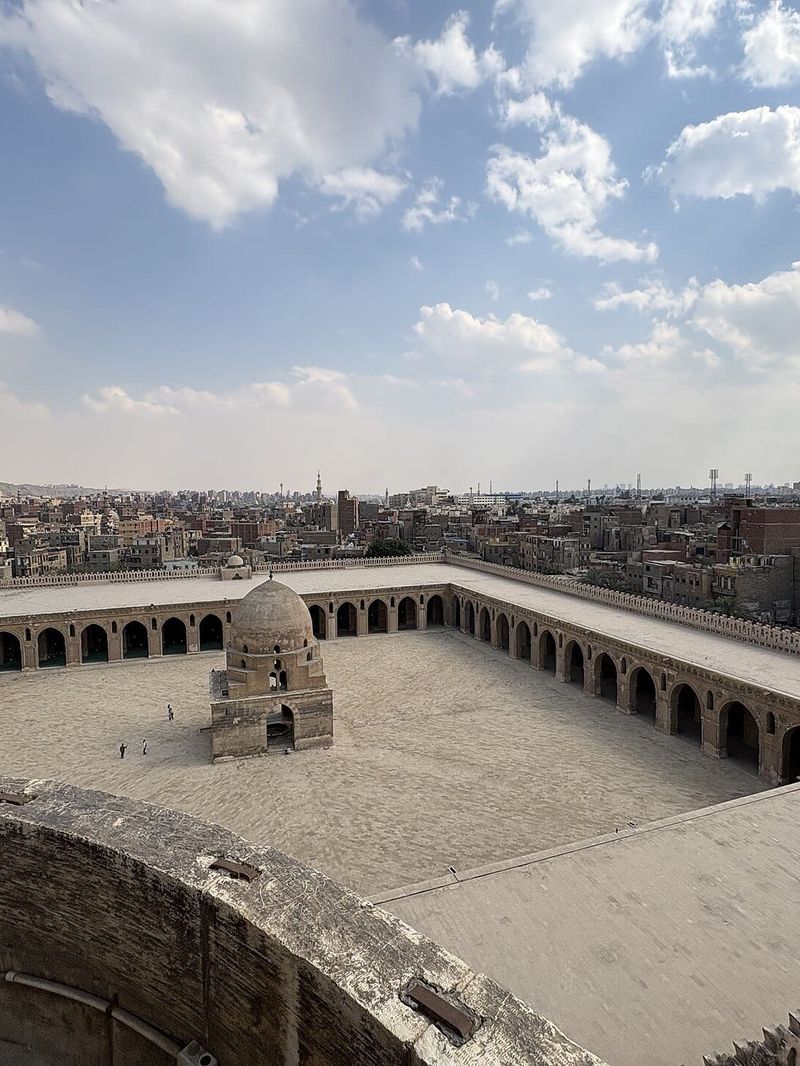
After the Tulunids fell the mosque declined; by the late thirteenth century it was a ruin, used as a shelter for travellers. In 1293 the Mamluk emir Lajin, an accomplice in the murder of Sultan al-Ashraf Khalil, hid inside it and vowed to restore it if he survived and became sultan. He did and in 1296 he carried out the restoration that shaped much of what stands today: the domed ablution fountain at the centre of the courtyard, the mihrab's marble and mosaic decoration, the minbar and the minaret. The present minaret, in stone, stands on the north-west side of the ziyada and is joined to the mosque by an arched bridge. Its lower part is square, with an external stair winding around a cylindrical middle section, crowned by an octagonal kiosk and a ribbed helmet; the outside stair recalls the spiral Malwiya of Samarra, which the original Tulunid minaret is thought to have copied.
Later history
Further repairs followed in the nineteenth and twentieth centuries, by the Comité de Conservation des Monuments de l'Art Arabe and later by the Supreme Council of Antiquities, most recently in the early 2000s. The mosque is part of the UNESCO World Heritage Site of Historic Cairo. Against its north-east wall stand the two Ottoman-era houses that form the Gayer-Anderson Museum, which can be visited on the same walk.
Exhibo editorial
The first thing Ibn Tulun gives you is room. Cairo is a city where every square metre is argued over. Here, in the middle of it, is a courtyard so large and so empty that the noise of the street simply stops at the wall. The arcades are brick and plaster, the colour of bread. The light moves across them all day like a sundial no one bothered to mark.
Then climb the minaret. The stair runs around the outside of the tower and with each turn the city opens a little more: the domes of Sultan Hassan, the Citadel on its spur, a sea of rooftops and satellite dishes. Go in late afternoon, when the courtyard turns gold and the call to prayer comes from a dozen directions at once. You will understand why a fugitive emir, hiding here in the ruins in 1293, promised to bring it back to life.
Gallery
How to find it
In the Sayyida Zaynab district, about 1 km west of the Sultan Hassan Mosque along Saliba Street. Enter from the side of the Gayer-Anderson Museum, which adjoins the mosque.
Similar places
All places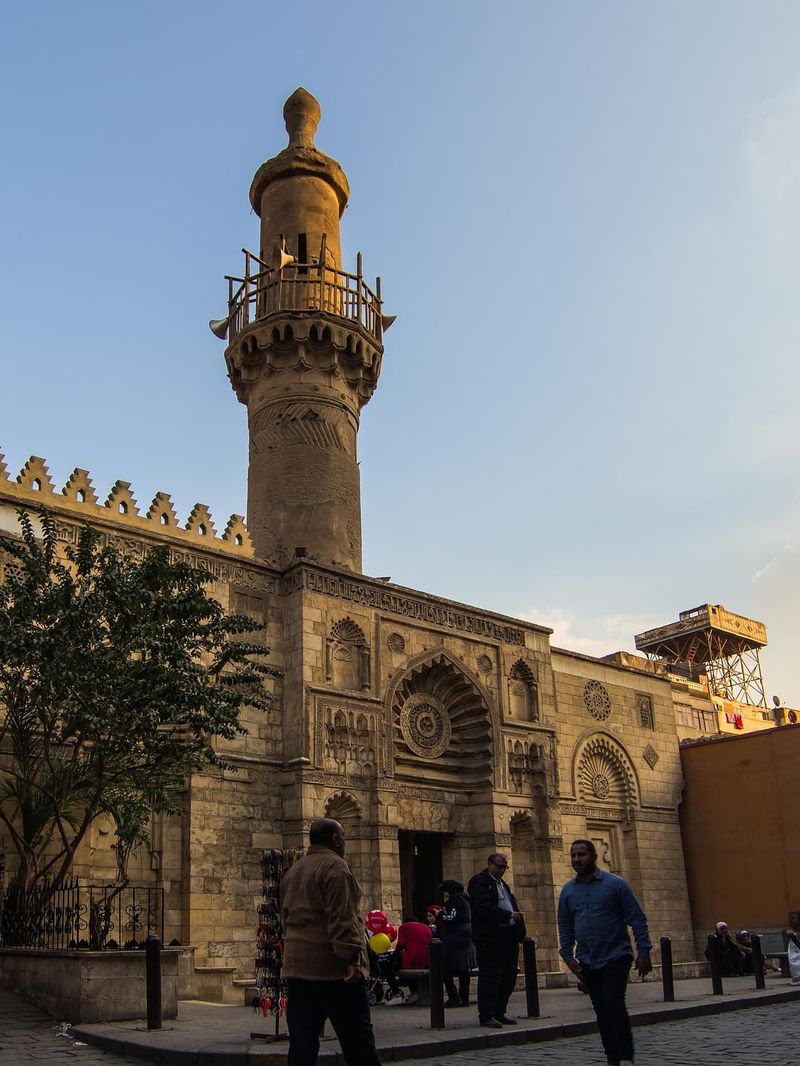
News by Exhibo
Editorial coverage on Exhibo

Where Is Agrabah? The City Disney Assembled From Real Places
Agrabah was going to be Baghdad. A war made it fictional — and then Disney built it back out of real places, from a tomb in Agra to a valley in Jordan that usually plays Mars.
The Sultan's palace where Princess Jasmine feels trapped has the silhouette of the Taj Mahal — which is not a palace at all, but a tomb. That is how Agrabah works. Disney's fairy-tale city was going to be Baghdad, until the Gulf War made the name impossible; the studio invented a place that could not be found on a map, then quietly rebuilt it out of real ones — Isfahan and Agra, Marrakesh and Mandalay, a Jordanian desert that has played both Arabia and Mars.
Islamic Decorative Arts: Ceramics, Metalwork, Glass and Textiles
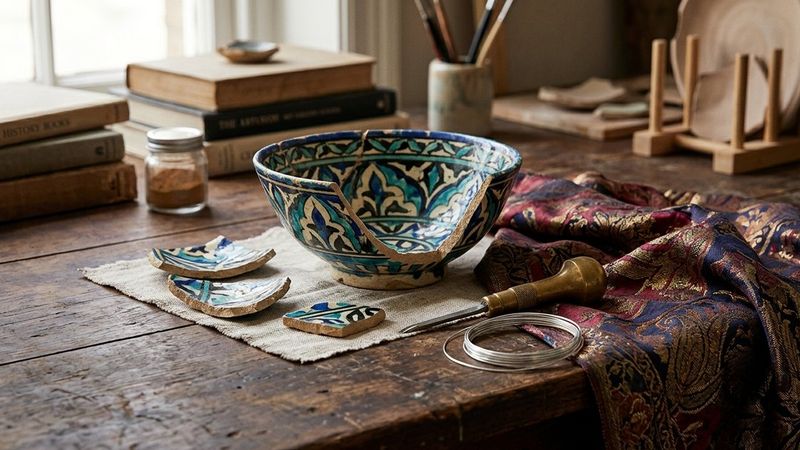
From Kashan luster bowls to Mamluk mosque lamps and Safavid silks: a museum survey of four luxury media with named works in London, New York and Doha
Islamic decorative arts are the portable luxury crafts of Muslim-ruled lands: pottery and tile, inlaid brass, enamelled glass, woven silk and knotted carpet. This survey follows workshop conditions, techniques and trade from Abbasid Iraq to Ottoman Istanbul, with four close readings and a media comparison table, while Iznik depth, arabesque theory and building programmes sit in sibling articles on the series hub.
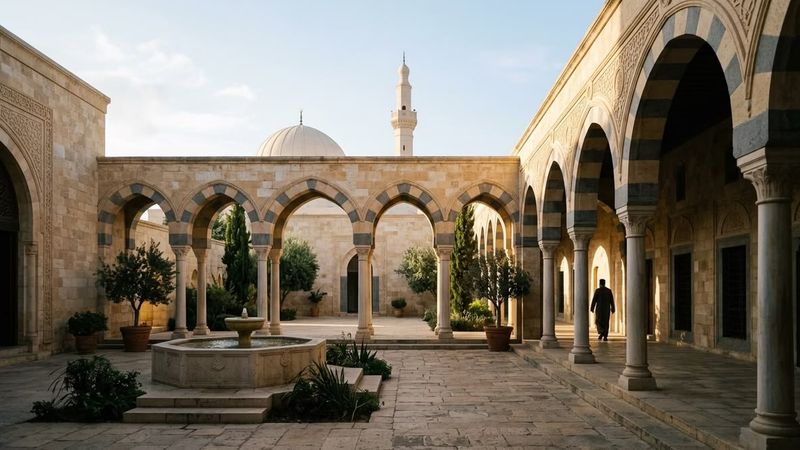
Islamic Architecture, Explained
Mosque types, domes, minarets and courtyard plans from Umayyad Jerusalem to Ottoman Istanbul, with five regional schools read through buildings you can visit
Islamic architecture is the building tradition of Muslim-ruled lands from the seventh century onward: hypostyle mosques, courtyard sahn, minaret towers and dome engineering shaped by prayer law, climate and regional craft. This guide maps Umayyad, Mamluk, Safavid, Mughal and Ottoman schools through named monuments, with muqarnas vaulting and decorative arts deferred to sibling pages in the series.