
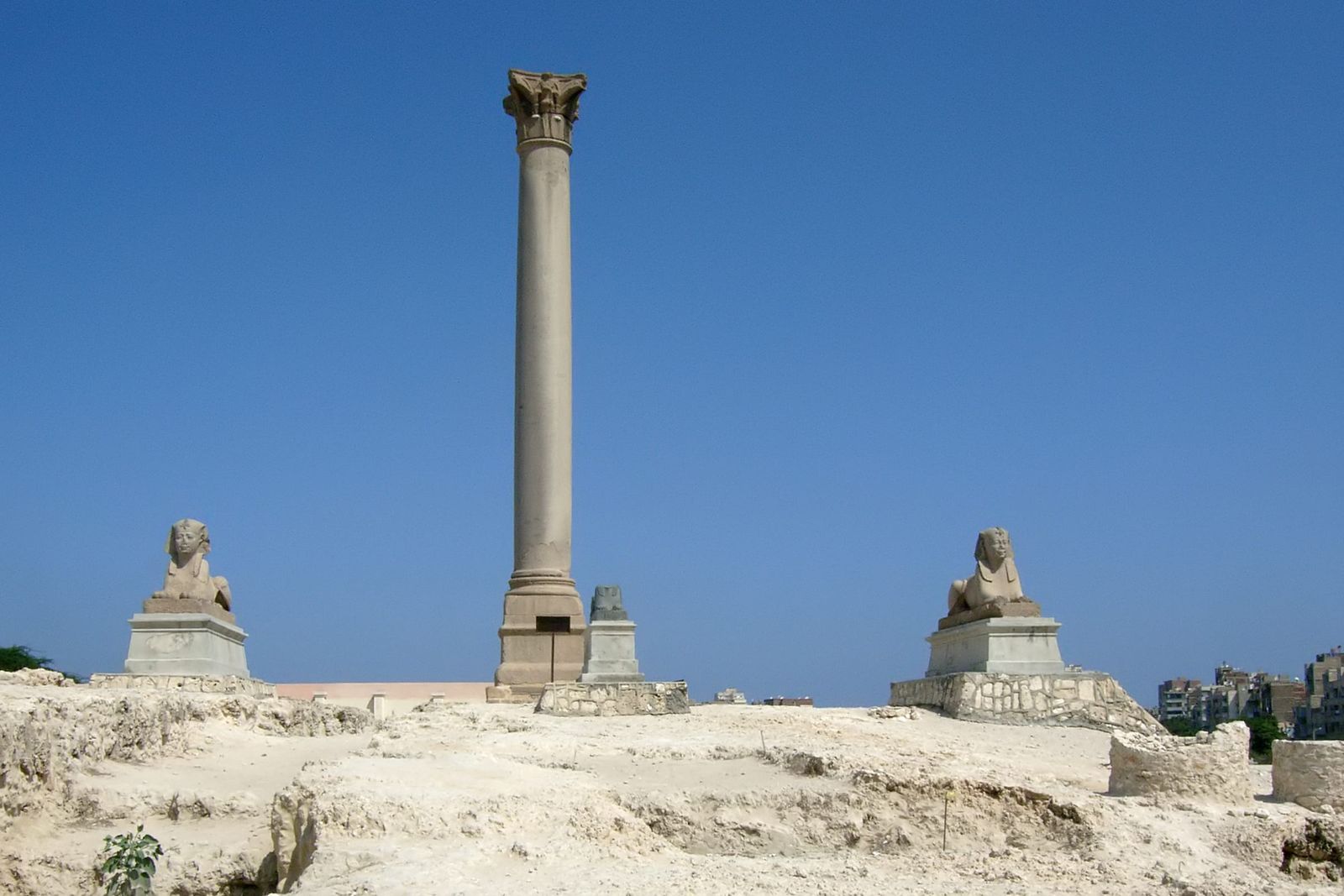
Pompey's Pillar and the Serapeum
A 27-metre granite column raised for Diocletian on the hill of the Serapeum, the great temple of Serapis and 'daughter' library of Alexandria.
The column of Diocletian
Pompey's Pillar is the tallest ancient monument still standing in Alexandria: a single column of red Aswan granite, about 27 metres high including its base and Corinthian capital, rising on the hill of Rhakotis, the old Egyptian quarter of the city. Despite its name, it has nothing to do with the Roman general Pompey; medieval travellers believed it marked his tomb. A Greek inscription on its base records that it was erected around AD 297 in honour of the emperor Diocletian, probably after he suppressed a revolt in Alexandria and relieved the city in a time of famine.
The Serapeum
The column stands in the ruins of the Serapeum, the great temple of Serapis, the Greco-Egyptian god created under the early Ptolemies to unite Greek and Egyptian worshippers. Founded by Ptolemy III in the third century BC, the Serapeum was one of the most magnificent temples of the ancient world, and it housed a library known as the "daughter" of the great Library of Alexandria. In AD 391, under the emperor Theodosius, Christians led by the bishop Theophilus destroyed the temple, an event often seen as marking the end of the pagan world in Alexandria.
What remains
Today the site is an archaeological park. Besides the column, visitors can see two granite sphinxes of the Ptolemaic period, the foundations of the temple, and underground galleries that may have been part of the library or of the cult of the sacred Apis bull, as well as a statue base and fragments of sculpture. The Catacombs of Kom el-Shuqafa are a short walk away.
Exhibo editorial
From the street below, the column seems to float above the rooftops of Karmouz, a single red granite shaft against the sky. Up on the hill it is even more impressive — and the more you know, the more poignant the site becomes. Beneath your feet lie the foundations of the Serapeum, where scholars once read in the 'daughter' of the great library, before the temple was torn down in 391.
Walk round the column, look at the sphinxes and go down into the underground galleries. Then sit for a while on the hill and think about everything Alexandria once was.
How to find it
Pompey's Pillar stands in the Karmouz district of western Alexandria, in the area known as Amoud al-Sawari; the entrance is on the street at the foot of the hill. Climb the path to the column; the sphinxes and the entrance to the underground galleries are nearby on the hilltop.
Similar places
All places
News by Exhibo
Editorial coverage on Exhibo
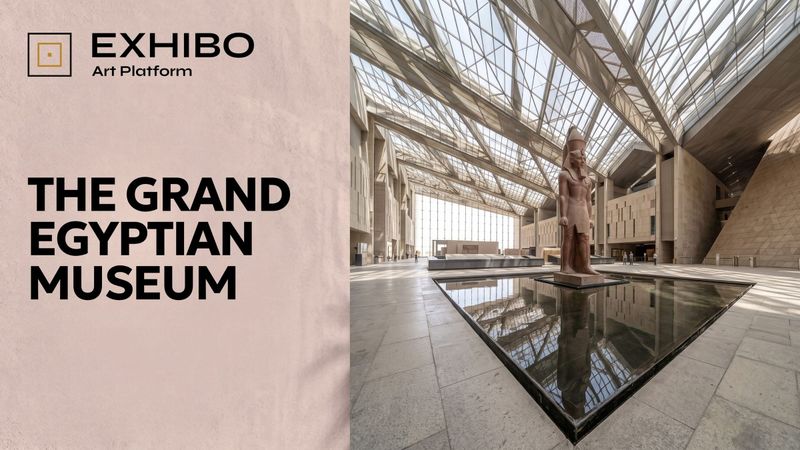
The Museum That Reflects Everything, Including You
How the world's largest single-civilisation museum gathers a nation's heritage, national story, tourism economy and repatriation claims under one reflective roof — and what those mirrored surfaces quietly ask of everyone who walks in.
Around the colossus of Ramses II, shallow pools mirror the floor so exactly that visitors keep stepping in. It is a small, faintly comic thing — and a way into a much larger question about the Grand Egyptian Museum. A civilisation is gathered here and made whole, while its three most famous faces stay abroad. A home for a nation's heritage opens, and the nation queues outside it. A monument to Egyptian sovereignty rises, financed largely from Tokyo.
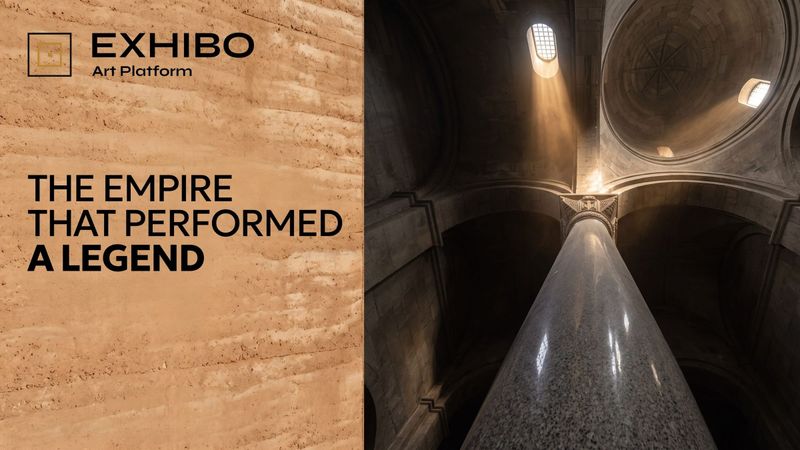
Seventy Thousand Solomons: The Empire That Performed a Legend
A demon catalogue in the conqueror's library, a sixteenth-century text where kingship is an office held seventy thousand times, and the columns a sultan dragged across three provinces to prove he held it.
Mehmed II kept a Greek catalogue of demons in his library at Topkapı. Seventy years later a sultan named for a prophet was rebuilding the walls of Jerusalem and hauling Roman columns out of Egypt and the Lebanon into a mosque above the Golden Horn. In between, Ottoman writers turned Solomon from a warning into a job — and the empire applied for it in stone.