
Catacombs of Kom el-Shuqafa
A three-level Roman-era necropolis cut into the rock, where Egyptian gods wear Roman armour — one of the Seven Wonders of the Middle Ages.
Discovered by a donkey
The Catacombs of Kom el-Shuqafa, in the Karmouz district of western Alexandria, are the largest Roman-period burial complex in Egypt. Their name means "mound of potsherds", after the heaps of broken pottery that once covered the area. The catacombs were rediscovered in 1900, according to the well-known story, when a donkey pulling a cart fell through the ground into the shaft. Carved deep into the rock in the first and second centuries AD, probably as the tomb of a wealthy family and later extended for many more burials, they were used into the fourth century.
A descent through three levels
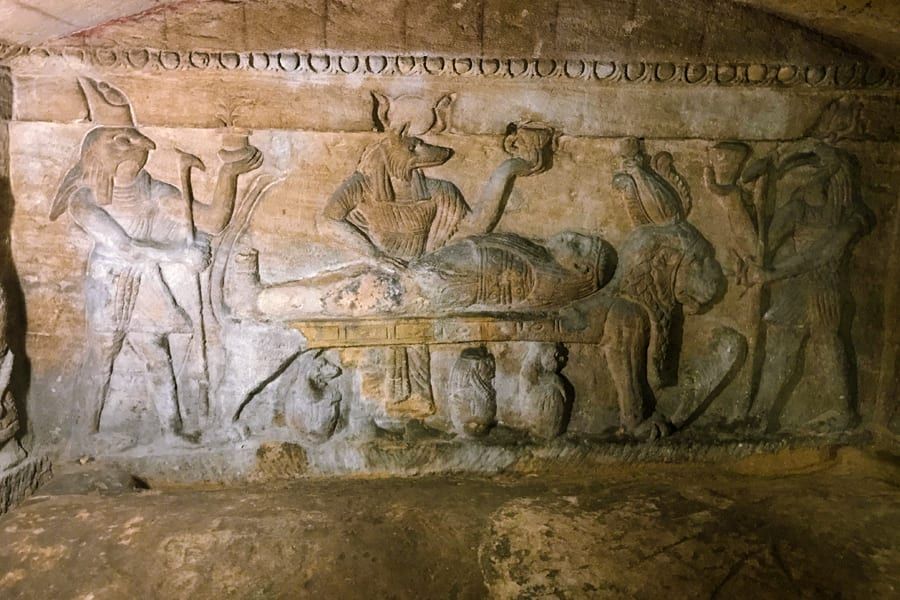
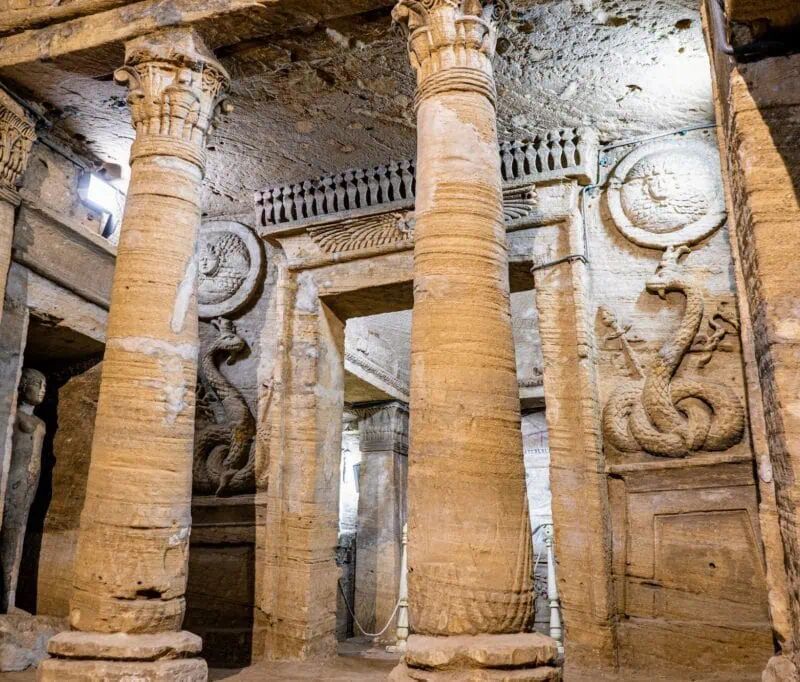
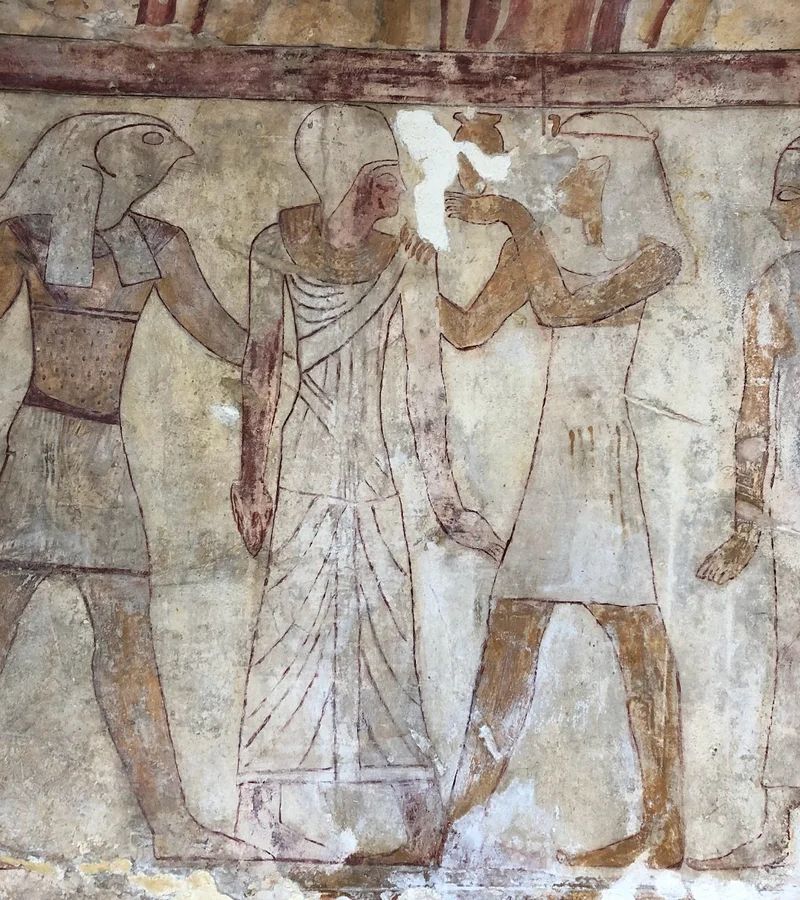
A wide spiral staircase, around which the bodies of the dead were lowered on ropes, leads down through three levels cut into the rock, the lowest now flooded by groundwater. On the upper levels are a rotunda and a banqueting hall, the triclinium, where relatives held funerary feasts. The centrepiece is the main tomb chamber, whose façade and interior combine Egyptian, Greek and Roman art in an extraordinary way: the jackal-headed Anubis and the crocodile-god Sobek appear dressed as Roman legionaries, Egyptian funerary scenes are carved in a classical style, and great serpents wearing the double crown of Egypt guard the entrance, alongside Greek motifs such as Medusa heads. Around the main chamber, corridors lined with hundreds of loculi — niches for burials — run in all directions.
The Hall of Caracalla
A separate set of tombs, linked to the catacombs, is known as the Hall of Caracalla; it was long believed to hold the remains of young men massacred by the emperor Caracalla in AD 215, though the bones found there are mostly of horses. The catacombs were included in the medieval list of the Seven Wonders of the Middle Ages.
Exhibo editorial
Going down the spiral staircase into Kom el-Shuqafa feels like descending into another world: cool air, the smell of damp stone, the noise of Alexandria fading above you. Then you reach the central tomb, and the strangeness hits — Anubis in the armour of a Roman soldier, serpents in pharaohs' crowns, Medusa heads beside Egyptian gods.
This is Alexandria in a single room: a city where Egyptian, Greek and Roman cultures didn't replace each other but blended into something new. Take your time in the dim corridors, and imagine the funeral feasts in the banqueting hall above.
Gallery
How to find it
The catacombs lie in the Karmouz district of western Alexandria, a short taxi ride from Pompey's Pillar, which is about 500 metres away. From the ticket office, walk through the garden to the entrance building and descend the spiral staircase to the main tomb chamber on the second level.
Similar places
All places
News by Exhibo
Editorial coverage on Exhibo
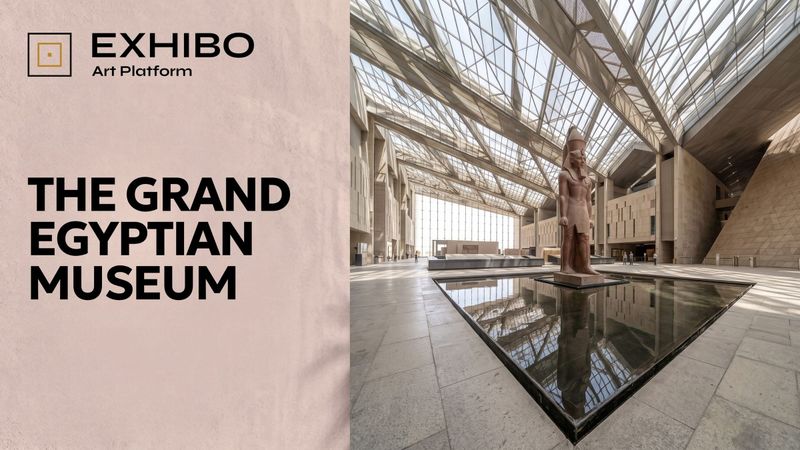
The Museum That Reflects Everything, Including You
How the world's largest single-civilisation museum gathers a nation's heritage, national story, tourism economy and repatriation claims under one reflective roof — and what those mirrored surfaces quietly ask of everyone who walks in.
Around the colossus of Ramses II, shallow pools mirror the floor so exactly that visitors keep stepping in. It is a small, faintly comic thing — and a way into a much larger question about the Grand Egyptian Museum. A civilisation is gathered here and made whole, while its three most famous faces stay abroad. A home for a nation's heritage opens, and the nation queues outside it. A monument to Egyptian sovereignty rises, financed largely from Tokyo.
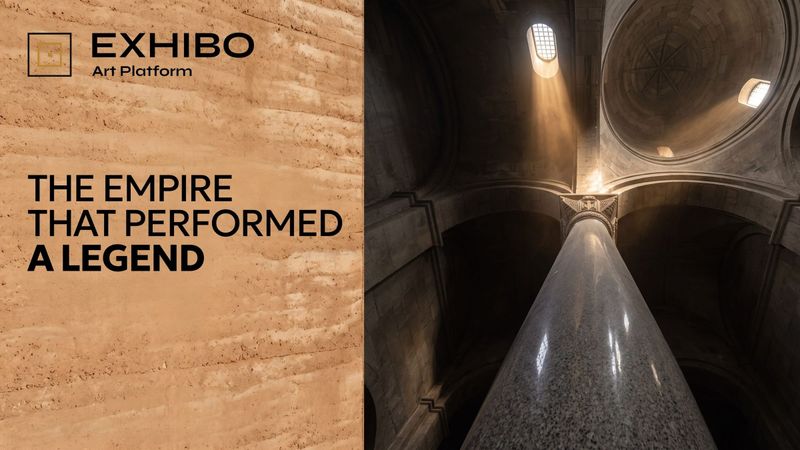
Seventy Thousand Solomons: The Empire That Performed a Legend
A demon catalogue in the conqueror's library, a sixteenth-century text where kingship is an office held seventy thousand times, and the columns a sultan dragged across three provinces to prove he held it.
Mehmed II kept a Greek catalogue of demons in his library at Topkapı. Seventy years later a sultan named for a prophet was rebuilding the walls of Jerusalem and hauling Roman columns out of Egypt and the Lebanon into a mosque above the Golden Horn. In between, Ottoman writers turned Solomon from a warning into a job — and the empire applied for it in stone.