Saadiyat Cultural DistrictAbu Dhabi
UAE Pavilion
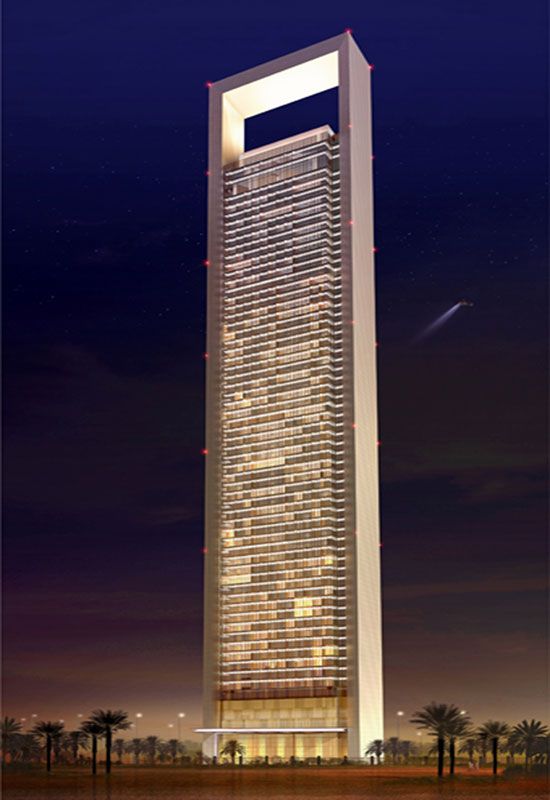
A gold steel sand dune shipped from Shanghai in 60 containers and rebuilt, panel by numbered panel, on Saadiyat.
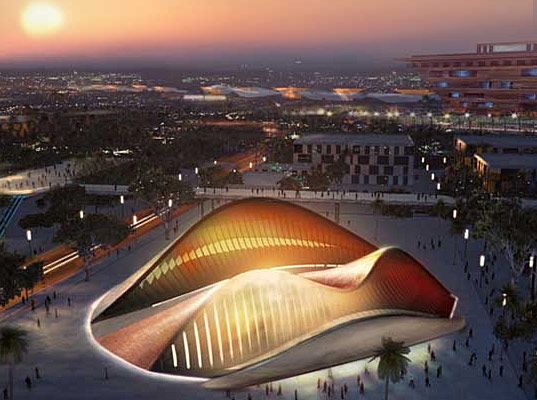
The UAE Pavilion is a dune-shaped steel structure standing opposite Manarat Al Saadiyat in the Saadiyat Cultural District. It is the only national pavilion from World Expo 2010 in Shanghai to have been dismantled and rebuilt in another country — the first such relocation since the international exhibition tradition began with London's Great Exhibition of 1851.
It was designed by Foster + Partners, with Gerard Evenden as lead architect, and stood on the banks of the Huangpu River from May to October 2010, one of the largest structures built for the Expo. Its form takes the sand dune as its subject and its logic: smooth and curved on the windward face, steep and rippled on the leeward side where sand collects, and oriented to deflect the prevailing wind. The north elevation is porous, louvred to admit daylight; the south is solid, minimising solar gain. Lit from inside at night, the louvres glow.
The shell is a triangulated lattice of flat stainless-steel panels on a two-metre grid, treated to read as gold, joined by adjustable nodes designed from the outset for demounting and reassembly. It rises to a peak of about 20 metres over a footprint of roughly 3,500 square metres. Abu Dhabi's Tourism Development & Investment Company announced the relocation in February 2011; the components — reported variously as 24,000 stainless-steel pieces and 30,000 total components — were coded, packed into 60 shipping containers and moved 6,546 kilometres, then slotted back together to Foster + Partners' instructions. The steel has weathered since, shifting from gold towards a warmer bronze that tracks the colour of the dunes it depicts.
On Saadiyat the building initially served as an exhibition venue, hosting Abu Dhabi Art. Following renovation it now houses Berklee Abu Dhabi, the Middle East's first outpost of Berklee College of Music, established under the Department of Culture and Tourism – Abu Dhabi. The 42,000-square-foot interior holds a performance space, a recording studio, rehearsal and ensemble rooms, practice rooms and a multimedia tech lab, and the institution runs a public programme of student, alumni and guest performances. The exterior is freely viewable at any time; interior access follows Berklee Abu Dhabi's event and programme schedule.
Exhibo editorial
Buildings are supposed to be the one thing that stays put. This one has an itinerary. Shanghai for six months, then a coded disassembly, sixty containers, six and a half thousand kilometres of ocean, and a reassembly on an island that was mostly sand when the design was drawn — a building about dunes, behaving like one.
And it has kept moving in a quieter way. The steel was gold when it arrived and it is not gold now; ten-odd years of Gulf sun have pulled it towards bronze, which is closer to what actual dunes do at four in the afternoon than the original ever was. Then the inside changed too — an exhibition hall became a music school, and on the right evening you can stand on the approach from Manarat and hear a rehearsal leaking out of a shell that was built to be temporary and has outlasted almost everything it was exhibited alongside.
How to find it
In the Saadiyat Cultural District, directly opposite Manarat Al Saadiyat and a short walk from the Louvre Abu Dhabi. Park at Manarat Al Saadiyat and cross to the dune-shaped building facing its entrance — you cannot mistake it. Walk around to the north side to see the louvred, porous elevation, then to the south for the smooth unbroken curve; the contrast between the two faces is the point of the design. The exterior is free to view at any hour. To go inside, check the Berklee Abu Dhabi programme for public performances and events.
Similar places
All places
News by Exhibo
Editorial coverage on Exhibo
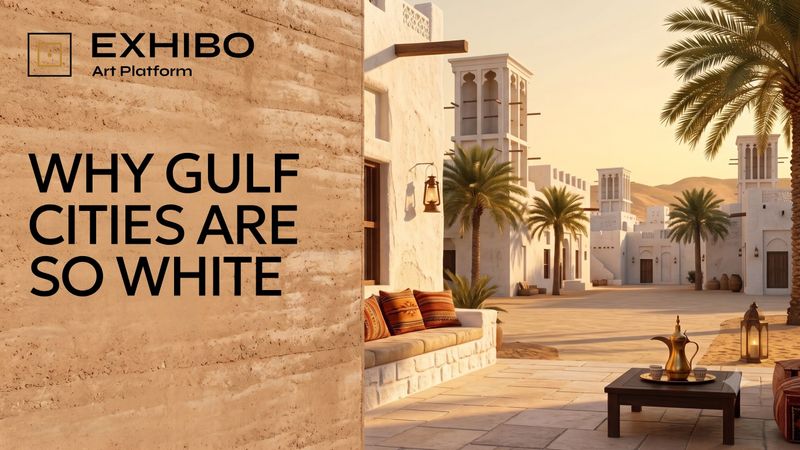
Why Gulf Cities Are So White
The dazzling white of Gulf cities looks like simple physics — sunlight, reflected. The real story runs through coral, lime, faith, oil and the way traditions acquire their reasons after the fact.
Everyone knows why Gulf cities are white: white reflects the sun. It isn't wrong — it's just one strand of a much thicker rope. Follow it back through coral walls and lime skins, a sustainability code that never mentions colour, and a desert that was never really dark and the tidy explanation starts to look like something we tell ourselves afterward.
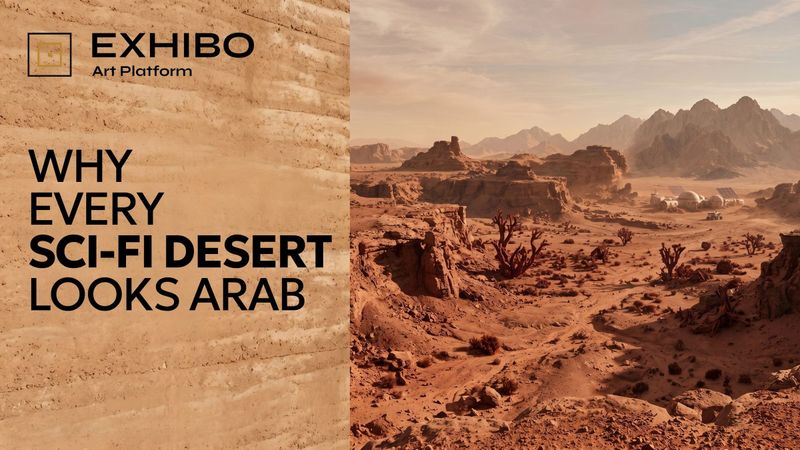
Why Every Sci-Fi Desert Looks Arab
From Arrakis to Tatooine, when a film wants a desert to feel ancient, prophetic and alien, it reaches for an Arab and Berber vocabulary — and reveals more about the West that built it than the region it borrows from.
The wrapped faces, the trilling women, the barely-displaced Arabic: cinema's alien deserts keep sounding Arab. But the vocabulary was assembled in the West — from Orientalist painting to Lawrence to Dune — and it says more about who is looking than about anyone being looked at.
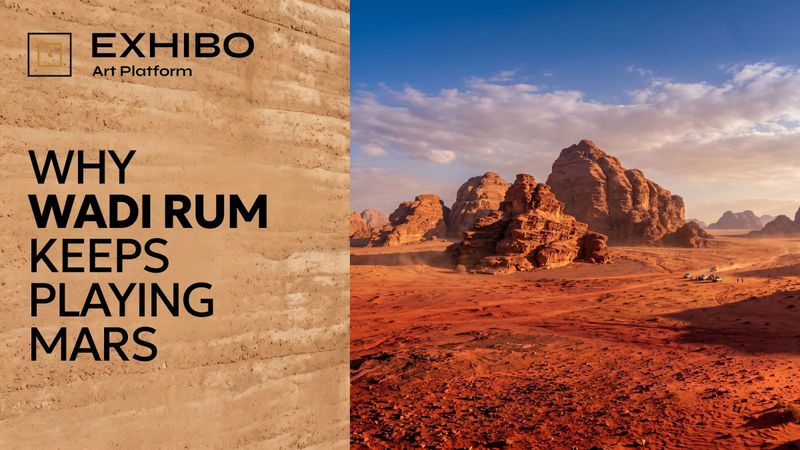
Why Wadi Rum Keeps Playing Mars: A Desert That Is Right About the Wrong Planet
A valley in southern Jordan has become cinema's favourite Mars — not because it is like the planet, but because it looks like the one we carry in our heads.
Put Wadi Rum beside a rover photograph and you can't tell which is Mars. But the desert shares almost nothing with the real planet except its colour — and lately, the illusion has grown powerful enough that real space missions have come to Jordan to rehearse.