Al Bateen & Al KhalidiyaAbu Dhabi
Mamsha Al Khair
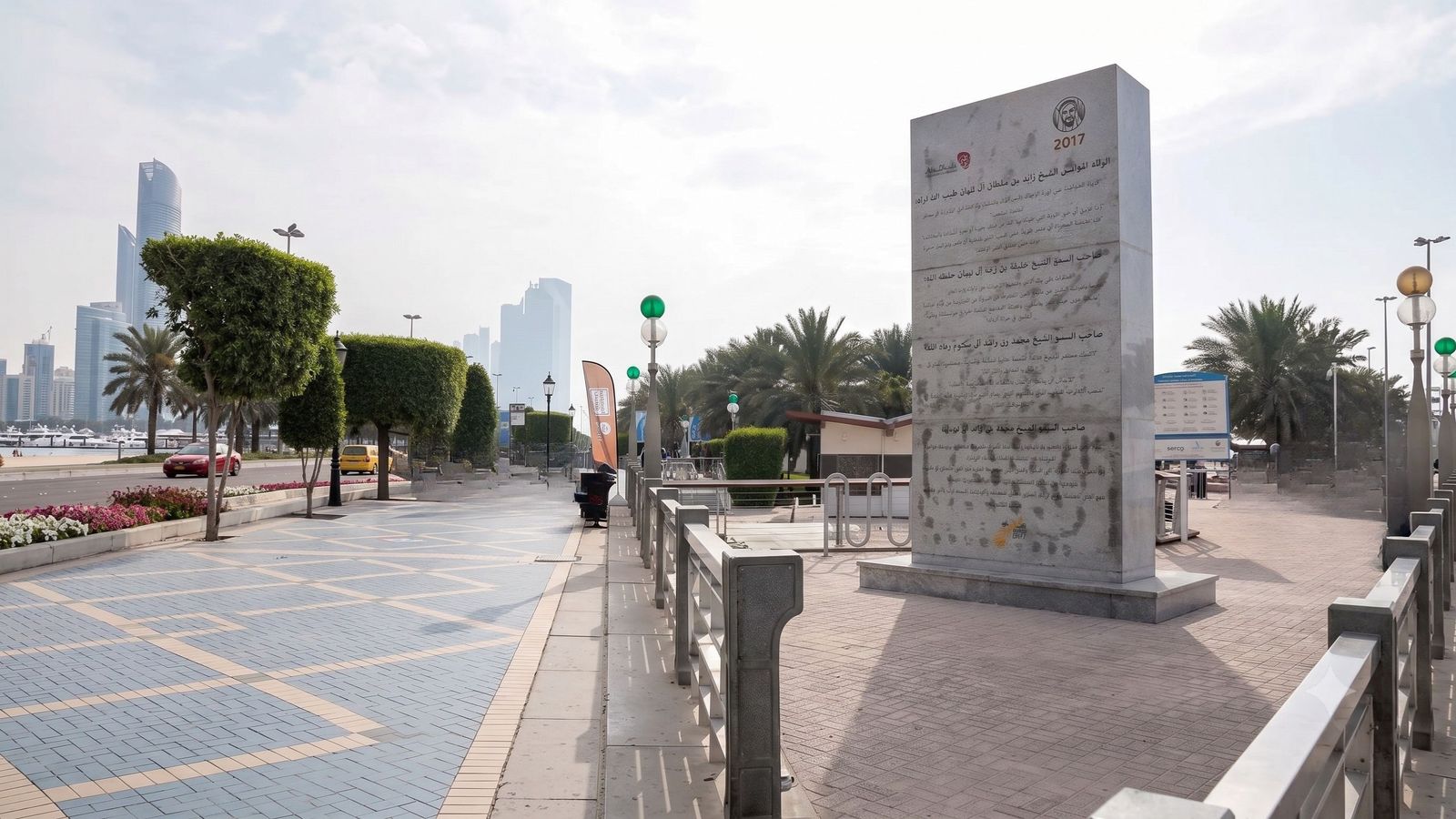
A granite monolith and limestone blocks along the Corniche, carrying a quotation every thirty metres.
Mamsha Al Khair — the Walk of Giving — is a permanent public landmark along the Abu Dhabi Corniche promenade, composed of a granite monolith and a series of limestone installations carrying engraved inscriptions. The quotations appear every 30 metres, running from the East Plaza to the intersection at Emirates Palace.
The project was created by the Abu Dhabi Tourism and Culture Authority — now the Department of Culture and Tourism — and launched in support of the UAE's Year of Giving in 2017. The inscriptions are in both English and Arabic, and the selection is deliberately mixed: alongside the UAE leadership — Sheikh Zayed bin Sultan Al Nahyan, Sheikh Khalifa bin Zayed Al Nahyan, Sheikh Mohammed bin Rashid Al Maktoum and Sheikh Mohamed bin Zayed Al Nahyan — the walk quotes international figures including Mahatma Gandhi and Mother Teresa.
The theme is generosity, social responsibility, tolerance and volunteerism. Mohamed Khalifa Al Mubarak, then chairman of TCA Abu Dhabi, described the installations as intended to enhance the appeal of the Corniche while promoting social responsibility and cultural inclusion. The pieces were designed to be interacted with rather than merely read: visitors are explicitly encouraged to photograph and film themselves with them, so that the messages circulate.
The installations sit within the wider 8-kilometre Corniche promenade, alongside the Blue Flag Corniche Beach, the cycle track and the landscaped waterfront park. They are free, outdoors and accessible at any hour.
Exhibo editorial
Every thirty metres, something to read. That is an unusual rhythm to impose on a seafront — most promenades are designed so you can stop thinking — and it means the Corniche has a text running alongside it that most people walking there have never actually read a single line of.
The casting is the interesting decision. Sheikh Zayed you expect. Gandhi and Mother Teresa on the same walkway, in a state initiative about generosity, is a choice that says something specific about how Abu Dhabi wanted to frame the Year of Giving — not as a national virtue but as a shared one, with the founder placed among people who have nothing else to do with this country. Read four or five in a row on an evening walk between the East Plaza and Emirates Palace. It takes no extra time, since you were walking anyway, and it is the only piece of public art in the city that is designed to be encountered at walking pace rather than stood in front of.
How to find it
Along the Abu Dhabi Corniche promenade, running from the East Plaza west to the intersection at Emirates Palace. The granite monolith is the largest element and stands near the Corniche beach in the Al Bateen stretch, close to the road and the cycle path in a wide paved area; the limestone pieces are spaced at roughly 30-metre intervals along the walkway. Note that some inscriptions are in Arabic only. Free, outdoors and accessible at any hour — best combined with an evening walk along the Corniche, which is also when the light is kindest on the stone.
Similar places
All places
News by Exhibo
Editorial coverage on Exhibo
Nordic and Scandinavian Art
Viking carving to Golden Age light, national romantic myth and early modern museums, mapped through named museum holdings
Scandinavian art history runs from Viking animal ornament through Danish Golden Age painting, national romanticism and early modern experiments. This museum map names periods, painters and rooms in Oslo, Copenhagen, Stockholm and Helsinki, and leaves furniture-shop “Scandi style” to a different search intent.
Latin American Modernism
From São Paulo’s 1922 Week and Antropofagia to Torres-García, Madí, Lam and neo-concrete colour: modernisms south of the US border
Latin American modernism is a cluster of twentieth-century programmes, not one school. This guide maps Brazilian Antropofagia, Río de la Plata constructivism, Caribbean Afro-Atlantic painting and later concrete and kinetic work, with named museum holdings and a visit chronology.
Indian Art: A History
Indus seals, Buddhist sculpture, temple towers and court painting on the subcontinent, from Harappa to the Bengal School
Indian art history tracks Indus urban craft, Buddhist stupas and Gupta Buddhas, Hindu temple programmes and court miniatures across the subcontinent. Named works in Delhi, Karachi, Sarnath, Thanjavur, London and New York show how patronage and ritual shaped form without collapsing into one national style.