
Al Fay Park
The Middle East's first urban biodiversity park — 2,000 native trees, textile canopies, and a hundred-per-cent birdsong guarantee.
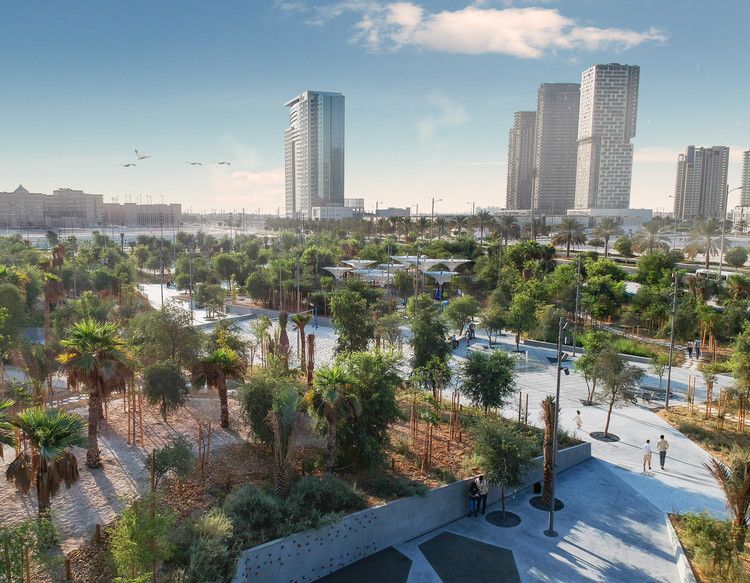
Al Fay Park is a 27,500-square-metre public park on Al Reem Island, and the first urban park in the UAE designed to use biodiversity itself as the instrument for improving local microclimate and public realm. It was designed between 2019 and 2020 and built from 2020 to 2021 on what had been barren sand.
The park is the work of the Danish nature-based design studio SLA, for the Abu Dhabi Department of Municipalities and Transport, with Parsons as architect of record, iGuzzini on lighting, Barari as contractor and shade structures supplied by MDT-tex. SLA's in-house biologists and planting experts spent a year researching the region's flora and fauna, publishing an internal plant book covering the UAE's native species, their optimal growing conditions and how to integrate them into design.
The result uses solely native species — more than 2,000 trees and bushes, including national ghaf trees replanted from desert nurseries. Density is the strategy: high tree cover and a layered understorey create a forest-like microclimate that lowers ambient temperature, filters air pollution and reduces traffic noise, while local grasses and bushes stop sand infiltration so the park stays usable through the summer. Sloping entrances funnel a cool southern breeze down into the site. Perforated textile canopies supplement the tree cover where planting alone cannot yet shade. A modern irrigation system using solely recirculated water means the park consumes around forty per cent less water than a conventional Gulf park.
A winding Forest Track runs along the edge of the site for walking among the planting. Social provision includes sports and basketball courts, a skate park, playgrounds, climbing walls, fitness areas, mini golf and informal seating. The planting is designed to attract bees, pollinators and birds — SLA describe the outcome as a hundred-per-cent birdsong guarantee. The park is free and open daily.
Exhibo editorial
Gone are the water-consuming and soulless Las Vegas landscapes of the past, SLA wrote when the park opened, which is an unusually rude thing for a design practice to say about an entire region's park-building tradition. Walk the Forest Track and you see they had earned it. The lawn-and-decorative-palm formula uses enormous quantities of water to produce something that offers no shade and supports nothing; this uses forty per cent less and sounds like a forest.
That sound is the thing to come for. Stand fifteen metres in from Al Matla'i Street with the towers of Reem going up on every side and what reaches you is birds, not traffic — a hundred-per-cent birdsong guarantee, which reads as marketing copy until you are standing inside it. The trees were chosen by biologists rather than by a landscape palette, the ghaf were dug up from desert nurseries and replanted here, and the whole park is essentially an argument that shade and cool air are things you grow rather than things you build. In this climate that is not a soft claim. It is infrastructure.
How to find it
On Al Matla'i Street on Al Reem Island, set among the residential towers a short drive from Al Maryah Island. Enter from the street side and take the sloping entrance down into the park — the level change is deliberate, funnelling cooler air in, and you feel the temperature drop within a few paces. The winding Forest Track runs along the edge of the site and is the route that shows the planting properly; the sports courts, skate park and playgrounds sit towards the centre. Free entry, open daily from early morning until late evening.
Similar places
All places
News by Exhibo
Editorial coverage on Exhibo
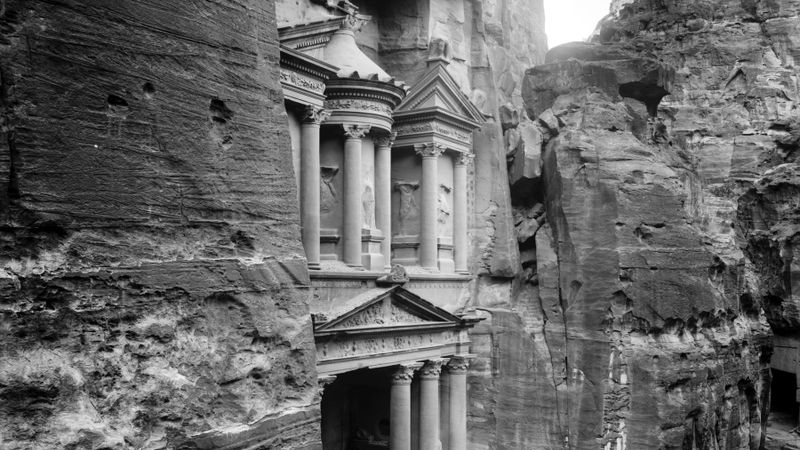
Filmed, but Not Recorded: The Arab World’s Missing Film Locations
Wikidata knows Gladiator was filmed in Morocco. It doesn’t know where.
Ouarzazate is the second most filmed place in the Middle East and North Africa, yet 25 of its 27 productions are recorded only in Wikipedia prose. We compared filming records worldwide and found that in the Arab world, Wikidata usually knows the country but not the place.
Why Every Sci-Fi Desert Looks Arab
From Arrakis to Tatooine, when a film wants a desert to feel ancient, prophetic and alien, it reaches for an Arab and Berber vocabulary — and reveals more about the West that built it than the region it borrows from.
The wrapped faces, the trilling women, the barely-displaced Arabic: cinema's alien deserts keep sounding Arab. But the vocabulary was assembled in the West — from Orientalist painting to Lawrence to Dune — and it says more about who is looking than about anyone being looked at.
Why Wadi Rum Keeps Playing Mars: A Desert That Is Right About the Wrong Planet
A valley in southern Jordan has become cinema's favourite Mars — not because it is like the planet, but because it looks like the one we carry in our heads.
Put Wadi Rum beside a rover photograph and you can't tell which is Mars. But the desert shares almost nothing with the real planet except its colour — and lately, the illusion has grown powerful enough that real space missions have come to Jordan to rehearse.