Al Bateen & Al KhalidiyaAbu Dhabi
Abu Dhabi Corniche Promenade
Eight kilometres of reclaimed waterfront on an undulating line — the city's front room, facing the Gulf.
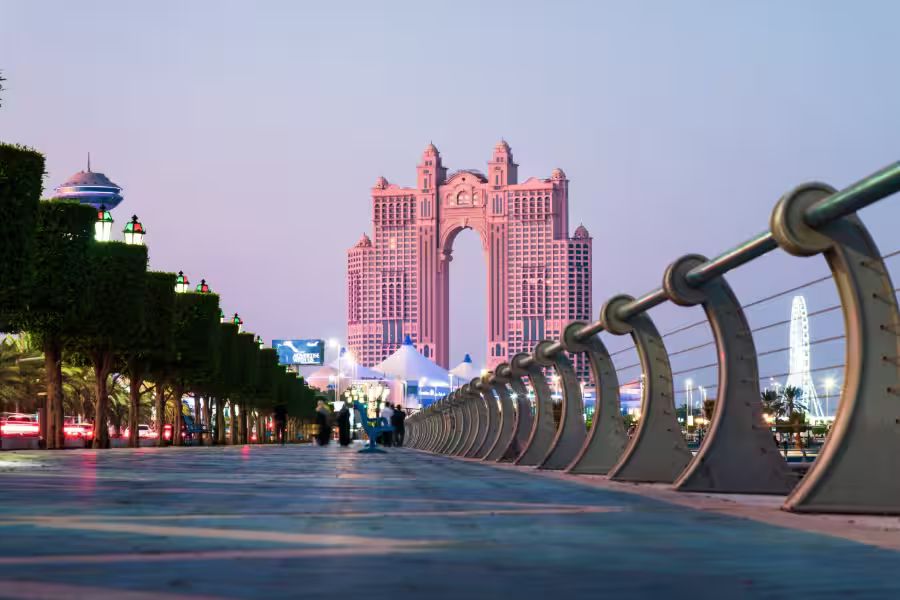
The Corniche is an eight-kilometre waterfront promenade along the north-western shore of Abu Dhabi island, running roughly from Emirates Palace to the fish market and forming a sweeping curve on the seaward side of the city. It is the capital's principal piece of public realm and the setting for most of its civic life.
The present promenade is largely a product of land reclamation carried out between 2002 and 2004, when a substantial strip was added to the head of the island; earlier landmarks including the volcano fountain and the Abu Dhabi clocktower were removed in the process, with phased inaugurations following around 2004 to 2005. The waterfront park was designed by landscape practice LANDinc as design specialist on a team led by Parsons International. LANDinc conceived it to celebrate the water and to build a strong visual relationship between people and the water's edge — the undulating plan evokes that interaction and the connection between the urban landscape and the natural Gulf systems, with strategic links back into downtown to keep the park accessible from the city.
The promenade separates pedestrian, cycle and vehicular traffic throughout, with dedicated cycle tracks and jogging paths, and is wheelchair accessible along its full length. Programme includes children's play areas, exercise equipment, quiet contemplation zones, manicured gardens, fountains, shaded seating and viewing platforms, restaurants and cafés.
Corniche Beach runs along roughly two kilometres of it, divided into three sections and holding Blue Flag certification; the free Al Sahil section is at Gate 4, with paid sections elsewhere offering loungers, umbrellas and watersports. The outlook is north-westerly, which makes the entire promenade a sunset frontage, with Lulu Island offshore and one of the world's tallest flagpoles beside Marina Mall. The promenade is free and open at all hours.
Exhibo editorial
Two kilometres of this did not exist in 2001. The Corniche people walk on now was pulled out of the Gulf between 2002 and 2004, and the volcano fountain that an entire generation of residents remembers was demolished to make room for it — a fact that gets mentioned in Abu Dhabi with a particular tone, half pride and half grievance.
What replaced it is better than it needed to be. The line undulates rather than running straight, which is a landscape decision rather than an engineering one and the reason a very long walk does not feel like a corridor. Traffic, bikes and pedestrians are properly separated, so nobody is negotiating. And the whole thing faces north-west, which means that every evening the city's main public space is pointed directly at the sunset. Go at six in the cooler months and watch what happens: the entire population appears to arrive at once, and the reclaimed land does exactly what it was reclaimed for.
How to find it
Running along the north-western shore of Abu Dhabi island, from Emirates Palace at the western end to the fish market in the east, opposite Marina Mall and the Heritage Village. Multiple entry points connect from downtown; separate lanes run for pedestrians, cyclists and traffic along the full length. For the beach, Gate 4 (Al Sahil) is the free section, with paid sections offering loungers and watersports. The outlook is north-westerly, so it faces the sunset along its entire length — go in the two hours before dark, and in the cooler months if you plan to walk any distance. Free and open at all hours; wheelchair accessible throughout.
Similar places
All places
News by Exhibo
Editorial coverage on Exhibo
Nordic and Scandinavian Art
Viking carving to Golden Age light, national romantic myth and early modern museums, mapped through named museum holdings
Scandinavian art history runs from Viking animal ornament through Danish Golden Age painting, national romanticism and early modern experiments. This museum map names periods, painters and rooms in Oslo, Copenhagen, Stockholm and Helsinki, and leaves furniture-shop “Scandi style” to a different search intent.
Latin American Modernism
From São Paulo’s 1922 Week and Antropofagia to Torres-García, Madí, Lam and neo-concrete colour: modernisms south of the US border
Latin American modernism is a cluster of twentieth-century programmes, not one school. This guide maps Brazilian Antropofagia, Río de la Plata constructivism, Caribbean Afro-Atlantic painting and later concrete and kinetic work, with named museum holdings and a visit chronology.
Indian Art: A History
Indus seals, Buddhist sculpture, temple towers and court painting on the subcontinent, from Harappa to the Bengal School
Indian art history tracks Indus urban craft, Buddhist stupas and Gupta Buddhas, Hindu temple programmes and court miniatures across the subcontinent. Named works in Delhi, Karachi, Sarnath, Thanjavur, London and New York show how patronage and ritual shaped form without collapsing into one national style.