Qasr Al Hosn & Al MarkaziyahAbu Dhabi
Abu Dhabi Central Bus Station
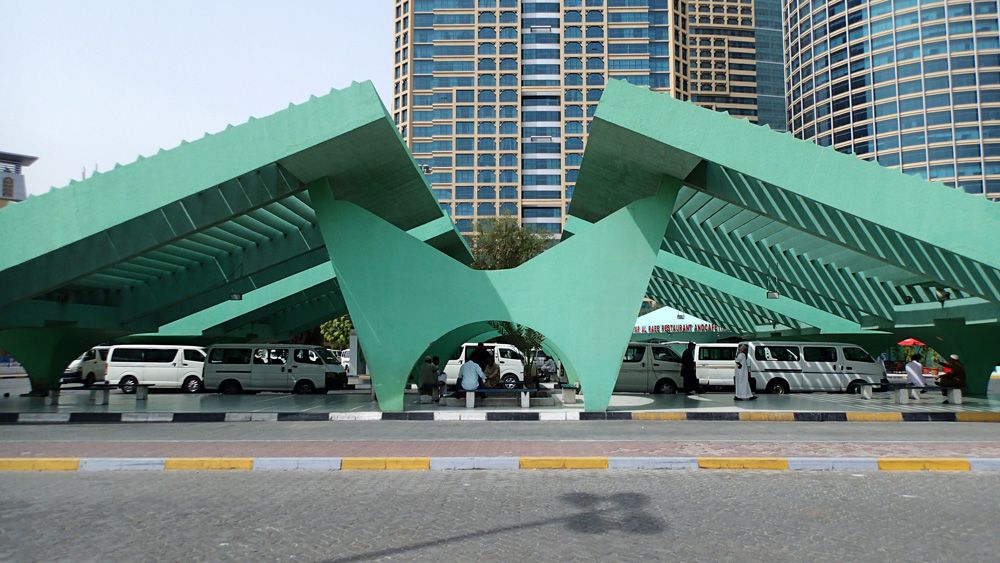
Mint-green concrete wings folded over a 1989 terminal — Gulf modernism still doing its day job.
Abu Dhabi Central Bus Station, also known as the Main Bus Terminal or Al Wahda station, opened in 1989 and remains the city's principal intercity and local bus hub. It is one of the clearest surviving examples of late twentieth-century modernism in the Gulf, and among the most photographed pieces of pre-millennium architecture in the emirate.
The terminal was designed by the Bulgarian architect Georgi Kolarov, who worked for the state contractor Technoexportstroy; construction was carried out by contractors Zakum. The Eastern European authorship is legible in the building's massing, and the design is regularly described as carrying the imprint of Soviet-era brutalism — though the label sits awkwardly. Alongside the angular concrete and hard-edged silhouette are repeated arches, unexpected curves and, above all, a vivid teal-green paint scheme that belongs firmly to the Gulf rather than to Eastern Europe.
The original scheme comprised two U-shaped structures facing in opposite directions. The now-iconic roof was added later, producing four sweeping canopy structures with half-rounded arches that shade waiting passengers and give the building its distinctive flowing profile. A control tower anchors one end, with four prongs extending outward.
Abu Dhabi's Department of Culture and Tourism classified the terminal as a landmark building in 2012. It remains fully operational, with buses to Dubai, Sharjah, Al Ain and across the emirate, alongside cafeterias, small shops, a mosque and passenger facilities. The building was a principal venue of the first Public Art Abu Dhabi Biennial in 2024–25, when Daniel Buren, Zeinab Alhashemi, Henrique Oliveira, Eko Nugroho and Hussein Sharif installed site-specific works in and around it; those installations were temporary and the Biennial closed on 30 April 2025.
Exhibo editorial
Nobody preserved this building. It simply never stopped being useful, which in a city that has rebuilt itself twice since 1989 turns out to be the most effective conservation strategy going. Every listed modernist landmark in the Gulf is a fight; this one survived by being the place you catch the bus to Dubai.
The colour is the tell. Strip the teal off and you have a competent piece of Eastern Bloc infrastructure that could sit outside Plovdiv without comment — the same slabs, the same authority, the same faint sense of being told where to stand. Painted, it becomes something else entirely, and you understand why the Biennial curators came here rather than to any of the shiny things on Saadiyat. Go on a weekday morning when the Dubai coaches are loading. The architecture is better when it is working, and this building has been working for thirty-seven years.
How to find it
On Rashid Bin Saeed Al Maktoum Street (2nd Street) in Al Wahdah, beside Al Wahda Mall in central Abu Dhabi. Approach on foot from the mall side for the full sweep of the canopy — the four arched roof structures read best from the forecourt, wide of the passenger entrances. The control tower marks the far end. The concourse is publicly accessible during operating hours; step inside to see the original 1989 fabric, then walk the perimeter for the exterior massing.
Similar places
All places
News by Exhibo
Editorial coverage on Exhibo
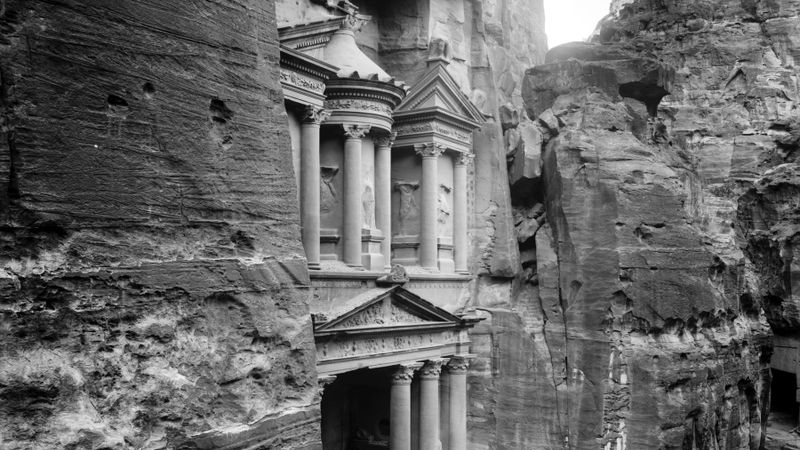
Filmed, but Not Recorded: The Arab World’s Missing Film Locations
Wikidata knows Gladiator was filmed in Morocco. It doesn’t know where.
Ouarzazate is the second most filmed place in the Middle East and North Africa, yet 25 of its 27 productions are recorded only in Wikipedia prose. We compared filming records worldwide and found that in the Arab world, Wikidata usually knows the country but not the place.
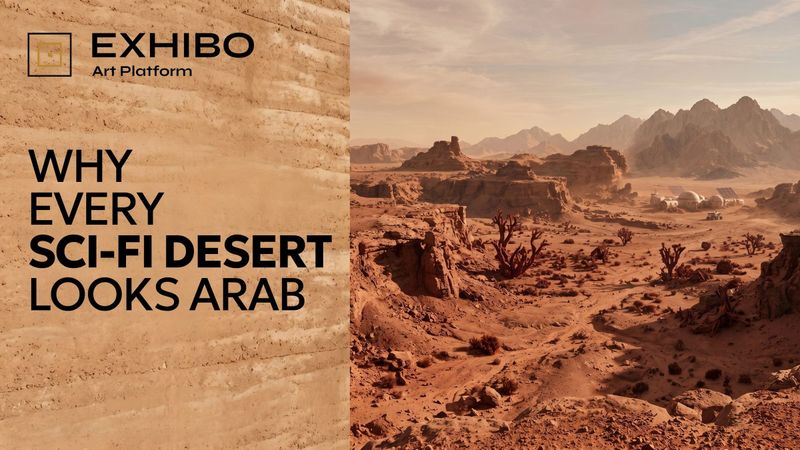
Why Every Sci-Fi Desert Looks Arab
From Arrakis to Tatooine, when a film wants a desert to feel ancient, prophetic and alien, it reaches for an Arab and Berber vocabulary — and reveals more about the West that built it than the region it borrows from.
The wrapped faces, the trilling women, the barely-displaced Arabic: cinema's alien deserts keep sounding Arab. But the vocabulary was assembled in the West — from Orientalist painting to Lawrence to Dune — and it says more about who is looking than about anyone being looked at.
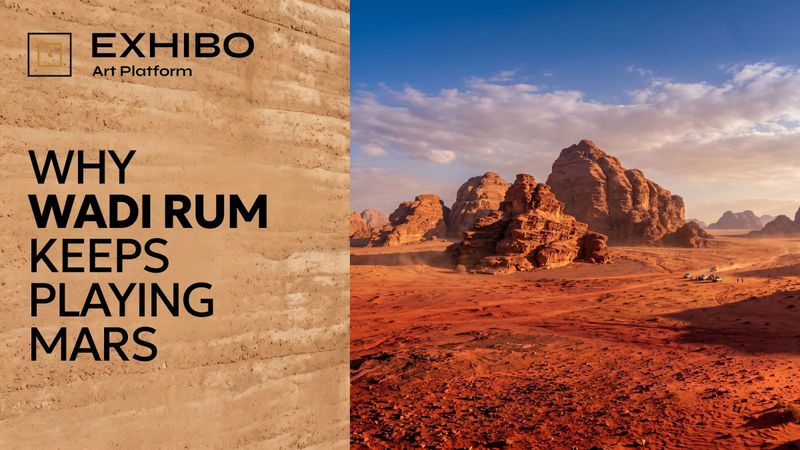
Why Wadi Rum Keeps Playing Mars: A Desert That Is Right About the Wrong Planet
A valley in southern Jordan has become cinema's favourite Mars — not because it is like the planet, but because it looks like the one we carry in our heads.
Put Wadi Rum beside a rover photograph and you can't tell which is Mars. But the desert shares almost nothing with the real planet except its colour — and lately, the illusion has grown powerful enough that real space missions have come to Jordan to rehearse.