
Exhibo Editorial
Diptych and Triptych, Explained
Hinged panels, wings, and the move from Roman writing tablets to Bosch, van Eyck, and Rothko: how two- and three-part formats work as structure, not only as altarpiece lore.
A triptych is a work of art made in three parts, usually three painted or carved panels set side by side. The outer two panels, called wings, often hinge inward so they can fold over a wider central panel and close like a book. A diptych does the same job with two panels. Tate’s glossary calls a triptych an artwork in three panels; the panels may be physically joined or simply presented as a set. Merriam-Webster adds the older root: Greek triptykhos, “three-layered,” from tri- (three) and ptykhē (fold). The fold is not decorative. It lets a large image travel, hide, or change meaning when someone opens or shuts the wings.
You meet these words in museums, auction catalogues, and studio talk. They name a format, not a subject. A triptych can hold a Last Judgement, a abstract colour field, or three related photographs of a coastline. The Art Techniques and Materials series treats diptych and triptych here as structure and process: panel count, hinges, wings, workshop order, and how the format behaves on a wall. Iconography of specific altarpiece programmes belongs to genre articles elsewhere; this page stays on the carpentry and the looking. For combination methods that paste and build across supports, see the sibling what is mixed media art. Collection pages for the museums named below sit in the museums directory.
What the words name on a museum label
When a label reads “triptych, oil on oak panel,” you are being told how many physical units make the object and what they are made of. The subject line may say “Crucifixion” or “Three Studies.” The format line tells you how those images relate in space and whether the work was built to move. Museums sometimes show only the centre panel because wings were lost, cut, or sold separately. A single panel that once hinged to neighbours is still read as a fragment of a multi-panel commission.
Diptych and triptych also leak into music, film, and literary criticism, where they mean any work in two or three linked parts. Search results mix those uses with painting. In a gallery context, keep the visual meaning: flat or low-relief panels arranged as a set, often with a hinge axis. Photography retailers sell “triptych wall art” as three matching prints in a row. That is the same format word with a factory finish and no hinge. The structure (three related rectangles) survives even when the hardware does not.
Three confusions arrive early. First, triptych is not a synonym for altarpiece. Many altarpieces are triptychs, but some are polyptychs with five, seven, or more panels. Second, diptych is not only a devotional pair. Roman writing tablets, modern catalogue spreads, and Andy Warhol’s paired silkscreens share the count without sharing a church job. Third, three canvases hung near each other are not automatically a triptych unless the artist intended one work in three parts. Intent and joinery, or a documented single title, matter more than wall arrangement alone.
The SERP for “what is a triptych” is dominated by dictionaries, hobby guides, Netflix (a unrelated thriller title), and short blog definitions. Few pages follow a hinged object through materials, hinge wear, or how wings change what you see when closed versus open. That gap is what this article fills.
Diptych, triptych, and polyptych: counting panels
The Greek root ptykhos (fold) links these words to things that bend. Roman diptycha were paired wax tablets hinged along one edge; closed, they protected notes inside. Medieval and Renaissance painters inherited the fold habit for portable devotions and large church gifts. Panel count is the first sorting key. Everything else (scale, subject, hinge direction) hangs off the number of units the workshop planned as one commission.
English art writing keeps the Greek numerals rather than saying “three-panel painting,” because the fold and the hinge history ride in the term. Auction houses use the same words for contemporary works on three separate canvases with no hardware, which can annoy purists but reflects common usage. When you write an essay, quote the label: if the museum says triptych, use triptych even if the panels are only aligned on the wall.
Scale is independent of count. A pocket diptych for travel can fit in a case; a triptych altarpiece can exceed four metres wide when open. Photographers and print studios sell ready-made “triptych” sets in three equal widths for domestic walls. Those sets borrow the gallery word without borrowing the hinge. The format still imposes a reading order: left, centre, right, or outer wings framing a middle.
Diptych: two panels
A diptych (diptychos, two-fold) joins or pairs two panels. In late medieval Europe, diptychs often placed a sacred scene on one leaf and a donor portrait on the other, so the patron appeared to address the saint when the work stood open on a desk. Piero della Francesca’s paired profile portraits of Federico da Montefeltro and Battista Sforza (c. 1473–75, Uffizi, Florence) are a famous diptych in double portrait form: two panels designed as one object, painted as if they were ancient medals turned toward each other.
Modern diptychs drop the hinge but keep the pair logic. Andy Warhol’s Marilyn Diptych (1962, Tate, T03093) repeats the same screenprint image across two canvases, colour on one side and fading black on the other. The pair is the work. You cannot exhibit one canvas as the whole story without the other. Diptych in studio talk can also mean any deliberate two-part work, including facing pages in a artist’s book or two-channel video on two screens.
Triptych: three panels
A triptych adds a third unit. Convention, especially in Northern European altarpieces, gives the largest field to the centre and treats the wings as doors. Open, you see a wide scene; closed, you may see a different scene in grisaille or a patron’s coat of arms. Hieronymus Bosch’s The Garden of Earthly Delights (c. 1490–1500, Museo del Prado, Madrid) is the textbook triptych for students who will never visit a church altar: three oak panels, outer wings that fold, an interior programme that shifts from creation to garden to hell.
Not every triptych uses a larger centre. Some modern triptychs assign equal width to each panel, as Mark Rothko did when he grouped three canvases from the Seagram mural commission. Equal width pushes the eye to read colour and scale rather than hierarchy. The format still forces a left–centre–right rhythm on the body standing in front of it.
Polyptych: many panels
A polyptych (poly- many) extends the same logic beyond three. Jan van Eyck’s Adoration of the Mystic Lamb, the Ghent Altarpiece (completed 1432, St Bavo’s Cathedral, Ghent), opens into multiple hinged panels on upper and lower registers. Inventory and scholarship call it a polyptych, not a triptych, because the wing system multiplies beyond a single trio. The word matters when you describe hinge stress, travel crates, and how many painted surfaces a conservator must monitor.
Smaller polyptychs still appear in domestic devotion: four or five panels with a central Madonna and folding saints. The format family is one carpentry tradition at different counts. If only three panels survive from a larger ensemble, catalogue honesty usually says “triptych, formerly part of a polyptych” or notes missing wings.
Hinges, wings, and how multi-panel works move
Multi-panel painting is also furniture. Wings are the outer panels that swing on vertical axes at the left and right edges of the assembly. The centre panel may be fixed to a wall or altar frame while wings move, or the entire set may lift as one crate for travel. Historic hinges were iron or brass pintle hinges: a pin through paired leaves, strong enough for oak panels several centimetres thick. Reproduction hinges on cheap decorator triptychs are often too weak for real panel weight; museum mount makers calculate torque and long-term sag.
Closed wings change the picture. A grisaille Annunciation on the outside can protect a gilded interior from candle soot and curious touch. Donor portraits on outer wings advertise who paid when the altarpiece stands shut on weekdays. Open wings on feast days reveal the full narrative. You are meant to experience two states of one object. Modern gallery display often locks wings open for safety and sightlines, so reproductions on postcards show only the open view. That habit flattens how the work was timed to the liturgical calendar.
Photography and digital art borrowed the vocabulary without the hardware. A “triptych” of three prints is static. Still, artists sometimes mimic wing logic by printing a closed exterior view on hinged facsimile doors for an installation. The behaviour (reveal and conceal) persists even when the hinge is theatrical.
Open, closed, and half-open display
Historic church furniture assumed a sacristan or priest could fold wings. Museum policy today rarely lets visitors shut a Bosch wing. Climate control, security, and fear of torque on brittle paint films keep most hinged works fixed open at a slight angle or pinned in place. When you see a half-open wing in a conservation photo, you are looking at documentation of hinge clearance and checking whether the inner edge scraped the centre panel.
Half-open display can also mean a wing set at ninety degrees to suggest depth in a vitrine. That is a mount design choice, not a liturgical one. For learning, seek out museums that publish closed-view reproductions or show facsimile outer wings beside the open original, as some Northern Renaissance rooms do with annotated diagrams.
Hinge hardware and panel edges
Panel edges along the hinge line are reinforced. Workshops routed recesses for hinge leaves, used screws or nails with rosette washers, and sometimes added leather or parchment strips as flexible connectors on smaller works. Misaligned hinges bind; binding scrapes paint at the inner margin. Conservators document hinge metal and whether a wing was reversed in a later restoration. A wing swapped left-for-right reads the same to a casual viewer but tells a different story about past damage.
Weight limits matter for contemporary artists who build triptychs from hollow doors or aluminium composite. A pintle rated for a two-kilogram wing will fail on a thirty-kilogram panel with wet oil paint and heavy cradle. Studio-built works often use continuous piano hinge along the full inner edge for even load, or they hang separate canvases in a frame with no movement at all.
Materials and panel construction
Northern European triptychs from the fifteenth and sixteenth centuries are often oak panels, sometimes lime or poplar where weight had to stay low. The Ghent Altarpiece uses oak; Bosch’s Garden of Earthly Delights is oil on oak panel, about 205.5 × 384.9 cm with frame when open (Prado panel height 185.8 cm). Panel makers selected radially cut boards, joined them edge to edge, and planed a support that could receive gesso ground and oil paint without flexing at the join.
Multi-panel commissions added joinery beyond the hinge. Upper and lower registers in polyptychs connect with horizontal joints; predella panels (long narrow scenes under the main tier) bolt or slot into the base. Guild regulations in some cities specified which workshop carved the frame and which painted the wings, but the patron experienced one ensemble. Ground layers, imprimatura, and gilding had to match across panels so a closed exterior read as one skin.
Modern triptychs may use cotton canvas on three stretchers, aluminium panels, or medium-density fibreboard for print mounting. Materials change failure modes. Canvas triptychs warp with humidity; solid panels crack at restrained points; heavy cradles on old oak can lock in tension and produce cupping. The format multiplies every material risk by three or more.
| Format | Typical panel count | Hinge habit | Usual support (historic → contemporary) | Scale habit | Named example | Date | Collection |
|---|---|---|---|---|---|---|---|
| Diptych | 2 | Often hinged; modern pairs may be separate | Wax tablet → oak panel → paired canvas | Small devotional to double portrait | Warhol, Marilyn Diptych | 1962 | Tate, London |
| Triptych | 3 | Wings fold inward common in altarpieces | Oak panel → three stretchers or aluminium | Centre wider in church work; equal widths in modern abstract | Bosch, The Garden of Earthly Delights | c. 1490–1500 | Museo del Prado, Madrid |
| Triptych (abstract) | 3 | Usually fixed; separate canvases in one frame | Canvas, oil | Room-scale width | Rothko, Black on Maroon (Seagram series) | 1958–59 | Tate, London (multiple panels) |
| Polyptych | 4+ | Multiple vertical and horizontal hinges | Oak, polychrome | Altarpiece scale | Van Eyck, Ghent Altarpiece | completed 1432 | St Bavo’s Cathedral, Ghent |
| Diptych (portrait) | 2 | Hinged or paired | Poplar/oak panel | Moderate | Piero, Urbino–Sforza profiles | c. 1473–75 | Uffizi, Florence |
| Triptych (portable) | 3 | Hinged wings | Oak, oil | Portable altarpiece | Jan van Eyck, Dresden Triptych | 1437 | Gemäldegalerie, Dresden |
| “Triptych” (photography) | 3 | None; aligned frames | Archival paper or aluminium dibond | Domestic to gallery | Three-print sequences (genre) | contemporary | Various |
Building a hinged panel set step by step
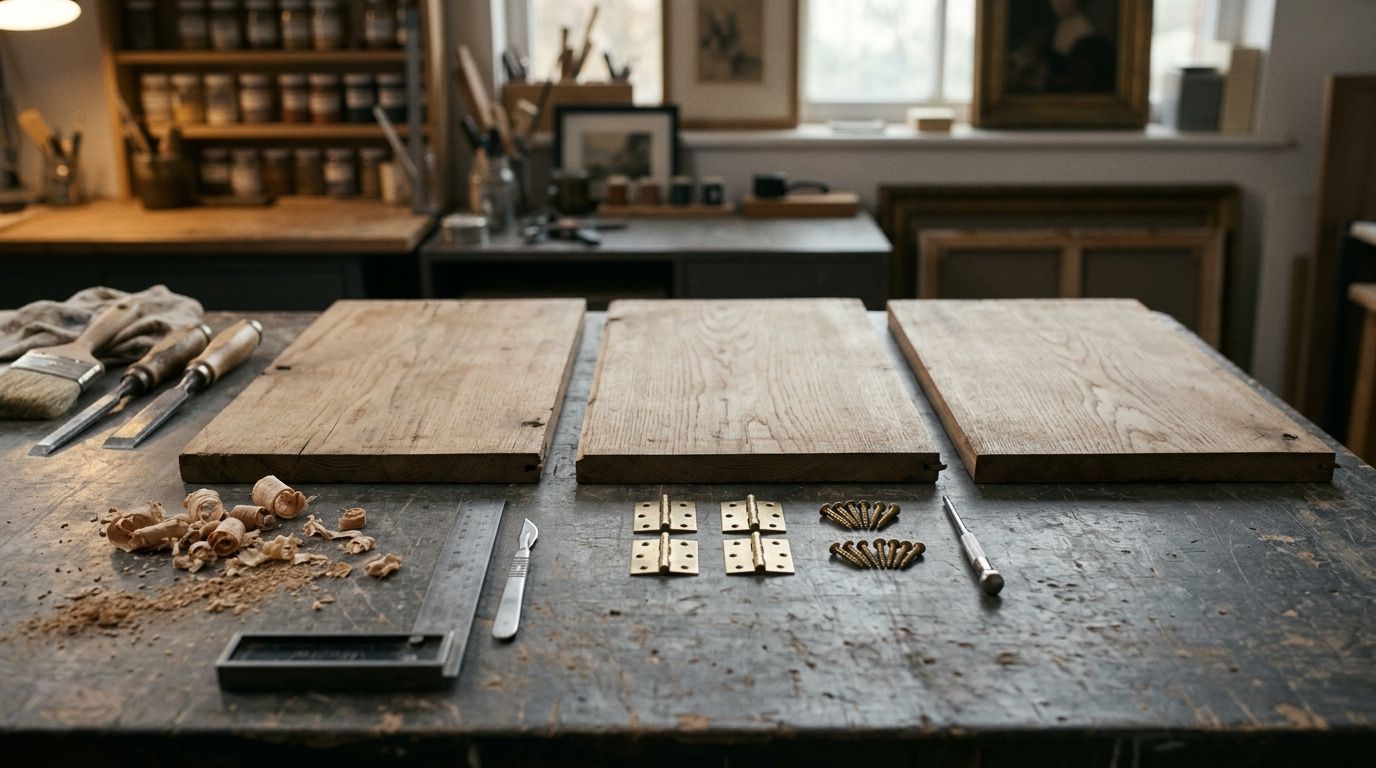
The sequence below follows historic and contemporary studio practice in compressed form. Individual workshops reorder steps. Carvers may build the frame before painters touch the ground. Print studios may only receive finished files and cut aluminium. The order still helps you read tool marks and failure points on a finished triptych.
When you stand before a Northern Renaissance wing, you can often spot the build sequence in cross-section diagrams published by conservation departments: ground layers stop short of the bare wood at the hinge edge; gilding on a closed exterior sometimes wraps a thin margin onto the side edge. Contemporary artists who want moving wings on new work must plan hinge recesses before the final paint layers, or accept that hardware sits on top of the surface and becomes part of the look.
Panel selection and joinery
Choose boards or sheet material with stable grain direction. Join centre panel boards first; wings can be slightly narrower but should match thickness so hinge axes line up. Allow seasoning time for wood before gesso. For canvas triptychs, build three stretchers to the same depth and profile so a shared outer frame can hold them. Number the backs of panels in pencil (centre, left wing, right wing) before disassembly for travel. Left and right are defined as you face the work.
Ground, paint, and gilding across panels
Apply gesso and sand to a continuous visual plane when the set will hang open. If the closed exterior must read as one grisaille scene, painters sometimes lay out the outer wings flat beside the centre, drawing across the inner margins before hinges stop the line. Interior scenes on wings often continue landscape or architecture into the centre, so misalignment of even a few millimetres breaks the illusion. Gold leaf on exteriors adds thickness; hinge gaps must be widened slightly so leaves do not bind.
Hinging, fitting, and final frame
Mount hinges with the wings at open angle, test swing clearance, then paint final touch-ups at inner edges. Fit an outer architectural frame or altar surround if the commission includes it. Predella panels lock in last. For non-moving modern triptychs, a single museum-style frame with three apertures may be enough. Document whether the work is allowed to travel with wings folded; couriers need that note for crate design.
How the format developed from Roman tablets to museum walls
Romans used hinged wax tablets for notes and accounts. The form was practical: two protective boards around a writable core. Early Christian and Byzantine small ivory diptychs carried relief carving for liturgy and gift exchange among elites. Those objects trained viewers to expect paired or tripled images that fold.
Gothic and Renaissance church economies scaled the habit up. Merchants and guilds funded triptychs for chapels and side altars. Wings that closed protected expensive colour and gold during ordinary weeks; opening them marked feast days. Netherlandish painters in the fifteenth century pushed continuous landscape across wings and centre, so open panels read as one wide world. Jan van Eyck’s Ghent Altarpiece is the extreme case: an entire polyptych of many hinges, not a single trio, but the same format logic at cathedral scale.
Reformation iconoclasm, wars, and later sale of wings to collectors broke many ensembles. Museums reassemble what survives. Some “triptychs” on gallery walls are reconstructions with missing wings replaced by blank panels or photographs. Provenance files note those gaps.
Modernism freed the triptych from the altar while keeping the count. Francis Bacon painted many triptychs of figures on orange grounds in the 1960s and 1970s; Tate holds several. Mark Rothko’s Seagram commission (1958–59) produced groups of large red and black canvases intended as an environment for the Four Seasons restaurant in New York. Rothko withdrew from that project; the paintings entered museums and private collections. Tate displays Black on Maroon panels from the series as triptych groupings. Scale, colour, and flank logic replace narrative wings, but the body still reads left, centre, right.
Six multi-panel works to read in the room
Definitions stay abstract until you test them on dated objects with inventory numbers. The six below span Northern Renaissance allegory, Eyckian polyptych, modern abstraction, Pop diptych, Italian double portrait, and workshop triptych. Visit via the museums directory when travel allows. Reproductions often crop wings or omit closed views.
You do not need iconographic decoding to study format here. Watch instead how wide the open span feels, whether the centre dominates, and whether outer panels mirror or contradict the middle. Bosch rewards that structural reading before any symbolic inventory. Rothko removes narrative entirely but keeps flank colour different enough that your peripheral vision catches the side panels as pressure, not decoration.
Hieronymus Bosch, The Garden of Earthly Delights
Bosch’s triptych in Madrid is oak panel, oil paint, about 205.5 × 384.9 cm with frame when open (panel height 185.8 cm). The Prado dates it to about 1490–1500. Closed, the outer wings show the Creation in grisaille with a small globe scene in the upper roundel. Open, the left wing shows Eden, the centre a crowded garden of figures and giant fruit, the right wing a hellscape of instruments and fire. The three interior panels share a continuous horizon line at the lower third, so the format behaves like one wide stage with three acts.
The hinge is part of the meaning machinery even if you only see the open state in the gallery. Medieval viewers could encounter the work shut first: a sober exterior, then an explosive interior. Modern scholarship still argues over whether the centre is moral warning or fantasy satire. This article does not settle that debate. The format fact is firm: three hinged fields, two distinct viewing states, wings sized to protect the centre.
Jan van Eyck and the Ghent Altarpiece
Hubert van Eyck began and Jan van Eyck completed the Adoration of the Mystic Lamb by 1432 for St Bavo’s Cathedral, Ghent. Scholarship treats the ensemble as a polyptych: upper and lower tiers, multiple wings, inner and outer shutters. Open, the lower register shows the mystic lamb on an altar with crowds; prophets and martyrs occupy upper panels. Closed, the view is different entirely: grisaille Annunciation figures and portraits of Jodocus Vijd and Elisabeth Borluut, the donors.
The object is the benchmark for Eyckian oil technique, but it is also a hinge tutorial at scale. Each panel joint is a place where dirt, wax, and later restorers intervene. The altarpiece underwent major conservation (2012–2016) with public documentation of panel structure and past overpaint. If you use “van Eyck triptych” in homework, specify whether you mean this polyptych or the smaller Dresden Triptych (signed 1437, Gemäldegalerie, Dresden), a true three-panel portable work with Madonna and saints in a continuous interior.
Mark Rothko, Seagram Black on Maroon panels
Rothko’s Seagram murals were conceived as an ensemble for a dining room, not a single canvas. Tate’s collection includes several Black on Maroon paintings from 1958–59 (for example T01031, T01163, T01164), hung as triptych groups in gallery displays. Each panel is roughly 266 cm high; together they wrap the viewer in dark red-brown fields with soft-edged black rectangles. There is no story in the Bosch sense. The triptych format supplies peripheral vision: side panels colour your experience of the centre.
Do not confuse these groups with the Rothko Chapel in Houston (1964–67), which holds fourteen muraled paintings in an octagonal building. That is a multi-panel environment, not one triptych. For Rothko, count and installation intent define the format word more than hinge hardware.
Contemporary diptychs and triptychs beyond the church
Living artists use two- and three-part formats for catalogue rhythm, narrative sequence, and market packaging. A photographer may sell a landscape as three equal prints for a wide wall. A painter may build a centre panel with flanking details of the same sitter. Francis Bacon’s triptychs (Tate holds Triptych August 1972, 1972) place three related figure groups in one row; the triptych frame is part of how tragedy reads in serial images.
Digital workflows split one wide composition into three files for print. The result is a static triptych with no hinge, similar to poster triptychs sold online. That is still a legitimate use of the term if the artist titles the work as one triptych. Collectors should ask whether the piece is one edition in three parts or three separate editions that only hang together by convention.
Installation art sometimes returns to moving wings. Artists build plywood shutters, project video onto centre and wing screens, or use triptych layout for three-channel sound. The vocabulary migrated because the body position of the viewer remains the same: you stand centred and compare flanks. For glued and layered surfaces on a single panel, see collage in this series; collage can occupy one wing of a triptych without changing the format name.
Conservation, display, and what fails over time
Multi-panel works fail at joints first. Hinge pins wear oval; wings sag and scrape paint. Panel joins open with humidity cycles; dirt tracks into cracks. Cupping across grain pulls the inner edge away from the neighbour panel, leaving a bright line at the split. Restorers may add cradles or crossbars to the back of old panels; an over-rigid cradle on one wing only can twist the set so hinges bind.
Travel magnifies risk. Couriers crate each panel separately or build a foam nest for the open assembly. Wings that still move get taped in fixed position for flight. Climate ramps slowly to avoid sudden torque. Insurance values triptychs as one work when the commission is intact; separated wings sometimes sell as fragments with discounted pedigree.
Light exposure differs panel to panel if one wing spent decades folded inward. Faded versus saturated colour can document which wing was exposed. Modern canvas triptychs suffer tension mismatch if one stretcher was keyed out more than its neighbours. Registrars photograph the backs and hinge leaves on acquisition so future conservators know original hardware.
Gallery labels rarely explain closed views. If you care about the full object, read collection websites and conservation blogs. The Prado publishes extensive material on Bosch; the Ghent Altarpiece site documents open and closed states. Tate’s entries on Rothko note restaurant commission history and current grouping.
What a multi-panel commission costs today
Historic triptychs were luxury church and court expenditures: oak, gold, multiple specialist painters, frames, and sometimes freight by river. Today’s costs split by medium and movement.
A photographic or giclée triptych for domestic display might run from a few hundred to a few thousand pounds or dollars for three large archival prints, frames, and installation, depending on size and printer. That is product pricing, not unique art pricing.
A contemporary painter’s triptych on three canvases often prices above a single canvas of the same total width because collectors treat the set as one work with display constraints. Studio quotes vary by reputation and size. Three modest 60 cm canvases from a mid-career painter might sit in the low thousands; three two-metre panels from a gallery-listed artist can reach tens or hundreds of thousands. Hinged wooden panels with custom framing cost more in carpentry and conservation-grade hardware.
Commissioning a hinged altarpiece-style work for a chapel or institution involves fabricators, engineers, and climate planning. Six-figure budgets are normal when scale, gilding, and installation engineering enter. Ask for hinge specifications rated for panel weight, crate design for travel, and whether wings may ever close after delivery. Museums lending historic triptychs charge fees and require climate-controlled transport; those lines belong in exhibition budgets, not in the artist’s studio quote alone.
Common confusions and misuses
Triptych versus altarpiece: An altarpiece is furniture for a altar; a triptych is a panel count. Overlap is common, not mandatory.
Three separate paintings: Without artist intent or a shared title, three canvases are a series, not necessarily a triptych.
Netflix Triptych: The streaming thriller borrows the word for its three-timeline plot. It is unrelated to art format.
Writing and music: Literary triptychs are three-part essays or poems. Useful for search, but not what a museum registrar means on a label.
Photography “triptych” products: Mass-market three-print sets use the word for layout. They rarely include hinges or single-edition status.
Iconography deep-dives: Knowing every symbol in Bosch’s hell panel is valuable; it is also a different article from how wings fold. This page stops at structure.
Polyptych miscount: Calling the Ghent Altarpiece a “triptych” undersells its hinges. Call it a polyptych unless you discuss only three specific panels.
FAQ
What is a triptych in art?
A triptych is a work of art in three panels, usually meant to be read together. Historic examples often hinge the outer panels as wings that fold over a centre. The word comes from Greek triptykhos, three-fold. Tate defines it simply as an artwork in three panels. The panels can be attached or presented side by side.
What is a diptych?
A diptych is the two-panel form of the same tradition: paired panels, often hinged, designed as one object. Roman wax notebooks were diptychs. Renaissance donors used diptychs for portable devotion. Modern diptychs include Andy Warhol’s paired Marilyn screens at Tate.
How do you pronounce triptych?
English speakers usually say TRIP-tik, rhyming with “lipstick” without the s. Merriam-Webster and Cambridge Dictionary both give /ˈtrɪp.tɪk/. Diptych is DIP-tik.
What is the difference between a diptych and a triptych?
Count. A diptych has two main panels; a triptych has three. Both can hinge. Narrative triptychs often treat the centre as the main scene and the wings as flanking episodes or doors. Diptychs pair scenes or repeat an image across two leaves.
What is a polyptych?
A polyptych has more than three painted or carved panels in one ensemble, often with multiple hinges. Jan van Eyck’s Ghent Altarpiece is a famous polyptych. The word keeps panel arithmetic honest when a work is bigger than a trio.
What are wings on a triptych?
Wings are the outer panels, left and right, that flank the centre. On hinged altarpieces they fold inward to protect the interior or show a different image when closed. Not every modern triptych has moving wings, but the name still marks outer versus central panels in many compositions.
Can a triptych be photography?
Yes, if the artist presents three related photographs as one work, often in a row. Many commercial “triptych” products are three matching prints with no hinge. The format is the triple layout and shared title, not the church hardware.
Why did artists hinge panels?
Hinges protected painted surfaces during travel and daily church use, allowed a closed view that differed from the feast-day open view, and let large images fold to a portable width. Modern museums often fix wings open for conservation and visibility.
What are famous triptych examples to see in museums?
Hieronymus Bosch’s The Garden of Earthly Delights (Museo del Prado, Madrid), the van Eyck Ghent Altarpiece (St Bavo’s Cathedral, Ghent), and Mark Rothko’s Black on Maroon Seagram panels (Tate, London) span Renaissance and modern format uses. Check current loans before travel; large works move for conservation and exhibitions.
Is a triptych the same as three separate canvases?
Only if the artist made them as one work. Three independent paintings hung together are a display choice unless documentation calls them a single triptych. Edition prints sold as a set of three may still count if the title and contract treat them as indivisible.
Related reading
Curating Tomorrow's Archive: Hamburger Kunsthalle Seeks Contemporary Collections Lead
A new permanent appointment will steer the museum's post-1960 holdings across paper, photography, and media formats.
The Hamburger Kunsthalle is inviting applications for a senior curatorial position focused on contemporary acquisitions, exhibition strategy, and digital collection management. Applications close October 2026 for a January 2027 start.
Whilst We Are Savages: Colonial Constructs and Atlantic Dialogues
A critical survey at TEA Tenerife exploring how colonial frameworks shaped identity, territory, and knowledge across Europe, Africa, and Latin America.
William Morris Gallery Reopens With Intimate Restoration and New Focus
A comprehensive overhaul at the Walthamstow venue explores the designer's contradictions through newly displayed archives and a domestic curatorial approach.