
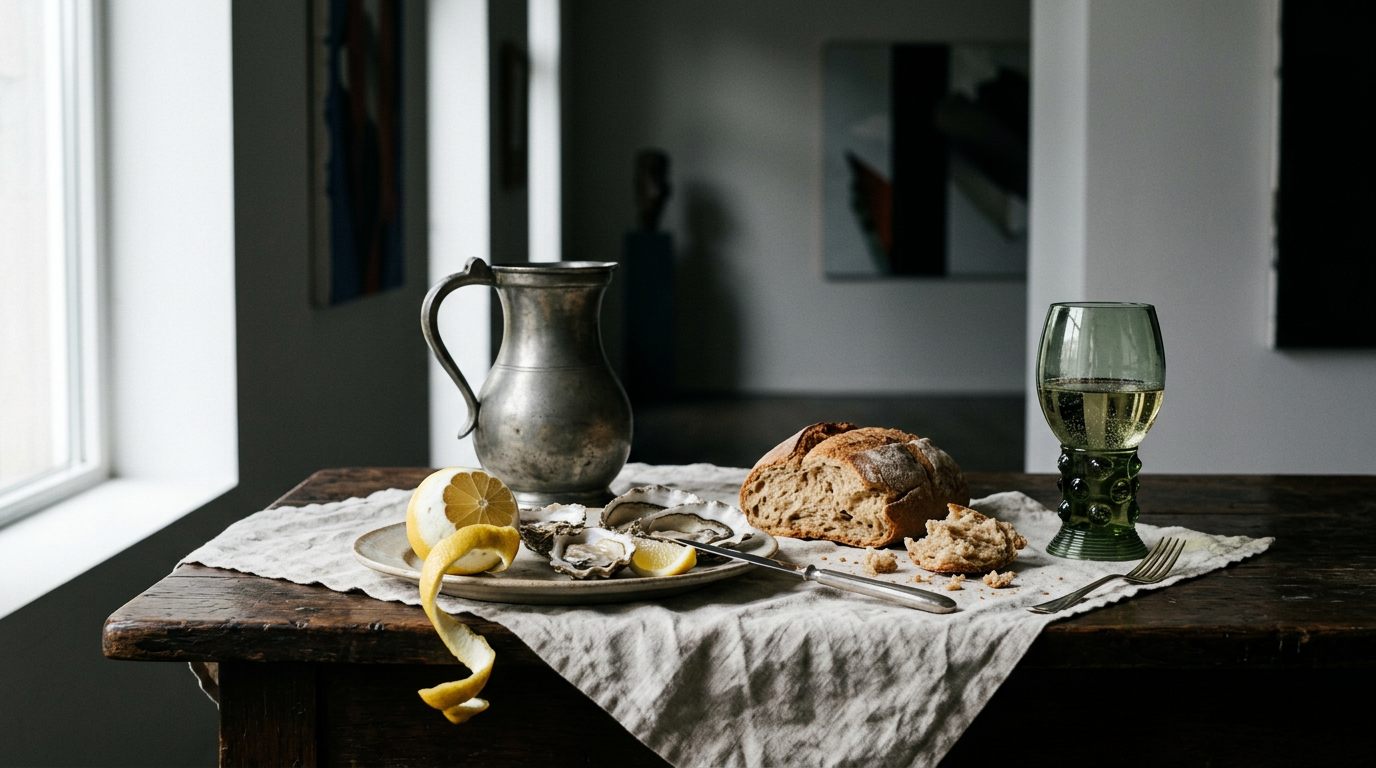
Exhibo Editorial
Still Life Painting, Explained
Breakfast tables, flower pieces, and kitchen pictures: how still life painting works from Haarlem specialists to Cézanne and Cubism.
Still life painting is the depiction of arranged, inanimate things as the main subject: fruit, cut flowers, glass, pewter, game, books, kitchen tools, and the other objects a household already owns. The English phrase follows the Dutch stilleven, which the National Gallery, London, dates as a workshop label from about 1650. French later used nature morte. Both names point to the same brief: the painter stages things that do not walk off the table, then asks you to look at surface, light, and order as if those things were a history scene.
The genre sits at the bottom of the French Academy’s seventeenth-century ranking, after history painting, portraiture, scenes of everyday life, and landscape. Painters ignored the snobbery in practice. Haarlem breakfast specialists, Spanish larder painters, Chardin in Paris, Cézanne in Aix, and Picasso in a Paris studio all used still life painting as a laboratory for how paint can pretend to be metal, skin of fruit, or printed oilcloth. For the wider map of subject types, see Genres and Symbolism in Art. Dutch market conditions that paid for so many of these pictures sit in Dutch Golden Age Painting.
What still life painting is
A still life is a picture whose principal actors are objects. A portrait may include a glass of wine; a kitchen still life makes the glass, the fish, and the pestle do the work. Tate’s glossary lists man-made and natural things together: cut flowers, fruit, vegetables, fish, game, wine. National Galleries of Scotland adds drawing and photograph to the same definition. The objects can be humble (a cabbage, a clay jug) or imported luxury (Chinese porcelain, a Turkish carpet). Scale runs from a collector’s cabinet panel to a kitchen canvas more than a metre wide.
The arrangement is almost never a snapshot of a real meal left as found. Dutch breakfast pieces look casual because the painter planned a diagonal of bread, lemon peel, and overturned glass. Flower pieces combine species that bloom in different months. Spanish bodegones hang fruit on strings because a larder did that, and because the strings turn produce into a geometry lesson. You are looking at a constructed set. The painter controls light, overlap, and the edge of the table the way a director controls a stage.
Independent still life painting as a saleable type thickened in the Low Countries and Spain around 1600. Painters had long tucked objects into altarpieces and portraits. Jan van Eyck’s metal, glass, and cloth already prove that northern oil could make things feel present. The change is independence: a panel whose title is the objects, sold to a merchant house rather than a chapel. Jacques de Gheyn II’s Vanitas Still Life of 1603 (Metropolitan Museum of Art, New York) is an early free-standing moral table. Pieter Claesz and Willem Claesz Heda then made Haarlem famous for quieter breakfasts. Spanish painters such as Juan Sánchez Cotán, working in Toledo before he entered a Carthusian house, hung vegetables in a dark niche with a severity that has little to do with Dutch pewter.
Modern painters kept the objects and dropped the market ranking. Cézanne used apples and a ginger jar to test how colour builds volume. Cubists used bottles, newspapers, and café tables to break and restack space. Giorgio Morandi spent decades on bottles that look like the same family of forms under different light. The subject stayed “things on a table.” The job of the picture changed from virtuoso texture and coded plenty to an argument about seeing.
Technique: set, light, and paint
Technique in still life painting is a set of problems the objects force on the painter. A portrait can hide a weak hand in shadow. A lemon peel hanging over a silver dish cannot. You have to decide where the table edge sits in relation to the frame, how one light source models round forms, and how to paint materials that bounce light in different ways. Conservators and museum labels keep returning to those craft choices because they explain why a small breakfast panel can feel more “real” than a large history canvas.
The painter starts with a set, not with a story. Objects are chosen for contrast of shape and surface: a cylinder against a sphere, dull pewter against wet oyster, a matte loaf against a cut-glass roemer. Overlap creates depth. A knife pointing toward you, its tip on a plate, is a favourite Dutch device because it proves foreshortening in a few centimetres. Backgrounds tend to be dark or plain so that the table reads as a shallow stage. Spanish niches go further: a black void behind the produce, so that each fruit is a lit solid against nothing.
Arrangement, light, and the table as a stage
Light is the main actor after the objects. Haarlem breakfast painters of the 1620s and 1630s often used a limited palette (greys, ochres, muted greens) so that value, not hue, describes form. Heda’s 1635 panel at the Met works in pewter tones: silver, glass, oyster, and beer all live in a narrow colour band. Later pronkstilleven (display still lifes) by Willem Kalf and Abraham van Beyeren reverse the recipe. They pack Chinese bowls, gilt cups, and imported fruit under a warmer, glossier light that makes luxury gleam.
A single directional source, from a high window or an implied lamp, gives you a coherent shadow family. Multiple sources flatten the set and confuse the eye. That is why studio still-life teaching still uses a shadow box: control the light, then paint the fall from highlight through half-tone into cast shadow. Chardin’s kitchens keep that discipline. Cézanne breaks it on purpose. He lets table edges slip and apples tilt so that the painting records looking over time rather than a single optical instant.
The table edge is a horizon. Place it too high and the objects stack like a shop window. Place it too low and you lose the sense of a world beyond the cloth. Dutch painters often crop the cloth so that it hangs toward you, a white plane that both displays skill (linen versus silk, as in Claesz’s 1649 National Gallery panel) and invites you to the meal. Spanish bodegón ledges do the opposite: a stone sill, produce advancing into your space, darkness behind. Both solutions treat the picture plane as a window onto a shelf.
Paint, glaze, and the problem of surfaces
Oil on panel or canvas became the default because it can go from thin glaze to loaded highlight in one sitting or across many. Dutch specialists built glass and metal with layered half-transparent strokes, then hit the specular points last, often with a stiff, pale touch. Lemon peel, a recurring prop, is a test of warm colour against cool silver and of a spiral that must read as both drawing and flesh of fruit. Pewter is painted with softer, greyer reflections than silver. The National Gallery’s note on Claesz’s Still Life with Drinking Vessels (1649) spells out that difference: silver glints more; pewter stays duller; the painter shifts colour as well as value.
Flower painters faced a different clock. Blooms wilt. Rachel Ruysch and her predecessors studied live specimens, drawings, and prepared plants so that a bouquet could include irises, tulips, and poppies that never share a week in a garden. Insects, dew, and eaten leaves are not decoration. They prove close looking and, in some pictures, the short life of the cut stem. The Mauritshuis notes that Ruysch’s Vase with Flowers (1700) even shows a stem “bleeding” after a spent bloom has been removed.
Grounds and supports matter. Many Dutch breakfasts sit on oak, a stable, smooth field for small specular details. Larger kitchens and later French still lifes move to canvas. Picasso’s Still Life with Chair Caning (spring 1912, Musée national Picasso-Paris) abandons the pretence that paint must imitate caning at all: he pastes oilcloth printed with a caning pattern onto the canvas and binds the oval with rope. The technical lesson of the genre, from Claesz to Picasso, is that “truth to materials” can mean either painting a roemer until it fools the eye or admitting that the picture is an object among objects.
Types of still life: breakfast, flower, kitchen, display
Museum labels and sale catalogues still sort still life painting by the kind of set. The sorts overlap. A breakfast can include a Wanli bowl that belongs in a display picture. A flower piece can carry a watch. Treat the names as workshop dialects, not sealed boxes. The Metropolitan Museum’s essay on northern still life between 1600 and 1800 maps the geography with useful bluntness: monochrome banquet or breakfast pieces clustered in mercantile Haarlem; fancy pronk displays grew with Amsterdam’s wealth in the 1650s and 1660s; flower pictures ran from Middelburg and Antwerp specialists through Ruysch and Jan van Huysum; dead-game trophies borrowed an aristocratic hunting image, stronger at first in the Spanish Netherlands with Frans Snyders and Jan Fyt.
Those Dutch and Flemish dialects did not own the idea. Spanish painters built the bodegón, a larder or tavern still life, often with a stone niche and few objects. Italian collectors already knew painted fruit in Roman wall painting and in Caravaggio’s independent Basket of Fruit (Pinacoteca Ambrosiana, Milan). The date is unsettled: John T. Spike argues 1596; Catherine Puglisi prefers about 1601 by comparison with the London Supper at Emmaus basket; catalogues often print a late-1590s compromise. French eighteenth-century painters inherited Netherlandish craft through Chardin and Jean-Baptiste Oudry. Nineteenth- and twentieth-century painters then used the same object classes as a neutral kit for experiment, which is Tate’s point about Cézanne, Cubism, and Patrick Caulfield.
A classroom list of “four types” circulates online and in exam notes. History does not issue four official types. The table below is a working map of dialects you will meet on museum labels, with one named canvas each. Photography, sculpture, and installation later stretch the word until supermarket goods or a vitrine of medicine bottles still count, because the subject remains arranged things rather than a posed person or an outdoor view.
| Dialect | Peak decades (approx.) | Typical set | Exemplary work | Date | Collection |
|---|---|---|---|---|---|
| Spanish bodegón / niche | c.1600-1650 | Produce on a stone ledge, dark void | Cotán, Still Life with Quince, Cabbage, Melon, and Cucumber | c.1602 | San Diego Museum of Art |
| Haarlem breakfast (ontbijtje) | 1620s-1640s | Pewter, glass, interrupted meal, limited palette | Heda, Still Life with Oysters, a Silver Tazza, and Glassware | 1635 | Metropolitan Museum of Art |
| Dutch breakfast, later colour | 1640s-1650s | Imported bowl, fish, mixed drinkware | Claesz, Still Life with Drinking Vessels | 1649 | National Gallery, London |
| Flower piece | 1600s-early 1700s | Mixed-season bouquet, insects, glass vase | Ruysch, Vase with Flowers | 1700 | Mauritshuis, The Hague |
| Pronkstilleven (display) | 1650s-1660s | Porcelain, carpet, gilt, tropical fruit | Kalf, Still Life with Fruit, Glassware, and a Wanli Bowl | 1659 | Metropolitan Museum of Art |
| Independent vanitas | from 1603 | Skull, bubble, watch, fading bloom | de Gheyn II, Vanitas Still Life | 1603 | Metropolitan Museum of Art |
| French kitchen | 1720s-1760s | Game, pots, worktop, domestic scale | Chardin, The Ray | 1728 | Musée du Louvre, Paris |
| Modern table | 1890s-1910s | Fruit and vessels as construction | Cézanne, Still Life with Apples | 1895-98 | MoMA, New York |
| Cubist / collage still life | 1912 onward | Café nouns plus pasted matter | Picasso, Still Life with Chair Caning | 1912 | Musée national Picasso-Paris |
Breakfast pieces and Haarlem monochrome
The ontbijtje, or breakfast piece, shows a meal interrupted: pie with a wedge gone, a glass on its side, a peeled lemon, a rumpled cloth. Pieter Claesz (1597/8-1660), settled in Haarlem by 1617, made the type his living. His 1620s panels squeeze colour toward a tonal grey-brown so that light on pewter and bread does the talking.
The National Gallery’s loaned Still Life with Pie, Pewter Jug and Berkemeyer (L1387) is a textbook case of that 1620s phase; the Gallery dates it about 1628. Diagonal from foreground food to a tall jug, a berkemeyer glass, broken bread, peeled lemon. Heda (1594-1680) pushed the same grammar toward cooler silver and glass. The Met’s Still Life with Oysters, a Silver Tazza, and Glassware (1635) adds a torn almanac paper cone for spices, a small calendar of passing days without turning the breakfast into a skull picture.
These pictures sold to a Protestant merchant culture that could display skill and imported goods without hanging a saint. The National Gallery’s 1649 Claesz still looks “modest” until you name the Wanli bowl, the roemer, and the salmon. Trade is in the props. The painter’s boast is texture: olives, walnut shells, the difference between linen and silk. Related still lifes by Jan Davidsz. de Heem (Utrecht then Antwerp) pack oysters and lemon peel onto even smaller panels meant for a cabinet, one viewer at a time.
Flower pieces, kitchen pictures, and pronkstilleven
Flower still life is a separate specialism. Ambrosius Bosschaert, Jan Brueghel the Elder, de Heem, Willem van Aelst, Ruysch, and van Huysum built reputations on bouquets against dark grounds. The flowers are portraits of species and of a collecting culture that paid for rare bulbs.
A full flower-by-flower emblem dictionary belongs in a later piece in this series. Here the type matters as a way of painting: impossible season, insect life, glass vase as a second still life inside the first, marble ledge as a cool counter to petals.
Kitchen and game pictures shift the set to labour and appetite. Chardin’s The Ray (Louvre, reception piece at the Académie royale in 1728) hangs a gutted skate above oysters, pots, and a cat. Flemish painters had already filled larders with hanging birds and hares. Spanish bodegones strip the kitchen to a few vegetables and a ledge. Display still lifes (pronkstilleven) do the reverse of the Haarlem breakfast: they pile porcelain, nautilus cups, and tropical fruit until the table becomes a treasury. Kalf’s Still Life with Fruit, Glassware, and a Wanli Bowl (1659, Met) balances a Chinese bowl on bread, lemon peel over the lip, wine and a carpet nearby. Gerard de Lairesse later praised Kalf’s still-life skill and grumbled that Kalf could not explain why he chose this or that object. Many display pictures argue first through shine.
Vanitas as a subtype, not the whole genre
Vanitas is a still life organised around the emptiness of worldly goods: a skull, a bubble, a snuffed candle, a watch, fading flowers, scattered coins. The Met calls Jacques de Gheyn II’s 1603 panel the earliest known independent vanitas still life of that kind. Dutch and Flemish painters then mixed moral props into breakfasts and flower pieces, which is why a lemon peel or a broken glass can read as both craft and warning. The National Gallery’s glossary ties stilleven to decay and the futility of worldly life, then names vanitas and memento mori as the pictures that carry that reading in full.
Most still life painting does not need a skull. A Claesz breakfast can hint at time with an almanac scrap and still be a study of pewter. A Ruysch bouquet can show wilt and still be a flower piece. If you collapse the whole genre into death emblems, you miss the Haarlem tonal experiment, the Spanish niche, Chardin’s kitchen gravity, and Cézanne’s apples. For the subtype in its own right, see Vanitas Painting, Explained.
Six still lifes to read at length
Close looking is the genre’s native sport. The six pictures below are chosen for different jobs: a Spanish niche, a Haarlem breakfast, a late flower piece, a French kitchen, a Cézanne table, a Cubist collage. Dates and locations follow museum records. Where scholars disagree, the disagreement is named.
Walk the sequence as a change of contract. Cotán and Heda still want you to believe the objects occupy a measurable space in front of a wall or cloth. Ruysch wants botanical abundance that no single hour of a garden could supply. Chardin wants kitchen weight and academic rank for a “low” subject. Cézanne wants the table to confess that it is paint. Picasso wants a café still life to include a scrap of manufactured pattern. Together they show why still life painting survived the Academy’s insult: the objects are cheap to hire and inexhaustible as problems.
Juan Sánchez Cotán, Still Life with Quince, Cabbage, Melon, and Cucumber, c.1602
San Diego Museum of Art. Oil on canvas. Cotán (1560-1627) paints a larder niche: quince and cabbage hang on strings, melon and cucumber rest on the sill, a black void behind. The San Diego museum and the Meadows Museum’s 2022 loan notes treat the canvas as among the first masterpieces of independent still life in Europe, painted in Toledo before Cotán entered the Carthusian order. Hanging produce was ordinary storage. In the picture it becomes a curve of volumes against darkness, each item a different green or yellow, each cast shadow a proof of one light.
The spare count of objects is the point. No cloth, no glass, no imported bowl. You get four things and a void. Later Spanish still life (Zurbarán’s vessels, Meléndez’s kitchens) keeps some of that severity. Dutch breakfasts fill the table. If you are learning to identify types, this is the bodegón at its strictest: a shelf, produce, darkness, scant anecdote.
Willem Claesz Heda, Still Life with Oysters, a Silver Tazza, and Glassware, 1635
Metropolitan Museum of Art. Oil on wood, about 50 by 81 cm. Heda lays oysters, lemon, beer, silver, and glass on a table and then drains most of the colour out of them. The Met’s label invites you to pair culinary pleasure with two reminders of time: broken glass and a spice cone torn from an almanac. The picture remains a breakfast piece. The moral is a murmur, not a sermon.
Look at how few hues he needs. Polished silver, wet oyster, beer, and glass all sit in a grey-green key. That restriction is Haarlem craft. Compare it with Kalf’s 1659 Wanli bowl in the same museum: same country, a generation later, a different appetite for imported colour and velvet dark. Heda teaches you to read still life painting as a specialist dialect inside Dutch Golden Age painting, not as a generic bowl of fruit.
Rachel Ruysch, Vase with Flowers, 1700
Mauritshuis, The Hague. Oil; signed and dated on the table edge. Ruysch (1664-1750), daughter of the botanist Frederik Ruysch and a court painter to a German prince, specialised in crowded bouquets. The Mauritshuis stresses that this one is past its peak: a withered iris, a tulip about to drop a petal, a stem still dripping after a spent bloom (the Mauritshuis suggests an opium poppy) has been taken out. Insects and water drops belong to the same close looking.
The bouquet is a fiction of seasons, as her 1704 Detroit canvas and 1716 Rijksmuseum marble-table still life also are. That fiction is technical, not a licence to invent species. Ruysch studied live and prepared plants. Flower still life painting here means time-lapse botany compressed onto one vase. A later article in this series will take floral emblems species by species. This canvas is the type in action: glass, marble, dying bloom, and a painter who sold that knowledge across seven decades.
Jean Siméon Chardin, The Ray, 1728
Musée du Louvre, Paris. Oil on canvas, 114 by 146 cm. Chardin showed the picture at the open-air Exposition de la Jeunesse in June 1728; on 25 September the Académie royale accepted him and kept The Ray and The Buffet as reception pieces. The Louvre dates the work 1728. A gutted skate hangs above a kitchen table with oysters, vessels, and a cat. Flemish kitchen still life is the obvious ancestry. The French Academy, which ranked still life last, still had to admit the picture.
Diderot and later painters treated Chardin as the proof that “low” objects could carry the gravity of figure painting. The skate is a ghastly, pearly kite of flesh; the kitchen ware has the dull truth of things used. Compared with Kalf’s porcelain, this is labour and appetite, not display. Compared with Cotán, it is crowded, anecdotal, and Parisian. Kitchen still life painting in the French eighteenth century runs through this canvas.
Paul Cézanne, Still Life with Apples, 1895-98
Museum of Modern Art, New York (Lillie P. Bliss Collection). Cézanne turns the breakfast table into a construction site. Apples, a ginger jar, a bottle, and cloth sit on a surface whose edges refuse to obey one-point perspective. Tate’s still-life entry names Cézanne as the painter who made simple arrangements a base for formal experiment. MoMA’s canvas is a late, dense example of that habit.
You are not meant to reach for the fruit. You are meant to watch how adjacent colour patches become a sphere, how the cloth both lies on and becomes the table, how the jar’s ellipse is a drawing decision. Still life painting after Cézanne can abandon illusionism without abandoning the object. Cubism takes the next step. If a museum label says a modern still life is “about seeing,” this is the picture that phrase is borrowing from.
Pablo Picasso, Still Life with Chair Caning, spring 1912
Musée national Picasso-Paris (MP36). Oil and printed oilcloth on canvas, oval, bound with rope, 29 by 37 cm. The Musée Picasso presents it as an early Cubist collage, and its teaching notes call it the first collage in modern painting (May 1912), while treating Braque’s mid-September 1912 papiers collés as a related but distinct invention. Historians still argue terminology (collage versus assemblage). The picture itself is a café still life (glass, lemon, the letters JOU from journal) plus a piece of oilcloth printed to look like chair caning. The caning is a manufactured trompe-l’oeil pasted in, not painted. The rope is a frame that is also an object. Picasso later called the game a trompe-l’esprit, a fooling of the mind.
The picture keeps the genre’s old kit (table, citrus, drink, printed matter) and wrecks the contract that paint must impersonate every surface. Still life painting here becomes mixed media without leaving the café table. Daniel Spoerri’s later trap-pictures, in which a real meal is glued down, extend the same insult to illusion. Once you have seen the oilcloth, Kalf’s porcelain looks like one option among others, not the law of the type.
How contemporary artists use still life
Painters after 1945 did not retire the table. They changed what counts as an object and how honest the picture is about being a thing on a wall. Giorgio Morandi (1890-1964) spent most of his career in Bologna arranging bottles, boxes, and vases in muted greys and earths. Tate holds still lifes from 1946 and 1960; Museo Morandi in Bologna holds the largest public group. The same vessels return under shifted intervals of space. Contemporary painters who stack humble containers are often in conversation with him whether they say so or not.
British painters used the genre as a design problem. Patrick Caulfield, whom Tate flags in its still-life glossary, flattened interiors and objects into hard outlines and commercial colour, closer to a signwriter’s kit than to Heda’s glaze. Pallant House Gallery’s 2024 British still-life exhibition, The Shape of Things, stressed later turns: photography (Lee Miller, Claude Cahun), digital printing, and political subject matter. Gordon Cheung’s Still Life with Golden Goblet (after Pieter de Ring 1640-1660) (2017) reprints a Dutch display picture through inkjet and contemporary anxiety about value. The old pronkstilleven becomes a comment on markets rather than a merchant’s boast.
If you collect routes rather than names, use a museums search for “still life” and then sort by type. Haarlem and Amsterdam collections explain breakfast and pronk. The Mauritshuis and Rijksmuseum explain flowers. The Louvre explains Chardin. MoMA and the Musée Picasso explain the modern break. San Diego’s Cotán explains how little you need on a ledge.
How to identify still life painting when you are in front of it
Start with the question of who, or what, occupies the centre. If a person is the subject and the fruit is furniture, you are in portrait or genre. If the fruit, vessels, or flowers hold the frame, you are in still life painting even when a cat or a cookmaid sneaks in at the edge (Nathaniel Bacon’s Cookmaid with Still Life of Vegetables and Fruit, Tate, is a hybrid: figure plus produce display). Spanish kitchens sometimes include a servant. The still-life test is whether you could crop the person and keep a complete picture of things.
Next, name the dialect. Breakfast: meal, metal, glass, rumpled cloth, often a diagonal. Flower: vase, mixed seasons, insects, dark ground. Kitchen or game: hanging fish or fowl, pots, stone or wooden worktop. Display: porcelain, carpets, gilt, tropical fruit. Vanitas: explicit time-and-death props in charge of the meaning. Modern: objects used as shapes, collage, or serial bottles. You will meet mixtures. Naming the dominant dialect still helps you know what skill you are being asked to admire.
Then read light and surface. One coherent source and close attention to reflection signal pre-modern easel craft. Broken perspective, Cézanne colour patches, pasted printed matter, or industrial flat tints signal a later contract. Step close enough to see whether a highlight is a raised touch of pale paint, a photographed glare, or a piece of real oilcloth. Still life painting trains that small distance between eye and surface.
Finish with context on the label. Haarlem, 1630s, oak panel: expect Claesz/Heda language. Amsterdam, 1660s, canvas, Chinese bowl: expect Kalf. Paris, 1728, kitchen scale: expect Chardin’s bid for academic dignity. A 1912 oval with rope is not a failed breakfast. It is Picasso changing the rules while keeping the café nouns.
Common confusions and misuses
People treat “still life” as a synonym for vanitas. Vanitas is one programme inside the genre. A bowl of strawberries can celebrate trade and texture with only a faint hint of time. Read Vanitas Painting, Explained when you want the skull-and-bubble argument in full. Do not demand that argument from every lemon.
People mix still life with genre painting. Genre shows people doing ordinary things: a letter, a tavern, a kitchen with a cook at work as the subject. Still life can share a kitchen and still centre the skate and the copper pan. The cookmaid hybrid exists. Use the centre-of-interest test.
People mix flower still life with botanical illustration or with a landscape that happens to include blossom. A flower piece is an arranged bouquet (or a wreath, or flowers around a niche) as the picture’s job. A botanist’s plate isolates a species for science. A landscape with trees in bloom is landscape. Plein-air views of fields are a different genre and a different article.
People call any photograph of objects a still life, then stop looking. The term can fit. It still asks you to judge arrangement, light, and whether the picture is about the things. A catalogue shot of a chair for sale is product photography. A Cindy Sherman is not a still life because the person is the subject. A Morandi photograph of his own bottles would be.
People repeat a school-chart of “four types” as if the French Academy issued it. Workshop practice is messier. Use types as a walking stick. Let the picture correct you. People also use “still lives” as the plural. English usage in museums is “still lifes.”
Trompe-l’oeil is a cousin, not a synonym. A painted letter-rack that tricks you into reaching for a comb is still life plus a dare. Picasso’s oilcloth inverts the dare: the caning is real printed fakery, and the mind has to sort the layers. Both belong in the family of pictures about objects. One of them tries to make you tap the glass.
FAQ
What makes a painting a still life?
The main subject is inanimate objects, natural or made, arranged for the picture. Tate’s list (flowers, fruit, fish, game, wine, utensils) is a fair inventory. A portrait with a side table of books is still a portrait. A canvas of those books without the sitter is still life painting. Hybrids exist; decide by what occupies the centre and what you would lose if you cropped the rest.
What are the main types of still life art?
European easel painting clusters into breakfast or banquet pieces, flower pieces, kitchen and game pictures, display (pronk) tables, and vanitas programmes. Spanish bodegones are a larder dialect. Modern still life keeps the objects for formal experiment. Online lists that freeze the field at four types are teaching shorthand. They omit photography, collage, and the overlap between a breakfast and a moral table.
What is an example of a still life painting?
Heda’s 1635 oyster-and-silver breakfast at the Met is a clear Dutch example. Cotán’s c.1602 quince and cabbage in San Diego is a clear Spanish one. Chardin’s The Ray in the Louvre is a clear kitchen example. Cézanne’s Still Life with Apples at MoMA and Picasso’s 1912 chair-caning collage in Paris show the modern fork. Famous is not a single canvas. The genre’s fame is a family of tables.
Is vanitas the same as still life?
Vanitas is a still-life programme in which emblems of time and empty display organise the meaning. Many still lifes share a prop or two with that programme and remain breakfasts or flower pieces. If the skull, bubble, or snuffed lamp runs the picture, you have crossed into the subtype. Keep the two terms nested, not swapped.
Why did the Academy rank still life so low?
French academic theory in the seventeenth century ranked subjects by moral and intellectual dignity. History painting staged scripture and myth. Portraiture recorded worthy sitters. Genre and landscape followed. Still life, lacking human action, sat last. The market disagreed. Dutch households bought breakfasts and flowers in volume. Chardin’s 1728 reception shows the Academy absorbing a painter it could not ignore. Modern art then used the “low” genre as a high laboratory.
Did still life painting begin in the Dutch Republic?
Independent saleable still life thickened there and in Spain around 1600, and the English name calques Dutch stilleven. Painted objects are older: Egyptian tomb offerings, Roman wall painting, objects inside religious pictures. Caravaggio’s Ambrosiana basket (date unsettled; often late 1590s) is an Italian stand-alone. Credit the Dutch and Flemish for specialisation and volume, not for inventing the idea of painting a thing.
What mistakes do students make when painting or reading still life?
In the studio: lighting the set from several directions, lining objects in a row without overlap, describing local colour before value, and placing highlights too soon. In the museum: hunting only for death symbols, ignoring trade goods in a “simple” breakfast, treating a Cubist table as incompetence at perspective, and confusing a flower piece with a landscape. Slow down at the table edge. That edge is where the genre tells you its rules.
Related reading
Ana Vaz: The Camera is the Body at Mudam Luxembourg
Mudam stages the inaugural major institutional survey of the Brazilian filmmaker's interdisciplinary practice
An immersive exhibition reimagines cinematic perception through embodied filmmaking, ecological inquiry, and postcolonial critique.
Lovis Corinth: Then Came Berlin!
How a mid-life relocation ignited a German modernist revolution
An expansive survey at the Berlinische Galerie traces how Lovis Corinth's 1901 move transformed him into a cornerstone of early twentieth-century avant-garde practice.

Bridging Japanese Craftsmanship and Contemporary Design
How international makers engage with Tokai's industrial heritage at the V&A
An exploration of how global designers collaborate with Japanese artisans to fuse ancestral techniques with modern conceptual frameworks.