
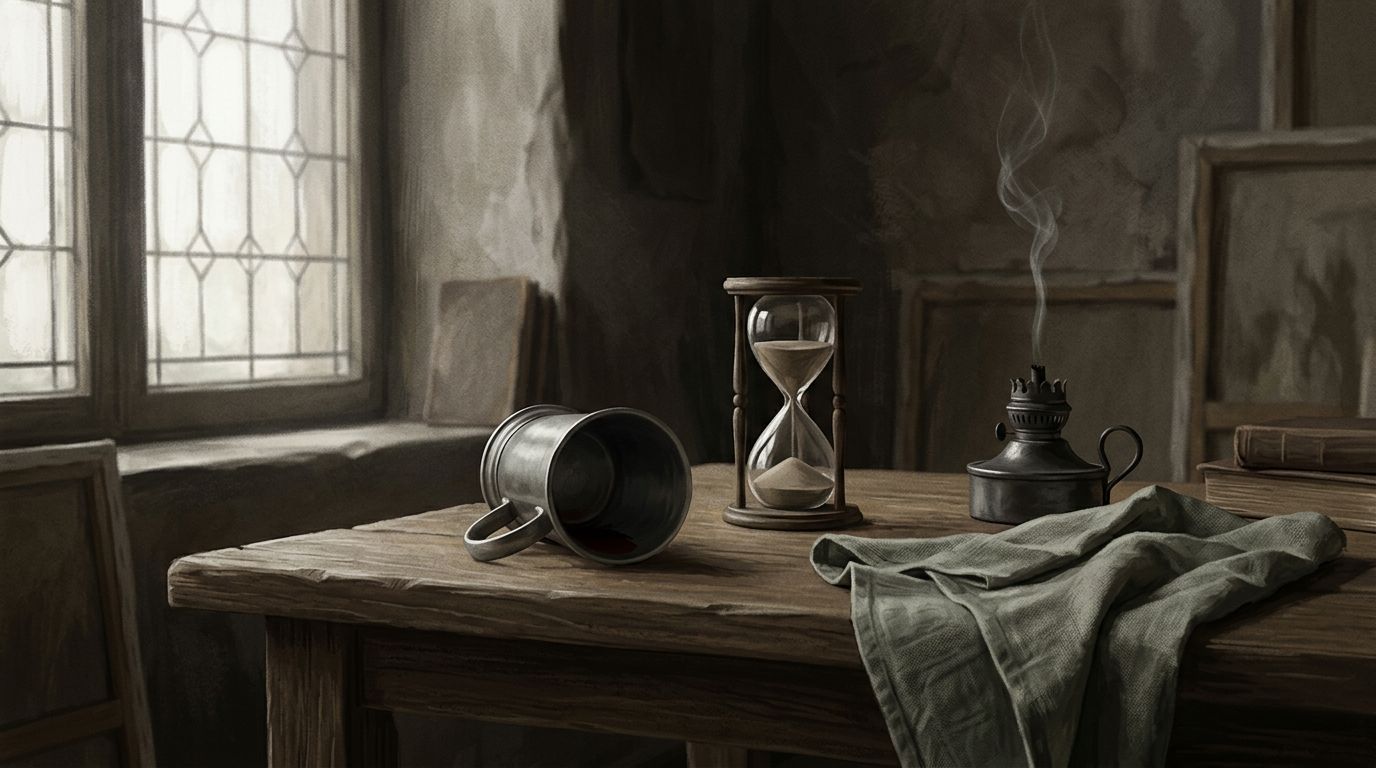
Exhibo Editorial
Vanitas Painting, Explained
Netherlandish still life as a moral argument: how painters built vanitas tables, six named works, and how to recognise the type.
A vanitas painting is a still-life type, not a mood and not a skull as decoration. In the Dutch Republic and neighbouring Flanders in the early seventeenth century, painters arranged books, glass, coins, instruments, and luxury metalwork on a table, then set those goods against a skull, a snuffed wick, a watch, or a bubble so the picture argued that earthly status and pleasure do not last. The Latin word names emptiness: the King James Bible renders Ecclesiastes as “Vanity of vanities… all is vanity.” Tate and the National Gallery, London, both tie the painting type to that verse.
This article stays with the painting type: how workshops built the table as an argument, who specialised in it, and how you recognise it on a museum wall. The longer cultural history of memento mori belongs in Memento Mori: A Cultural History. Object-by-object meanings belong in Vanitas Objects: A Symbol Dictionary. Broader still life sits in Still Life Painting. Period survey for the Dutch Republic is already live at The Dutch Golden Age. If you arrived here from an anime or game character of the same name, the art-historical type is the one below.
What vanitas names as a painting type
Vanitas, in museum English, names a subset of still life. The National Gallery’s glossary puts it in one sentence: a particular type of still-life painting in which objects refer to the transience of human action against the lasting claim of faith. Tate adds the extra clause that separates the type from a skull picture: vanitas still lifes also stage musical instruments, wine, and books so the viewer meets the worthlessness of worldly goods, not only the fact of death.
That double load is the type. A skull alone can serve as a memento mori in a portrait, a tomb, or a print. A breakfast of pewter and lemon peel can be a Haarlem ontbijtje that shows skill and appetite. Vanitas painting puts both registers on one support. The painter invites you to enjoy the gleam of a rummer or a silver tazza, then uses mortality markers to tax that enjoyment. The picture sells craft and warning in the same glance.
The type is Netherlandish and early modern in its classic form. Painters in Leiden, Haarlem, Delft, Antwerp, and later Madrid and Seville made independent table pictures whose subject is the argument, not a saint’s attribute in the corner of a larger scene. Jacques de Gheyn II’s 1603 panel in the Metropolitan Museum of Art is, in the Met’s own wording, generally considered the earliest known independent still-life painting of a vanitas subject. Haarlem tonal still life in the late 1620s, Leiden’s denser tables through the 1640s and 1650s, and Spanish desengaño pictures in the 1630s show the same idea under different palettes and patrons.
Call it a painting type rather than a movement. No manifesto, no shared academy, no end date you can hang a banner on. Specialists reused a grammar of objects and light because buyers in Calvinist towns and Catholic courts both paid for moral still life. The grammar later leaked into photography, photorealist painting, and installation. Those later uses count when they keep the table-as-argument structure. A skull print on a tote bag does not.
For the wider series of genres and symbols, start at Genres & Symbolism in Art. For dancing skeletons as a medieval and early-modern motif of death as equaliser, see Danse Macabre. That lineage is adjacent, not identical.
How a vanitas still life is built
The type works because the painter treats the table as a sentence. Objects sit in groups the way clauses sit in a period: goods of learning, pleasure, or rank; markers of time and death; sometimes an inscription that states the verdict. You do not need a wall label if the grouping is clear. You do need to look at support, palette, light, and the ledge, because those choices decide whether the picture reads as a sermon, a luxury display, or both.
Haarlem and Leiden solved the same sentence in different accents. Pieter Claesz in Haarlem, as the Mauritshuis notes on his 1630 Vanitas Still Life, became known for still lifes with a limited palette: brown and green, with a dash of blue on a watch ribbon. Leiden painters such as David Bailly and his nephew Harmen Steenwijck packed more objects, more colour, and often a portrait or a paper slip with the Ecclesiastes tag. Spanish painters added a winged figure or a Habsburg cameo. The technical habits below are the shared toolkit.
Support, scale, and the Haarlem palette
Most classic vanitas pictures are oil on oak panel, cabinet size, meant for a domestic wall rather than a chapel. Claesz’s Mauritshuis panel measures 39.5 by 56 cm. His Met picture of 1628 is smaller still: 24.1 by 35.9 cm. Steenwijck’s National Gallery oak panel is 39.2 by 50.7 cm. Bailly’s Lakenhal panel is larger, 89.5 by 122 cm, because it has to hold a half-length figure and a table of objects together. De Gheyn’s 1603 Met panel is vertical, 82.6 by 54 cm, closer to a niche altar than to a breakfast piece.
Panel, not canvas, suited the fine description of metal, glass, and bone. Oak takes a smooth ground. Painters built form in thin, opaque layers and tiny highlights: a window reflected in a rummer, a wet gleam on a tooth, smoke from a wick. Claesz and Willem Claesz Heda, working in Haarlem from the late 1620s, restricted hue so that value and texture carry the picture. The Mauritshuis text on Claesz 1630 is exact: besides brown and green he needed only a dash of blue to make the watch ribbon look true to life. That restriction is a technical choice and a moral one. Colour itself can look like vanity; grey-brown truth-telling looks like honesty.
Spanish and later Leiden pictures often break that restraint. Pereda’s Vienna Allegory of Vanitas (around 1634, Kunsthistorisches Museum) is a large canvas, about 139.5 by 174 cm, with armour, coins, clocks, and a winged genius. The type can scale up. When it does, the still-life core still has to hold, or the picture slides into history painting with props.
Light, ledge, and the table as argument
Light in a vanitas still life is directional and selective. Steenwijck’s National Gallery panel, in the gallery’s audio description, splits into two triangles: grey empty space above left, a wedge of objects on a wooden table below, lowest at left and highest at right. A beam from the upper left catches reflective surfaces. The skull sits in that beam. The empty zone is not leftover background. It is the space against which the heap of goods looks brief.
Painters also cheat space toward you. The Met’s note on Claesz’s 1628 panel stresses the pitted stone ledge that connects the picture’s space to ours. A quill, a glass foot, or a watch ribbon may overlap the front edge. You stand at the same table. The moral lands as a private address, not as a pulpit scene.
The argument itself is grouping, not a glossary. One cluster stands for learning or art (books, quill, instruments, a globe). Another stands for appetite and rank (wine, pipe, coins, silver). A third stands for time stopping (skull, snuffed lamp, watch, bubble, cut flowers). Inscriptions, when they appear, close the sentence: Bailly writes Vanitas vanitatum et omnia vanitas on a slip; Pereda’s table carries nil omne (“all is nothing”). For a full object dictionary, use the companion vanitas symbols article. Here the point is structural: if you cannot find both worldly goods and a mortality marker in active relation, you are looking at a different still-life type.
Leiden, Haarlem, and who paid for the type
Vanitas painting concentrated where two conditions met: a market for independent still life, and a public already trained by sermons, emblems, and university culture to read objects as morals. Leiden, a university town with a strong Reformed culture, became the specialist centre. The National Gallery’s artist page for Harmen Steenwyck (their spelling) states that he and his brother Pieter trained with their uncle David Bailly in Leiden, that Bailly is often credited with inventing the vanitas type, and that the vanitas was a speciality in Leiden. Museum De Lakenhal, which holds Bailly’s 1651 panel, puts the same claim in milder form: Bailly’s influence helped the genre become popular in seventeenth-century Leiden. Treat “invented” as a later credit, not a documented first-day patent. De Gheyn’s 1603 Met panel already exists as an independent vanitas, and De Gheyn had taught in the same intellectual world; Bailly studied with him.
Haarlem ran a parallel workshop culture around tonal breakfast pieces. Claesz (born Berchem, died Haarlem; Mauritshuis gives 1597/98–1661, the Met 1596/97–1660) and Heda painted tables of rummer, tazza, lemon, and watch in which vanitas can be explicit (skull on the cloth) or almost absorbed into the breakfast. The Rijksmuseum’s catalogue discussion of Heda’s early work notes a period of competition around 1628–30, with Heda’s 1628 vanitas in Museum Bredius recalling Claesz’s Met skull-and-quill panel. Specialisation inside Dutch Golden Age painting made that rivalry possible: still life was a saleable niche, and vanitas was a moral premium inside the niche.
Buyers were not monks. They were merchants, scholars, and householders who already owned pewter and books. A vanitas panel let them display taste and piety together. Calvinist interiors had less room for altarpieces; a table picture with a skull could hang in a study without looking like a forbidden image of God. Catholic Spain took the same grammar and court-scaled it: Pereda’s Vienna picture points to Habsburg power even as the inscription says all is nothing. The type travelled because the argument was portable. The local church settlement only changed the scale and the extra figures.
Flanders and the southern Netherlands fed the type as well, through Antwerp still-life density and through painters who moved north. Keep the geography Netherlandish-plus-Spain. This article does not inventory other regions’ death symbols.
Six paintings that show the type at work
A definition hardens when you walk it through named pictures. The six below are chosen for different dates, cities, and solutions: an early independent niche; Haarlem tonal still life; a Leiden diagonal heap; a Leiden portrait-table hybrid; a Spanish court allegory; a late-twentieth-century photorealist table. Together they cover the type without turning into a symbol list. Locations follow current museum records. Loans change; check the collection page before you travel.
| Work | Artist | Date | Support / size | Collection | How the argument is built |
|---|---|---|---|---|---|
| Vanitas Still Life | Jacques de Gheyn II | 1603 | Oil on wood, 82.6 × 54 cm | Metropolitan Museum of Art, New York (1974.1) | Skull in a niche; bubble; smoking urn; cut flowers; Democritus and Heraclitus on the arch |
| Still Life with a Skull and a Writing Quill | Pieter Claesz | 1628 | Oil on wood, 24.1 × 35.9 cm | Metropolitan Museum of Art (49.107) | Tonal Haarlem palette; ledge; skull, quill, toppled glass, guttering lamp |
| Vanitas Still Life | Pieter Claesz | 1630 | Oil on panel, 39.5 × 56 cm | Mauritshuis, The Hague (inv. 943) | Skull, snuffed candle, empty glass, watch; signed PC 1630 on the book |
| Still Life: An Allegory of the Vanities of Human Life | Harmen Steenwijck | c.1640 | Oil on oak, 39.2 × 50.7 cm | National Gallery, London (NG1256) | Diagonal heap; raking light; skull, lamp, watch, instruments, shell, books |
| Vanitas still life with portrait of a young painter | David Bailly | 1651 | Oil on panel, 89.5 × 122 cm | Museum De Lakenhal, Leiden (S 1351) | Half-length figure plus table; inscribed Ecclesiastes slip; oval portrait in the hand |
| Allegory of Vanitas | Antonio de Pereda | c.1634 | Oil on canvas, c.139.5 × 174 cm | Kunsthistorisches Museum, Vienna (GG 771) | Winged genius; armour, clocks, coins; table inscription nil omne |
De Gheyn, 1603: an independent niche
Jacques de Gheyn II (Antwerp 1565–The Hague 1629) painted a vertical panel that already contains the type’s full sentence. The Met’s wall-text style note lists the skull, large bubble, cut flowers, and smoking urn as signs of life’s brevity, and images inside the bubble (a wheel of torture, a leper’s rattle) as signs of folly. Democritus and Heraclitus, the laughing and weeping philosophers, flank the arch. Coins and medals litter the ledge.
The picture is still close to emblem and niche sculpture. The skull sits in a recess, as if in a tomb. The bubble restates the old tag homo bulla, man is a bubble, which Erasmus had circulated. What makes it a vanitas painting rather than a printed emblem is the oil description of bone, smoke, and iridescence, and the decision to let still-life objects carry the whole subject. Later Haarlem tables flatten the niche into a domestic ledge. De Gheyn keeps the architecture of a monument.
Claesz in Haarlem: the small tonal table
Pieter Claesz’s 1628 Met panel is a masterclass in economy. The museum text names the toppled glass, gap-toothed skull, and guttering wick of an oil lamp as symbols of brevity, then stresses the limited greys and browns and the stone ledge. A quill, inkwell, and pen case claim learning. The overturned rummer claims past pleasure. Smoke from the lamp claims time that has already gone. Nothing in the picture needs a second register of angels or philosophers.
Two years later the Mauritshuis panel (inv. 943) repeats the grammar with a watch and an empty glass. The museum’s public text is blunt: this is no random collection; each object conveys mortality. Claesz signs and dates the book, PC. Ao. 1630. The blue ribbon is the only high chroma. If you want to see how vanitas sits inside Haarlem still life rather than as a separate school, stand this panel next to a Claesz or Heda breakfast without a skull. The paint handling is cousin. The argument is stricter.
Leiden: Steenwijck’s heap and Bailly’s double time
Harmen Steenwijck (born Delft c.1612, active in Leiden) took the Haarlem table and stacked it. The National Gallery’s Allegory of the Vanities of Human Life, about 1640, heaps a skull, musical instruments, a pocket watch, books, a Japanese sword, a shell, and a snuffed lamp on a wooden table. Light from the upper left picks the skull. The gallery text cites Ecclesiastes and contrasts worldly labour with lasting faith. Steenwijck signs but, as was his habit, does not date. The c.1640 date is the gallery’s.
David Bailly’s 1651 Lakenhal panel goes further by putting a painter into the still life. Museum De Lakenhal’s current label is careful: Bailly portrayed himself in the oval painting the young man holds; the young painter’s identity is not certain, perhaps a colleague, perhaps Bailly in youth. The woman’s portrait may be his wife, whose face also appears as a ghost behind the flute glass. A slip at lower right quotes Ecclesiastes. Technical study published around the museum’s 2023 Bailly exhibition found overpainted portraits and moved objects, so the picture’s time-play is both subject and process. Older catalogue essays treated the young face as Bailly’s past self and the oval as his present age (he was in his late sixties in 1651). The museum now leaves the young sitter open. Either reading still makes the painting a vanitas about portraiture: paint preserves a face, and paint is also one more object on the table that will outlast the sitter.
Pereda in Madrid: the type at court scale
Antonio de Pereda y Salgado (Valladolid 1611–Madrid 1678) painted Allegory of Vanitas around 1634, now Kunsthistorisches Museum, Vienna. A winged genius presents clocks, miniatures, pearls, and coins, and holds a cameo of Charles V while pointing at a globe. Armour, a firearm, skulls, a blown-out candle, an hourglass, and brittle folios cover the table. The inscription nil omne states the verdict (the Kunsthistorisches Museum renders it “all is trivial”; English notes often say “all is nothing”). Museum commentary treats the Habsburg references as evidence of a courtly commission. The canvas is recorded as cut at the top (139.5 by 174 cm).
This is still vanitas, and it is also Spanish Baroque allegory. The still-life core (skulls, candle, hourglass, books) is Netherlandish grammar. The genius and the imperial cameo pull the picture toward political desengaño: even world empire is empty. If you use Pereda to stretch the type beyond the Dutch Republic, keep the still-life table in view. Without it, you have a history painting with a skull.
How later and living artists reuse the type
Once the table-as-argument existed, later artists could quote it without copying oak panels. Paul Cézanne’s late skull groups, including Pyramid of Skulls (c.1901), keep mortality as a still-life problem of form and volume more than as Calvinist warning. Pablo Picasso’s 1945 Skull, Sea Urchins and Lamp on a Table puts wartime still life next to the same objects. Those pictures sit on the border of the type: still life plus skull, thinner moral inscription.
The cleanest modern reuse in painting is photorealist vanitas. Audrey Flack’s Marilyn (Vanitas) (1977, oil over acrylic on canvas, 96 by 96 inches / about 244 cm square) is in the University of Arizona Museum of Art, Tucson (1982.035.001, Gallagher Memorial Fund purchase, 1982). Other pictures from the same Vanitas series sit in other US collections; this canvas is the named public example. It restages a dressing table with a photograph of Marilyn Monroe, cosmetics, fruit, a candle, an hourglass, and a framed calendar. The worldly goods are celebrity and makeup. The mortality markers are still timepieces and sweetness that will rot. Flack’s own writing on the series treats seventeenth-century Dutch vanitas as the model she updated with colour photography and airbrush smoothness. The type survives because the grouping still taxes the gleam.
That update also shows what the type can absorb. A 1970s dressing table is not a Leiden oak board, and Monroe is not a Haarlem merchant’s rummer. The structure holds: appetite (fame, lipstick, fruit) set against stoppage (hourglass, candle, the knowledge that the photographed face is already dead). If you strip the time markers and keep only the celebrity glitter, you have Pop. If you keep both, you still have vanitas, even at nearly two and a half metres square and in acrylic.
Photographers and film-makers run the same grammar in time. Sam Taylor-Johnson’s video Still Life (2001) lets a store-bought fruit plate collapse into mould. Ori Gersht’s exploding floral photographs (the Time After Time and Blow Up series) quote Dutch flower painting at the instant of destruction. Damien Hirst’s diamond skull For the Love of God (2007) is sculpture, not painting, but it restates the vanitas bargain in luxury materials: death as product, product as death. When a living artist keeps both sides of the bargain, you can still use the word. When only the skull remains, you are in costume.
How to identify vanitas when you are in front of the picture
Start with the support and the subject, not with a feeling of gloom. Ask whether the picture is primarily a table of objects (or a figure whose job is to present that table). If the main subject is a standing saint, a crucifixion, or a full-length portrait with a skull as attribute, you have a memento mori inside another genre. Vanitas painting makes the still life the vehicle.
Then check for the double cluster. You want at least one group of worldly goods (books, instruments, glass, coins, armour, cosmetics in a modern work) and at least one active mortality or time marker (skull, snuffed light, watch, bubble, cut flowers, rotting fruit). A bowl of fruit with no time marker is still life. A skull in a medical print is anatomy. The type needs the friction between appetite and stoppage.
Read light and edge next. Raking light on metal and bone, a dark ground, a ledge that overlaps toward you, a diagonal heap against empty space: those are workshop habits of the classic phase. A rainbow palette does not disqualify a later vanitas, but it should still organise gleam versus ash.
Read any text last. Vanitas vanitatum, homo bulla, nil omne, a watch face, a snuffed wick with a thread of smoke: these close the sentence. Absence of text does not kill the identification. Claesz’s small panels argue without a motto.
Use the museum’s own language as a check. Mauritshuis, Met, Tate, and the National Gallery all use “vanitas” for this still-life type. If a wall label says “still life” only, look again: you may be in a breakfast piece. If a shop calls a skull candle “vanitas,” you are in retail.
Watch scale and neighbours on the wall. A 25 cm Claesz next to a Heda breakfast will teach you faster than a textbook: same pewter skill, different sentence. A metre-wide Pereda in a Spanish Baroque room will look like allegory first; find the table, then decide. For public collections that hold the classic pictures, the museums directory is the practical next step.
Common confusions and misuses
Search engines treat “vanitas” as a collision of art history, manga, and a Kingdom Hearts villain. Museum usage is narrower. Curators at Tate, the National Gallery, the Met, and the Mauritshuis use the word for a still-life type with a moral table, not for every image of death and not for a fictional swordsman. If you keep that museum usage, the confusions below sort themselves. Each has a correct home elsewhere in this series or in pop culture. Keep the word for tables that argue, and send the rest of the traffic to the right sibling.
The cost of mixing the terms is practical. Students write essays that treat a tomb skull, a Haarlem breakfast, and a Leiden vanitas as one genre. Shops sell bone-print candles as vanitas. The painting type then looks like a mood board. The distinctions below are identification tools, not pedantry.
Vanitas and memento mori
Memento mori (“remember you must die”) is a wider prompt. It appears on tombs, in portraits, in prints, in jewellery, and in still life. Tate’s glossary treats vanitas as closely related to memento mori still lifes, then adds the extra worldly-goods clause. Use memento mori for the cultural history and for any work whose job is to recall death. Use vanitas for the still-life type that taxes worldly pleasure and status in the same picture. A portrait with a skull can be memento mori without being a vanitas painting. The full motif history is in Memento Mori.
Still life, flower pieces, and a skull as style
Still life is the parent genre: arranged objects, no narrative figures required. Flower pieces can include insects and dewdrops that hint at transience without becoming vanitas. Breakfast and banquet pieces can include a watch as a quiet time-mark. Vanitas is the subtype that makes transience the subject. If you need the parent genre, use Still Life Painting. If you need object meanings, use the symbol dictionary. Do not call every skull in contemporary décor a vanitas. The type is an argument in paint, not a palette of black and bone.
A related misuse is treating vanitas as a Dutch national mood. Haarlem and Leiden specialised in it. Spain took it to court scale. Later artists anywhere can quote it. The classic phase remains Netherlandish and early modern. Stretch the word past that phase only when the table-as-argument structure is intact.
Where to see the type
You can learn the type from a short museum circuit. The Metropolitan Museum of Art holds De Gheyn 1603 and Claesz 1628, a pair that shows the niche monument and the Haarlem ledge in one visit (check current gallery numbers; they move). The Mauritshuis in The Hague holds Claesz 1630 (listed as not on view at the 14 August 2026 check; confirm before you travel); the same building’s Dutch rooms also train your eye on related still life. The National Gallery, London, holds Steenwijck’s Allegory (NG1256 was not on display at the same check). Museum De Lakenhal in Leiden holds Bailly 1651 and treats Leiden as the specialist town. The Kunsthistorisches Museum in Vienna holds Pereda. Museum Bredius in The Hague holds Heda’s 1628 vanitas, useful if you want the Haarlem rivalry in the same city as the Mauritshuis.
The Rijksmuseum in Amsterdam is richer in Dutch still life than in textbook vanitas skulls; use it to see how breakfast pieces sit next to the moral type, then walk the vanitas examples elsewhere. Tate’s glossary page is a reliable short definition even when the hang of related works changes. For opening hours, tickets, and collection pages, start from the museums directory rather than from a search-engine carousel.
FAQ
What is a vanitas painting?
A vanitas painting is a still-life type in which painters arrange worldly goods (books, glass, instruments, coins, silver) with mortality and time markers (skull, snuffed candle, watch, bubble) so the picture argues that earthly status and pleasure do not last. The word comes from Latin vanitas, emptiness, via Ecclesiastes. Classic examples are Netherlandish oil panels of the seventeenth century.
What is vanitas a type of painting?
It is a subtype of still life, not a separate movement and not a synonym for all art about death. Tate and the National Gallery both define it as still life with symbolic objects. Portraits, tombs, and prints can use memento mori devices without being vanitas paintings.
What is the meaning of vanitas in art?
In art-historical English it means the emptiness of worldly things, staged as a table of objects. It does not mean “vanity” as pride in a mirror, though mirrors can appear. It does not name a manga protagonist or a video-game character. Those uses borrow the word.
Who are some famous vanitas painters?
Jacques de Gheyn II painted an early independent example in 1603. Pieter Claesz and Willem Claesz Heda specialised in Haarlem tonal tables. David Bailly and Harmen Steenwijck specialised in Leiden. Antonio de Pereda took the grammar to Madrid. Later painters such as Audrey Flack reused the table structure in photorealism.
How is vanitas different from a normal still life?
A breakfast piece or flower piece can exist as a display of skill and appetite. Vanitas still life keeps that display and adds a second cluster that taxes it. The friction between gleam and stoppage is the subject.
Why were vanitas paintings popular in the Dutch Republic?
Independent still life already sold to households. Reformed churches offered fewer altarpiece commissions. University and emblem culture in Leiden trained viewers to read objects as morals. A cabinet panel could show piety and painterly skill on one wall. See Dutch Golden Age painting for the wider market.
Is every picture with a skull a vanitas?
No. Anatomy studies, crucifixions, tomb sculpture, fashion photography, and Halloween décor all use skulls. Vanitas painting needs the still-life structure and the worldly-goods cluster. For dancing death as a separate motif, see Danse Macabre.
Where should I go after this article?
Read Memento Mori for the longer motif history, Vanitas symbols for the object dictionary, and Still Life Painting for the parent genre. The series hub is Genres & Symbolism in Art.
Related reading
Van Lévé: Sovereign Caribbean Visions Take Shape at Harvard
A transnational survey charts twenty-five years of Creole and Maroon artistic practice across the French Caribbean and Amazonia.
Harvard's Alain Locke Gallery presents a landmark survey tracing contemporary production from Guadeloupe, Martinique, Guyane, and Haiti since two thousand and one.
Gustave Fayet: Collector—Artist Designer
A comprehensive survey at the Fondation Louis Vuitton reuniting collected masterpieces with the designer's own studio practice.
The Paris institution expands its patronage series with a dual-focused examination of Gustave Fayet, bringing together hundreds of acquired works and restored creations to chart his impact on early modernism.
Mohammad Alfaraj: The Heart Is a Bird's Nest, the Brain Is a Spider Web
First European institutional solo explores cross-species kinship and domestic ecologies
Mohammad Alfaraj's latest showcase at the Delfina Foundation merges multimedia installations with regional folklore to reimagine shared habitats.