
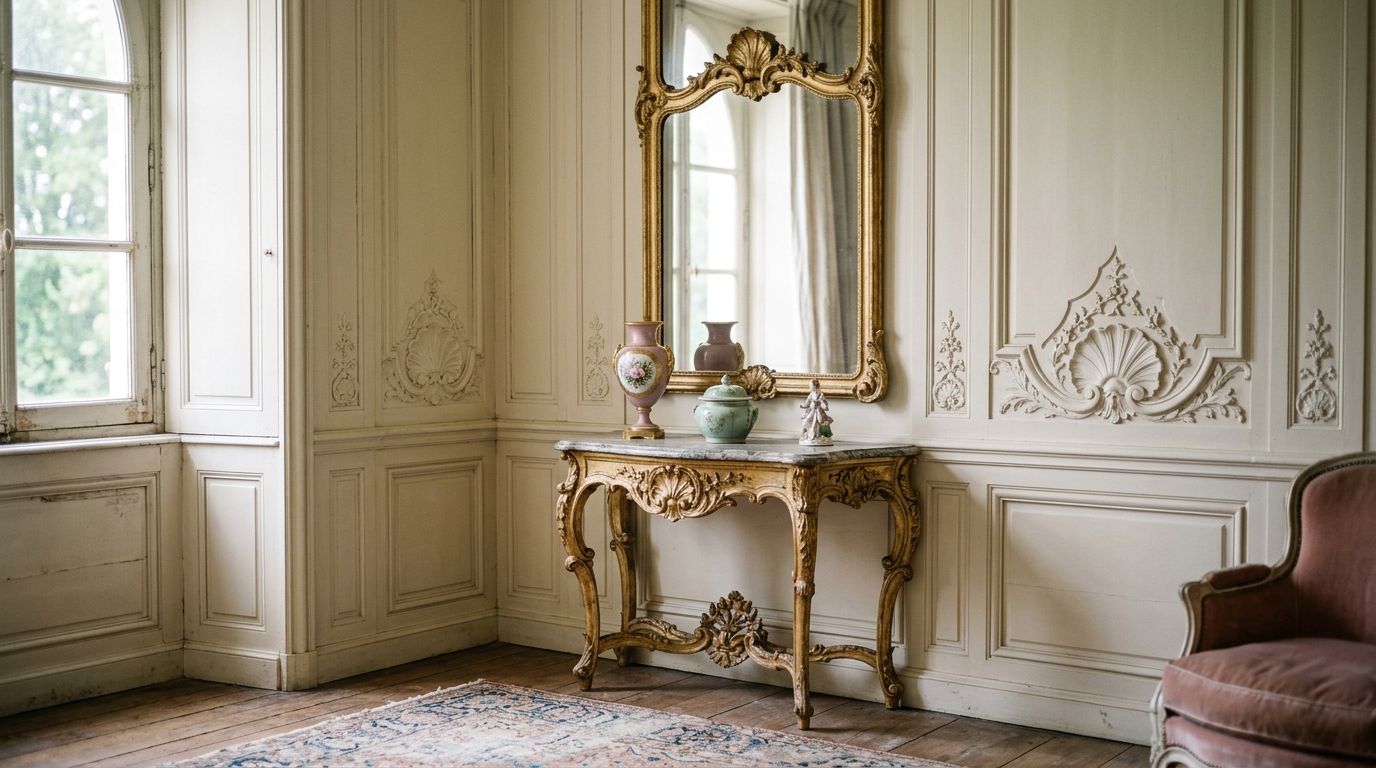
Exhibo Editorial
Rococo, Explained
Paris salons to European courts: the light, ornamental language of furniture, porcelain, painting and church interiors.
Rococo art is the light, ornamental visual language that took hold in Paris in the early eighteenth century and then travelled across Europe in furniture, interiors, porcelain, painting and church decoration. Designers and craftspeople built it first as a private alternative to the heavy state Baroque of Louis XIV’s Versailles: asymmetrical C- and S-curves, shell and rock forms (rocaille), pastel colours, gold, and subjects that favoured flirtation, pastoral theatre and myth over public grandeur. By the mid-century the style had a clear painting line in France (Watteau, Boucher, Fragonard), a spectacular architectural life in southern Germany and Austria, and a craft afterlife in Britain and colonial America.
This survey stays inside the period: how the taste formed, what marks a Rococo object or canvas, who carried it, which works still teach it best, how it mutated abroad, why Enlightenment critics and Revolutionaries turned against it, and what later generations kept. For the earlier monumental drama it reacted against, see the series piece on Baroque art. The wider sequence of Western period labels sits in Periods of Art History.
After Versailles: the conditions that made Rococo
Louis XIV died in 1715. The court left the ceremonial machine of Versailles for a time, and Parisian aristocrats poured money into hôtels particuliers: town houses where the salon, the boudoir and the cabinet mattered more than the parade gallery. Those rooms needed a different grammar. Pierre Le Pautre, Jean Berain, Juste-Aurèle Meissonnier and Nicolas Pineau, among others, thinned the official Louis XIV vocabulary into interlacing curves, shell work and light colour. Britannica places the style’s origin in that Parisian reaction against the ponderous design of Versailles; the Victoria and Albert Museum dates the first flowering to the 1720s and 1730s and stresses a point many painting-led summaries skip: Rococo began as a makers’ style, developed by craftspeople and designers more than by architects, which is why it saturates silver, ceramics and furniture before it fills churches.
The Régence and the early reign of Louis XV rewarded intimacy. Mirrors multiplied light. White and gold wall panelling (boiserie) framed overdoors and small cabinet pictures. Porcelain from Meissen, and later Sèvres, carried the same scrollwork into objects you could hold. Patrons commissioned rooms as total environments: plaster, upholstery, clocks, mounts on Chinese lacquer, and paintings designed to match. The Wallace Collection’s curatorial note on the style underlines that Rococo could touch every surface of an aristocratic interior once “total design” became the fashion at Louis XV’s court.
Painting adjusted to that domestic scale. Jean-Antoine Watteau (1684–1721), Flemish-trained and Paris-formed, offered the Academy a reception piece in 1717 that did not fit the existing history-painting categories. The Louvre’s Pèlerinage à l’île de Cythère (also known as L’Embarquement pour Cythère) entered the records as a fête galante: a new label for scenes of elegant leisure and courtship in parkland. That institutional invention matters. Rococo painting did not only decorate private rooms; it forced the official hierarchy of genres to admit a mood that was neither allegory on the grand scale nor low genre in the Dutch sense.
Political and social context matters without turning the style into a cartoon of decadence. The French elite of the 1720s–1750s still funded churches and royal projects, but the images that define Rococo for most viewers today were made for pleasure, flirtation and display inside houses. Madame de Pompadour’s rise as Louis XV’s official mistress from 1745 gave François Boucher a powerful court channel. By the 1760s that same world of pastel flesh and theatrical shepherdesses had become a target for writers who wanted art to instruct civic virtue. The style’s birth conditions and its death conditions are both social.
What Rococo looks like
Stand in front of a Rococo interior or a Fragonard cabinet picture and the checklist is short enough to use on a museum visit. Asymmetry rules. Forms curl into C- and S-shapes. Shells, rockwork, acanthus, flowers, birds, ribbons, trellises and putti recur. Pastels, ivory white and gold dominate French schemes; German church interiors often push brighter pinks, turquoise and white stucco into a more theatrical register. Painting tends toward a light tonal key, soft transitions, and subjects drawn from mythology, pastoral theatre and amorous play. Sculpture prefers intimate scale and varied surface effects over monumental rhetoric.
Those traits can mislead if you treat them as a personality test for an entire century. Jean-Siméon Chardin painted still lifes and quiet domestic scenes in the same decades and won Diderot’s praise for truth to nature. Canaletto’s Venetian views share a luminous clarity that writers sometimes fold under a broad “Rococo” umbrella, though his market and method sit apart from Boucher’s pastorals. Use the word for a family of ornamental and pictorial habits, not as a moral verdict on every object made between 1720 and 1770.
Purists still argue that Rococo belongs to decoration (boiserie, metalwork, furniture, porcelain) and only by extension to painting and architecture. Art UK, following the Concise Oxford Dictionary of Art Terms, notes that wider use is now standard: Watteau as the first great Rococo painter, Boucher and Fragonard as masters of the mature style, Étienne-Maurice Falconet as a leading sculptor whose designs also travelled in porcelain. Architectural historians sometimes reclassify the great Bavarian pilgrimage churches as late Baroque rather than Rococo proper. That debate is real; it does not stop museum labels from calling Vierzehnheiligen or the Wieskirche Rococo when they want visitors to see the French ornamental language fused with south German spatial drama.
Ornament: shells, curves and rocaille
The word itself points to materials. Rocaille meant the shell-covered rockwork used to dress artificial grottoes. Early eighteenth-century critics and craftsmen stretched that vocabulary into wall frames, silver mounts, furniture carving and porcelain. The V&A highlights curved asymmetric ornament that often resembles the letters S and C, with one half of a design refusing to mirror the other. Natural motifs of the sea sit beside a dense, stylised acanthus. British engravers and carvers later mined the same stock for Chippendale-era furniture.
On a practical looking visit, start with edges and corners rather than the centre of a painting. Rococo announces itself in the frame, the console’s knee, the clock’s case, the plaster cartouche over a door. The painting inside may share the mood (pink silk, leafy park, hovering putto) or it may be quieter; the room still reads as Rococo if the shell-and-scroll system wraps the space. Chinese and Japanese imports often received European Rococo mounts on arrival, a hybrid the Wallace Collection flags as typical of the taste for rare goods dressed in fashionable local ornament.
Painting: subjects, light and brush
French Rococo painting, in Britannica’s summary, runs from Watteau’s graceful, melancholic pastorals through Boucher’s playful mythological nudes to Fragonard’s open-brushed genre scenes. Common traits: lighthearted treatments of courtship and myth, delicate brushwork, a light tonal key, and sensuous colour. Portrait painters such as Jean-Marc Nattier dressed sitters in mythological costume; the courtly fiction and the ornamental frame belonged to the same culture.
Light in these pictures is seldom the theatrical spotlight of high Baroque altarpieces. Daylight filters through foliage. Flesh is pearl and rose. Distance softens into haze. That optical gentleness is part of why later moralists called the style soft and feminine: the pictures refuse the clenched fist of public rhetoric. They also repay slow looking. Watteau’s greens and greys carry as much of the meaning as the lovers’ gestures. Fragonard’s leaf canopy in The Swing is a machine for hiding and revealing, not mere backdrop.
Rooms as total design
Excellent French benchmarks include the Salon de Monsieur le Prince at the Petit Château, Chantilly (completed 1722, Jean Aubert) and Germain Boffrand’s salons at the Hôtel de Soubise in Paris (begun 1732). Mirrors, curved mouldings and pastel fields make the walls feel mobile. Furniture legs and table tops take serpentine profiles. Silver and porcelain pick up the same asymmetry at smaller scale.
Outside France the room language thickens. François de Cuvilliés’s Amalienburg pavilion in the park of Nymphenburg near Munich (1734–39) is a textbook of refined German Rococo: silvered stucco, mirrors, hunting motifs, a circular interior that treats ornament as architecture. Once you have seen a space like that, Boucher’s canvases look less like isolated “pretty pictures” and more like portable fragments of a world built for conversation, music and display.
Painters who defined the style
Three French painters still organise most classroom accounts of Rococo art, and for good reason: Watteau invents the mood and the Academy category, Boucher saturates the mid-century market and court, Fragonard delivers the late, knowing flourish that museum visitors recognise from a single pink dress on a swing. Around them stand Lancret and Pater (heirs to the fête galante), Nattier in portraiture, Falconet in sculpture, and Tiepolo in Venetian ceiling painting. The shortlist below is a spine, not a census.
National collections make that spine easy to walk. London alone holds Fragonard’s The Swing at the Wallace Collection, Watteau’s The Scale of Love at the National Gallery, and strong Boucher holdings at the Wallace. Paris keeps Watteau’s Academy piece at the Louvre. Washington’s National Gallery of Art frames the style as light-hearted decoration that began around 1700 in France and moved from the decorative arts into painting. Use those rooms; the biographies make more sense when you stand three metres from the varnish.
Jean-Antoine Watteau and the fête galante
Watteau left Valenciennes for Paris in 1702, trained in circles that included Claude Gillot and the decorator Claude Audran III, and absorbed Rubens and Flemish genre. The National Gallery, London, stresses his invention of the fête galante: small cabinet pictures that explore the psychology of love, often in a landscape. Commedia dell’arte characters (Pierrot, Harlequin, Columbine) gave him a vocabulary of masks and half-sincere gestures. He became a full Academician in 1717 with the Louvre Cythera.
He died in 1721, young enough that later Rococo looks like a building raised on a short foundation. Nicolas Lancret and Jean-Baptiste Pater continued the outdoor parties; neither matched Watteau’s mix of theatrical glitter and withheld feeling. If you only know Rococo as frivolity, start with Watteau. The melancholy is structural: couples hesitate, look back, leave an island of love that may already be emptying.
François Boucher and the court image
Boucher (1703–1770) turned Watteau’s inheritance into a production system: mythologies, pastorals, tapestry designs, porcelain models, and portraits tied to Madame de Pompadour’s patronage. He became first painter to the king. Flesh, silk and cloudy blues fill the field. Shepherds look as groomed as courtiers. Venus and her attendants supply a classical alibi for erotic display.
Denis Diderot’s Salon reviews in the 1760s made Boucher the emblem of what Enlightenment taste wanted to discard. Early notices still conceded colour and facility; later ones accused the painter of working from memory, repeating soft bodies, and exciting the senses instead of elevating judgement. That quarrel is as important to Rococo’s afterlife as any single canvas. Boucher did not invent aristocratic luxury, but critics used his pictures to prosecute it.
Jean-Honoré Fragonard and late play
Fragonard (1732–1806) trained for serious history painting, then chose intimate, often erotic subjects for private patrons. Les hasards heureux de l’escarpolette (The Swing), painted about 1767–68, is now in the Wallace Collection, London (oil on canvas, 81 × 64.2 cm, inv. P430). A woman in pink silk arcs through a garden; an older man works the ropes; a younger man in the bushes looks up as her slipper flies off. Contemporary anecdote, preserved via the poet Collé, says a court gentleman first approached the history painter Doyen with a more blasphemous brief involving a bishop; Fragonard took the commission and dropped the clerical jab, keeping the erotic geometry.
By the late 1760s Neoclassical taste was already rising. Fragonard’s bravura sits at the end of the fashion cycle: still Rococo in subject and colour, already half aware that the joke is on borrowed time. Later genre scenes and the unfinished progress of love cycles for Madame du Barry show how private patronage could still fund the style after public Salons had begun to sneer.
Four works worth close looking
Encyclopaedia entries list names. Close looking teaches the style’s habits: hesitation in Watteau, ornamental saturation in a German pavilion, erotic sightlines in Fragonard, myth as excuse in Boucher. The four below are chosen for secure attributions, stable public locations, and the different jobs Rococo asked art to do.
1. Jean-Antoine Watteau, Pèlerinage à l’île de Cythère, 1717. Musée du Louvre, Paris (INV 8525).
Reception piece for the Académie royale; the minutes record the subject and then reclassify the work as a fête galante. Couples move through a park toward or away from a boat; a term of Venus stands among roses; putti thicken the air. Scholars still argue whether the party is arriving at Cythera or leaving it. That ambiguity is the point. The brush stays open; edges dissolve; the social ritual of love looks as fragile as the weather. A second major version is at Charlottenburg Palace, Berlin; start with the Louvre canvas if you want the Academy story attached.
2. François Boucher, mythological and pastoral canvases for court and private rooms (Wallace Collection and other holdings).
Pick one Wallace Collection Boucher when you visit (for example the mythologies and Cupid a Captive, 1754, often cited in surveys) and track how flesh, drapery and foliage share one creamy temperature. Boucher’s “nature” is a stage set. Diderot’s complaint that these shepherds never dressed that way in real fields is fair as sociology and beside the point as workshop practice: the pictures were meant to match boiserie, porcelain and upholstery, not to document rural labour.
3. Jean-Honoré Fragonard, The Swing, c. 1767–68. Wallace Collection, London.
Read the sightline first: the lover’s eye, the airborne skirt, the stone putto who hushes or points, the husband who thinks he controls the game. Then read the trees. Fragonard paints leaves as a glitter of touches that hide the conspiracy in plain daylight. Conservation work completed around 2021 removed yellowed varnish and returned the pinks and greens the Wallace now emphasises in its public interpretation. The painting is small enough to miss in a crowded gallery if you arrive looking for a monumental masterpiece; it is sized for a private room, which is historically correct.
4. François de Cuvilliés, Amalienburg, Nymphenburg Park, Munich, 1734–39.
A hunting lodge that behaves like a jewel box. Mirrors and silvered stucco dissolve walls; ornament runs without a heavy classical cornice to police it. If your only Rococo encounters are French paintings in museums, this building corrects the bias: the style’s bravest statements are often rooms, not canvases. Pair it, if you travel further, with Balthasar Neumann’s Vierzehnheiligen pilgrimage church (1743–72) or the Zimmermann brothers’ Wieskirche (begun 1745–54), where French ornamental elegance meets south German spatial theatre. Some specialists still prefer “late Baroque” for those churches; walk inside before you pick a side.
From Paris salons to Bavarian churches: how the style travelled
Rococo left France as a portable ornamental system: engraved pattern books, immigrant craftsmen, imported objects, and court architects who had seen Paris or trained under French-connected designers. The Metropolitan Museum’s essay on American Rococo (Morrison H. Heckscher) gives a clean sequence for the wider Atlantic world: the style flourished in France from the 1730s, in England from the 1740s, and in America from the 1750s. Britannica tracks an earlier eastward jump: by the 1730s Catholic German-speaking lands were adapting French elegance to religious architecture with lingering Baroque drama.
Italy’s strongest Rococo signal in painting is Venetian: Giovanni Battista Tiepolo’s vast decorative ceilings and canvases, with Guardi and Canaletto’s city views sometimes pulled into the same conversation by their luminosity and lightness of touch. Russia and parts of Central Europe adopted the ornamental language for palace interiors. Local politics shaped what “Rococo” meant on arrival. In Bavaria it could serve pilgrimage devotion; in London it competed with Palladian classicism; in Philadelphia it dressed the furniture of a colonial elite who still looked to London for craft prestige.
Britain: silver, pattern books and Chippendale
The V&A dates English Rococo design roughly 1740–1770, with an earlier foothold in silver and ornament prints in the 1730s. Huguenot immigrant goldsmiths such as Paul de Lamerie carried French-linked skills into London workshops. William Hogarth’s circle around the St Martin’s Lane Academy, including the French book illustrator Hubert-François Gravelot, helped normalise the taste among artists and designers even as Hogarth’s own satirical painting pushed a different moral agenda.
Matthias Lock and Henry Copland issued influential ornament prints from 1742. Thomas Chippendale’s The Gentleman and Cabinet-Maker’s Director (collected edition 1754) gave clients and provincial makers a shared catalogue of chairs, case furniture and carved detail in which French-derived scrollwork sat beside Gothic and Chinese fantasies. British Rococo is often more angular in the carving and more mixed in its pattern-book sources than Parisian boiserie, but the shell-and-scroll DNA is shared.
German-speaking lands: churches and pavilions
Cuvilliés, Neumann, Dominikus and Johann Baptist Zimmermann, Johann Michael Fischer and Georg Wenzeslaus von Knobelsdorff built or decorated spaces where white and gold stucco, frescoed vaults and curved plan forms produce an almost edible brightness. Vierzehnheiligen and the Wieskirche remain pilgrimage destinations as well as art-history case studies. The scholarly quarrel (Rococo versus late Baroque) turns on whether French ornamental fashion or continuing Italianate Baroque spatial planning is the dominant parent. Visitors feel both.
Colonial America: craft transmission
American Rococo, in Heckscher’s account, focused on ornamental motifs (shells, rocailles, scrollwork, acanthus) applied to interiors, silver and furniture. Engraved designs helped; immigrant London-trained artisans mattered more. Boston, New York, Charleston and Philadelphia were the main centres, all seaports tied to London. Philadelphia’s wealth pulled skilled carvers and cabinetmakers; Charleston mixed local production with imports; New York’s surviving examples are scarce after wartime fire and Loyalist removal. The American story is a craft story first, which matches the European origin myth the V&A tells about makers rather than architects.
Rococo and Baroque: related, not interchangeable
Search demand for “rococo vs baroque” is steady because textbooks pair the labels and museum visitors meet both within a few galleries. Treat Rococo as a later, lighter, more private and ornamental phase that grew out of late Baroque court culture, not as Baroque’s opposite in every medium. Shared DNA includes theatricality, curved form, and a willingness to overwhelm the eye. The differences that help on the ground are scale, lighting, subject and setting.
| Feature | High / late Baroque (typical) | Rococo (typical) |
|---|---|---|
| Peak years (France-centred) | Mid-to-late 17th century into early 18th | c. 1720s–1760s (later in some regions) |
| Primary settings | Churches, palaces, public spectacle | Town-house interiors, pavilions, cabinet pictures; also south German churches |
| Ornament | Heavy massing, strong symmetry still common in state classicism | Asymmetry, rocaille, C- and S-curves |
| Colour and light | Strong contrasts, dramatic spot lighting in many church schemes | Pastels, gold, diffuse daylight, mirrors |
| Favoured painting subjects | Religious drama, state allegory, heroic history | Fêtes galantes, pastoral theatre, erotic myth, intimate genre |
| Social pitch | Dynastic and confessional power | Private leisure, courtly flirtation, craft luxury |
| Critical fate | Later classicists also attacked excess, but the label kept prestige | Pejorative by the 1790s; recovered as a period term in the 19th century |
| Bridge works / sites | Versailles state rooms; Roman and Flemish altarpieces | Hôtel de Soubise; Amalienburg; Watteau’s Cythera; Fragonard’s Swing |
A Bernini altar and a Fragonard swing do different jobs. One organises sacred awe for a crowd; the other organises a private joke about looking. Both may use diagonal energy and rich surface. If you need the longer Baroque account (Caravaggio to Rubens to Versailles), use the Baroque survey in this series and come back here for the eighteenth-century aftermath.
Attacked, discarded, revived: critics then and now
By the 1750s French critics were already calling Rococo trivial and excessive. By the 1760s Neoclassicism offered an austere alternative grounded in Greek and Roman models and in a moral theory of art. Diderot’s Salons supplied the sharpest published language against Boucher: facility without truth, seduction without instruction, children who never study or work, Virgins who look like “sweet little chicks.” The quarrel was aesthetic and political. Images that flattered aristocratic pleasure looked intolerable to writers building a public of reasoned citizens.
Art UK notes that the word “Rococo” itself was said to have been coined in the 1790s by a pupil of Jacques-Louis David as a slight on Louis XV taste, a blend of rocaille and barocco. Formal art-historical use settled in the mid-nineteenth century. The French Revolution sealed the moral case: classicism became the look of the new order, and Rococo read as the house style of a condemned elite. The Wallace Collection’s summary is blunt: the style was castigated as saccharine, feminine and morally bankrupt.
Nineteenth-century collectors quietly disagreed with the Revolution’s verdict. British and French buyers filled houses with Fragonard, Boucher and Watteau; the 4th Marquess of Hertford bought The Swing at the duc de Morny sale in Paris in 1865. Twentieth-century scholarship rehabilitated the decorative arts and complicated the “frivolous” label. Twenty-first-century painters such as Flora Yukhnovich, whom the Wallace Collection cites as a contemporary interlocutor, treat Rococo colour and gesture as a living resource rather than a warning label. The style still divides people. That division is part of its history, not a problem to tidy away.
What Rococo left behind
Strip away the pink dresses and you still inherit a set of modern habits. Interior design as total environment owes a debt to the eighteenth-century salon. Pattern books as consumer catalogues (Chippendale) prefigure later design publishing. The Academy’s creation of the fête galante category shows institutions rewriting genre rules when a market and a mood demand it. Porcelain and silver collecting still chase Meissen and Sèvres forms shaped in these decades.
In painting, the line from Watteau’s ambiguity to later intimiste and Symbolist moods is indirect but real: the idea that a landscape can stage private feeling without a full mythological programme. In architecture, the Bavarian churches remain arguments in stone about how far ornament can go before structure disappears. In criticism, Diderot’s campaign against Boucher rehearses a lasting European anxiety: that pleasure in looking might corrupt public virtue. Every generation that revives Rococo colour (in fashion, in contemporary painting, in period-room museology) reopens that file.
For travellers, the practical legacy is geographic. Paris and the Île-de-France hold the French painting and boiserie story. Munich and the Upper Franconian and Bavarian pilgrimage belt hold the architectural climax. London’s Wallace Collection concentrates Boucher and Fragonard in one house; the V&A tells the craft and English transmission story; the National Gallery supplies Watteau at intimate scale. Colonial American collections (and the Met’s American Wing) show how the ornamental system crossed the Atlantic in wood and silver. Museum directories such as exhibo.art/museums help map those holdings before you travel.
Rococo did not “lose” to Neoclassicism in a single season. Workshops kept carving shells while David’s studio preached Rome. Styles overlap in decades and in single careers. What ended was the confidence that aristocratic play could stand as the centre of ambitious art. What remained is a toolkit of curves, colours and subjects that still signals luxury, flirtation and ornamental intelligence the moment you walk into a room.
FAQ
What is Rococo art in one sentence?
Rococo art is the early-to-mid eighteenth-century European taste for light, asymmetrical ornament and intimate, often amorous subjects, born in Parisian interiors and decorative arts and extended into painting, sculpture and, in some regions, church architecture.
How is Rococo different from Baroque?
Baroque (especially in its public, seventeenth-century forms) leans toward monumental religious and state drama, strong light–dark contrasts and massed symmetry. Rococo keeps theatrical energy but shrinks the stage: pastel palettes, shell-like asymmetry, private rooms, and subjects of leisure and flirtation. They share curved form and richness; they diverge in pitch and purpose. See also Baroque Art, Explained.
When did the Rococo period start and end?
For French design and painting, most museum chronologies open in the 1720s–1730s (with Watteau’s 1717 Cythera as a painting prelude) and close as a dominant fashion in the 1760s as Neoclassicism rises, with a longer tail in furniture and regional architecture. England’s Rococo design run is often given as about 1740–1770; American colonial Rococo clusters in the 1750s–1770s. Exact year borders are teaching tools, not seals on objects.
Who are the most important Rococo artists?
In French painting: Jean-Antoine Watteau, François Boucher and Jean-Honoré Fragonard, with Lancret, Pater and portraitists such as Nattier in supporting roles. In sculpture, Falconet is a frequent reference. In architecture and decoration, names include Germain Boffrand, François de Cuvilliés, Balthasar Neumann and the Zimmermann brothers. Tiepolo anchors the Venetian decorative extreme.
Why was Rococo controversial?
Enlightenment critics wanted art to teach virtue and truth to nature. They read Boucher’s soft mythologies and court pastorals as luxury propaganda for a decadent elite. Revolutionary classicism then treated Rococo as the visual brand of the old regime. The pejorative coinage of the word in the 1790s locked that judgement into the name itself.
Was Marie Antoinette Rococo or Baroque?
Marie Antoinette (queen from 1774) lived at the end of the Rococo fashion cycle and through the rise of Neoclassical and Anglomania tastes at court. Some interiors and furnishings around her still show Rococo survival; her public image is often mixed with later eighteenth-century classicism. She is not a Baroque figure in art-historical period terms; Baroque’s French high moment sits in the previous century under Louis XIV.
What is the most famous Rococo painting?
Fragonard’s The Swing (Wallace Collection, London) is the work most non-specialists recognise. Watteau’s Louvre Pilgrimage to Cythera is the foundational Academy piece. “Most famous” depends on whether you mean popular recognition or historical origin story.
Where can I see Rococo art today?
Paris (Louvre; Musée Cognacq-Jay; Hôtel de Soubise / Archives nationales interiors), London (Wallace Collection; National Gallery; V&A), Munich and Nymphenburg (Amalienburg), Bavarian pilgrimage churches (Vierzehnheiligen, Wieskirche), Venice for Tiepolo, and major American museums for both French paintings and colonial Rococo silver and furniture. Check current displays before travel; loans and refurbishments move objects.
Related reading

Diego Rivera's Monumental Stadium Relief Set for Conservation in Mexico City
A multi-institutional campaign targets the artist's unfinished stone facade at UNAM alongside works by Siqueiros and O'Gorman
Local conservators will lead a phased preservation effort for Diego Rivera's volcanic stone relief at Mexico City's Olympic stadium, supported by the World Monuments Fund and US diplomatic grants.
Van Lévé: Sovereign Caribbean Visions Take Shape at Harvard
A transnational survey charts twenty-five years of Creole and Maroon artistic practice across the French Caribbean and Amazonia.
Harvard's Alain Locke Gallery presents a landmark survey tracing contemporary production from Guadeloupe, Martinique, Guyane, and Haiti since two thousand and one.
Gustave Fayet: Collector—Artist Designer
A comprehensive survey at the Fondation Louis Vuitton reuniting collected masterpieces with the designer's own studio practice.
The Paris institution expands its patronage series with a dual-focused examination of Gustave Fayet, bringing together hundreds of acquired works and restored creations to chart his impact on early modernism.