
Abu Dhabi · United Arab Emirates
The Word for Beautiful Was the Word for Moon
The moon has been the measure of a beautiful face in Arabic verse for fifteen centuries — but beauty was only one of the things that light was ever asked to carry. A history of one disc, from a pre-Islamic ode to a glowing sphere over an Abu Dhabi harbour.
Say ya qamar to someone in Arabic — you moon — and, at least in my experience of hearing it, it still lands, even as it starts to sound a little old-fashioned. Not like the moon. The moon. A whole face, a whole person, folded into the roundest, brightest thing in the night. The compliment is worn enough that it can be reached for the way an English speaker says gorgeous — automatically, barely hearing the picture inside the word. There is a full moon rising over the Corniche and a child is being told she is one.
The word for moon, of course, is not the word for beautiful. Qamar means moon and only moon; the beauty is something a thousand years of poets loaded onto it. But that loading is the whole story, and it is worth stopping the reflex, because the picture inside the word is stranger than the compliment lets on.
We think we know what this metaphor means. Moon, woman, beauty, romance — the modern chain feels obvious, almost too obvious, the stuff of song lyrics and baby names. But the chain is younger than it looks, and at least two of its links were forged late. The moon in classical Arabic verse was not always a woman, and not always even a compliment. Read enough of the poems and one recurring logic becomes hard to miss: what the image tends to measure is less femininity, or even beauty in the abstract, than a specific physical event — a bright, round face surfacing out of darkness, the way the full moon surfaces out of a black sky. (That reading is mine, a pattern drawn from the examples, not a doctrine the poets signed.) Much of the rest — the gender, the sweetness, the sense that calling a woman a moon is the natural thing to do — got written onto the image later, by people who made the old shape mean their own thing. Which is the pattern this whole series keeps finding: the sign is usually older than the story we tell about it.
So this is a piece about a metaphor we stopped reading closely, and about how much that one disc was made to carry. It runs from a sixth-century ode that does not use it, through a fourteenth-century encyclopedia that puts it on boys as readily as on women, through a mystic who turned it into a mirror for God, to a glowing sphere lifted over an Abu Dhabi harbour last winter. That is not one unbroken story — it is several: a poetic convention, a devotional image, a Qur'anic vocabulary, a mystic's cosmology, a modernist's shape. They rhyme more than they descend from one another, and part of the pattern I am tracing is a resemblance I notice, not a lineage I can prove. But by the end the title's promise has quietly inverted. The moon was never simply the word for beauty. Beauty was only one of the things this light was asked to mean — alongside completeness, distance, reflection, reverence, the impossible, and the way home.
Three moons, not one
Start with the vocabulary, because Arabic does not have one moon. It has a sequence.
The thin new sliver is the hilāl, the crescent — the one that opens Ramadan, the one that ended up on flags. The moon in general, the plain word, is qamar. And the full moon, the disc at its roundest and most complete — the one traditionally reckoned around the fourteenth night of the lunar month — is the badr. Arabic keeps a whole small vocabulary for the phases: waxing and waning, gibbous, quarters, each with its own word — the ordinary bookkeeping of a culture that runs on a lunar calendar, where the month is qamarī and the whole year hangs off these changes.
When poets want the moon at its most complete, the image is usually the badr. Not the crescent, which is too thin, too sharp, on its way somewhere. The full moon — round, complete, at its brightest, holding still for one night at the top of its arc. The most potent version of the compliment is built on completeness: your face is like the moon in its fullness, in the shape the phrase still takes when Arabic is taught to beginners. The word I would say is doing the real work is tamām — fullness, perfection, the thing being complete. A crescent would praise the wrong quality. You want the disc.
Hold on to the distinction between the crescent and the disc. It comes back at the end of this story, changed almost past recognising.
The ode that reaches for an egg
Here is the first surprise, and it complicates the obvious history in one stroke.
Go to one of the earliest texts the tradition kept — to Imruʾ al-Qays, the sixth-century prince later ages treat as a father of the whole art, and to his Muʿallaqa, the most famous of the "hanging odes" that legend says were once inscribed in gold and hung at the Kaʿba. (The gold and the hanging are almost certainly later story rather than fact; what is not in doubt is that the poem became canonical.) It contains one of the most celebrated passages of physical description in Arabic. The poet praises his beloved's complexion, her figure, her skin. And the image he reaches for is not the moon.
It is an egg. In complexion she is like the first egg of the ostrich — white, faintly blushed with yellow. Her waist is slender, her breast smooth and bright as a polished mirror. Elsewhere in the same tradition of description sits a related knot translators still tangle over — the phrase bayḍat al-khidr, where bayḍa shades from "egg" toward "white one" and the whole expression names the pale-skinned, sheltered woman of the curtained tent rather than any actual egg, a subtlety mangled into an "eggshell tent" in more than one English version. Two different moments, egg and cloistered whiteness, but they point the same way. What the poet prizes, on any reading, is whiteness, seclusion, a mirror-bright surface — and, if I can push the reading one step, the lustre of a thing kept carefully out of the light.
Not a moon in sight, at the fountainhead.
One famous passage cannot prove a negative — it does not show that no early poet ever likened a face to the moon; the badr and the shams both turn up as images of a radiant face across the tradition, and much else besides. What the passage does show is that the moon-face was not the inevitable, from-the-beginning centre of gravity we take it for. It shared a crowded field. Whiteness, the gazelle, the bough, the sun, water, the polished mirror — the early poets had a whole repertoire, and the moon was one option among many rather than the reflex it later became. By the time the tradition comes into clear view the badr is already a standard unit of praise, so common that medieval poems reach for it without explanation; but the moment it became the default — whether in the pre-Islamic odes, the Umayyad ghazal, or the Abbasid anthologies that sorted and canonised everything — is exactly the kind of thing the record does not let us date. What we can watch is not a birth but a hardening: by the time the anthologists are at work, the moon is the thing you reach for first. It reads now like the eternal Arabic image of beauty. It is more accurately a favourite that won out. The trope has a history. It just begins somewhere less obvious than we assume.
The moon was a boy
Now the link that the modern chain quietly dropped.
If you want to know what the classical trope actually did, the most honest place to look is not a love song but a filing cabinet — specifically the enormous fourteenth-century compendium of Shihāb al-Dīn al-Nuwayrī, nine thousand pages trying to hold everything a cultivated person circa 1314 might want to know, from lunar cults to the sultan's soft drinks, translated in part by Elias Muhanna. When al-Nuwayrī reaches love poetry he does the thing a filing cabinet does: he sorts it. And his headings are Love Poetry About Men and Love Poetry About Women, in that order.
Read the two sections side by side and the modern assumption quietly falls apart. In the surviving section on male beloveds the moon does strikingly visible work. Here is Abu Nuwas, the great Abbasid libertine, on a boy: his face like a full moon, with a gazelle's eyes, the body of a boy and the coquetry of a girl — in public a man, in private a woman, his curls lighting up the gloom. Here is Ibn Munir al-Ṭarabulusī staging a small competition: ask the full moon whom on earth it envies, and it names a certain youth who rises over me in his virtues. The moon, envying a boy. The brightest thing in the sky, conceding.
This is not a marginal or coded tradition being smuggled in. Love poetry addressed to a beautiful youth was, as the Arabist Thomas Bauer has shown, an established genre of high Arabic literature, not the private quirk of one libertine — and it sits in the reference books under its own heading, unembarrassed. Turn to a modern scholarly anthology, Geert Jan van Gelder's Classical Arabic Literature for the Library of Arabic Literature, and the table of contents alone tells the story: an Umayyad ghazal by ʿUmar ibn Abī Rabīʿa, a poem by Abū Nuwās titled simply "On a Boy Called ʿAlī", the love poems of al-ʿAbbās ibn al-Aḥnaf, whose work is nothing but the hopelessness of love. The beloved of the ghazal is, as readily as a woman, a young man — the wine-pourer, the beautiful youth, a fully established subject of the genre — and the moon is his face as much as anyone's. There is even a nice accident of biography in one of the early masters of the ornate style, Bashshār ibn Burd, blind from birth: a poet working in a tradition that prized the moon-face, who by report never saw a moon.
Nor is it only men doing the looking, or only women being looked at. The Abbasid princess ʿUlayya bint al-Mahdī, half-sister of the caliph Hārūn al-Rashīd, addressed her love poems to male palace servants — a woman singing the beauty of a man — so the gaze that turned a face into a bright thing in the dark was never the property of one sex, in either direction. And above all of it sits the most exalted radiant face of all — the Prophet Muhammad, whom the early tradition describes as brighter than the badr (the description is preserved in al-Tirmidhī's Shamāʾil, the classic compendium of the Prophet's person), and whom devotional praise-poetry has likened to the rising full moon ever since. The image travels a long way — from the wine-song to the hymn — with much of its visual force intact, the same bright disc doing very different work at each stop: desire in one place, reverence in another.
Which forces a question the modern reflex never has to ask: if the moon is a boy, a man, a prophet, a patron, as easily as it is a woman — what is it actually measuring?
Not femininity. It cannot be femininity; the examples run the wrong way for that. And here Arabic itself plants a small, stubborn flag. The word qamar, moon, is grammatically masculine. Shams, the sun, is feminine. The intuition a European reader brings — moon as soft, female, receptive; sun as blazing and male — is not just absent here, it is reversed. And the reversal is old, older than any surviving poem. In the epigraphic record of pre-Islamic South Arabia the sun turns up as a goddess — Shams, "sun," is a female solar deity — while among the Minaeans the national god Wadd, whose name means love, was very probably a moon god, his sign a crescent scratched onto amulets and lintels. (I put this carefully. Ancient Arabian religion is reconstructed from fragments; the pantheons differed from kingdom to kingdom, scholars argue over which god governed what, and "moon god" is a label some of these deities wear more securely than others.) It would be too much to build a tidy male-moon, female-sun theology out of that scatter of evidence, or to make the grammar the heir of the theology. The grammatical gender is simply old, and there is no need to load a religion onto it. What it is worth doing is resisting the folk-explanations that rush to fill the gap — the sun burns and gives, the moon only reflects, and so on. They are charming, and they are after-the-fact rationalisations, not causes. Other languages assign the genders the other way round and feel just as certain about it. Grammar is not the reason. It is only a reminder that the reason we assume — moon equals woman — is something we brought with us, not something the poems were carrying.
What the poems were carrying is simpler and more physical. Read enough of them and the same event keeps surfacing: a bright, round face emerging from darkness — from the black of the hair, the black of the night. Abu Nuwas's boy has curls lighting up the gloom. The face is a moon because it is the luminous thing in the dark frame, the disc against the black. That, at least, is the pattern I keep seeing — not a thesis the poets stated but a logic their images share: less gender, less even beauty in the abstract, than a specific optical fact, radiance surfacing out of surrounding dark. Much of what the poets found worth praising in a face, they seem to have loaded onto that one event.
And the language had already sorted the two lights by tone. The Qur'an calls the sun a sirāj, a lamp — elsewhere sirājan wahhājan, a blazing lamp — and the moon munīr or nūr, light-giving, luminous. This is a fact about the register of the words, not a claim that the seventh century had worked out reflected light; the terms are not even strictly exclusive, and the commentators knew it. But the tonal difference is unmistakable, and it is the poets' difference too. The sun-words run hot — lamp, blaze, scorch. The moon-words run cool — light, glow, luminous. A face you set beside a lamp is a face that dazzles and drives the eye away. A face you set beside the moon is one that glows at you across the dark, cool enough to be met and held. It is worth holding on to that word munīr, light-carrying, because a much stranger tradition is about to pick it up and build a whole cosmos on it.
Why the moon and not the sun
Which raises the obvious objection. If the thing being praised is radiance, why not the sun? The sun is brighter. The sun is the source; the moon, as every schoolchild and every medieval astronomer knew, only borrows. Why did generations of poets come to treat the highest thing you could say about a face as a resemblance to the lesser light?
Several answers are true at once, and the honest thing is to hold them together without letting any one of them carry the whole load.
One plausible advantage is simply that you can look at the moon. You cannot look at the sun — it turns your praise into a squint, drives you away, refuses the gaze. The badr invites it. It lets you stare, the way a lover stares, the way the beloved's own gaze is described as something you fall into. A face compared to the sun would be a face that hurts to look at. A face compared to the full moon is one you cannot stop looking at. For a poetry so preoccupied with the eyes — with the gaze that wounds, the glance like an arrow — the thing you can hold in your sight beats the thing you can't.
The second is the calendar, and here I mean availability rather than cause. This is a culture that counts its months and its fasts and its pilgrimage by the moon; the lunar cycle is the structure of the year and the structure of worship. The moon is not a distant ornament here, it is the timekeeper, checked for monthly, watched for at the start of Ramadan. An object already this present in the life of the year is an object close to hand when a poet reaches for an image — which is not the same as saying it is why he reached for it.
The third is climate, and I offer it as the softest of the three, because it is the easiest to over-tell. In a desert, the sun is the adversary of the daylight hours and the moon presides over the relief — the cool, the rest, the travel that waits for nightfall. It is tempting to build the whole trope on that contrast. Tempting, and more than the evidence will bear; plenty of cultures with brutal suns never made this particular move. Better to say the association was available, sitting there in the lived texture of the place, than to say it was the cause.
Put the three together and the moon's advantage over the sun comes clear without any of them having to be the single key. The sun is power you flee. The moon is presence you can rest your eyes on — bright enough to command the night, gentle enough to be looked at, already close to hand in the life of the year. That is what the poets wanted a face to be.
The moon has spots
Here is where the trope gets interesting, because a tradition that used an image this heavily also knew exactly what was wrong with it.
The full moon is not, in fact, a flawless disc. It is blotched. It waxes to fullness and immediately starts to fail. It is the very emblem of the thing that will not stay at its peak — round tonight, gnawed by next week, gone by the end of the month. A poet reaching for the moon to promise permanence is reaching for the least permanent bright thing there is. And the tradition, being far too clever to miss this, turned the flaw into a second life for the image.
Sometimes the moon simply loses. Set it beside the sun in a poem and it can be demoted — I serve the sun, runs one such line, I do not worship the moon — the borrowed light exposed as borrowed. And sometimes the beloved simply refuses the compliment outright. Al-Nuwayrī preserves the sharpest version, a woman answering a poet who has just called her a full moon. She laughs in his face. Just when did I become so ugly as the moon? The moon does not gaze the way she gazes, she says, does not smile the way she smiles, has no shawl to slip from its shoulders, no throat for a necklace. She takes the tradition's supreme compliment apart piece by piece and hands it back as an insult. Whoever measures me against the moon, she finishes, can stay a prisoner of my abandonment.
That poem is doing something the modern reflex can no longer feel. It is a joke that only works because the moon-compliment is automatic enough to be worth attacking. By the fourteenth century the comparison was familiar enough to be parodied — a cliché ripe for mockery, centuries before English had the vocabulary for one.
And a related double edge lives on in the language, though this is a separate strand of meaning rather than a survival of the poets' trope. In modern Arabic usage the moon can also stand for the unreachable: to ask for the moon — titlub al-qamar — is to ask for the impossible, and to promise the moon is to promise what you cannot deliver. The same disc that can mean the most beautiful thing in the world can also mean the thing you will never get and the vow that will never be kept. Beauty and impossibility, gathered around one word. The moon was never only a compliment.
The moon that is a mirror
If the wits were busy wearing the moon-compliment out, the mystics were quietly turning it into something the love poets never dreamed of.
For the Sufi tradition, and above all for the great Andalusian metaphysician Ibn ʿArabī — an Arab, born in Murcia in 1165, who wrote his vast body of work in Arabic — the moon was not a face. It was a mirror. One image he returns to takes the plain fact the Qur'an had already flagged, that the moon has no light of its own but shines with borrowed sun, and reads it not as the moon's poverty but as a picture of the soul: the heart, too, has no light of its own, and can only be polished until it reflects a light from elsewhere. I am compressing a vast and difficult metaphysics into a single figure here, and Ibn ʿArabī's cosmos is far stranger than this one mirror; but the mirror is his, and it turns the moon the poets prized into a diagram of reception — the self burnished until it can take the glare of God and give it back.
And here the three moons can be read back in, promoted. In this kind of scheme the crescent, the half, the full line up with degrees of the soul's illumination — the thin first light, the growing disc, the full reflection in which the human being shows the divine attributes complete. The badr the love poets wanted for a face answers to the al-Insān al-Kāmil, the Perfect Human, realised above all in the Prophet — the same badr the praise-poets sang. I should be plain that this is my orderly gloss on a famously unorderly body of work: Ibn ʿArabī nowhere sets it out as a neat ladder of phases, and his cosmos is far stranger and more ramified than any three-step scheme. These are correspondences he draws among symbols, not equations he solves. But the compliment and the cosmology turn out to rhyme.
Then the system does something that should make the hair stand up, given where this essay ends. The moon passes through twenty-eight stations on its monthly circuit — the manāzil al-qamar, the lunar mansions the desert navigators had charted for centuries to tell the season and steer by. Ibn ʿArabī sets those twenty-eight stations in correspondence with the twenty-eight letters of the Arabic alphabet in his cosmology of how creation is spoken into being — a scheme far more intricate than the bare count suggests. The moon, the soul, and the script fall into one order. The bright disc that was a boy's face in the tavern is, three streets away in the same city, part of a map of how a letter becomes a word becomes the Word. Hold that thought — the moon that is also a letter — because it is waiting for us at the very end, on a wall in Sharjah.
Why a tired image can still work
If the moon-face was already a cliché seven hundred years ago, why did poets keep using it — and how did any of them make it live?
The best answer in the tradition comes from ʿAbd al-Qāhir al-Jurjānī, the eleventh-century grammarian of Persian origin whom Arabic criticism treats as its greatest theorist of the image. Across two books — Asrār al-balāgha, "the secrets of eloquence," on simile and metaphor, and Dalāʾil al-iʿjāz, "the proofs of inimitability," on the deeper question of how meaning is built out of arrangement, or naẓm — he comes closer than anyone to a physics of the figure. And one way to read what he is after is exactly what a tired image most needs. On this reading, the power of a comparison does not sit in the two things compared. A face and a moon, laid side by side, are inert — the likeness is obvious, and the obvious is dead on arrival. The force is in the making: in the arrangement, and in the small labour the mind has to perform to complete the leap. Put it in the terms he keeps returning to and a metaphor lives to the degree that it makes the mind move.
Which explains everything the good poets do with the moon. They never just say face like a moon and stop; that line died before they were born. They make the moon envy the boy — so the mind has to flip the hierarchy, put the human above the celestial, and feel the outrage of it. They make the sun hide behind a cloud in shame rather than meet the beloved's face. They make the beloved reject the moon, so the reader has to hold the compliment and its refusal in the same breath. Each of these forces a second thought, a completion the reader has to supply. The bare likeness is inert. The turned one is alive, and alive for the reason al-Jurjānī's theory points to: it makes you do something. The moon survived a thousand years of overuse not because it was beautiful but because it was a platform sturdy enough to keep building surprises on.
The moon that is only distant
The modern poets kept turning it, and the sharpest of them turned it all the way around.
Mahmoud Darwish, the great Palestinian poet, is widely credited with one of the most quoted lines in modern Arabic about exactly this exhausted, glorious image — though it travels on its own, unmoored from any named poem, more aphorism now than located text, and I have not been able to fix it to a specific source: la-rubbamā al-qamaru laysa jamīlan illā li-annahu baʿīd, maybe the moon is beautiful only because it is far. Attribution aside, it is one line, and whoever shaped it was not writing a history of the trope — but read it against fifteen hundred years of moon-faces and it relocates the whole convention. Perhaps, it lets you think, every poet who ever called a face a moon was not registering beauty at all but registering distance: the beloved who cannot be reached, the homeland left behind, the thing whose glow is a function of how far away it is held. That is my reading pressed onto the line, not a claim it makes for itself. But the line only permits it because the trope is so completely established that you can stand on it and dismantle it at once. It does to the whole convention what al-Nuwayrī's laughing beloved did to one suitor.
By now, in ordinary speech, mitl al-qamar — like the moon — has softened into something a little dated, a compliment with the patina of an earlier generation on it. The disc still drifts through popular song, from Fairuz to Amr Diab, whose 1999 album Amarain takes its title from the dual of qamar — "two moons"; I would not lean on these as proof that the classical trope survives intact, only as a sign of how naturally the image still comes to hand. It keeps getting handed forward, a little more worn each time, to be renewed or mocked or quietly retired by whoever picks it up next.
The crescent comes back as a compass
Which brings the disc, at last, to Abu Dhabi — and to the distinction we set aside at the start, between the crescent and the full moon, now returned in a form the classical poets would not immediately recognise.
When the region's modern artists reached for the moon, most of them did not reach for the badr and the beautiful face. They reached for the hilāl, the crescent — the shape, not the radiance. The great Sudanese modernist Ibrahim El-Salahi built his 1964 painting The Last Sound, now in the Barjeel Art Foundation in Sharjah, out of curved and angular forms mourning the death of his father, a Muslim cleric — the title naming the soul's last passage from the corporeal world to the eternal. The art historian Elizabeth Rauh reads its crescents through the old habit of likening the arching Arabic letter nūn to the new moon, so that the crescent here is also a letter, a sound, a script — a pairing old enough to surface in vernacular love poetry, where, in one Judeo-Arabic song of the western Mediterranean, a beloved's eyebrows arch in the shape of the letter nūn and the moon sits in the very next line. I would not claim El-Salahi was working from Ibn ʿArabī's twenty-eight; the resonance is what matters, not a proven line of descent. But it is the same knot the Sufis had tied eight centuries earlier — the moon that is also a letter, the disc and the alphabet folded together — arriving now on a canvas in Sharjah. The Iraqi sculptor Jawad Selim spent a career on crescent forms — what Rauh calls his hilāliyāt; his 1954 Motherhood makes the crescent a vessel cradling a seed, the moon, in her reading, as gestation and fertile arc. Neither is praising a face. The moon has moved from the vocabulary of love to the vocabulary of cosmos, script and nation, and Rauh follows that lunar thread from these mid-century canvases right through to the science-fiction imaginings of Gulf Futurism. The full-moon face gives way to the crescent sign.
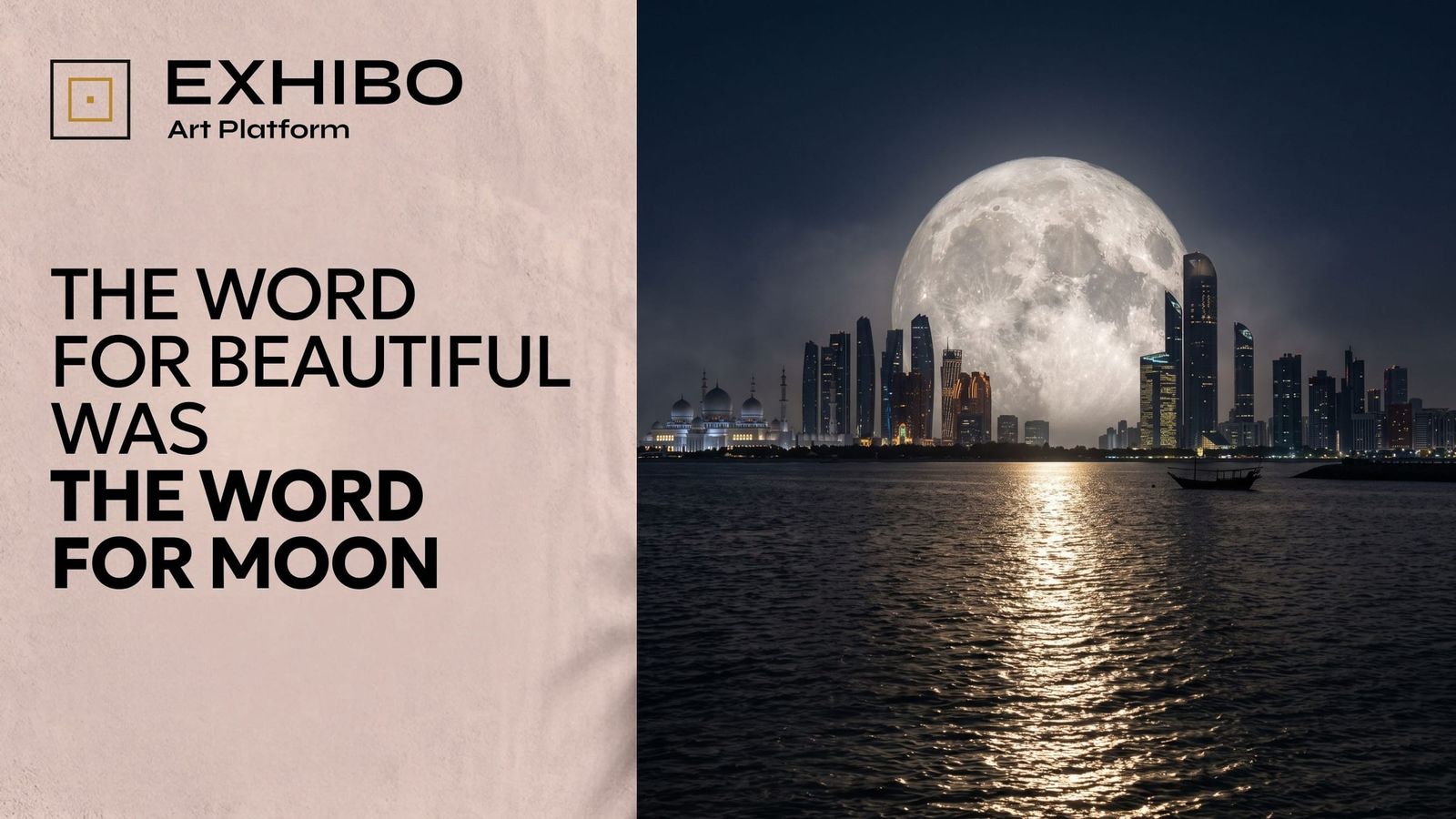
And then, some winters, the disc comes back whole. This past one, in the port district of Mina Zayed, the American artist KAWS laid one of his giant reclining Companion figures along the Abu Dhabi shore for Manar Abu Dhabi, the emirate's second great festival of light — and set it lifting a single glowing moon over the harbour. The festival's theme was "The Light Compass," and its works, spread from Jubail Island's mangroves inland to the oases of Al Ain, were built around light as wayfinding, navigation, guidance. The festival framed the KAWS moon in those terms: a glowing sphere over the water that nods to celestial navigation and the region's maritime history — the moon the Gulf's sailors once steered by, the same disc whose twenty-eight mansions the mystics had borrowed for their ladder, hung back over the sea that taught them to read it.
Notice what has happened to the beauty. The moon over that harbour is not a face and not a compliment. It is a compass. I do not want to overstate the neatness of that — there is no single line unspooling from Imruʾ al-Qays to Mina Zayed, and the moon never did just one thing at a time. It was always several things at once: a calendar and a compass, yes, but also a god, a portent, a ripening-sign for crops, a face, a mirror, a letter, an impossible wish. The harbour has not closed a circle so much as picked one of those old functions back up and turned the festival lights on it. But it is a telling one to choose. Alongside every song that made the moon a lover's face ran the plainer, older uses — the disc you told the month by, the disc you crossed the desert by, the disc you looked up to find your place in the dark. The poets took a timekeeper and a wayfinder and made it, for a very long time, into the most beautiful face they could imagine. In Abu Dhabi the lights have handed some of that beauty back and lit up the navigation again: a bright, round thing in the dark, showing you where you are.
You can still say it, standing on the Corniche with the full moon up. Ya qamar. You moon. Just know that you are not only paying a compliment. You are reaching for one of the oldest instruments the region owns — and calling someone, in the same breath, radiant, unreachable, and the thing that shows you the way home.
Related reading
Why Every Sci-Fi Desert Looks Arab
From Arrakis to Tatooine, when a film wants a desert to feel ancient, prophetic and alien, it reaches for an Arab and Berber vocabulary — and reveals more about the West that built it than the region it borrows from.
Why Wadi Rum Keeps Playing Mars: A Desert That Is Right About the Wrong Planet
A valley in southern Jordan has become cinema's favourite Mars — not because it is like the planet, but because it looks like the one we carry in our heads.
Threads of Heritage: Batima Zaurbekova's Woven Legacy
A survey of Kazakh tapestry pioneers redefines fibre art at Almaty's Kasteyev Museum