
Almaty · Kazakhstan
Threads of Heritage: Batima Zaurbekova's Woven Legacy
A survey of Kazakh tapestry pioneers redefines fibre art at Almaty's Kasteyev Museum
Weaving Memory into Contemporary Form
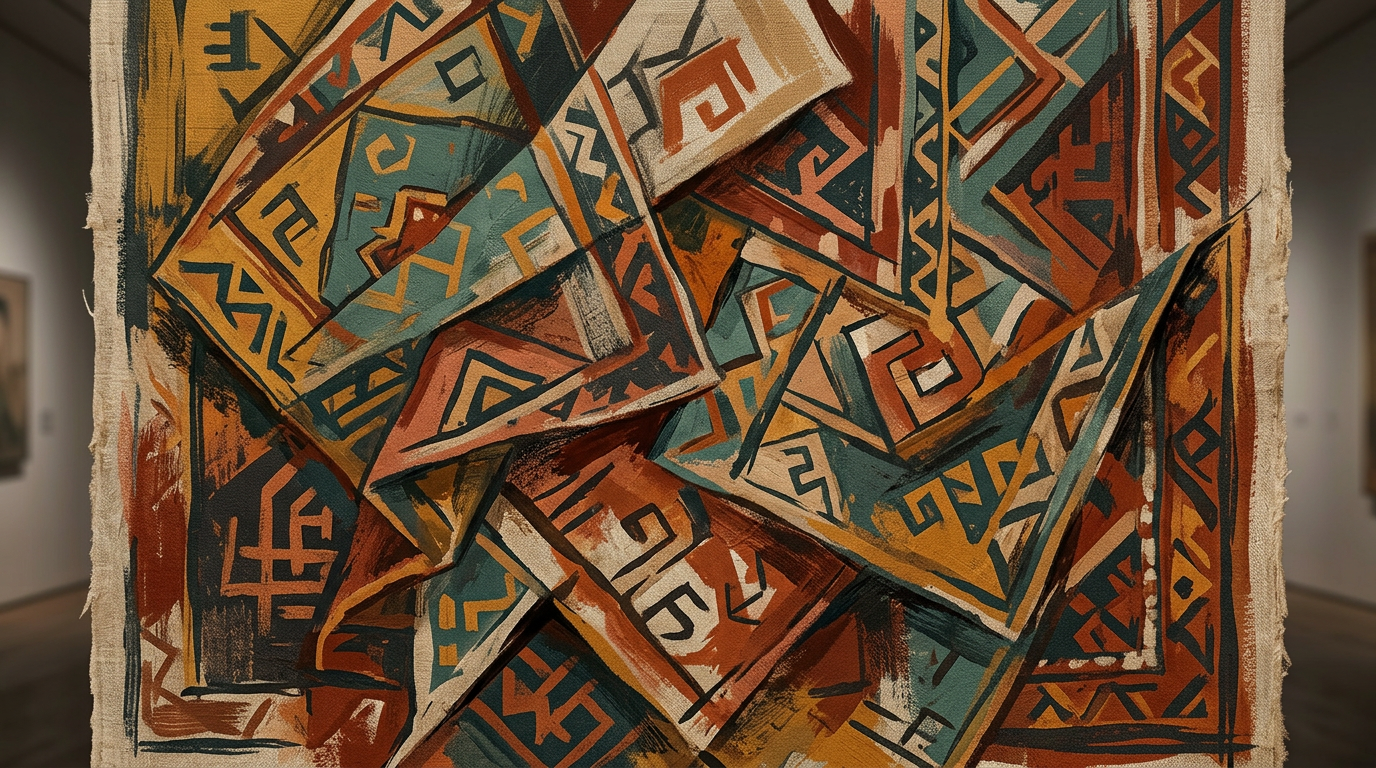
At the Abylkhan Kasteyev National Museum of Arts in Almaty, the exhibition Threads of Heritage opens to celebrate eight decades since Batima Zaurbekova's birth. Running from twenty-fifth September to eighth November two thousand and twenty-six, the survey gathers over eighty pieces spanning woven textiles, canvas paintings, and graphic prints. Drawn from institutional holdings alongside private family records, the selection positions Zaurbekova firmly within the canon of Central Asian visual culture. Alina Fedorovich handles the curatorial framework.
Rather than applying pigment, these compositions emerge through the interlacing of dyed yarns across a frame. During the postwar era, regional practitioners began elevating ancestral carpet techniques into independent studio practices. This shift birthed a distinct national movement that fused indigenous motifs with avant-garde aesthetics. Zaurbekova emerged as a central architect of this discipline, dedicating more than fifty years to refining flat-woven Gobelin techniques on upright frames. Her methodology bridges domestic craftsmanship with global modernist currents, treating fibre as a legitimate vehicle for conceptual expression. After graduating from the Alma-Ata Art School in nineteen sixty-nine, she quickly transitioned from small-scale experiments to public commissions, notably contributing to the monumental Rainbow installation completed for a prominent hotel banquet hall in nineteen seventy-nine.
The spatial arrangement divides visitors across three distinct environments. Initial encounters occur within existing decorative arts displays, establishing historical precedents that influenced the creator's early development. Architectural references to the Mausoleum of Khoja Ahmed Yasawi permeate the pavilion design, echoing recurring structural forms found throughout her canvases. This geometric vocabulary operates simultaneously as a symbol of domestic sanctuary and spiritual grounding, reinforcing her preoccupation with ecological balance and material reverence. Moving inward, the middle section adopts an open layout where individual panels interact dynamically. A bespoke audio environment accompanies the viewing experience, layering traditional instrumental textures over ambient frequencies.
The concluding chamber shifts focus toward maternal archetypes and generational transmission. Dominating the space is a wooden shanyrak—the circular crown piece of a nomadic dwelling—encircled by photographic studies depicting local women in ceremonial dress. Supplementary installations include a biographical documentary and a functional demonstration frame, inviting participants to manipulate warp and weft directly. These pedagogical elements underscore how technical knowledge remains essential to appreciating the labour embedded in each finished surface.
Beyond regional recognition, her large-scale commissions extended internationally, including four substantial hangings installed at Geneva's United Nations headquarters. Official honours such as the Shokan Valikhanov State Prize acknowledge her technical mastery and cultural impact. Today, the institution reaffirms how tactile traditions remain vital to present-day artistic discourse. By positioning handmade fibre work alongside established fine art categories, the presentation challenges conventional hierarchies while honouring a lifetime of disciplined innovation.
Related reading
Hockney and Wu Guanzhong in Dialogue at Christie's Hong Kong
A pioneering non-selling exhibition explores shared landscapes and cross-cultural influences
M+M: The Day of the Mantis at the 16th Gwangju Biennale
Luxembourg Pavilion's immersive insect-centric film trilogy explores ecological anxiety and non-human perspectives
Birke Gorm: the evening and the morning and the night at the Gwangju Biennale
Austria's national pavilion reimagines a museum loft as a living archive of repurposed sculpture and hidden histories.