The Force of Nature II
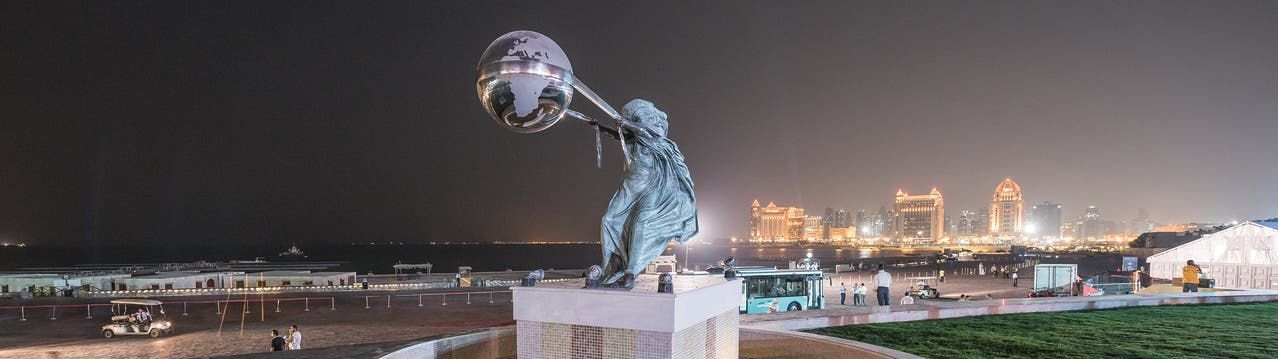
Lorenzo Quinn's bronze figure swirling a hoop of wind at Katara Amphitheatre.
The Force of Nature II by Lorenzo Quinn shows a figure casting a circular wave of bronze, a literalised gust frozen at Katara Amphitheatre. Quinn's series explores humanity's relationship with the elements; the Katara cast sits on the steps where concerts and festivals already draw crowds, so the sculpture functions as both landmark and meeting point.
The amphitheatre's stone tiers frame the work with a classical echo that Quinn's fluid metal deliberately softens.
Exhibo editorial
Quinn's public works divide opinion, but the Katara placement is smart: the amphitheatre already stages spectacle, and the sculpture extends that energy into the off-season.
Catch it when an event is setting up — the contrast between living crowd and static bronze is the photograph worth taking.
How to find it
Katara Amphitheatre, Katara Cultural Village. Enter via the main Katara gate and follow signs to the amphitheatre; the sculpture is on the approach steps.
Similar places
All places
News by Exhibo
Editorial coverage on Exhibo
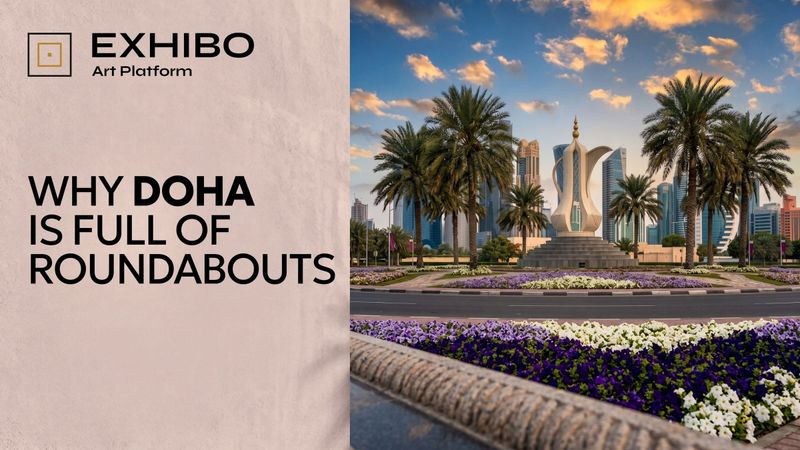
Why Doha Is Full of Roundabouts
An old circle at a crossroads, sharpened by British road engineering, became the way an Arabian city found its way and remembered itself — and it took the bulldozers to reveal it.
In a city where a landmark was more useful than an address, Doha's roundabouts became its navigation, its landscaping and its national image all at once. Now they're being torn out for signalled junctions — and the affection for them arrived, as one scholar put it, only posthumously.
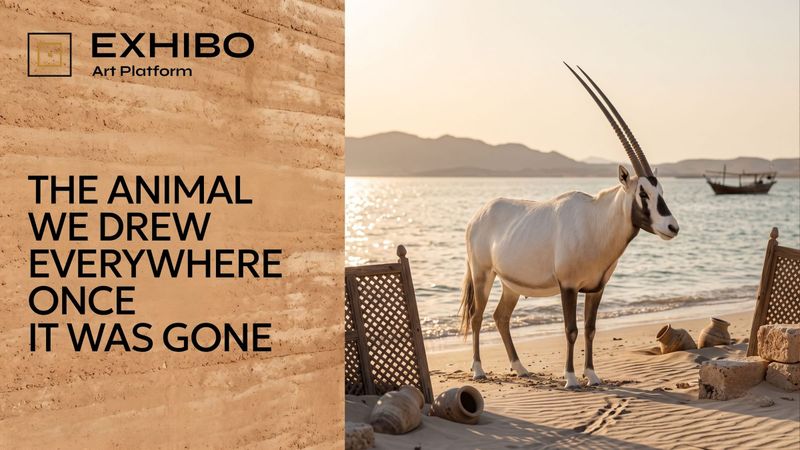
The Animal We Drew Everywhere Once It Was Gone
From Neolithic rock to airline tailfin — how the Arabian oryx vanished from the desert, came back from nine animals, and multiplied everywhere as a symbol in the very decades it was gone.
The last wild Arabian oryx was shot in 1972. By then it was already a picture — carved on Bronze Age tombs, mistaken by the ancients for a unicorn, praised by poets as the eyes of the beloved. This is the story of an animal that went extinct in the wild and was brought back from nine survivors, and of the strange gap between the creature and the emblem it became: fast, sharp and ascendant on a nation's tailfin, while the animal itself survives by standing still in the shade.
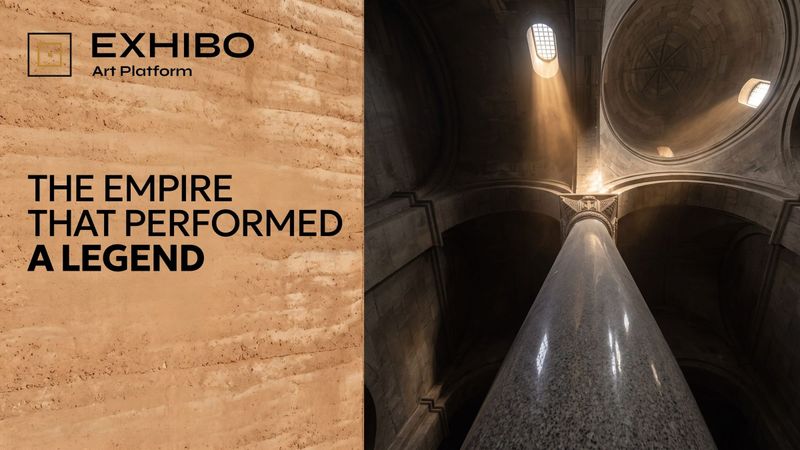
Seventy Thousand Solomons: The Empire That Performed a Legend
A demon catalogue in the conqueror's library, a sixteenth-century text where kingship is an office held seventy thousand times, and the columns a sultan dragged across three provinces to prove he held it.
Mehmed II kept a Greek catalogue of demons in his library at Topkapı. Seventy years later a sultan named for a prophet was rebuilding the walls of Jerusalem and hauling Roman columns out of Egypt and the Lebanon into a mosque above the Golden Horn. In between, Ottoman writers turned Solomon from a warning into a job — and the empire applied for it in stone.