
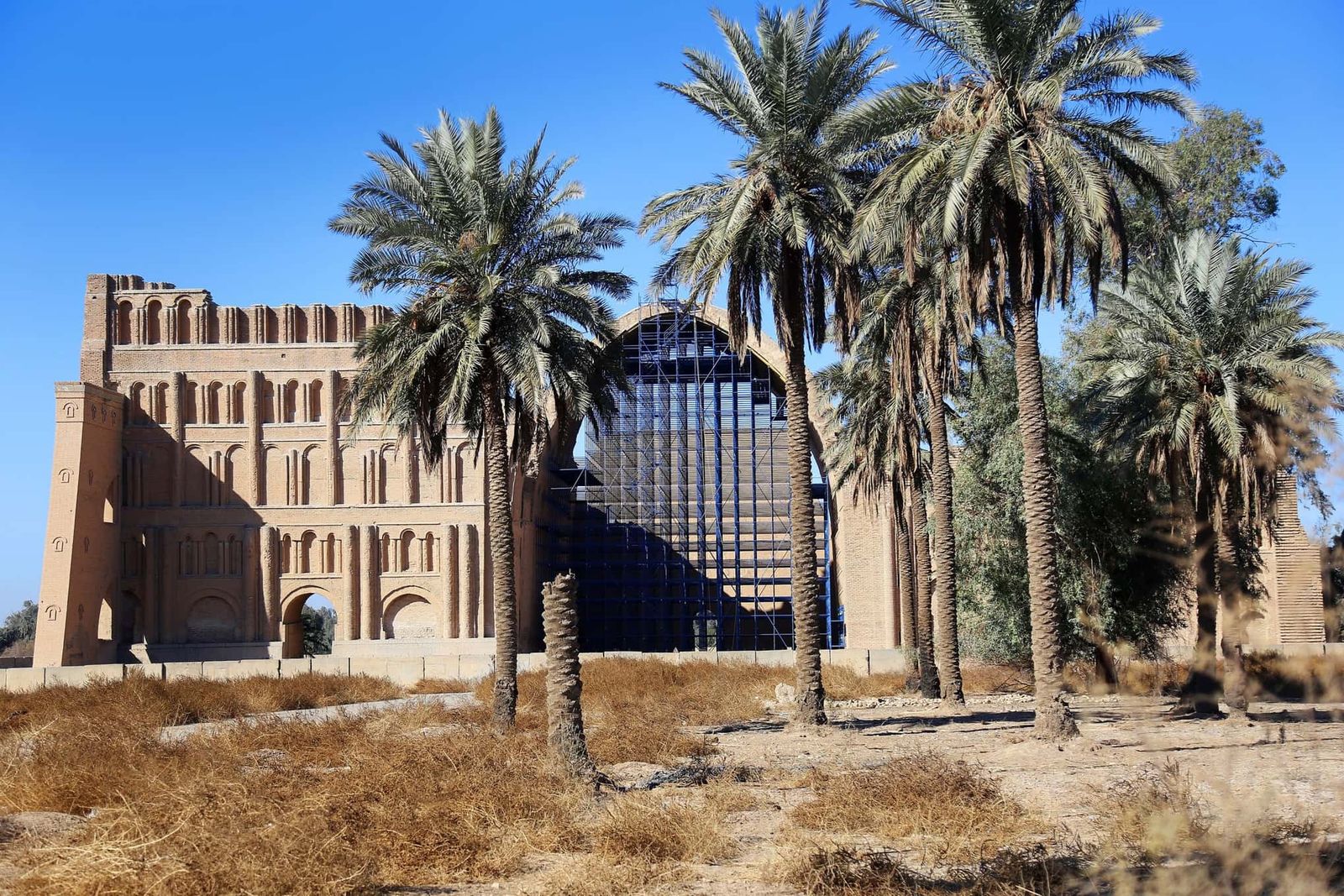
Taq Kasra, Arch of Ctesiphon
The great brick vault of the Persian kings at Ctesiphon, 37 metres high, still standing beside the Tigris.
The palace of the Persian kings
Taq Kasra, the Arch of Khosrow, stands at al-Mada'in on the east bank of the Tigris, about 30 km south-east of central Baghdad, near the town of Salman Pak. It is the last great standing building of Ctesiphon, the capital of the Parthian and then the Sasanian Persian empires for some seven centuries.
The arch was the audience hall of a royal palace. Its date is debated: it is placed anywhere between the 3rd and 6th centuries AD. Tradition links it with the Sasanian king Khosrow I, who ruled in the 6th century. Here the king received envoys under a vault built to overwhelm them. Contemporary and later writers describe a palace decorated with marble, glass mosaic and carpets worked with jewels.
The vault
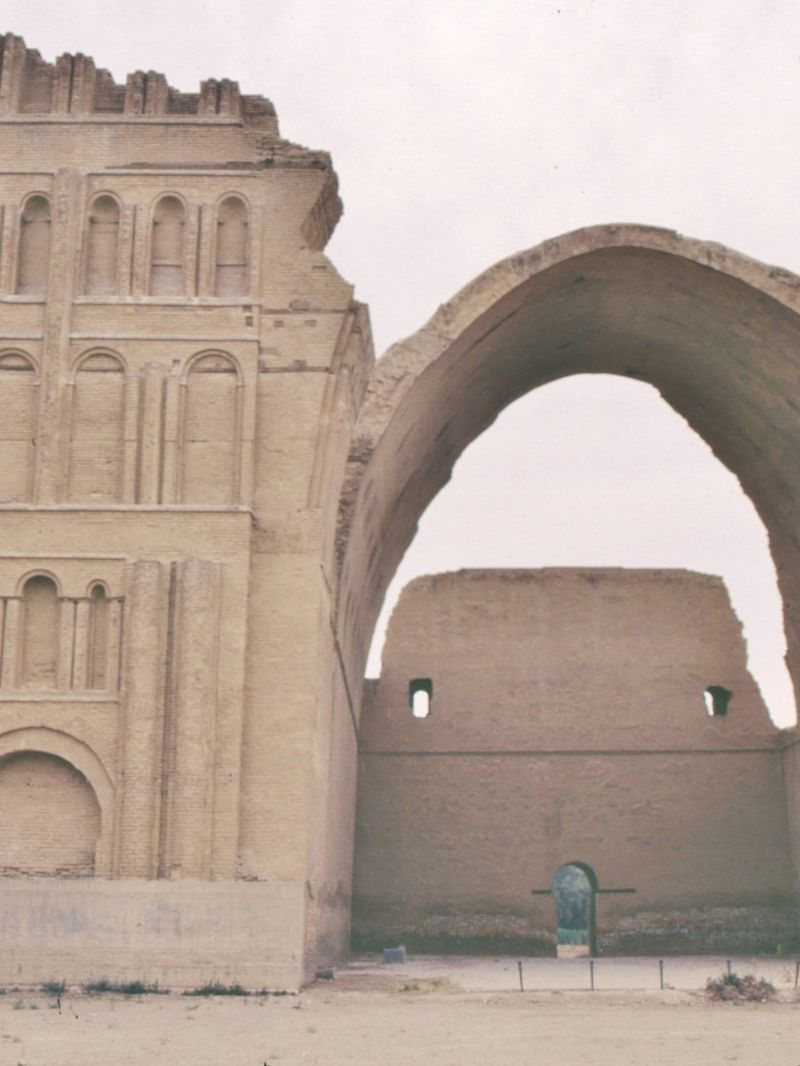
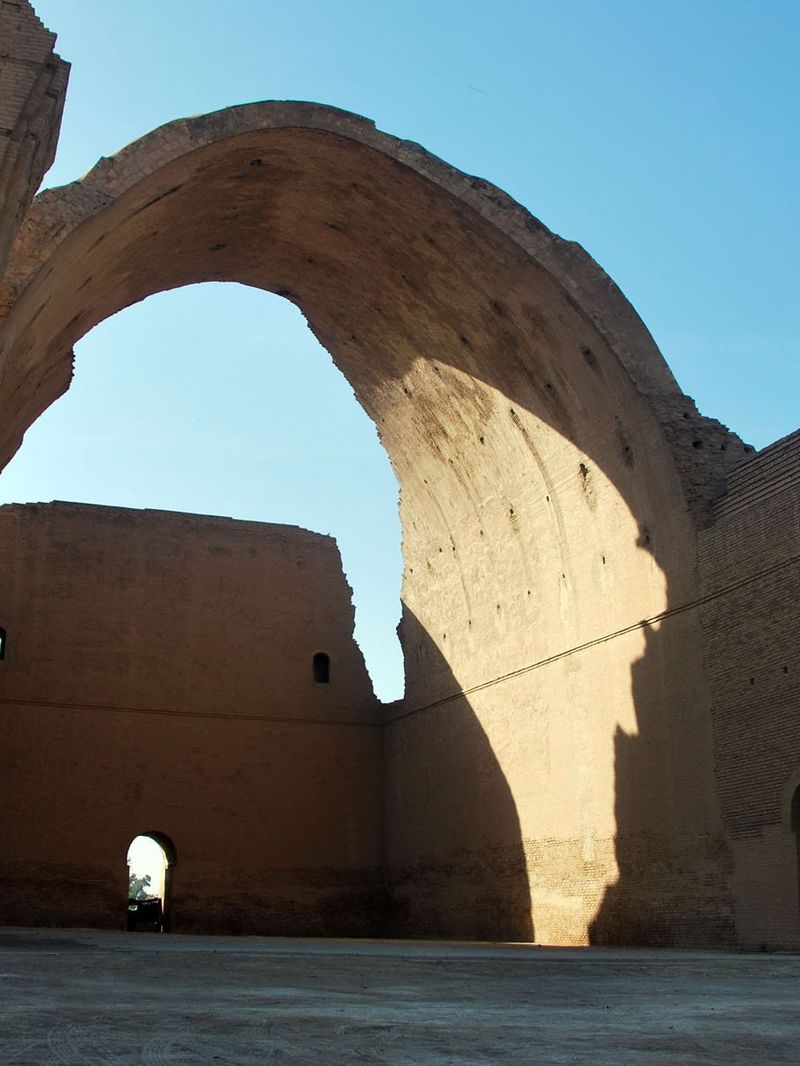
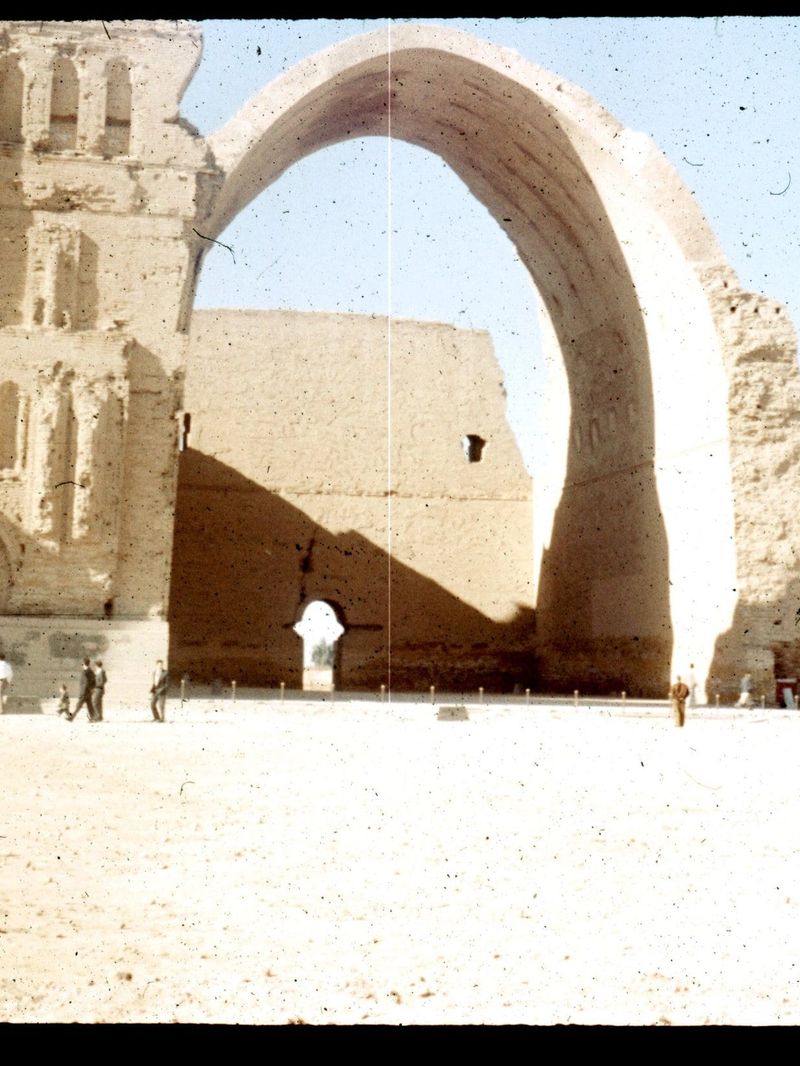
The iwan is a single parabolic vault of fired brick and mortar, about 37 metres high and 26 metres wide, running some 48 metres deep. It is often described as the largest single-span vault of unreinforced brickwork ever built.
The vault was flanked by a vast façade covered with tiers of blind arches and engaged columns. Today one wing of this façade survives, with the arch beside it.
Conquest and memory
Arab armies took Ctesiphon in 637, after the Battle of al-Qadisiyya. The city became al-Mada'in, "the cities". Salman the Persian, a companion of the Prophet Muhammad and governor of al-Mada'in, was buried about a kilometre away. His shrine gave the modern town of Salman Pak its name. The arch passed into Arabic and Persian poetry as the image of vanished royal splendour.
Collapse and repair
A flood in 1888 brought down a large part of the building. In the 20th century parts of the façade were rebuilt. A large slab fell after heavy rain in 2013. Further sections of the arch collapsed in 2019 and 2020. In 2020 the heritage fund ALIPH financed emergency stabilisation, designed with the University of Pennsylvania's Iraq Heritage Stabilisation Programme under the archaeologist Michael Danti. Iraqi restoration of the vault followed in 2021, with scaffolding filling the arch to hold the brickwork.
Exhibo editorial
Most of Ctesiphon is earth mounds now, so the arch has to carry the memory of an entire capital on its own. It does. You see it from far across the flat land, a single curve of brick higher than anything around it. The scale still works the way it was meant to work on a foreign ambassador.
For Baghdadis it has long been a weekend outing, a picnic under one of the great buildings of late antiquity. Go in the soft light of a winter afternoon and stand inside the vault, looking up at brickwork laid some fifteen centuries ago.
Gallery
How to find it
Taq Kasra is at al-Mada'in near Salman Pak, about 30 km south-east of central Baghdad, a drive of under an hour by taxi or car along the road towards Kut. The arch stands in an open fenced site among palm trees; the Shrine of Salman al-Farsi is about a kilometre away and easy to combine with the visit.
Similar places
All places
News by Exhibo
Editorial coverage on Exhibo
Iraq Museum Reopens in Baghdad After Two-Year Closure
New galleries put lamassu and Abbasid mihrabs back on view as December nears.
The Iraq Museum in Baghdad reopens on 1 December after two years of renovations. New rooms bring lamassu, Assyrian reliefs and Islamic galleries back onto the floor.
The Real Oasis of The Alchemist: Al-Fayoum and the Dream Coelho Borrowed
Paulo Coelho sent his shepherd to a real place in Egypt. What Santiago would have found there and where the story of the treasure at home came from.
Santiago's oasis is real. Al-Fayoum lies 100 km from Cairo, with Roman-era painted portraits, a temple on the caravan road and a dream story centuries older than Coelho.
Filmed, but Not Recorded: The Arab World’s Missing Film Locations
Wikidata knows Gladiator was filmed in Morocco. It doesn’t know where.
Ouarzazate is the second most filmed place in the Middle East and North Africa, yet 25 of its 27 productions are recorded only in Wikipedia prose. We compared filming records worldwide and found that in the Arab world, Wikidata usually knows the country but not the place.