
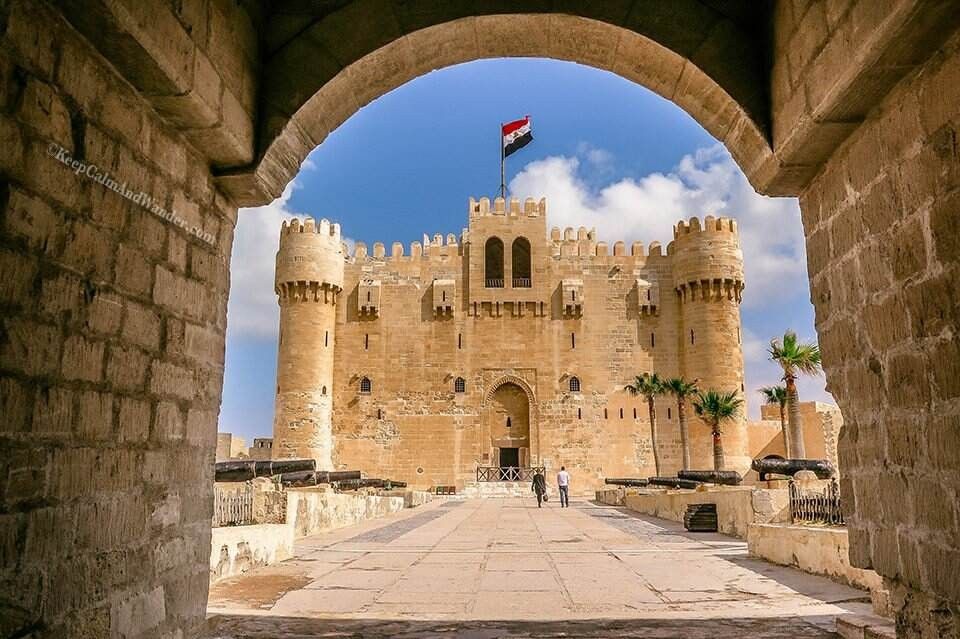
Citadel of Qaitbay
A fifteenth-century Mamluk fortress on the site of the Pharos lighthouse, one of the Seven Wonders of the ancient world.
On the site of the Pharos
The Citadel of Qaitbay stands at the tip of the Pharos peninsula, at the eastern end of Alexandria's harbour, where the Mediterranean meets the city. It occupies the site of the Pharos lighthouse, one of the Seven Wonders of the Ancient World, built under Ptolemy I and Ptolemy II in the third century BC. Over a hundred metres tall, the Pharos guided ships into Alexandria for more than a thousand years, until it was badly damaged by earthquakes in the tenth to fourteenth centuries and finally collapsed, leaving only ruins.
Qaitbay's fortress
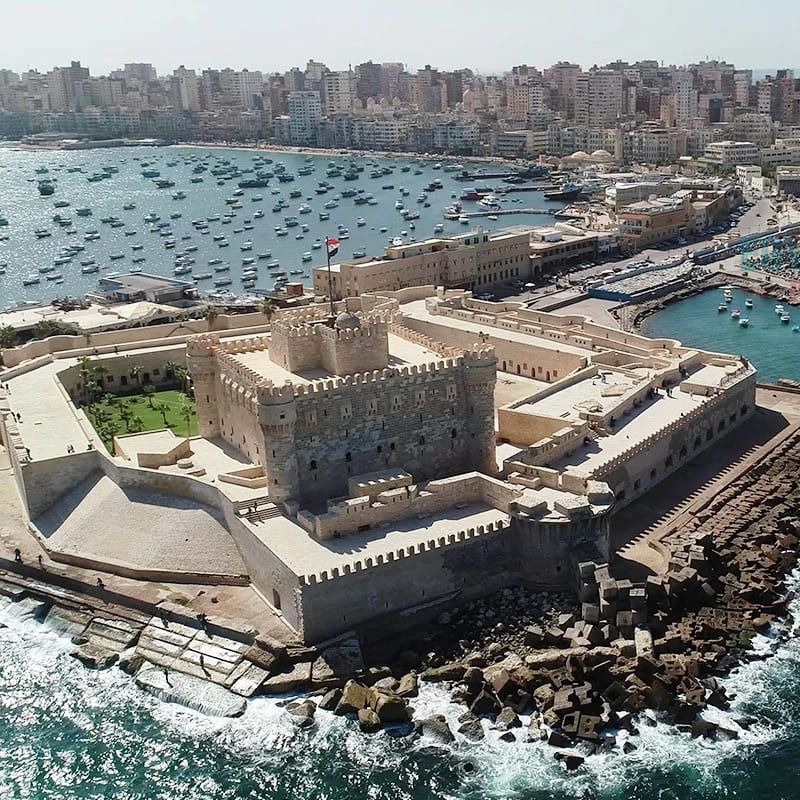
In 1477, the Mamluk Sultan al-Ashraf Qaitbay, concerned by the growing threat of the Ottomans, ordered a fortress to be built on the ruins of the lighthouse, reusing some of its stones; it was completed around 1480. The citadel consists of a massive square keep with corner towers, containing a mosque, surrounded by an outer wall with towers facing the sea and the land. It was garrisoned through the Ottoman period and modernised in the nineteenth century by Muhammad Ali, and was damaged during the British bombardment of Alexandria in 1882. Restored in the twentieth century, it houses a small maritime display.
The view and the sea
From its walls, there are sweeping views over the Eastern Harbour and the Corniche to the city. Beneath the waters around the citadel, underwater archaeologists have found thousands of blocks and statues thought to come from the Pharos and from Ptolemaic monuments, some of which are displayed in Alexandria's museums.
Exhibo editorial
The best time to come is late afternoon: walk the length of the Corniche, past the fishing boats of the Eastern Harbour, and watch the citadel's pale walls turn golden against the sea as the sun goes down. The waves break on the rocks, families stroll the breakwater, and the whole of Alexandria curves away behind you.
Inside, climb to the top of the keep and look out to sea, and remember that you are standing where the Pharos once rose — the lighthouse that gave its name to lighthouses in half the languages of Europe. Few views in Egypt carry so much history.
Gallery
How to find it
The citadel stands at the western tip of the Eastern Harbour, at the end of the Corniche in the Anfushi/Bahary area; take a taxi or walk along the Corniche from Raml Station (about 45 minutes). Enter through the outer gate, cross the courtyard and climb the keep for the views.
Similar places
All places
News by Exhibo
Editorial coverage on Exhibo
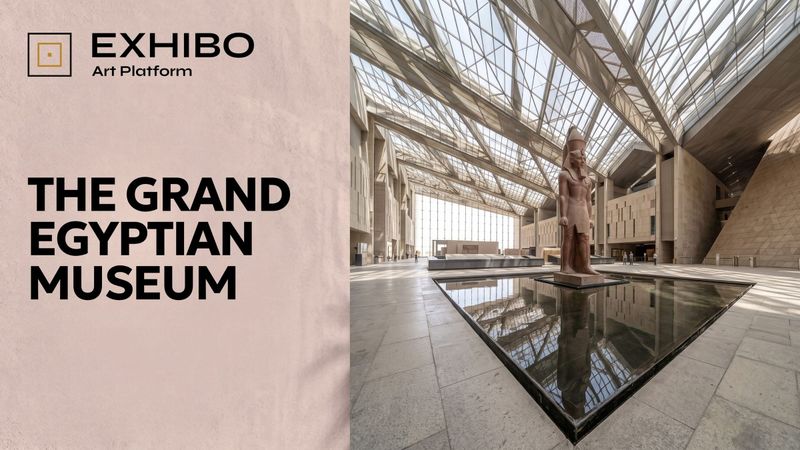
The Museum That Reflects Everything, Including You
How the world's largest single-civilisation museum gathers a nation's heritage, national story, tourism economy and repatriation claims under one reflective roof — and what those mirrored surfaces quietly ask of everyone who walks in.
Around the colossus of Ramses II, shallow pools mirror the floor so exactly that visitors keep stepping in. It is a small, faintly comic thing — and a way into a much larger question about the Grand Egyptian Museum. A civilisation is gathered here and made whole, while its three most famous faces stay abroad. A home for a nation's heritage opens, and the nation queues outside it. A monument to Egyptian sovereignty rises, financed largely from Tokyo.
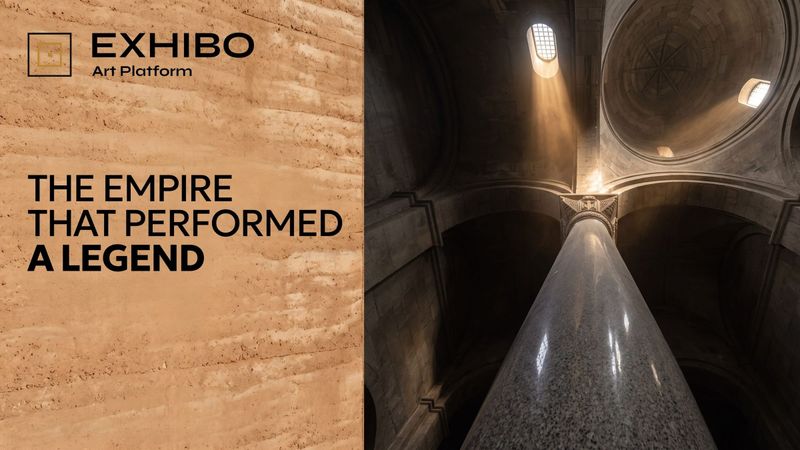
Seventy Thousand Solomons: The Empire That Performed a Legend
A demon catalogue in the conqueror's library, a sixteenth-century text where kingship is an office held seventy thousand times, and the columns a sultan dragged across three provinces to prove he held it.
Mehmed II kept a Greek catalogue of demons in his library at Topkapı. Seventy years later a sultan named for a prophet was rebuilding the walls of Jerusalem and hauling Roman columns out of Egypt and the Lebanon into a mosque above the Golden Horn. In between, Ottoman writers turned Solomon from a warning into a job — and the empire applied for it in stone.