The Founder's Memorial — The Constellation
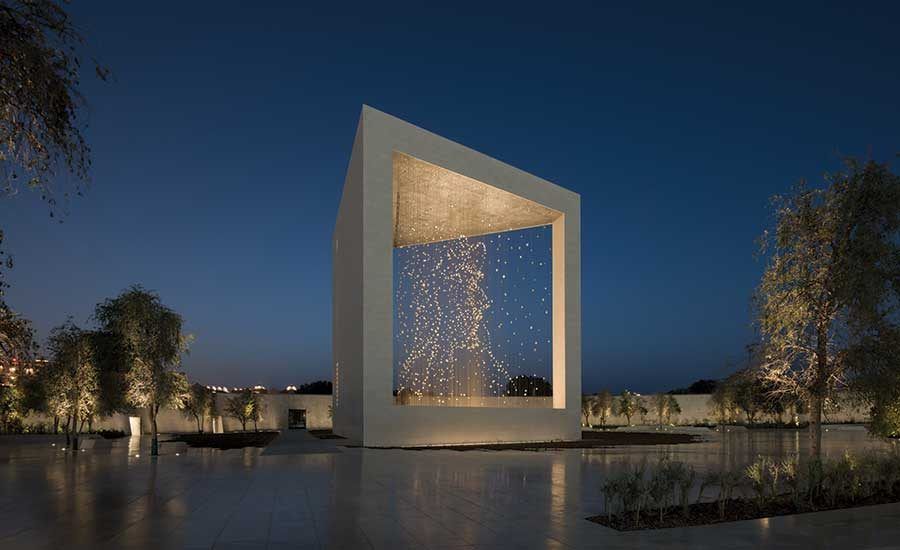
A portrait of Sheikh Zayed made of 1,327 floating solids that only resolves into a face from certain angles.
The Founder's Memorial is a 3.3-hectare public memorial park on the Corniche at Al Ras Al Akhdar, established by the Ministry of Presidential Affairs as a permanent national tribute to Sheikh Zayed bin Sultan Al Nahyan, founder and first president of the UAE. It opened to the public in April 2018, on the centenary of his birth.
At its centre stands The Constellation, a monumental public artwork by the Boston-based American artist Ralph Helmick. It consists of 1,327 geometric solids suspended on 1,110 stainless-steel cables within an open-sided, prism-like pavilion roughly 30 metres high, with a total weight of around 250 tonnes. The suspended shapes are Platonic solids — the five regular convex polyhedra: tetrahedron, cube, octahedron, dodecahedron and icosahedron — each roughly the size of a football, and each standing in for a star.
The work is a disaggregated three-dimensional portrait. Rather than presenting a fixed likeness, it relies on what Helmick calls active perception: the abstract array only resolves into Sheikh Zayed's features from specific vantage points along the elevated walkway that rings the pavilion, and dissolves again as the viewer moves. Helmick has said the concept drew on Zayed's lifelong devotion to nature and on his early life in Al Ain before a regional electrical grid, when the night sky was undimmed. The structure was engineered by Zutari, fabricated and installed by Stage One Creative Services, with lighting design by dpa lighting consultants; the cables and solids were designed to withstand Gulf wind, heat and humidity, and the project took close to a decade from design to completion.
The surrounding Sanctuary Garden is planted with native desert species — ghaf trees, date palms, henna and medicinal desert plants — and incorporates a traditional falaj irrigation channel. An elevated walkway gives views over the Arabian Gulf and the city skyline. A visitor centre with an interpretive exhibition on Zayed's life is open daily from 9:00 to 22:00. The Constellation is lit after dark. Entry is free.
Exhibo editorial
It does not work from everywhere, and that is the design. You walk in, you look up, and you get 1,327 objects hanging in the air doing nothing in particular. Then you keep moving along the walkway and at some point that you did not choose, the whole thing snaps shut into a face — and a few steps later it lets go again.
Think about what that avoids. In a country where the founder's likeness hangs in every lobby, airport corridor and hotel reception, fixed and unmissable, Helmick built a portrait that requires you to walk to the right place and stand still. It cannot be glanced at. And then the second decision, which is the better one: it is a constellation, so the reference is a boy in Al Ain before the grid arrived, looking up at a sky we have since lit out of existence. Come at dusk and watch the solids go from aluminium to stars as the lights come up. It takes about twenty minutes and it is the best free thing on the Corniche.
How to find it
On the Corniche at Al Ras Al Akhdar, between the ADNOC Headquarters and Emirates Palace, set back from the beachfront road. Enter through the visitor centre, then follow the path through the Sanctuary Garden — the Constellation pavilion sits at the heart of the site. Walk the full elevated walkway that rings the pavilion rather than stopping at the first view: the portrait only resolves from particular vantage points and the whole piece is designed around that movement. There is a café on site. Free entry, open daily until 22:00; arrive before sunset to see it in both daylight and darkness.
Similar places
All places
News by Exhibo
Editorial coverage on Exhibo
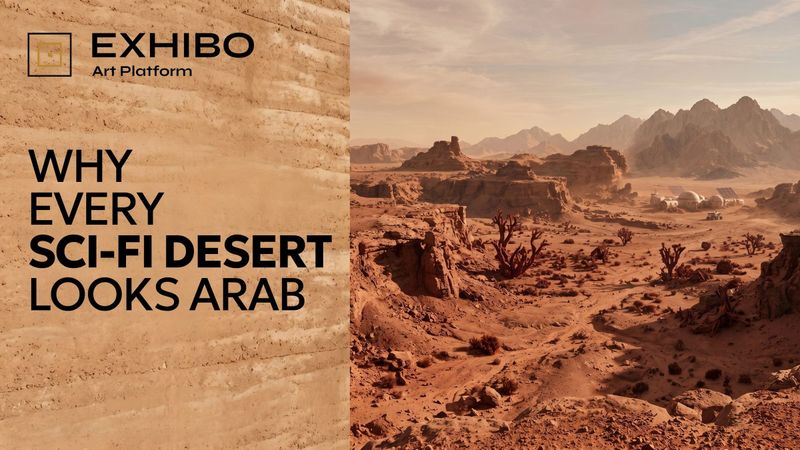
Why Every Sci-Fi Desert Looks Arab
From Arrakis to Tatooine, when a film wants a desert to feel ancient, prophetic and alien, it reaches for an Arab and Berber vocabulary — and reveals more about the West that built it than the region it borrows from.
The wrapped faces, the trilling women, the barely-displaced Arabic: cinema's alien deserts keep sounding Arab. But the vocabulary was assembled in the West — from Orientalist painting to Lawrence to Dune — and it says more about who is looking than about anyone being looked at.
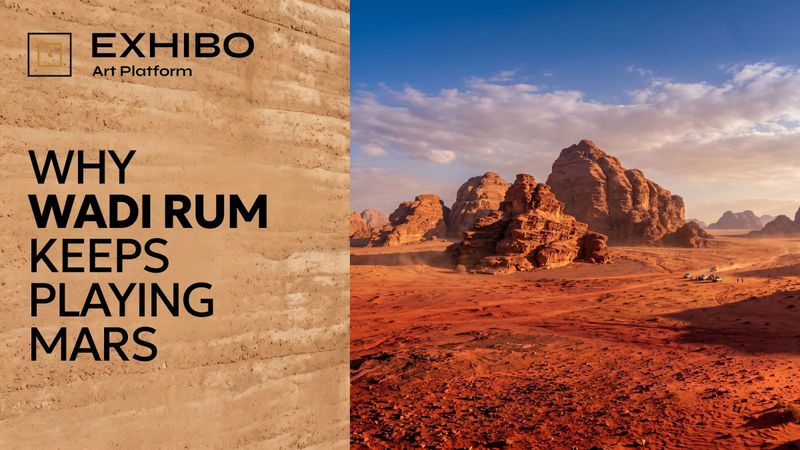
Why Wadi Rum Keeps Playing Mars: A Desert That Is Right About the Wrong Planet
A valley in southern Jordan has become cinema's favourite Mars — not because it is like the planet, but because it looks like the one we carry in our heads.
Put Wadi Rum beside a rover photograph and you can't tell which is Mars. But the desert shares almost nothing with the real planet except its colour — and lately, the illusion has grown powerful enough that real space missions have come to Jordan to rehearse.
Threads of Heritage: Batima Zaurbekova's Woven Legacy
A survey of Kazakh tapestry pioneers redefines fibre art at Almaty's Kasteyev Museum
Eight decades after her birth, Batima Zaurbekova's textile innovations take centre stage in a major retrospective that bridges Central Asian craft and contemporary visual culture.