
The Emerging Man (The Giant)
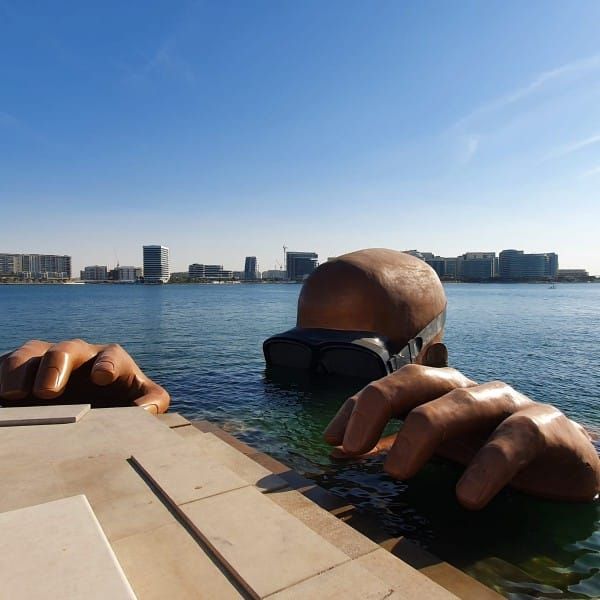
An eight-metre head and two vast hands surfacing out of the Gulf, as though something enormous is climbing out.
The Emerging Man, also known as The Giant, stands in the water at the Yas Bay Waterfront on the southern edge of Yas Island, near Etihad Arena. It depicts a colossal figure surfacing from the Arabian Gulf: a bronze-coloured head roughly eight metres in diameter, flanked by two oversized hands, set by the steps of the waterfront so that the figure appears mid-emergence.
The work is concrete, built in situ rather than cast off site. Because of its permanent exposure to salt water, high temperatures and humidity, the engineering team specified Mateenbar glass fibre-reinforced polymer rebar as the primary reinforcement instead of steel: the GFRP was placed on site and then sprayed with shotcrete, with a minimum concrete cover of 40 millimetres. GFRP requires less cover than steel and needs no corrosion protection, which is what makes a sculpture of this scale viable standing directly in the sea.
Authorship is not consistently reported. The National has attributed the piece to Fathima Mohiuddin, the Indian-Canadian artist known as Fatspatrol who grew up in the UAE; other coverage credits her instead with Humanity, a large mural near Etihad Arena, and leaves The Emerging Man unattributed. Treat the attribution as unsettled.
It was commissioned for the Yas Bay public art trail, part of a wider programme that has made Yas Bay Waterfront and Pier71 home to twelve public artworks — among them Takashi Murakami's ten-metre gold Flower Parent and Child, a KAWS sculpture, and four Astrocat figures by CoolRainLabo, with artists including Supakitch, MonkeyBird and Beastman having painted the area's electrical substations.
The sculpture sits in open water on a free public promenade and can be seen at any hour. Access immediately around it has occasionally been restricted by waterfront construction works.
Exhibo editorial
Everyone asks the same two questions at the railing, and neither is about art. Who made it, and is he coming out or going under. The first has no reliable answer, which is faintly absurd for an eight-metre head in the middle of a flagship waterfront. The second is the actual design decision — the head and hands are pitched so that the direction of travel is genuinely ambiguous, and once you have noticed that you cannot un-notice it.
The part that deserves more credit is invisible. Putting a concrete figure this size permanently into the Gulf is an engineering problem before it is a sculptural one; steel rebar in salt water is a slow death sentence. So the whole thing is reinforced with glass fibre instead, sprayed on site, which is why it is still here and not weeping rust down its own face. Come at dusk when the light goes low across the water and the bronze picks up the last of it — and stay for the walk, because there are eleven other artworks along this promenade.
How to find it
In the water at the Yas Bay Waterfront on the southern end of Yas Island, close to Etihad Arena and set by the steps down to the promenade. Park at Yas Bay and walk the boardwalk — the head and hands are unmistakable from a distance. The best angle is from the steps directly opposite, where the head and both hands read together. While you are there, the same promenade holds eleven other public artworks including Murakami's gold Flower Parent and Child and the Astrocat figures. Free and open at any hour, though barriers occasionally restrict close access during waterfront works.
Similar places
All places
News by Exhibo
Editorial coverage on Exhibo
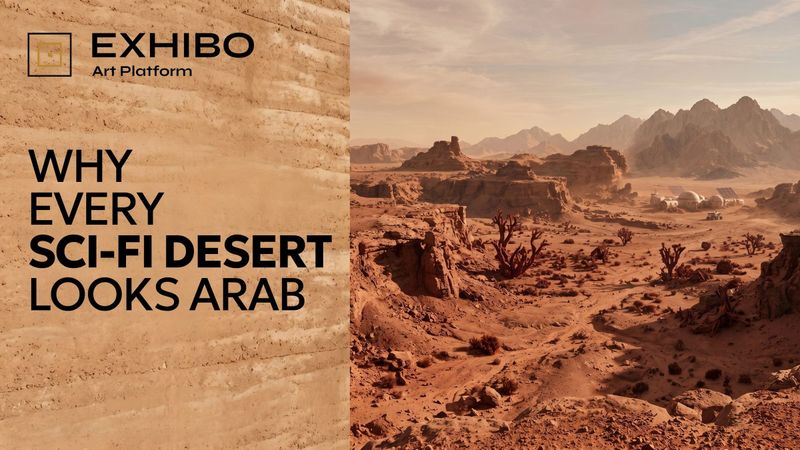
Why Every Sci-Fi Desert Looks Arab
From Arrakis to Tatooine, when a film wants a desert to feel ancient, prophetic and alien, it reaches for an Arab and Berber vocabulary — and reveals more about the West that built it than the region it borrows from.
The wrapped faces, the trilling women, the barely-displaced Arabic: cinema's alien deserts keep sounding Arab. But the vocabulary was assembled in the West — from Orientalist painting to Lawrence to Dune — and it says more about who is looking than about anyone being looked at.
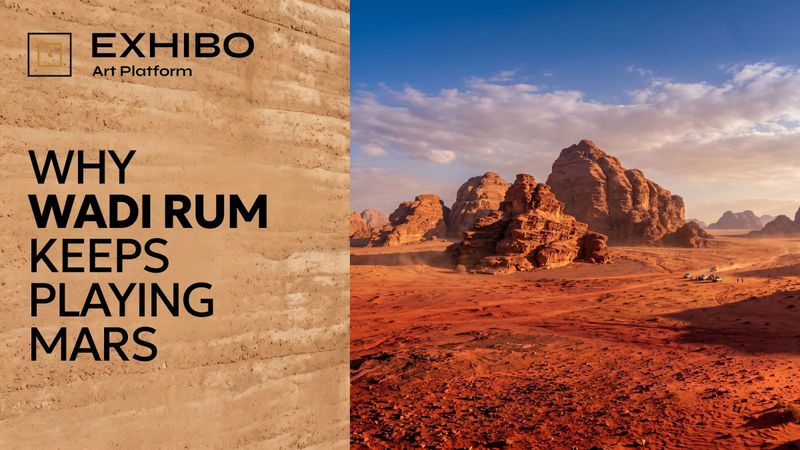
Why Wadi Rum Keeps Playing Mars: A Desert That Is Right About the Wrong Planet
A valley in southern Jordan has become cinema's favourite Mars — not because it is like the planet, but because it looks like the one we carry in our heads.
Put Wadi Rum beside a rover photograph and you can't tell which is Mars. But the desert shares almost nothing with the real planet except its colour — and lately, the illusion has grown powerful enough that real space missions have come to Jordan to rehearse.
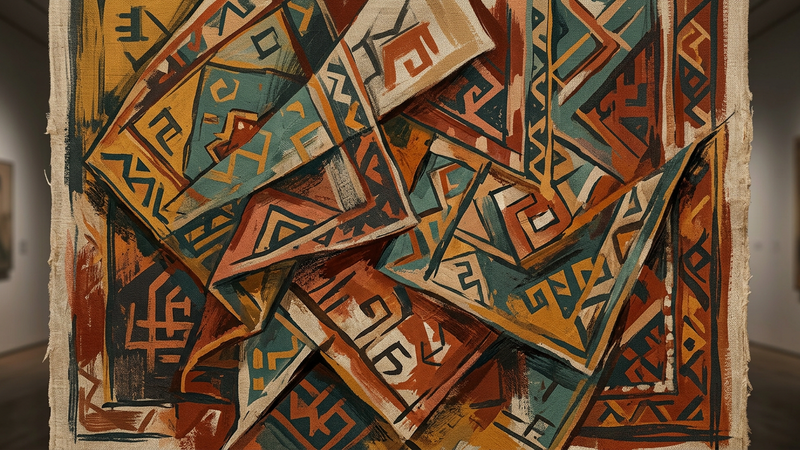
Threads of Heritage: Batima Zaurbekova's Woven Legacy
A survey of Kazakh tapestry pioneers redefines fibre art at Almaty's Kasteyev Museum
Eight decades after her birth, Batima Zaurbekova's textile innovations take centre stage in a major retrospective that bridges Central Asian craft and contemporary visual culture.