Saadiyat Cultural DistrictAbu Dhabi
Louvre Abu Dhabi Outdoor Commissions: Penone and Holzer
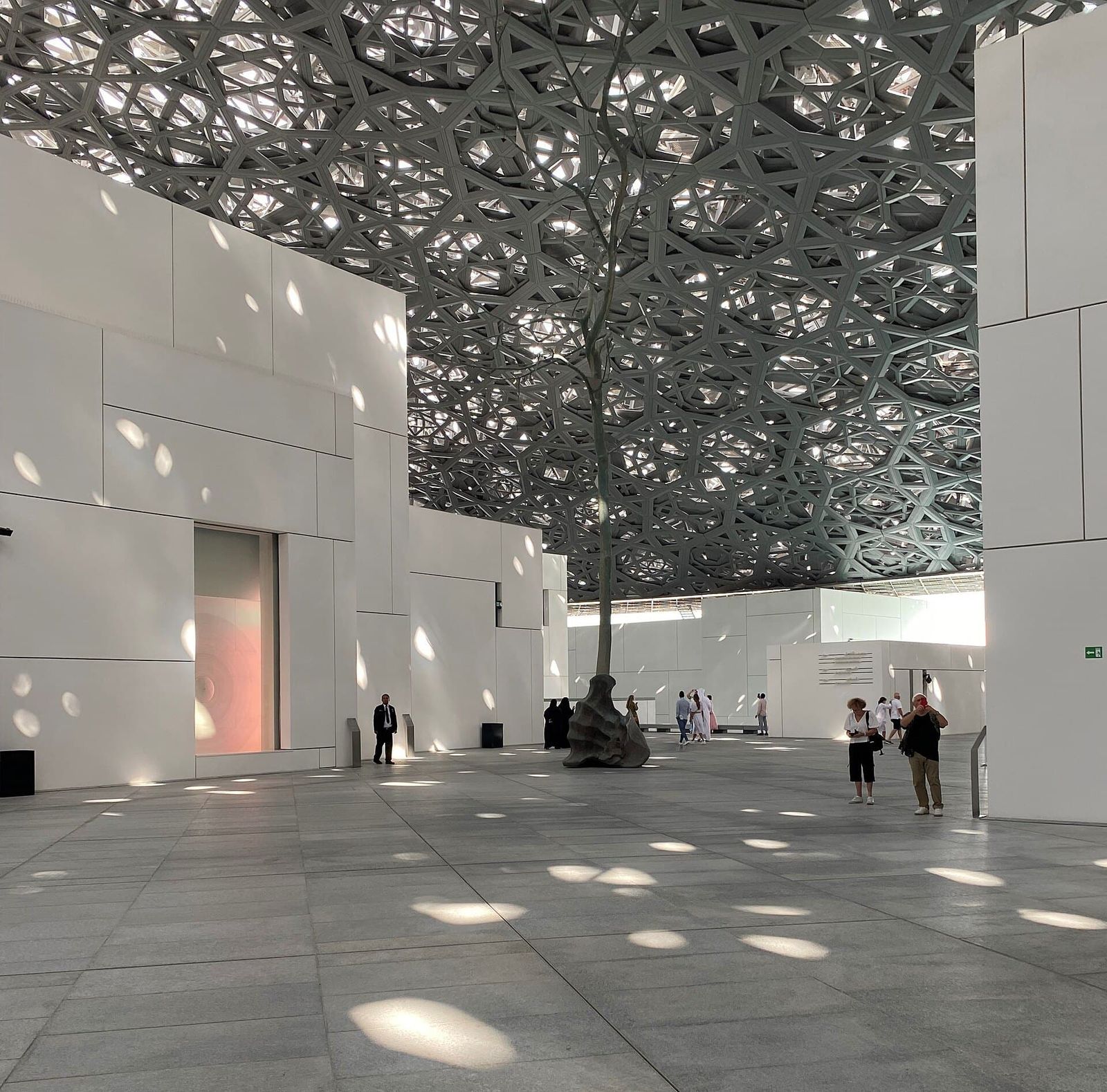
A bronze tree with mirrored leaves and three stone walls of ancient text, commissioned for the plaza under Jean Nouvel's dome.
Two commissions for the opening
When Louvre Abu Dhabi opened on 11 November 2017, two contemporary artists had made permanent works for its open spaces. Giuseppe Penone and Jenny Holzer were commissioned to respond to Jean Nouvel's architecture, a cluster of white buildings sheltered by a perforated dome 180 metres across. Both works belong to the museum's collection and stand outside the galleries.
Giuseppe Penone: Germination
Penone came to prominence in the late 1960s as the youngest member of Arte Povera. For Abu Dhabi he made Germination, a series of works that the museum describes as starting from a handprint. Its best-known part is Leaves of Light, a bronze tree whose branches carry leaves of mirrored steel that catch the sunlight falling through the dome. Propagation is a wall of porcelain made with Sèvres on which Penone transposed the fingerprint of Sheikh Zayed bin Sultan Al Nahyan, founder of the UAE, at life size. Lines drawn around it spread outwards like the growth rings of a felled tree.
Jenny Holzer: three walls of text
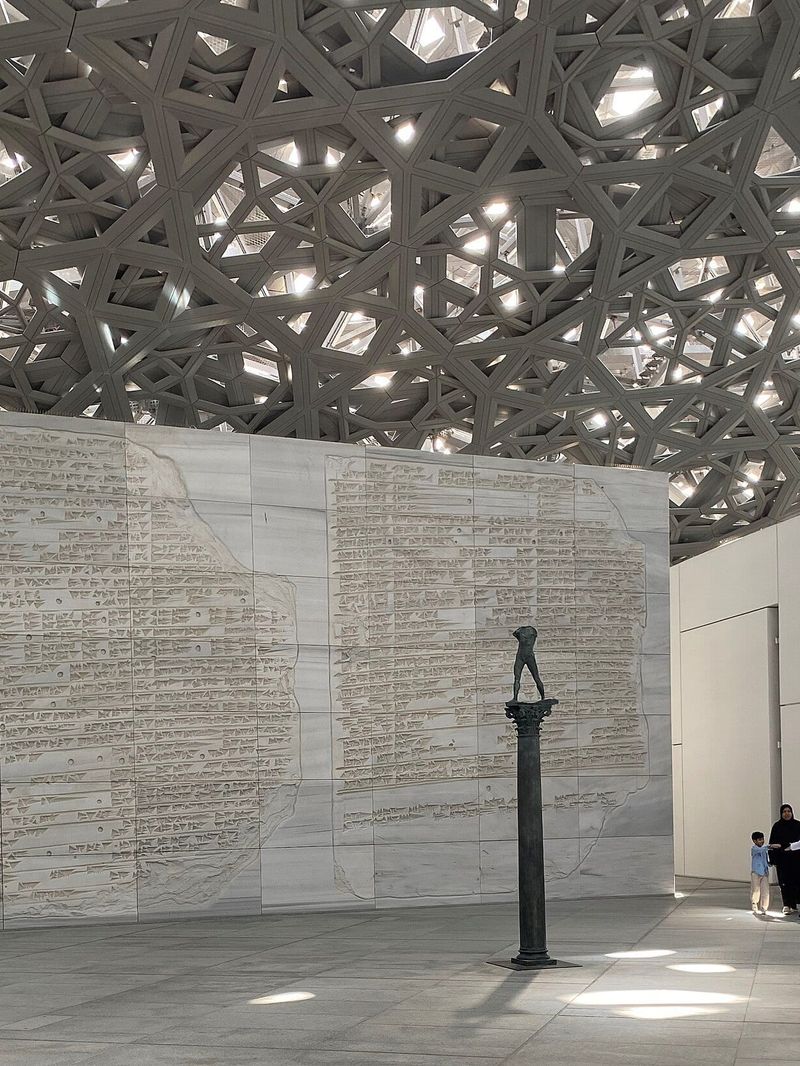
The American artist Jenny Holzer engraved three stone walls with extracts from historical texts. One carries a Sumerian-Akkadian creation myth from a cuneiform tablet in the Vorderasiatisches Museum in Berlin. Another quotes the Muqaddimah of Ibn Khaldun, written in the fourteenth century. The third is drawn from Michel de Montaigne's Essais of 1588. Holzer reproduces the pages and tablet in their original scripts at a monumental scale.
Visiting
The works stand in the museum's outdoor areas, which are reached with a museum ticket. The museum is closed on Mondays.
Exhibo editorial
Everyone photographs the dome. Very few people stop at the tree, which is a shame. Leaves of Light is the one object here made to be looked at in the light the dome produces. Its mirrored leaves catch the moving spots of sun. That pattern is never the same twice.
Holzer's walls ask something harder. Three texts from three civilisations, none of their authors aware of the others, cut into stone side by side at the same scale. It would be easy to read that as diplomacy. Yet Ibn Khaldun and Montaigne were both writing about how societies fool themselves. Setting them beside a Sumerian creation story is sharper than the polished setting suggests. Give the plaza twenty minutes before going inside, then look again on the way out.
Gallery
How to find it
Inside Louvre Abu Dhabi on Saadiyat Island. After the ticket hall walk out onto the plaza under the dome. Penone's bronze tree stands in the open plaza and Holzer's walls are set among the museum buildings around it.
Similar places
All places
News by Exhibo
Editorial coverage on Exhibo
Hamburg Convicts Simonian Siblings Over Looted Antiquities Proceeds
Landmark verdict targets financial gains from alleged Egyptian artefact trafficking network
German court orders €32m seizure and issues fines against the siblings of a prominent antiquities dealer, setting a precedent for European provenance litigation.
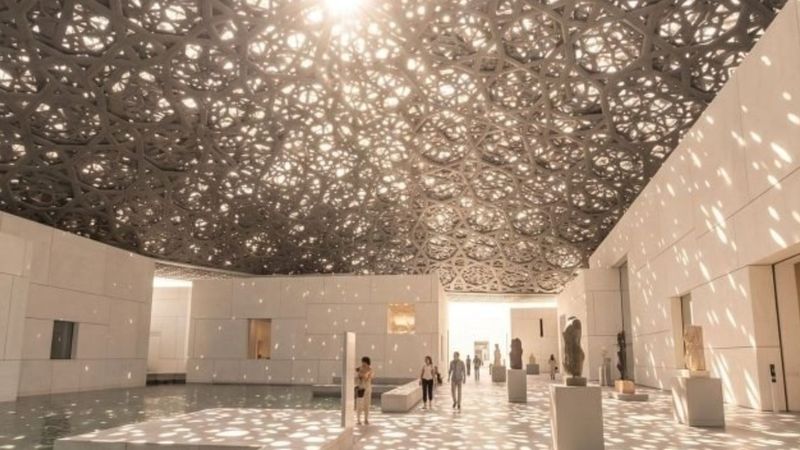
The Universal Museum, Rebuilt on Arab Soil
How Abu Dhabi took one of the West's most contested ideas — the museum that claims to hold all of humanity — and moved the question of who gets to frame the world
A portolan chart in the floor, three ewers without a hierarchy, and a $450-million Leonardo no one has seen since it was bought. The Louvre Abu Dhabi is a French–Emirati experiment in what the universal museum becomes when it is rebuilt from a different centre — and whether that moves the centre, or merely moves the Louvre, is the question the building leaves open.
Museum Jobs, Explained
An organogram of museum employment families, from collections and learning to security, retail and the routes people use to enter them
Museums hire curators, but they also hire registrars, educators, conservators, handlers, visitor hosts, fundraisers and facilities teams. This guide maps the employment families behind a working museum, how major institutions organise those teams, what a working week looks like in each cluster, and how pay and entry routes vary by region.