
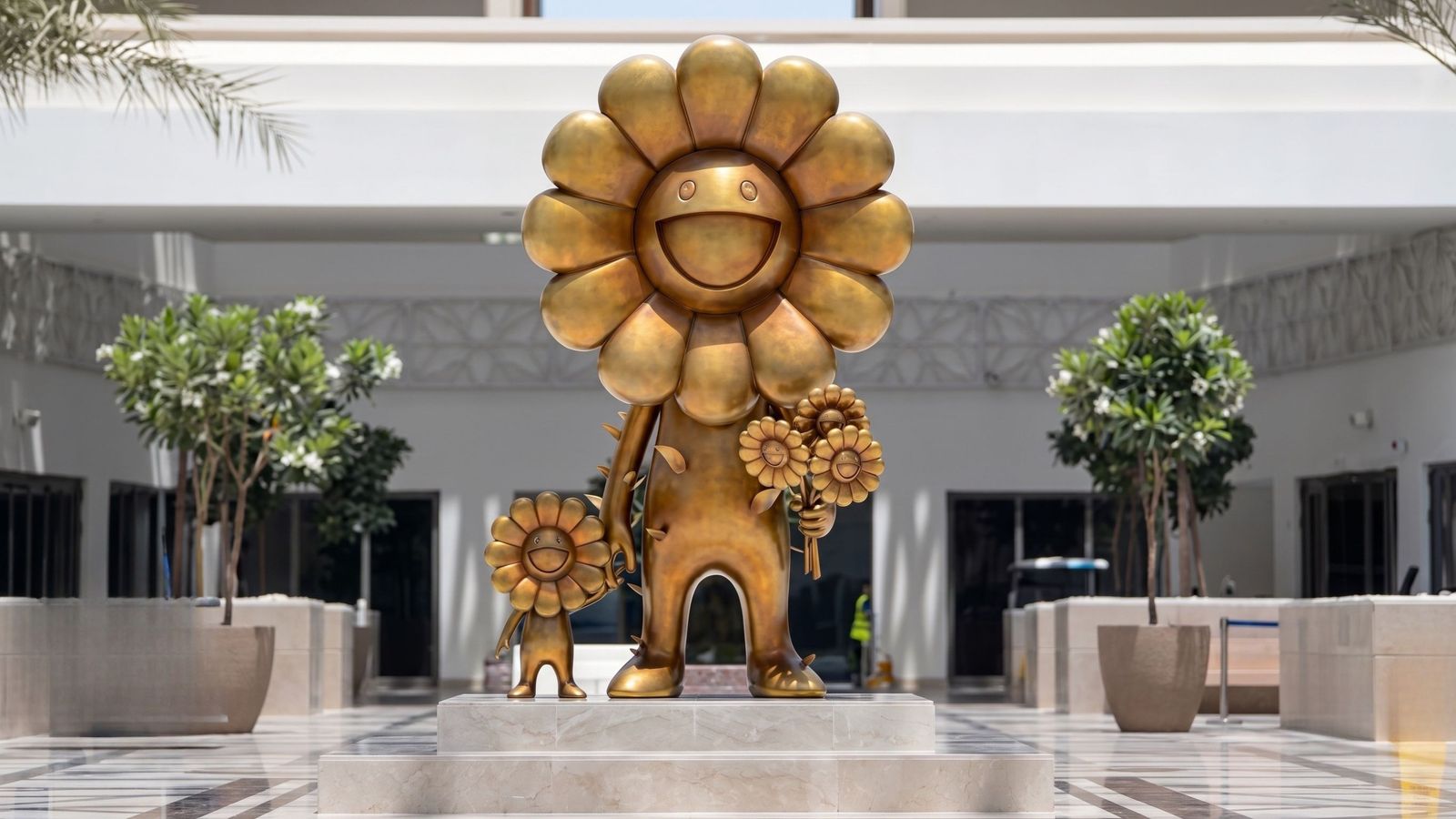
Flower Parent and Child by Takashi Murakami
Ten metres of gold leaf and grinning flowers on the waterfront — one of Murakami's largest works anywhere.
Flower Parent and Child is a ten-metre golden sculpture by Takashi Murakami standing on the Yas Bay Waterfront promenade on Yas Island. It was unveiled in July 2022 alongside KAWS's Final Days, and is among the largest works Murakami has produced.
The piece renders the artist's signature smiling flower motif at monumental scale, finished in gold leaf. Every side of the sculpture is decorated with flower motifs, so the work presents differently depending on where the viewer stands — Murakami's stated intent being that it projects diverse expressions of hope from different angles. The developer's description frames the gold-leaf work as conveying energy and hope for the future.
The sculpture has a history before Abu Dhabi. It was first unveiled in Tokyo in 2020 under the earlier title Haha Bangla Manus, conceived as an expression of Murakami's conflicting feelings about the pandemic and his determination to keep moving forward. A related version, produced in collaboration with Louis Vuitton and standing atop a monumental Monogram Multicolor trunk, was later shown at the Kyoto City KYOCERA Museum of Art in 2024.
Murakami came to prominence as the founder of the Superflat movement, which set out to expose what he called the shallow emptiness of Japanese consumer culture, working across painting, sculpture and animation with an idiom drawn from manga and pop iconography. Placing that idiom at ten metres on a Gulf waterfront, in gold, does something the gallery-scale versions cannot.
The sculpture is outdoors on a free public promenade, viewable at any hour, and forms part of the Yas Bay Waterfront art trail of twelve-plus works.
Exhibo editorial
Gold leaf in this climate is a provocation. The Gulf sun is merciless on finishes, the salt air worse, and Murakami's answer to a seafront commission was to gild a ten-metre flower and put it directly in both — which either shows enormous confidence in the fabricators or a certain indifference to what happens next.
What it buys is the hour before sunset. The sculpture is covered on every face, so there is no front and no back and no correct angle, and as the light drops the gold shifts from flat and gaudy to something considerably stranger — a two-storey grin holding the last of the day while the water behind it goes dark. Murakami built his career on the argument that consumer culture is cheerful and empty at the same time. It is oddly moving to see that argument made in gold on the edge of a country that was sand seventy years ago.
How to find it
On the Yas Bay Waterfront promenade on the southern end of Yas Island, near Etihad Arena. Park at Yas Bay and walk out onto the boardwalk — at ten metres tall and finished in gold, it is visible from most of the promenade. Walk a full circle around it rather than photographing from one side: every face is decorated differently and the work is designed to read differently from each angle. Free and outdoors at any hour; best in the hour before sunset when low light catches the gold. KAWS's Final Days is inside the adjacent lobby.
Similar places
All places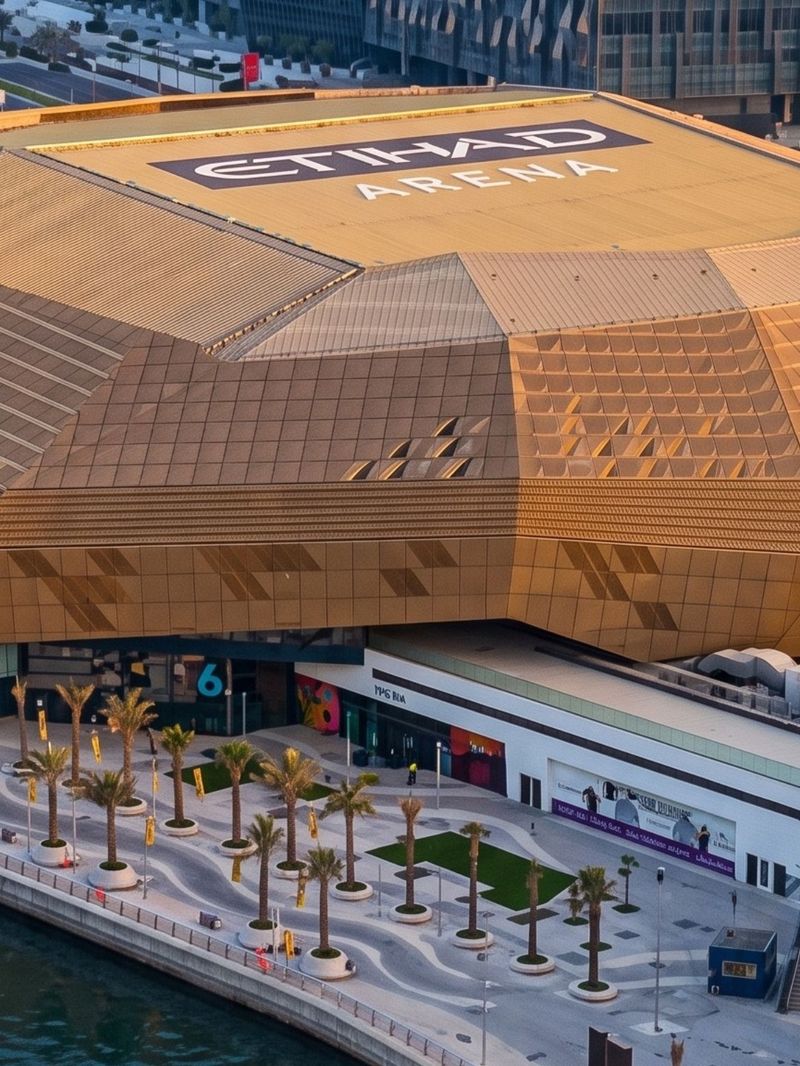
News by Exhibo
Editorial coverage on Exhibo
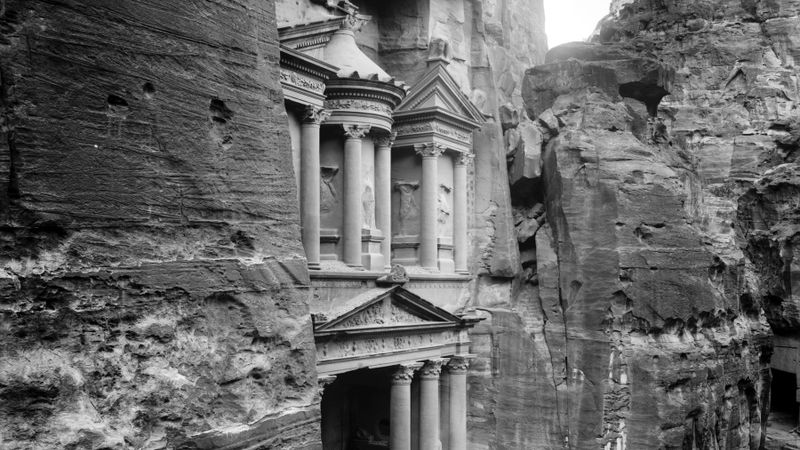
Filmed, but Not Recorded: The Arab World’s Missing Film Locations
Wikidata knows Gladiator was filmed in Morocco. It doesn’t know where.
Ouarzazate is the second most filmed place in the Middle East and North Africa, yet 25 of its 27 productions are recorded only in Wikipedia prose. We compared filming records worldwide and found that in the Arab world, Wikidata usually knows the country but not the place.
Why Every Sci-Fi Desert Looks Arab
From Arrakis to Tatooine, when a film wants a desert to feel ancient, prophetic and alien, it reaches for an Arab and Berber vocabulary — and reveals more about the West that built it than the region it borrows from.
The wrapped faces, the trilling women, the barely-displaced Arabic: cinema's alien deserts keep sounding Arab. But the vocabulary was assembled in the West — from Orientalist painting to Lawrence to Dune — and it says more about who is looking than about anyone being looked at.
Why Wadi Rum Keeps Playing Mars: A Desert That Is Right About the Wrong Planet
A valley in southern Jordan has become cinema's favourite Mars — not because it is like the planet, but because it looks like the one we carry in our heads.
Put Wadi Rum beside a rover photograph and you can't tell which is Mars. But the desert shares almost nothing with the real planet except its colour — and lately, the illusion has grown powerful enough that real space missions have come to Jordan to rehearse.