
Aldar Headquarters (The Coin Building)
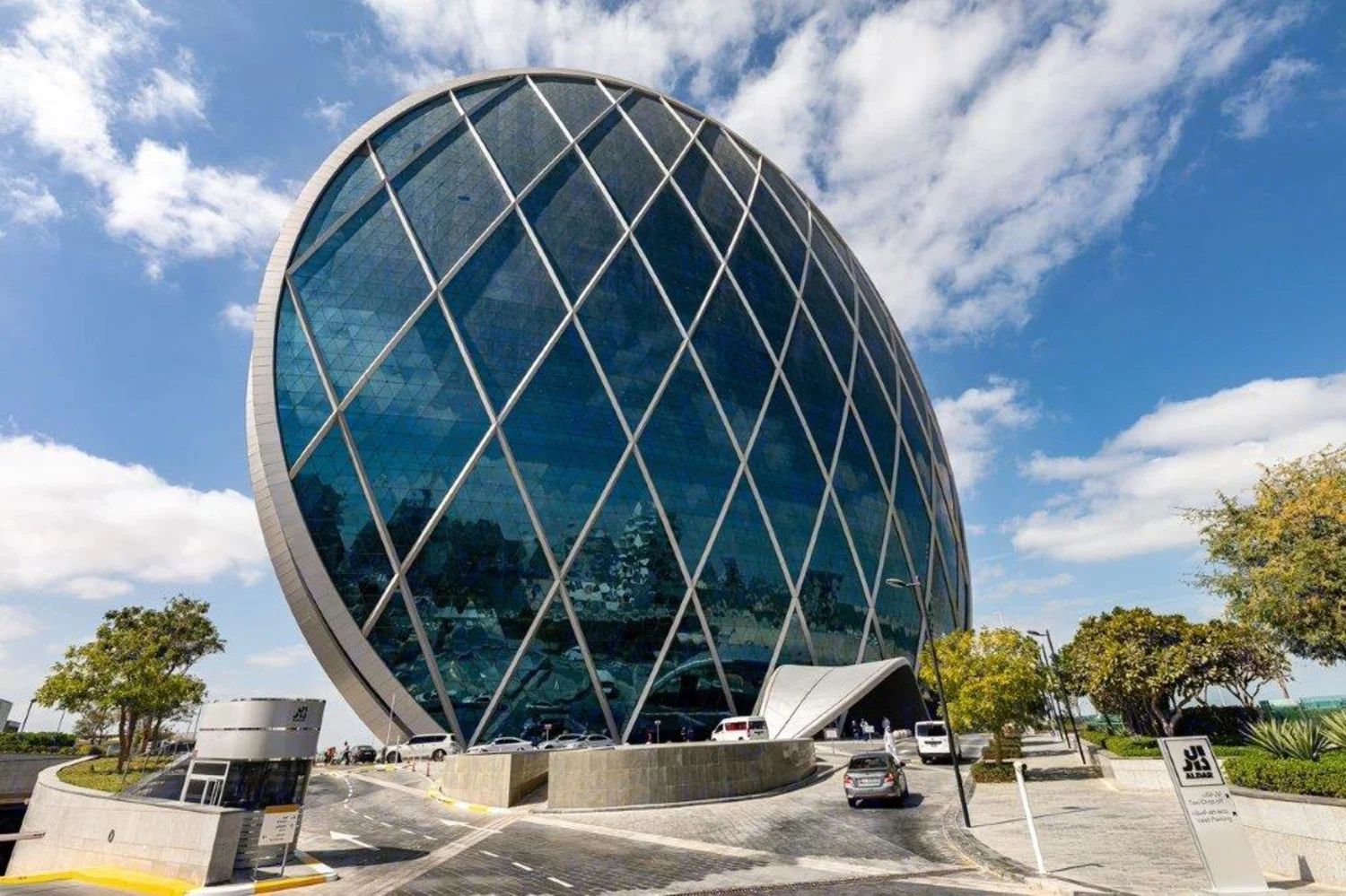
A 121-metre glass disc standing on its edge — the Middle East's first circular skyscraper, and its most-photographed silhouette.
The Aldar Headquarters is a circular skyscraper at Al Raha Beach on the mainland edge of Abu Dhabi, completed in 2010 as the head office of developer Aldar Properties. Standing roughly 110 to 121 metres over 23 storeys, with a diameter of about 121 metres and some 61,900 square metres of floor space, it was the first circular building of its kind in the Middle East and is widely known locally as the Coin Building.
It was designed by MZ Architects under principal Marwan Zgheib, with Arup as engineer, Josef Gartner on the façade and Aldar Laing O'Rourke as contractor. The form is not a sphere but a disc: two convex circular glass façades joined at the perimeter by a corrugated connecting strip, so that the building reads as a full circle head-on and as a lens in profile. Zgheib's stated reference was the clam shell — a shape carrying real weight in a city whose pre-oil economy ran on pearling — alongside the circle's associations with unity and stability.
The structure is a diagonal steel grid, or diagrid, running around the envelope and transferring load to the foundations, supported internally by two concrete cores. The diagrid eliminates internal columns entirely, freeing open-plan floors; the glazed skin is assembled from triangular panels that curve with the geometry. Wind performance was tested on a 1:400 scale model fitted with roughly 350 pressure taps. The building was developed to LEED principles and has collected a series of international awards, including Best Futuristic Design at the Building Exchange conference.
The building is an operating corporate headquarters. Its ground level holds some retail and food and beverage, but the offices above are private; for most visitors it is a landmark seen from the Abu Dhabi–Dubai highway and the Al Raha waterfront.
Exhibo editorial
Scale collapses in the desert. That is the first thing anyone who has driven the E11 will tell you — distances lie, and objects that ought to resolve at a kilometre stay stubbornly abstract until you are nearly on top of them. The Coin exploits this shamelessly. It appears as a bright disc floating somewhere over the road, holds that reading for far longer than it should, and only becomes a building in the last thirty seconds of the approach.
There is a reason people photograph it head-on and almost never from the side. Face it and you get the icon: a perfect circle, weightless, faintly absurd. Step around it and the illusion goes flat — you can see it is a disc, that it has an edge and a thickness, that a very large amount of Arup's arithmetic went into keeping a shape this daft standing up. Both views are worth having. The first is the one the city put on its postcards; the second is the one that explains why it works.
How to find it
At Al Raha Beach on the mainland, directly beside the Abu Dhabi–Dubai highway (E11) roughly midway between Yas Island and the city island — you pass it on the right heading into Abu Dhabi from Dubai. For the classic head-on circular view, approach from the highway side or the Al Raha waterfront promenade opposite. Ground-floor retail and cafés are publicly accessible during business hours; the offices above are not.
Similar places
All places
News by Exhibo
Editorial coverage on Exhibo
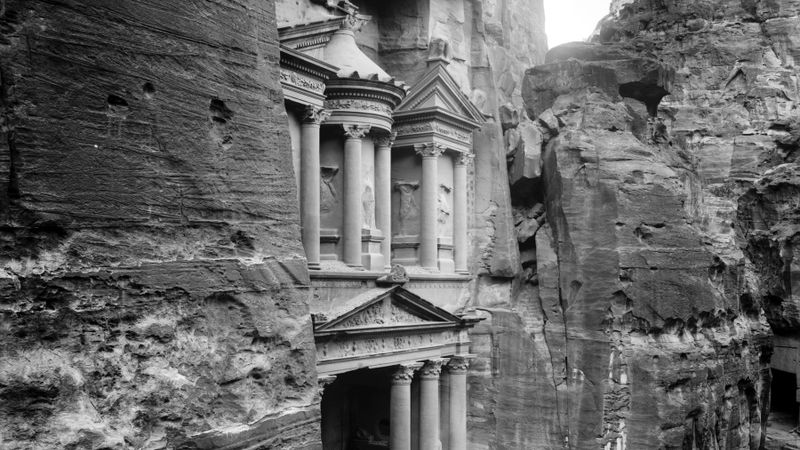
Filmed, but Not Recorded: The Arab World’s Missing Film Locations
Wikidata knows Gladiator was filmed in Morocco. It doesn’t know where.
Ouarzazate is the second most filmed place in the Middle East and North Africa, yet 25 of its 27 productions are recorded only in Wikipedia prose. We compared filming records worldwide and found that in the Arab world, Wikidata usually knows the country but not the place.
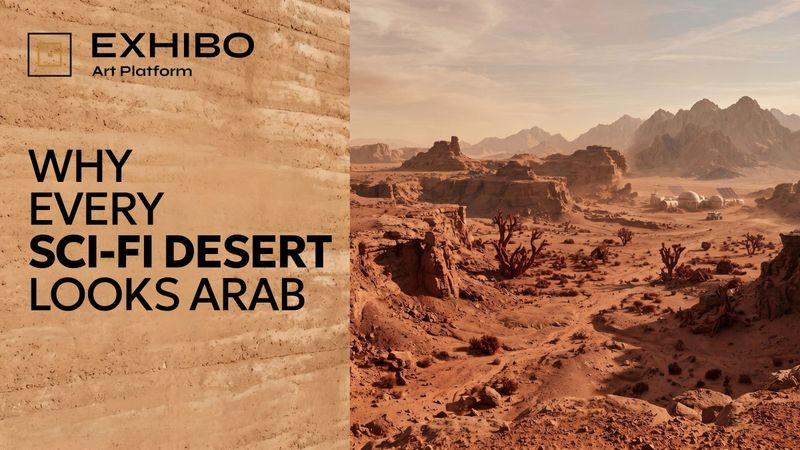
Why Every Sci-Fi Desert Looks Arab
From Arrakis to Tatooine, when a film wants a desert to feel ancient, prophetic and alien, it reaches for an Arab and Berber vocabulary — and reveals more about the West that built it than the region it borrows from.
The wrapped faces, the trilling women, the barely-displaced Arabic: cinema's alien deserts keep sounding Arab. But the vocabulary was assembled in the West — from Orientalist painting to Lawrence to Dune — and it says more about who is looking than about anyone being looked at.
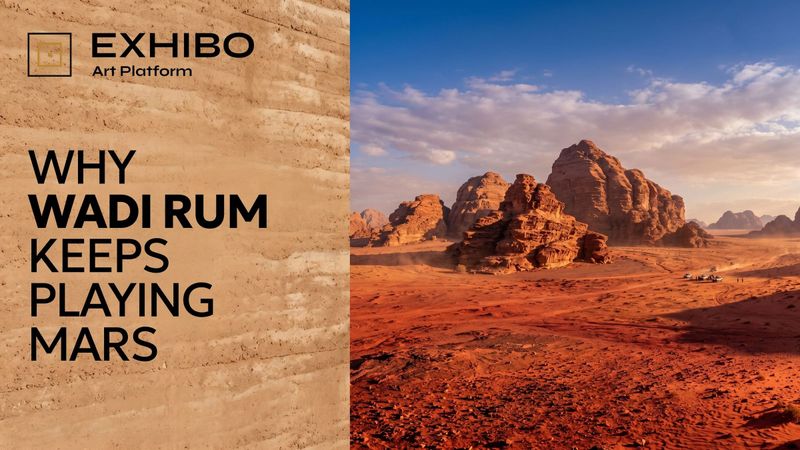
Why Wadi Rum Keeps Playing Mars: A Desert That Is Right About the Wrong Planet
A valley in southern Jordan has become cinema's favourite Mars — not because it is like the planet, but because it looks like the one we carry in our heads.
Put Wadi Rum beside a rover photograph and you can't tell which is Mars. But the desert shares almost nothing with the real planet except its colour — and lately, the illusion has grown powerful enough that real space missions have come to Jordan to rehearse.