Sharjah

Al Mureijah

5 galleries · 0 museums · 0 places

About this district

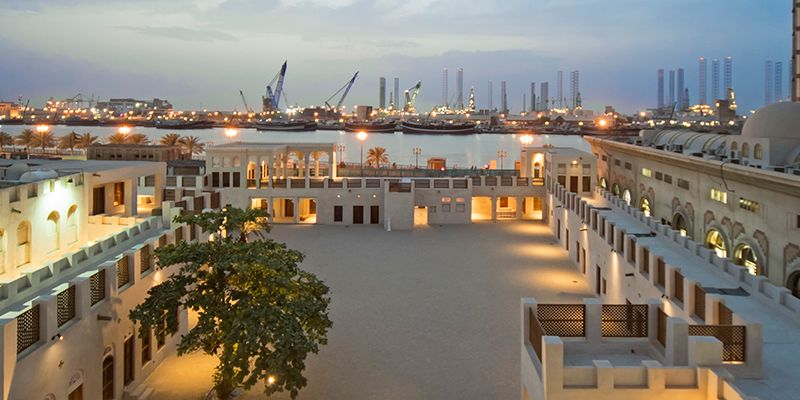
A historical quarter running from Sharjah Creek, where Al Zahra Mosque stands, to the reconstructed city walls — and the home of Sharjah Art Foundation's Al Mureijah Art Spaces. Five white-cube galleries with about 2,000 square metres of exhibition area, linked by courtyards, narrow alleys and open rooftops, standing alongside restored traditional houses. Free to enter. The pace is slow. The scale is intimate.

Galleries

Museums

No published museums in this district yet.

Places

No published places in this district yet.

A cross-section of a medieval bathhouse: bathers above, and below them two horned fire spirits tending the furnace that heats the water.
Editorial

The Real Jinn: How the Middle East Imagined Them Before Disney

Seven kings, one for each day of the week. A portrait of Fever. Two spirits keeping a bathhouse warm. What the manuscripts actually show — and what the lamp replaced.

Folio 35v of a manuscript in Oxford shows the public baths at Tiberias in cutaway. Upstairs, people washing. Downstairs, two jinn tending the furnace, mid-conversation. It is not what most of the world expects — and it is much closer to what the unseen was actually understood to be for. A long read across twelve centuries of manuscripts, fieldwork, survey data and horror cinema.

A strand of natural Gulf pearls, the luxury export that built the Arabian Gulf before oil
Editorial

The Sea That Came Before the Oil: The History of the Pearl

Eight thousand years before the first barrel, the Gulf had already built a global economy — out of an oyster, a held breath, and a rope.

Before oil, the Arabian Gulf ran on the pearl: a global luxury trade that raised its cities from the sand, drew fortunes and real suffering in equal measure, and then vanished almost overnight. The story of the industry that made the modern Gulf — and the quiet way it is coming back.

The Tunisian desert that became Tatooine — its Berber architecture, its vanishing film sets, and the living street-art scene painting over the myth.
Editorial

The Real Tatooine: Star Wars, Southern Tunisia and the Living Art Beneath the Myth

The Tunisian desert that became Tatooine — its Berber architecture, its vanishing film sets and the living street-art scene painting over the myth.

George Lucas filmed Star Wars across southern Tunisia, borrowing Berber pit-houses and 15th-century granaries as an alien world. But the real story is what's underneath: a living tradition of desert architecture, two millennia of coexistence on Djerba, and one of the most ambitious street-art projects on Earth.

Petra Beyond Indiana Jones — blog article
Editorial

Petra Beyond Indiana Jones

The 1989 film gave Petra a façade and invented everything behind it. The real story is in the water systems, the aniconic sculpture, the painter who framed your photograph in 1839 and the families moved out so the world could come in.

Spielberg's crew filmed the Treasury's façade in Jordan, then built the Grail chamber on a soundstage in Hertfordshire — because the real interior of Al-Khazneh is a plain, undecorated room. It's a perfect miniature of how Petra is understood: one wall, photographed a million times a year, standing in for a city that is mostly still unexcavated.