
Exhibo Editorial
What Is Fine Art?
Academy hierarchy, Beaux-Arts training, and how a European category still organises museums after the old ladder collapsed
Fine art is a rank that European academies gave to certain arts, not a description of how a work is made. From the sixteenth century onward, painting, sculpture and architecture claimed kinship with the liberal arts: invention, drawing, and learned subject matter counted more than workshop skill alone. The French phrase beaux-arts and the English phrase fine art name that claim. A still life, a landscape, a portrait and a history painting could all sit inside the category, yet the academy did not treat them as equals. The point of the term was prestige and training, not a list of materials.
Searchers who type “what is fine art” or “fine art meaning” often meet a shorter formula: art made for beauty rather than use. That formula is a later classroom compression. It hides the hierarchy that produced the word, the Beaux-Arts schools that taught it, and the twentieth-century collapse that left the label on museum departments and degree titles while emptying it of its old exclusions. This page stays with that history. Medium as a technical word belongs with what a medium in art is. History painting as a genre has its own live essay at history painting. Looking vocabulary for line, value and the rest sits at the Elements and Principles of Art hub. Collection pages for the museums named below are in the museums directory.
Fine art meaning: a category, not a look
Fine art, in the sense that still governs Western museums, is art admitted to a learned hierarchy whose top rungs were painting, sculpture and architecture, later joined in practice by drawing, printmaking and, after long argument, photography and other studio forms. The “fine” does not mean delicate. It translates beaux: the arts of beauty and of liberal invention, set against the mechanical arts of the guild. Giorgio Vasari, writing in Florence, grouped painting, sculpture and architecture as the arti del disegno: arts of design, where disegno means both drawing and the intellectual plan. Cosimo I de’ Medici founded the Accademia e Compagnia delle Arti del Disegno in 1563, with Vasari as organiser. The Accademia di San Luca in Rome and, in 1648, the Académie royale de peinture et de sculpture in Paris copied the model: gentlemen practising a liberal art, not craftsmen selling a trade.
A usable definition for a student or a first museum visit: fine art is work presented for contemplation and for a learned public, inside institutions that inherited the academy’s map. Use is not forbidden. Architecture always had a job. Altarpieces served liturgy. Portraits served families. The category judges primary purpose and institutional home. A jug in a kitchen is not, by that map, fine art. The same jug on a plinth in a contemporary gallery may be. The shift is curatorial, not chemical.
High art is a sibling phrase, not a synonym. Tate’s glossary on history painting notes that the classical, idealised manner thought proper to grand subjects was called the grand style, and that the result was known as High Art. Joshua Reynolds used that English language in the Royal Academy Discourses. High art names a manner and a moral claim: ideal form, serious subject, public address. Fine art names the institutional set that claimed to house that manner. You can have fine-art photography that refuses High Art’s ideal nude. You can have a High Art history painting that a later museum files as “European painting” without using the old rank at all.
How the category worked as a technical system
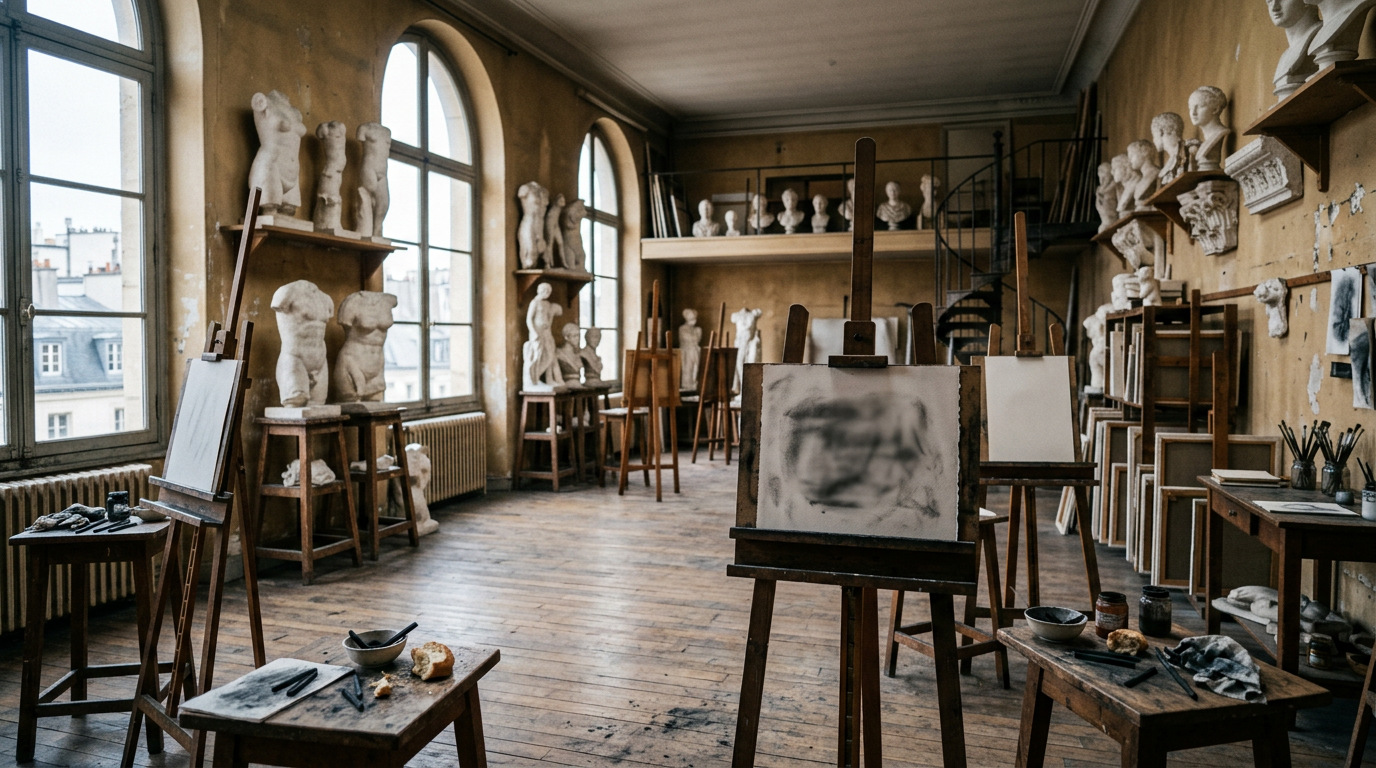
The academy ran a production system: life drawing from the antique and from the model, a ladder of genres, a salon or summer exhibition, prizes that sent students to Rome, and a language of disegno that treated the human figure as the hardest problem. That system is the technical content of “fine art” before 1900. Pigment chemistry and support belong to medium. Here the technique is institutional: how a work qualified, how large it was, which room it hung in, which prize it could win.
Tate’s page on genres records the French Royal Academy’s descending order: history, portrait, genre (everyday life), landscape, still life. Landscape and still life sat at the bottom because they did not centre the human figure as the measure of all things. History sat at the top because it treated religion, myth and public action. The National Gallery’s glossary agrees that history painting was the noblest form and that the ranking drew on ancient literary parallels. It orders the lower rungs in a different sequence (portraiture, landscape, still life, then everyday genre last). Treat both lists as teaching maps, not as a single statute. André Félibien’s preface to the Conférences of the Académie royale for 1667, published in 1668, is the classic French statement. He ranks still life of fruit and shells below landscape, living animals above dead ones, the human figure above animals, portrait below multi-figure history, and allegory above even that.
Academy hierarchy as a working method
History painting demanded anatomy, grouping, architecture, drapery, and a subject the painter could not copy from a single sitting. Félibien’s point is capacity. The painter of shells, in this theory, copies what sits on the table. The painter of the Horatii must invent an oath, a setting, and a moral. Portrait sat below history because likeness was thought to be copying rather than invention, even though few portraits were made without artifice. Genre painting included people but not, in theory, great ideas. Landscape and still life could be superb as paint and still fail the intellectual test.
The hierarchy governed size, fees, and teaching. A reception piece for the Paris academy advertised the rank you claimed. Chardin entered in 1728 with still lifes, not with a Homeric machine. Turner and Constable fought for landscape to occupy the large wall that history had owned. The British Royal Academy, founded in 1768 with Reynolds as first president, imported the French ladder and then watched British collectors buy portraits and sporting pictures instead. Technical looking still uses the ladder: when you stand in a nineteenth-century salon hang, the biggest canvases with the most bodies are making a claim to history, even if the subject is a recent battle in modern dress.
Beaux-Arts as school, style and afterlife
Beaux-arts is French for fine arts. The École des Beaux-Arts in Paris is the school that made the phrase international. Beaux-Arts de Paris traces itself to the Académie royale de peinture et de sculpture (1648). Britannica records the Académie royale d’architecture (1671) and a merger of teaching functions after the Revolution; architecture left the school in 1968. Formal regulations of 1819 organised painting, sculpture and architecture on the rue Bonaparte site. Students advanced by drawing, then figure, then the concours. The Prix de Rome sent winners to the French Academy in Rome. Géricault, Ingres, Degas, Seurat and others passed through that funnel. Auguste Rodin applied three times and was refused. Paul Cézanne applied twice and was refused. The refusals are part of the technical story: the school defined competence as a classical figure in a learned composition.
Beaux-Arts architecture, the public language of opera houses and libraries into the early twentieth century, is the same pedagogy applied to buildings: antique order, axial plans, rendered presentation drawings. From about 1935, Britannica notes, a German functionalist curriculum associated with the Bauhaus displaced that system in many schools. The word survived as a degree title (Bachelor of Fine Arts, Master of Fine Arts) and as a museum department. The technique changed. The letterhead did not.
Fine arts versus visual arts
Visual arts is a wider, later, and more descriptive phrase: arts you look at. It covers painting, sculpture, drawing, print, photography, film stills, design objects, textiles, ceramics, and installation, without the academy’s moral ranking. Fine arts, in older European usage, also included music, poetry and dance. Charles Batteux’s Les Beaux-Arts réduits à un même principe (1746) grouped arts that imitate beautiful nature. School quizzes that ask for “the 7 fine arts” are mixing that performing-and-visual bundle (often architecture, sculpture, painting, music, poetry, dance, cinema) with the classroom “7 elements of art.” Those seven elements are line, shape, form, space, value, colour and texture. They are a looking list, not a census of art forms. Keep them on the elements hub.
In a university prospectus, “Faculty of Fine Arts” may mean studio practice plus art history, or it may include theatre and music. “Department of Visual Arts” usually means studio work you see. “Applied arts” and “design” name work with a brief and a user. None of these office names is a judgement of quality. A poster can be sharper than a salon nude. The distinction that still matters in a gallery is presentational: is the object offered as a unique (or editioned) work for looking, or as a product for use? Even that line moves. A chair in a design museum and a chair in a sculpture show are the same joinery under two captions.
When a search asks “fine arts vs visual arts,” answer with institutions. Fine arts is the older honourific. Visual arts is the broader descriptive field. High art is a manner. Applied art is work tied to function. Craft is skilled making, often in clay, fibre, metal or wood, with its own schools and museums. One object can sit in two of those sentences at once.
High art: manner, not membership
High art, in Reynolds’s British usage and in Tate’s note on the grand style, is idealised, classicising treatment of a serious subject. The nude is generalised. Costume is timeless or antique. Emotion is public. Benjamin West’s The Death of General Wolfe (1770, National Gallery of Canada, Ottawa) keeps the High Art grouping of a Lamentation, the flag as a pyramid, Wolfe as a dying hero, while putting the figures in contemporary military dress. Tate cites West and John Singleton Copley as painters who pulled modern history into the old genre. High Art here is a set of poses and a claim on public feeling, not a refusal of current clothes.
Low art, in the same vocabulary, was popular print, caricature, shop sign, later comic and advertising. The insult was social. Hogarth’s modern moral subjects used low settings for high argument. Manet’s Olympia (1863, Musée d’Orsay, Paris) used a Titian-derived nude and a contemporary sex worker’s stare; the 1865 Salon crowd heard that as a breach of High Art, not as a new medium. You identify High Art in a room by idealisation, scale, and a subject that asks you to take a civic or sacred stance. You identify fine art by the institution that hangs it. The two overlap in David. They part company in a small Chardin still life that the academy still accepted as painting.
Six works that show the rank in action
Definitions stay thin until a specific canvas or object is in front of you. The six works below are not a canon of “the best fine art.” They are machines that make the category visible: an academic history picture, a still life that entered the academy at the bottom, a landscape that seized history’s wall, a modern-dress history that Tate still files under High Art, a readymade that withdrew craft, and a ceramic vessel that a Turner Prize treated as contemporary art. Dates and locations below follow museum collection pages. Hangs change; accession numbers do not.
Read them in order if you can. The sequence is the ladder going up, then sideways, then down.
David, The Oath of the Horatii (1784-85)
Jacques-Louis David painted Le Serment des Horaces in Rome for a royal French commission and showed it to Paris in 1785. The Louvre holds it (Denon wing, Salle Daru, room 702 in recent hang notes). Three brothers swear on swords; the father holds the blades; the women collapse in a separate rhythmic group. The architecture is a shallow Roman hall. The bodies are antique statues given pulse. This is the academy’s technical test made large: multi-figure invention, moral history, the male nude as civic instrument. David invented the oath episode; Livy does not stage it this way. Invention, in Félibien’s scale, is the point.
Stand at the distance the canvas demands. The men form a repeating triangle of legs. The women form a falling arc. You are looking at disegno as grouping, not at a battlefield report. Later politics read the picture as revolutionary virtue. The commission came from Louis XVI’s administration. The category “fine art” here means: this size, this subject, this public, this claim to be the highest painting.
Chardin, The Ray (1728)
Jean-Siméon Chardin’s La Raie (Louvre, INV 3197) is a kitchen still life: a gutted skate hung above a table, oysters, utensils, a cat. The Louvre records it as Chardin’s reception piece for the Académie royale in 1728, kept by the Academy until the Revolution, then shown in the Louvre from 1796. Félibien had placed fruit, flowers and shells at the bottom of the ladder. The Academy still admitted Chardin as a painter of animals and fruit. The work is fine art by institutional act: a morceau de réception, oil on canvas, later a museum picture.
The technical lesson is the opposite of David’s. No hero, no architecture of virtue. Chardin builds form with tone, the wet interior of the fish against the dull metal of a pan. Diderot later praised that attention. The hierarchy did not vanish; Chardin also began to add figures, a move scholars read as an answer to rank. You look at The Ray to see the bottom of the ladder doing the work of painting as hard as the top.
Constable, The Hay Wain (1821), and West, The Death of General Wolfe (1770)
John Constable’s The Hay Wain (National Gallery, London, NG1207) is a large Stour landscape, shown at the Royal Academy in 1821 as Landscape: Noon. The Gallery’s catalogue traces Flatford millpond, Willy Lott’s house, a wagon in the water, and a full-size oil sketch now at the V&A. In 1824 the picture went to the Paris Salon and helped win Constable a gold medal. Landscape, on the French ladder, was near the bottom. Constable’s size and finish steal history’s wall. The subject is a working ford, not Carthage. The category “fine art” here is the Academy exhibition and the later national collection, not the nobility of hay. In 2026 the canvas is on loan to Christchurch Mansion, Ipswich, for Constable 250 (11 July–4 October 2026); it remains NG1207. Check the hang before you travel.
Benjamin West’s The Death of General Wolfe (1770, National Gallery of Canada) keeps history’s grouping and swaps antique dress for 1759 uniforms on the Plains of Abraham. Tate’s history-painting entry cites West as a type of modern historical subject inside High Art. Wolfe’s pose quotes a Lamentation. An Indigenous warrior sits in the foreground as a witnessing type, a construction that later viewers have to read as imperial theatre, not as reportage. Together the Constable and the West show two ways the ladder bent: landscape inflated to public scale; recent war given the grammar of sacred history.
Duchamp, Fountain (1917, replica 1964)
Marcel Duchamp submitted a urinal, signed R. Mutt, to the Society of Independent Artists in New York in 1917. The original is lost. Tate holds an authorised replica of 1964 (Fountain, T07573). The object withdraws the academy’s technical core: no figure, no disegno, no unique handmade surface. Choice and caption do the work. Fine art, after this, can be a nominated industrial object in a museum of modern art. The collapse is not “anything is beautiful.” It is “the institution can admit a thing that fails every Beaux-Arts exam.”
If you only know Fountain from a photograph, you miss the porcelain and the plumbing joke at human height. In the room, it is still a urinal on a plinth. The category is the plinth and the label. That is the technical fact to keep, not a sermon about genius.
How contemporary artists use the term
Artists after 1960 seldom need “fine art” as a compliment. They need it as a door. A Master of Fine Arts is a studio degree. A “fine art photographer” signals prints for the wall, not a wedding album. A “fine art ceramicist” signals the gallery, not the kitchen shop. The old rank survives as a market and school dialect.
Grayson Perry treats that dialect as material. Tate records his ceramic vases with classical silhouettes and images that refuse polite decoration; he won the Turner Prize in 2003, the first time the prize went to a ceramic artist. In Tate’s studio film he calls pottery his gimmick: the craft stigma is the point. Aspects of Myself (2001) is in Tate’s collection. The vessel form is coil-built, glazed, narrative. A Beaux-Arts jury would have sent it to the applied arts. A twenty-first-century jury hung it as contemporary art. Perry’s tapestries, including The Vanity of Small Differences (2012), take Hogarth’s modern moral subject into woven wool, another craft that museums now caption as art.
Theaster Gates sews decommissioned fire hoses into Civil Tapestry works (series from 2011). The hose is civic equipment and a memory of water turned on protestors in Birmingham in 1963. The object is neither a Beaux-Arts painting nor a useful hose. It uses the museum’s fine-art slot (unique, wall-hung, charged with civic history) while the material comes from labour and city stores. Kerry James Marshall paints large figurative canvases that occupy the history-painting wall with Black subjects the academy’s Europe omitted. The medium is oil or acrylic on canvas, the old fine-art support. The argument is who gets the grand size.
Degree language still splits “fine art” from “illustration,” “design,” and “craft.” Students feel the split as a career fork. This page will not map that fork; it is a different brief. The looking point is smaller. When a living artist says “I work in fine art,” they often mean: I make unique or editioned work for galleries and museums, not for a client brief. When they say “I work across craft and fine art,” they mean the old ladder is the thing they are standing on and kicking.
Craft versus art: one honest section
The craft-versus-art debate is a fight about labour, gender, race, and money, dressed as a fight about beauty. European academies pulled painting and sculpture out of the guilds and called the remainder mechanical. Ceramics, weaving, metalwork and furniture kept use as their alibi, even when the object was too precious to use. That split trained generations to see a pot as lesser than a picture of a pot. It was never a law of perception. Chinese literati painting had its own rank against court and workshop production. Islamic ceramics carried inscription and geometry that European still-life theory had no slot for. The academy map is local.
Honesty requires two sentences that sit together. Skill in clay or fibre is not a lesser intelligence than skill in oil. Museums and markets still price and caption them apart, and that apartness has a history you can name. A collector’s guide to living with ceramics, to condition, and to studio pottery versus sculpture belongs in a later editorial piece on craft and fine art (E10 in the programme). That article is not live, so there is no slug to follow here. This vocabulary page stops at the historical mechanism.
Perry, Gates, and a long list of fibre artists after the 1960s used the museum to force a re-caption. They did not abolish craft. They made the fine-art room admit objects the Beaux-Arts school would have sent down the corridor. You still meet the old insult in casual speech (“that’s just craft”). Answer with the institution: who trained the maker, where the object sits, what use it still has. Then look at the surface.
How to identify fine art when you are looking
Start with the caption, not with a feeling of elevation. Museum labels inherit department names: Prints and Drawings, Painting, Sculpture, Decorative Arts, Photography, Design. Decorative arts is the old mechanical remainder, often the most interesting room. If the object is in Painting, the institution has already applied the fine-art stamp. If it is in a design gallery, the stamp is different even when the maker is the same person.
Then test scale and address. Academic fine art often wants a public distance: a canvas you step back from, a marble you walk around, a subject that assumes you know a story. A miniature portrait is still fine art by medium and collection, but it wants a hand’s distance. A conceptual certificate on A4 paper wants a reading distance. The category is not one size.
Then test the training residue. Casts, life drawing, squaring-up, a visible underdrawing, a Salon varnish, a carved marble that hides the tool: these are Beaux-Arts habits. A welded steel pile, a video loop, a stitched hose: these are later habits that still occupy the same buildings. You are not grading authenticity. You are naming which exam the object would have sat.
A short looking sequence you can run in any European-style museum:
- Read the department and the date.
- Name the genre in academy terms (history, portrait, genre scene, landscape, still life) even if the wall no longer does.
- Ask whether use is present, residual, or refused.
- Ask whether the maker’s hand is displayed as virtue (brush, chisel) or withdrawn (readymade, fabrication).
- Only then ask whether you think it is good.
Goodness is not the category. Plenty of academy machines are dull. Plenty of workshop objects are not.
Common confusions and misuses
Fine art as a medium. Oil, bronze, clay, inkjet and 16mm are media. Fine art is a rank some of those media were granted. Send medium questions to the sibling on medium.
Fine art as “better art.” The word began as a social promotion of painters and sculptors. It does not grade a specific canvas. A weak history painting is still history painting.
Fine art as the seven elements. The seven elements are a classroom kit for describing marks. They are not seven art forms. “What are the 7 elements of fine art?” is a search mash-up. Answer with the elements list, then return to rank.
Fine art as the seven arts. Architecture, painting, sculpture, music, poetry, dance, cinema is a different census, descended from beaux-arts in the wide sense. Useful for a quiz. Useless as a museum map of a single object.
Fine arts versus visual arts as a quality gap. Visual arts is the larger descriptive field. Fine arts is the older honourific and a degree name. Neither word is a score.
High art as a synonym. High art is grand-manner treatment and civic seriousness. A Chardin kitchen can be fine art without being High Art. A pompous allegory can be High Art and still bore you.
“Not for use” as a rule. Architecture, liturgical painting, portraiture and much photography had jobs. The academy claimed a surplus of meaning beyond the job. A teapot can carry that surplus. A ceiling fresco can fail to.
Fine art photography as a camera setting. The phrase means prints (or files) made for exhibition and collection, not a filter. Intent and editioning do the sorting, not megapixels.
Career advice disguised as definition. “How to become a fine artist” is a training and labour question. It is not this page.
A chronology you can keep
The table is a crib for dates and sites, not a complete history of art.
| Date | Actor or institution | What changed in the category | Object or site to look up |
|---|---|---|---|
| 1563 | Vasari; Cosimo I de’ Medici | Florence Accademia delle Arti del Disegno treats painting, sculpture, architecture as liberal disegno | Florence; Vasari’s Lives (1550, 1568) |
| 1648 | Charles Le Brun and others | Paris Académie royale de peinture et de sculpture; later monopoly on teaching and the Salon | Louvre’s academy history; later École |
| 1667-68 | André Félibien | Preface to the Conférences ranks still life below landscape, portrait below history, allegory at the summit | Text of the Conférences |
| 1728 | Jean-Siméon Chardin | Reception at the Academy with still lifes, including The Ray | Louvre, INV 3197 |
| 1768-90s | Joshua Reynolds; Royal Academy, London | English grand manner / High Art; Discourses | RA; Tate glossary on grand manner |
| 1770 | Benjamin West | Modern dress inside a history-painting Lamentation | The Death of General Wolfe, National Gallery of Canada |
| 1784-85 | Jacques-Louis David | Neoclassical history as the academy’s public face | Oath of the Horatii, Louvre |
| 1819 / 1968 | École des Beaux-Arts, Paris | 1819 regulations; architecture teaching ends 1968 | rue Bonaparte; Britannica on the École |
| 1821 / 1824 | John Constable | Large landscape at the RA, then Paris Salon gold medal | The Hay Wain, NG1207, National Gallery, London |
| 1917 / 1964 | Marcel Duchamp | Readymade admitted to the art institution; Tate replica 1964 | Fountain, Tate T07573 |
| 2003 | Grayson Perry | Turner Prize to a ceramic artist; craft form in the contemporary slot | Tate collection, e.g. Aspects of Myself |
FAQ
What is considered fine art?
In museum English, painting, sculpture, drawing, printmaking and, later, photography and other studio work shown for looking rather than as a trade product. The older core was painting, sculpture and architecture. Ceramics, fibre and design objects enter when a gallery or prize captions them as art. The test is institutional home and presentational intent, not a checklist of pretty subjects.
What is the meaning of “fine” in fine art?
It translates beaux: the arts of beauty and of liberal invention, as opposed to the mechanical arts of the guild. It does not mean fragile, expensive, or a moral upgrade. A rough charcoal cartoon for a fresco is fine art by training. A jewelled snuffbox may be decorative art by department.
What is the difference between art and fine art?
Art is the wide word for made images, objects, sounds and events offered as such. Fine art is a European institutional subset with an academy past. People say “art” for a child’s drawing and “fine art” for a degree show. The second phrase carries the old rank even when the speaker only means “not illustration.”
What is the difference between fine arts and visual arts?
Visual arts names things made to be seen. Fine arts, in older usage, also included music, poetry and dance, and in school usage still names a faculty. In studio talk, fine arts often means gallery-oriented practice; visual arts is the broader umbrella that includes design and, in some campuses, craft.
What are the seven fine arts?
Quiz answers vary. One common list is architecture, sculpture, painting, music, poetry, dance and cinema. That list comes from the wide beaux-arts family, not from Félibien’s painting genres and not from the seven elements of art. If an exam sheet wants the elements, it wants line, shape, form, space, value, colour and texture.
What is not considered fine art, on the old map?
Workshop production for use, commercial illustration, most advertising, and the decorative arts as museums still file them: furniture, tableware, textiles, jewellery. The old map was unfair and unstable. Photography, film, ceramics and tapestry have all crossed the line in public collections. “Not fine art” is a caption, not a destiny.
Is high art the same as fine art?
No. High art is a manner: ideal form, serious subject, public address, the grand style Reynolds taught. Fine art is the institutional category that claimed to house that manner and much else, including still life and, later, the readymade.
Is history painting the same as fine art?
No. History painting is one genre inside the academy’s painting ladder, the top rung. The genre has its own explainer at history painting. Fine art is the larger rank that also included portraits, landscapes and sculpture.
Related reading
Kiasma Outlines a Robust 2027 Season Featuring Major Surveys and Prize Showcase
Helsinki's Museum of Contemporary Art Kiasma unveils a comprehensive schedule balancing institutional retrospectives, immersive solo projects, and regional award programmes.
The 2027 calendar at Kiasma positions spatial experimentation and critical historiography at the forefront of Nordic contemporary practice.
Ukrainian Museum Celebrates Half-Century With Community-Led Lobby Project
Molly Gochman transforms archive fragments into a projected collage marking five decades of cultural preservation
As the institution turns fifty, an immersive lobby installation invites locals to contribute personal artefacts, weaving private histories into a broader narrative of Ukrainian heritage and resilience.
When Defending Heritage Becomes a Crime: The Arrest of Iraqi Archaeologists
Whistleblowers targeted over corruption claims and controversial investment legislation
Detentions of leading experts raise alarms over censorship, rapid site clearance, and the future of Iraq's archaeological record.