
Exhibo Editorial
What Is a Medium in Art?
Materials, supports and mixed media, read through named museum works, plus why the plural is media rather than mediums
A medium in art is the material an artist uses to make the work, and, in a second, overlapping sense, the kind of practice that material belongs to. Oil on oak is a medium line on a label. Painting is also a medium in the broader sense Tate uses when it groups painting, sculpture, drawing and printmaking as media of art. A third, studio sense names the liquid that carries pigment: linseed oil is the medium inside oil paint. Students meet the first sense in essays. Conservators live in the second and third. The same English word does all three jobs, which is why the query keeps returning.
This page sits in the Elements and Principles of Art series. Medium is not an element like line or value. It is the stuff those elements are made of. Fine art as a category, with its old opposition to applied and decorative work, belongs with what is fine art. Collection pages for the museums named below sit in the museums directory. Oil versus acrylic as a process essay, and fresco chemistry as a workshop, belong to later technique pages. Here the job is vocabulary: what the word means, how a support differs from a medium, what mixed media names, and why the plural is media.
What the word names
Tate’s glossary states the overlap without apology. Painting, sculpture, drawing and printmaking are media as types of art. A sculpture can still be “in the medium of bronze or marble,” a painting “in the medium of oil paint on canvas,” a drawing “in pencil or crayon,” a print “in etching or lithography.” The Getty Art and Architecture Thesaurus, writing for cataloguers, tightens the materials sense: media are “the materials that are applied to a support in the making of a work of art, such as ink on paper or oil paint on canvas.” Getty’s teacher glossary adds the vehicle: a medium is also “the adhesive that carries paint’s pigments.” Three sentences, three jobs. You need all three when you stand in front of a label.
The Latin root is medius, middle. The material sits between the idea and the finished object. It is not a neutral pipe. Bronze takes a polish and a weight that plaster does not. Egg tempera dries in a thin, opaque film; oil stays open long enough for a glaze. A woodblock print exists as an edition because the block can be inked again. When you name the medium you name a set of physical limits and a history of workshop practice. You do not yet name the subject, the style, or the market.
“Art medium” in search results often collapses into a list: oil, acrylic, watercolour, charcoal, clay, bronze, digital. The list is useful as a crib. It is not a definition. Digital pixels are a medium in the materials sense once they are the stuff of the image. They are also a type of art once “digital art” functions as a category beside painting. Both uses are current. Pretending there is only one correct sense produces pedantry. Pretending the senses never clash produces muddle on student papers.
Support versus medium
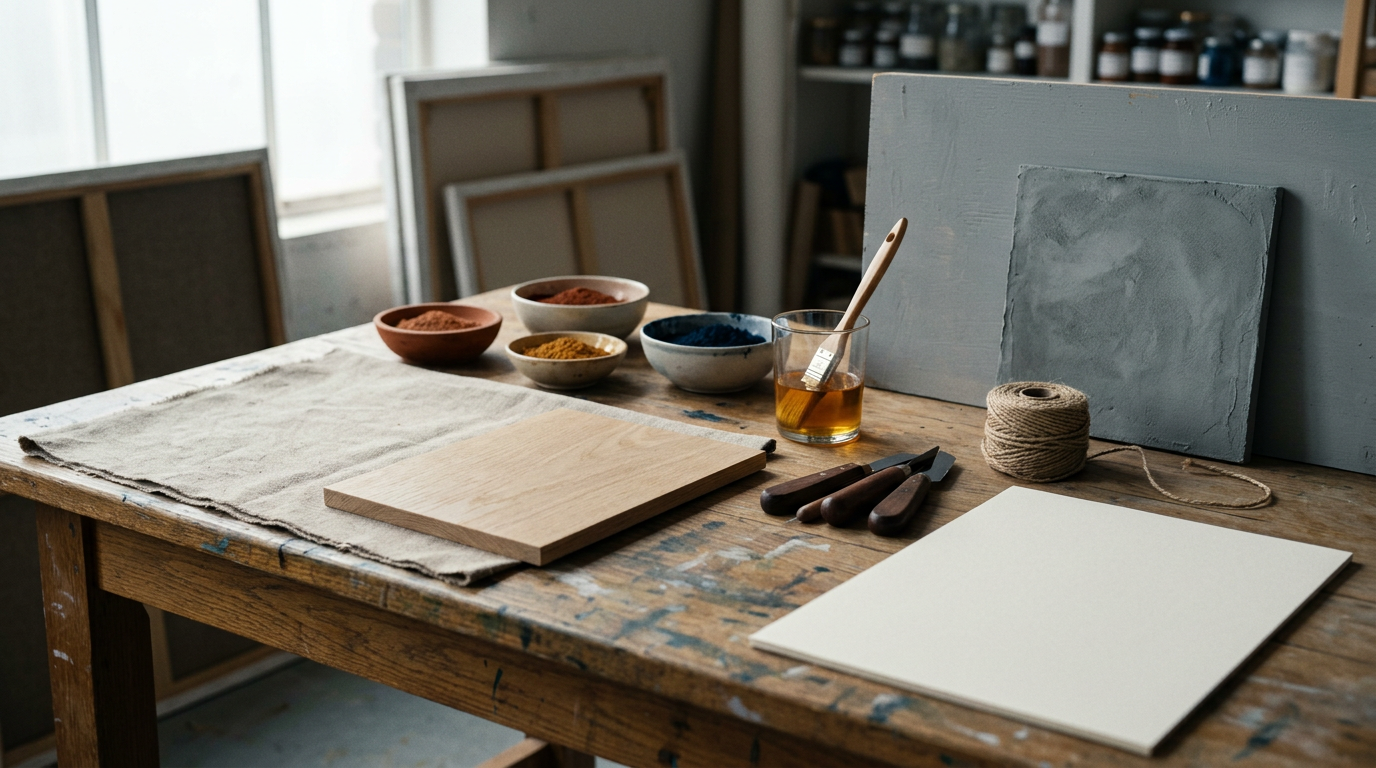
Getty’s thesaurus treats support as a different concept from medium. Supports are “materials to which media are applied to create an image or design, or materials to which a work is mounted.” Paper, wood panel, canvas and glass are typical supports for two-dimensional work. The paint, ink or photographic emulsion is the medium. A National Gallery label for Jan van Eyck’s The Arnolfini Portrait (1434) therefore reads, in substance, oil on wood (oak). Oil is the medium. Oak is the support. The sentence “oil on canvas” is a compressed materials line, not a single substance.
The distinction matters because the same noun can switch roles. Paper is a support for a graphite drawing and a medium when the sheet is the object: a folded form, a cut silhouette, a collage of printed scraps. Canvas is a support for oil and, in some twentieth-century work, a raw field that the artist leaves unprimed as part of the look. A bronze figure has no “support” in the painting sense; the metal is the work. Conservators still speak of armatures, cores and later mounts. Those are structural, not pictorial supports.
Primary and secondary supports appear in conservation reports. The primary support is the original surface: the panel, the canvas, the paper. A secondary support is a later lining, a mount board, a cradle on the back of a panel. A wall label will not always spell this out. A catalogue entry might. When you copy a materials line into an essay, copy the museum’s wording first. Do not invent “oil on canvas” for a panel picture because canvas is the default in your head.
The liquid vehicle sits inside this map as Tate’s third meaning. Conservators and paint-makers call that liquid a medium as well: gum arabic for watercolour, egg yolk for tempera, acrylic polymer for modern emulsion, linseed or walnut oil for oil paint. A tube labelled “alkyd medium” or “glazing medium” is an additive you mix into paint to change flow, gloss or drying. That is a legitimate studio use of the word. It is not the answer to “what is a medium in art” on a general search. The SERP currently mixes the two because manufacturers rank for the same phrase.
Medium, technique and type of art
Technique is how the artist handles the material. Medium is what is handled. Impasto is a technique in oil (or acrylic). Etching is both a technique and, on many labels, the named medium of a print, because the process and the material are hard to split. Tate’s print glossary treats etching as a method that uses chemical action on a metal plate. The impression on paper is the object. Saying “the medium is etching” is museum English. Saying “the medium is ink on paper, made by etching” is more precise and longer. Labels pick the short form.
Genre and type of art sit one level up. Landscape is a subject category. Painting is a medium-as-type. A landscape can be oil, watercolour, tapestry or photograph. “Photography” names a medium and a field. “Portrait” does not. Students lose marks when they write “the artist’s medium is Impressionism.” Impressionism is a movement and a set of habits of looking. The medium of a Monet haystack is oil on canvas.
Sculpture’s four textbook processes (carving, modelling, casting, constructing) are techniques that select materials. Marble invites carving. Clay invites modelling and, if fired, becomes ceramic. Bronze is cast from a model. Construction and assemblage use found or fabricated parts. The medium line on a sculpture label should name the material you can point at: bronze, marble, terracotta, welded steel, plaster. If the object is mixed, the label will say so.
Point, do not linger, toward the technique cluster. How oil differs from acrylic in drying and solvent, how buon fresco sets in lime plaster, how a mezzotint rocker works: those are process essays. This page only needs you to keep the nouns in their lanes so a later technique article can assume the vocabulary.
How a medium behaves as a physical system
A painting medium, in the materials sense, is pigment plus a binder in a vehicle, laid on a prepared support. Pigment is the colouring matter, often a ground mineral, an organic lake, or a modern synthetic. The binder holds the particles in a film. The vehicle makes the mix brushable and then leaves, by evaporation or by chemical drying. Egg tempera binds with protein. Oil polymerises as it takes oxygen. Acrylic water-borne paint forms a plastic film as water leaves. Fresco is the odd case: the pigment, mixed with water, is pulled into fresh lime plaster and locks as the plaster carbonates. The wall is support and, in a sense, binder.
Those sentences are enough physics for a vocabulary page. They explain why a medium is not a costume you can swap without changing the look. Van Eyck’s oak panel takes a smooth, absorbent ground. The oil film can be thin and translucent. Giotto’s Padua walls take a day’s patch of intonaco. The painter works while the plaster is alive. Hokusai’s printer inks a carved cherry block and lays damp paper on it. The Prussian blue that made The Great Wave possible in the early 1830s was an imported pigment in a woodblock medium, not a European oil glaze.
Sculpture and print add other systems. Lost-wax bronze starts as a model, becomes a mould, receives molten metal, and is chased and, in Donatello’s case, partly gilded. The medium you see is the metal after those steps. A photograph’s medium, on a museum label, may be gelatin silver print, albumen print, or pigment print. The paper is support. The silver or pigment image is the medium. Digital work on a screen has no paper until it is output. The file, the display, and the print are three different material facts. Name the one in front of you.
Binder, vehicle and the paint-maker’s “medium”
Getty’s second definition (the adhesive that carries pigment) is the one that collides with shop language. In a conservator’s report, “oil medium” means the drying oil in the paint film. In an art-shop aisle, “painting medium” means a bottle of stand oil, alkyd, or gel you add to tube colour. Both uses are old. Ralph Mayer’s handbook and the Getty Conservation Institute treat the binder-vehicle complex as medium. Manufacturers rank for the same word because students search it.
For looking, keep this rule. If the label names oil, acrylic, tempera, fresco or watercolour, it names the paint system, binder included. If a wall text mentions “a glazing medium” or “added wax,” it names an additive inside that system. Do not write that the painting’s medium is Liquin. Write oil on canvas, then, if the catalogue discusses it, note the additive.
Edition, unique object and digital output
Print and photography split the medium from the unique handmade object. A woodblock or etching exists as an impression. The block or plate is a matrix. The medium of the thing on the wall is still ink on paper, produced by that matrix. Museums record edition size when they know it. Hokusai’s Great Wave was a commercial ukiyo-e print, not a numbered fine-art edition in the later European sense. Later restrikes and copies complicate what you are seeing. The Met’s impression (JP1847) is ink and colour on paper, woodblock, ca. 1830–32.
Digital work repeats the split. The medium may be a software environment, a moving-image file, or a print from a file. A gallery that shows a video on a loop is showing a time-based medium. A gallery that hangs a pigment print of a 3D render is showing a print whose origin is digital. The label should say which. If it does not, ask.
Six works, six media
A definition stays abstract until you test it on objects that do not share a century or a continent. The six below are chosen so the medium does different work in each case: wall plaster, oil on panel, cast bronze, woodblock, collage, and a late-twentieth-century mixed canvas. Dates and locations are those of the museums and site authorities cited in the notes. Where scholars disagree on a year, the range is given rather than a fake precision.
Read them as a sequence of material arguments, not as a greatest-hits list. Each one answers a different question you can ask of any label: what was applied, what it was applied to, and what that choice made possible in the image or the object.
Wall plaster and oil on oak
Giotto di Bondone and his workshop frescoed the Scrovegni (Arena) Chapel in Padua in about 1303–05 for the banker Enrico Scrovegni. The chapel’s own site and the UNESCO serial listing for Padua’s fourteenth-century fresco cycles treat the interior as a single campaign: Lives of the Virgin and Christ, Vices and Virtues in grisaille, Last Judgement on the entrance wall. Britannica’s fresco article names this cycle among the canonical examples of the technique. The medium is pigment in fresh lime plaster (buon fresco), with some a secco passages on dry plaster for colours that the wet lime would wreck. The support is the chapel fabric. You cannot move the work without moving the building. That is the point of the medium: the pictures are the walls.
Jan van Eyck’s The Arnolfini Portrait, 1434, National Gallery, London (NG186), is oil on wood, oak. The Gallery’s object page stresses the small scale (about 82 × 60 cm) and the capacity of oil to hold minute reflections: the convex mirror, the brass chandelier, the piled-up cloth. Vasari later credited van Eyck with the “invention” of oil painting. Modern technical study does not. Oil binders were in use before 1434. What van Eyck and his Netherlandish peers did was push the medium toward thin, luminous layers on a smooth panel. The Ghent Altarpiece, completed 1432, still in Saint Bavo’s Cathedral, Ghent, is oil on oak panels at architectural scale. Same medium family, different support size, different job. Do not write that van Eyck invented oil. Write that he made oil on panel do optical work tempera on panel had not done in the same way.
Cast bronze and printed paper
Donatello’s bronze David, Museo Nazionale del Bargello, Florence, is a freestanding nude in metal, about 158 cm high. The commission date is not documented. The V&A’s essay, citing the Bargello object, gives about 1435–40 as a working range and notes that the bronze was partly gilded; other literature places it in the 1440s, and outliers run earlier or later. The statue is recorded in the Medici palace courtyard by 1469. Write a range. Do not invent a single year. Bronze here is not a colour word. It is a cast alloy that can take a thin, almost liquid modelling in the wax stage and then a chased surface. Marble Davids (Donatello’s earlier marble; Michelangelo’s later giant) are carved. The medium change is a change of process and of public meaning: bronze was costly, and a private family putting a life-size bronze in a courtyard was making a claim.
Katsushika Hokusai’s Under the Wave off Kanagawa (Kanagawa oki nami ura), from Thirty-six Views of Mount Fuji, ca. 1830–32, is a woodblock print, ink and colour on paper. The Met’s impression (JP1847) records those materials and the Prussian-blue landscape palette that Hokusai used in the series. The designer drew. The carver cut the blocks. The printer inked and pulled. The medium is collaborative and repeatable. Mount Fuji sits small in the trough because the block’s flat colour areas and the paper’s size (about 25.7 × 37.9 cm) favour a graphic, not a glazed, space. Calling the work “a painting” is a category error. Calling it “Hokusai’s medium” without naming woodblock and paper leaves the labour out.
Collage and a mixed canvas
Pablo Picasso’s Nature morte à la chaise cannée (Still Life with Chair Caning), spring 1912, Musée national Picasso-Paris (MP36), is oil and oilcloth on canvas, framed with rope. The museum’s object line is huile et toile cirée sur toile encadrée de corde. A printed oilcloth that imitates chair caning is pasted into the oval field. The rope is a real rope acting as a frame. Tate dates the rise of mixed media to about 1912 with the Cubist collages and constructions of Picasso and Georges Braque. This object is the usual teaching hinge for that story: a fragment of manufactured pattern enters the picture as material, not as painted illusion. It is not a proven global first collage. The letters “JOU” (from journal) sit in the same field. Medium here is an argument about what counts as painting.
Chris Ofili’s No Woman, No Cry, 1998, Tate (T07502), is oil paint, acrylic paint, graphite, polyester resin, printed paper, glitter, map pins and elephant dung on canvas. Art UK and Tate’s materials studies use that list. The canvas leans on two resin-sealed dung balls; a third forms a necklace pendant. Collaged faces of Stephen Lawrence sit in the tears. Phosphorescent paint carries a dedication visible in low light. The work is mixed media in Getty’s sense: a combination of materials and associated techniques in a single work. It is still a painting in Tate’s type-of-art sense. Both statements can be true on one label. The medium line is long because the object is long in material fact. Shortening it to “oil on canvas” would be a lie.
Mixed media, multimedia and intermedia
Tate’s mixed-media entry is blunt. The use of mixed media “began around 1912” with those Cubist collages and constructions and became widespread as artists treated any material as fair. “Essentially art can be made of anything or any combination of things.” Getty’s AAT note is the cataloguer’s version: mixed media flags “any combination of a variety of materials plus the associated techniques, used in the making of a single work of art.” In printmaking, the same term can mean more than one intaglio method on one plate. For oil glazes over tempera, Getty prefers “mixed technique,” a different phrase. Do not merge them.
Multimedia, in Tate’s usage, is mixed material that includes an electronic element: video, film, audio, computers. Getty distinguishes multimedia from mixed media and reserves intermedia for work that merges known forms into a new type. A sculpture with a soundtrack is at least mixed media and, if the sound is structural, multimedia. A student PowerPoint that pastes a photo onto a watercolour is mixed media in the weak, classroom sense. Reserve the Cubist and later sense for work that treats the combination as the point, not as extra decoration.
Assemblage, installation and performance, Tate notes, became types of art because the expansion of materials forced new category names. Assemblage builds from scavenged or fabricated parts. Installation occupies a room or a site. Performance uses the artist’s body as medium. Bricolage, in Tate’s related glossary, is making from whatever is to hand. Those words are siblings of mixed media. They are not synonyms. If the object hangs on a wall as a single pictorial field with pasted stuff in it, collage or mixed media will do. If you walk through it, installation is the better type-word, and the materials list still belongs on the label.
How contemporary artists use medium
Contemporary practice did not abolish the old materials. It multiplied the legitimate list and made the choice of medium part of the subject. Ofili’s 1998 canvas, already discussed, treats elephant dung, resin and collage as load-bearing, not as a joke in the margin. Phyllida Barlow’s large constructions, which Tate has commissioned and collected, use timber, cement, fabric and household colour at architectural scale. The medium is construction debris organised as sculpture. The type of art is installation as much as sculpture. Labels for such work run to paragraph length because a one-word medium would be false.
Time-based work makes the medium a duration. Nam June Paik’s video sculptures (for example the Paik works in museum collections such as Tate and the Smithsonian) use television sets and recorded image as material. The CRT or flat screen is as much the medium as the tape or file. A loop that fails is a medium failure, not a “content” failure. Performance, from the 1960s onward, treats the body and the allotted time as the medium. The residue (photograph, score, relic) is a different object with a different materials line. When you write about a performance, say whether you saw the event or the documentation.
Digital and networked work repeats the file-versus-display problem. Some artists output pigment prints and stop there; the medium on the wall is print. Some insist on a specific screen, a game engine, or a live data feed. Then the medium is the system. Photography after the 1970s often sits in this zone: Cindy Sherman’s Untitled Film Stills are gelatin silver prints whose medium is photography and whose subject is the look of cinema. The print is not a painting of a film still. It is a photograph performing a film still. Medium and subject lean on each other.
Craft materials (clay, textile, glass) returned to biennial and museum rooms without waiting for permission from a fine-art hierarchy. That hierarchy, and the word “fine,” are the sibling article’s problem. For this page, note only that a medium is not a rank. Porcelain and oil are both media. A museum that shows both still owes you an accurate materials line.
How to identify a medium when looking
Start with the label. UK and US museums tend to put artist, title, date, then a materials line, then credit. “Oil on canvas,” “bronze,” “gelatin silver print,” “woodblock print; ink and colour on paper” are medium-plus-support compressions. If the line is long, you are looking at mixed media or at a conservator’s honesty. Copy it. Then look at the object to see whether the line matches what you can see: the weave of canvas at the edge, the craquelure of an aged oil film, the chill of metal, the plate mark of an intaglio print, the sheen of resin.
Light is a tool. Rake light (light from the side) shows impasto, canvas texture, and the ridges of a woodblock. Specular light shows varnish and the difference between a matte fresco wall and a glossy oil. Do not touch. Angle your body. In a print room, the hinge and the sheet’s deckle tell you paper is the support. In a sculpture gallery, walk around. A bronze cast has seams and cold-shut stories if you know where to look; a carved marble has tool marks that stop at the grain.
Photographs of art flatten medium. A screen image of the Arnolfini panel and a screen image of a Hokusai print can look equally “smooth.” In the room they do not. That is why this series keeps sending you to museum objects. If you only have a reproduction, say so in the essay. Infer medium from a trusted catalogue, not from the JPEG’s saturation.
What a label includes and what it hides
Labels omit grounds, later linings, and sometimes the difference between buon fresco and a secco. They may say “oil on canvas” when the original support was panel and the paint was transferred. Transfer is a conservation history, not the artist’s medium choice. Catalogue raisonnés and technical bulletins (National Gallery Technical Bulletin; Tate Papers) are where those facts live. For coursework, the wall label plus the collection website is enough if you quote them.
Credit lines tell you who owns the object, not what it is made of. “Presented by…” is provenance of gift, not medium. Do not confuse the two.
Prints, photographs and screens
A print has a matrix somewhere, even if you never see it. Look for a plate mark, a woodgrain, a lithographic crayon grain, a screen of dots. Photography labels should name the process: albumen, platinum, gelatin silver, chromogenic, inkjet, pigment. “Photograph” alone is a type-word, like “painting.” Screens in galleries may be playback devices, not the work. Read whether the medium is “video, colour, sound” or “digital animation, duration 12 minutes.” Duration is part of the materials fact for time-based media.
If you are looking at a painting of a photograph, the medium is still paint. If you are looking at a photograph of a painting, the medium is the photograph. That sounds childish until you meet a work that is both, at which point the label’s length will warn you.
Common confusions and misuses
Search and classroom English tangle five nearby words. Medium (singular) is one material system or one type of art. Media (plural) is more than one. “Mixed media” is the set phrase for combination in one work. “The media” in news English is a collective for journalism. A spiritualist medium is a person who claims to speak with the dead. Only the first three belong on an art label. The Getty thesaurus lists “mediums” as a used-for term, so you will see it in shops and blogs. Academic and museum prose still prefers media as the plural: oil and fresco are different media.
“Mediums” as a paint-additive aisle is a further trap, already flagged. “What art medium sells best” is a market question this series does not answer. PAA boxes on the live SERP ask it. The editorial stream owns collecting advice. This page stops at identification.
Pencil is a medium (graphite, sometimes with clay, in a wood case, on paper). Paper can be support or medium, as above. Music and writing can be media in the type-of-art sense (composition, literature) and are not painting media. A student asking “is music an art medium?” is asking about the broad sense. Answer yes, then return to the materials line for the object in the gallery.
Fine art is not a medium. It is a value-laden category for certain practices. See what is fine art and stay on materials here.
| Work | Date | Medium (museum wording, condensed) | Support / body | Where | What the medium is doing |
|---|---|---|---|---|---|
| Giotto, Scrovegni Chapel cycle | c. 1303–05 | Pigment in lime plaster (fresco; some a secco) | Chapel walls, Padua | Scrovegni Chapel | Pictures locked to architecture; day’s patches of plaster |
| Jan van Eyck, The Arnolfini Portrait | 1434 | Oil | Oak panel | National Gallery, London | Thin, blendable film; interior light on a small panel |
| Donatello, David | c. 1435–40s (date disputed) | Bronze, partly gilded | Cast figure, no pictorial support | Bargello, Florence | Lost-wax modelling; costly metal as public claim |
| Hokusai, Under the Wave off Kanagawa | ca. 1830–32 | Woodblock print: ink and colour | Paper | Met, New York (JP1847) | Collaborative impression; flat colour, Prussian blue |
| Picasso, Still Life with Chair Caning | 1912 | Oil and oilcloth, rope | Oval canvas | Musée Picasso, Paris (MP36) | Manufactured pattern pasted into painting |
| Chris Ofili, No Woman, No Cry | 1998 | Oil, acrylic, graphite, resin, paper, glitter, pins, elephant dung | Canvas, leaning on dung | Tate, London (T07502) | Mixed media as the portrait’s body, not as garnish |
The table is a looking crib. It is not a ranking. Dates for Donatello remain a scholarly range; the V&A and Bargello literature do not pretend otherwise.
FAQ
What is a medium in art, in one sentence?
It is the material (and, in museum English, sometimes the whole practice) used to make the work: oil on oak, bronze, woodblock ink on paper, a video file on a loop.
What is the difference between medium and media?
Medium is singular. Media is the plural: oil and fresco are two media. Mixed media is the set phrase for several materials in one object. News “media” is a different word-use. Shop English that says “mediums” for paint additives is common and not the gallery plural.
Is paper a medium or a support?
As the sheet under graphite or watercolour, paper is the support. As the stuff of origami, cut-outs or papier-collé, paper is a medium. Collage often makes it both in one object.
Is pencil a medium?
Yes. Graphite (with clay in the lead) on paper is a drawing medium. The wood case is a delivery tool. Museum labels say graphite, pencil, or “graphite on paper.”
What is mixed media?
Tate ties the modern use to Cubist collage from about 1912: more than one material in one work, with an open attitude to what counts. Getty uses it as a cataloguing flag for combined materials and techniques. Multimedia adds an electronic element. Neither term is a licence to skip the materials list.
How do artists choose a medium?
They choose a set of limits: drying time, weight, cost, workshop skill, whether the object must travel, whether it must be unique. The choice is practical and historical, not a personality quiz. This page does not rank media by difficulty or by sales.
What medium did painters “mostly” use?
There is no single answer across centuries. European easel painting after the sixteenth century is dominated by oil on canvas or panel. Earlier Italian walls are fresco. East Asian painting has ink and colour on silk or paper. Today’s studios mix oil, acrylic, and everything else. Name the object in front of you.
Where do I see these objects?
Scrovegni Chapel, Padua; National Gallery, London; Bargello, Florence; the Met’s print collection, New York; Musée Picasso, Paris; Tate, London. Start from the museums directory for those institutions’ exhibo pages, then use each museum’s own collection site for the current location, because loans move.
Related reading
Kiasma Outlines a Robust 2027 Season Featuring Major Surveys and Prize Showcase
Helsinki's Museum of Contemporary Art Kiasma unveils a comprehensive schedule balancing institutional retrospectives, immersive solo projects, and regional award programmes.
The 2027 calendar at Kiasma positions spatial experimentation and critical historiography at the forefront of Nordic contemporary practice.
Ukrainian Museum Celebrates Half-Century With Community-Led Lobby Project
Molly Gochman transforms archive fragments into a projected collage marking five decades of cultural preservation
As the institution turns fifty, an immersive lobby installation invites locals to contribute personal artefacts, weaving private histories into a broader narrative of Ukrainian heritage and resilience.
When Defending Heritage Becomes a Crime: The Arrest of Iraqi Archaeologists
Whistleblowers targeted over corruption claims and controversial investment legislation
Detentions of leading experts raise alarms over censorship, rapid site clearance, and the future of Iraq's archaeological record.