
Exhibo Editorial
The Desert That Was Written Over
Twenty-five thousand ancient inscriptions, one British officer, and a Hollywood desert filmed largely in Spain — how Wadi Rum keeps being renamed by whoever holds the power to make it visible.
The first thing most visitors meet at Wadi Rum is a name that arrived late.
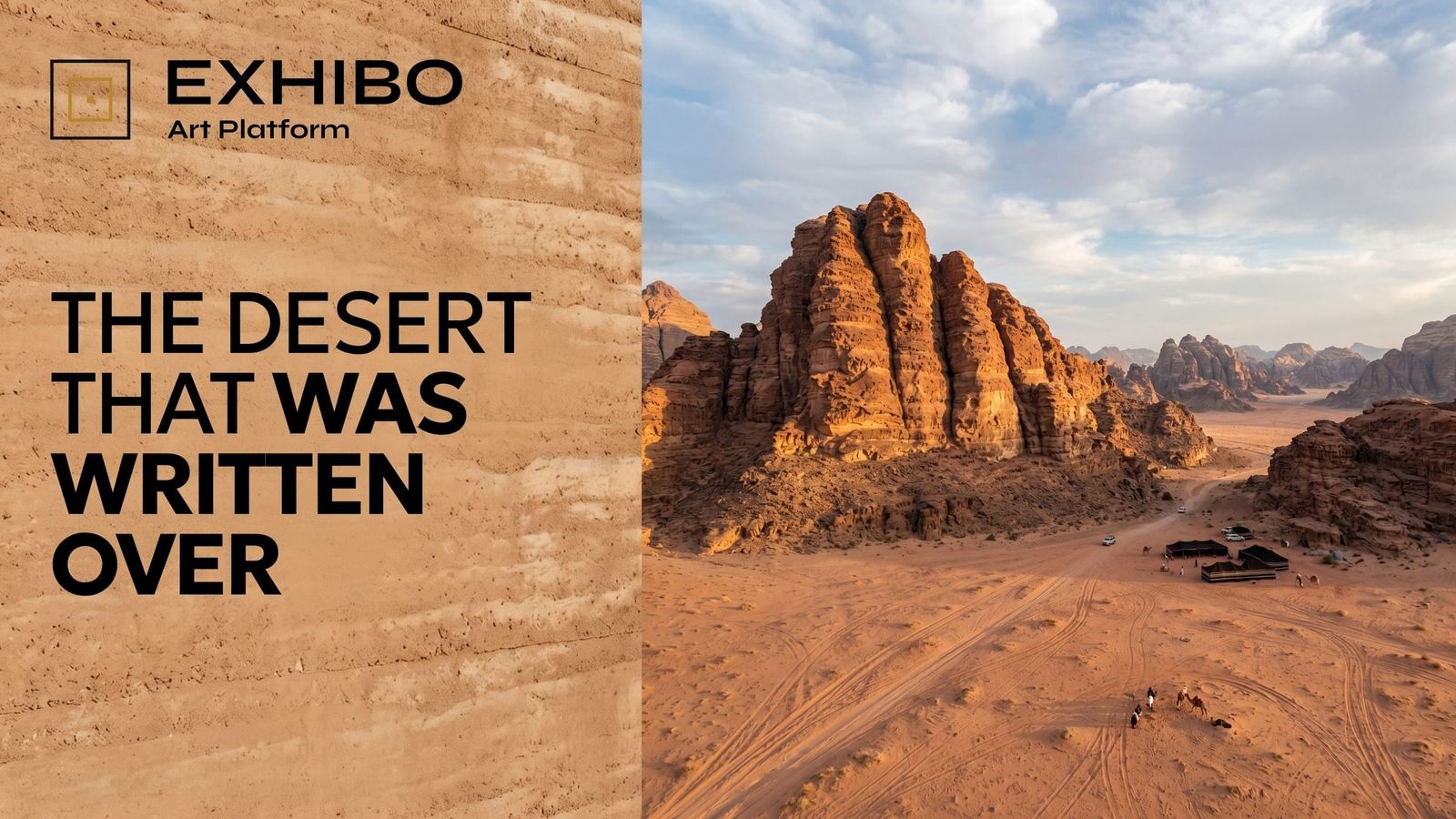
Drive in from Aqaba, past the checkpoint and the visitor centre, and a wall of rock stands up on your left: a broad sandstone massif split into vertical fins, russet at the base and bleached toward the top, catching the low sun the way a cathedral catches it. The handout map marks it as the Seven Pillars of Wisdom, after the book. Guides often tell visitors Lawrence named it. The name has the weight of something settled, something the desert itself decided a long time ago.
It is one of the newest things about the place. Count the fins and you rarely get seven — five stand in plain view, the others round the side, and the shortfall doesn't matter, because the number was never a description. Lawrence does not attach the phrase "Seven Pillars of Wisdom" to this mountain anywhere in his book; he took the title from the Book of Proverbs, from a verse about wisdom hewing out the pillars of her house. By the 1980s the formation had acquired its tourism name, "Seven Pillars of Wisdom," attached to the rock as the desert's Lawrence legacy grew into an industry. The formation has also been known locally as Jabal al-Mazmar, the Mountain of the Plague — though the age and reach of that older name are much harder to pin down than the neat before-and-after story suggests.
Hold the sequence in your hand for a moment, because the whole desert is in it. A rock acquires the title of a book, whose title comes from scripture by way of an author who had used it once already for a different, abandoned book, and the whole chain is bolted onto the sandstone two generations after the war it commemorates. I am not claiming the tourism office thought any of this through; the point is the opposite. The name was not inherited from Lawrence's description of this mountain; it was attached to the formation later, through the tourism afterlife of his book — and it stuck, and it now sits on the map with more authority than names thousands of years older. That is the thing worth watching here. Not which name is true — a desert does not have one true name waiting underneath the others — but why some names acquire the power to make us stop seeing all the rest.
Because Wadi Rum is covered in names, and in the writing of names. It is one of the most heavily inscribed desert landscapes in the world, and for most of the last century it has been famous for something else entirely: for being T. E. Lawrence's Arabia, and later for being Mars. It has stood in for a galaxy far, far away and for the surface of a dying planet and for a British officer's idea of himself. What it is rarely allowed to be, on screen or in the guidebook, is the thing it plainly is: a working archive of human writing, marked into the rock by people who used this landscape for something like twelve thousand years and left, in the most literal sense, their names.
So the question the desert keeps asking, if you let it, is about visibility. Every layer here was put there by someone — the carver, the caravan, the soldier who wrote a book, the American who filmed the soldier, the director who filmed the American's story, the marketing office that renamed the rock, the astrophysicist who saw Mars in the sand. These are not one process, and I don't want to flatten them into one; a carved prayer and a NASA press image are different kinds of act with different kinds of power. What they share is only this: each is a representation laid over the same rock, and each has, in its turn, made the ones beneath it harder to see. The desert holds all of them. It just doesn't privilege the one you came for. The story of Wadi Rum is the story of how one name, for a while, drowned out the others.
The signatures underneath
Start with what is marked into the stone, because it came first and it is still there.
When UNESCO inscribed Wadi Rum as a mixed World Heritage site in 2011 — mixed meaning it qualifies for both its natural landscape and its cultural record, a rare double — the citation put numbers to the writing: on the order of 25,000 petroglyphs, 20,000 inscriptions and 154 archaeological sites, across roughly twelve thousand years of human use. Those figures come from Jordan's nomination dossier rather than any independent recount, and the categories blur at the edges, so hold them loosely. But the order of magnitude is not in doubt, and the claim underneath it is remarkable. The inscriptions run across several North Arabian scripts, and UNESCO's own summary reaches for a striking phrase: the marks testify to widespread literacy among the region's pastoral societies. This was not writing sealed inside a temple or guarded by a priestly class. It appears out in the open, across a landscape used by herders and travellers, cut wherever people passed.
What the marks actually say is harder to recover than the guidebooks let on, and the honest researchers say so. The great camel panels at sites like Alameleh and Anfishiyyeh were made by many different hands over long stretches of time — the variation in the script rules out a single group — and a researcher with the Council for British Research in the Levant, Firas Bqain, has cautioned against the tidy stories visitors are told about them. When a guide explains that the camels all face north because they point toward Petra, the Nabataean capital, Bqain's response is a model of discipline: we cannot assume that. Some inscriptions clearly record ownership, names set beside animals; some read like messages between people who moved through the same hard country. But the confident narration — this one means this, that caravan was heading there — runs well ahead of what the epigraphy can bear. The carvings are older and stranger and less legible than the meanings we press onto them, which is, when you think about it, the same thing that will shortly happen to Lawrence.
The scripts themselves carry a caution worth stating plainly, because it corrects a story often told about this desert. Much of the writing here is labelled "Thamudic" — and "Thamudic," in modern epigraphy, is a residual, umbrella term for Ancient North Arabian scripts that have not yet been fully deciphered or grouped. The Oxford corpus project that catalogues these texts, OCIANA, puts it plainly: Western scholars gave this "pending file" the confusing name Thamudic even though the texts have little or no demonstrable connection with the ancient tribe of Thamud. The label was divided by Fred Winnett in 1937 into rough categories A through E; later work reassigned two of them, so that what was once "Thamudic E" is now called Hismaic, after the Hisma desert that includes Wadi Rum. Many of these inscriptions cannot be securely dated at all. What can be said is that the writing belongs broadly to the millennium or so between the eighth century BC and the fourth century AD, and that the nomadic scripts behave in a way that is almost too apt for this essay: they run in any direction the carver liked — right to left, left to right, downward, in a circle, spiralling — meandering across the uneven rock, over an edge onto the next face, sometimes onto the next stone entirely. Writing not yet disciplined into a line. A whole desert inscribed in every direction, by people writing their names the way you might carve initials into a beam.
There is a temple, too. In the village of Rum, a short walk from where the jeeps gather, stand the low ruins of a Nabataean sanctuary to the goddess Allat, built over the traces of an earlier shrine. On its stones, later Thamudic graffiti runs straight across earlier Nabataean inscriptions — one people writing over another, the whole history of the place compressed onto a single wall. Above the temple, at a spring the Bedouin call Ain Shallaleh, the French Dominican epigraphist Raphaël Savignac recorded Nabataean inscriptions in the early 1930s, and among them, as later epigraphic scholarship sets out, is a dedication to "the great goddess who is at ʾrm" — Allat, invoked as the deity of a place the text calls Iram. It is the same word Savignac and George Horsfield published from the temple itself, dated to the first century AD.
Iram. Keep the word for later, because a great deal has been hung on it, and the hanging is instructive. For now it is enough to say that the oldest legible name attached to this spring is not Lawrence's and not the tourism office's. It is a name cut into rock beside water, a long time ago, in the course of asking a goddess to be remembered.
The man who wrote himself in
Thomas Edward Lawrence passed through the Wadi Rum region during the Arab Revolt against the Ottoman Empire, particularly in 1917 and 1918, as a British liaison officer attached to the forces of Emir Faisal. The bare facts are not much disputed. He was one of several British officers sent to work with the Hashemite leadership; he was clever, physically reckless and genuinely useful; and he was involved in the capture of Aqaba in July 1917, one of the campaign's turning points. What he did with those facts afterwards is the interesting part, because it is where one name in this desert begins to grow larger than the rest.
Lawrence described Rum in Seven Pillars of Wisdom in prose no tourist board has improved on. He wrote of wheeling into the valley at sunset, the cliffs "as red as the clouds in the west"; he called the place, in a phrase everyone borrows, one where "the valley became a mind-landscape." He wrote of "the awe that Rumm compelled on her visitors" — and that phrase is quietly doing a great deal of work, because it is not merely describing awe, it is telling you the place demands it, of visitors, a category into which Lawrence has folded himself and every reader to come. He was not pretending to file a report. He knew exactly what he was making. When he climbs to the spring above the Allat temple and bathes, he calls the ferny crevice a "paradise just five feet square," notices the ancient inscriptions on the rock above him, gives them a sentence, and moves on to the story, which is his. The older names get a glance. The self gets the book.
This is not a knock on him. The writing is superb, and he plainly loved the desert. But Seven Pillars is a literary construction, and the historians who have gone back to the record show where the construction bends. The Modern War Institute's reassessment is a clear, unsentimental example. In the book Lawrence tends to shrink the British contribution to the revolt — the Royal Navy holding the Red Sea supply line, the armoured cars, the aircraft, the artillery, the uniformed and conventionally drilled Arab units, many recruited from former Ottoman prisoners — and to enlarge the romance of the irregular Bedouin column and his own place inside it. Part of that distortion can be read as political and moral rather than vain: Lawrence was acutely conscious of the gap between what had been promised to Arab leaders and the postwar settlement that carved the region into mandates, and heightening the Arab role on the page reads, to several of his biographers, as a kind of restitution for a betrayal he could see coming and could not stop. Whatever the mix of motives, the effect is a desert in which one figure stands unnaturally tall.
The single detail that catches it is a camel. The assault on Aqaba was Faisal's strategic conviction — General Allenby thought the overland approach futile, and Lawrence disobeyed his own superiors to help carry it through — and in the field it was led by Sherif Nasir and the Howeitat sheikh Auda Abu Tayi, with Lawrence advising; the decisive action came not at the port but inland, at Aba el Lissan, where Auda's horsemen swept the Ottoman position. Auda, still a national hero in Jordan, had brought hundreds of fighters and his own legitimacy to the revolt, and had refused repeated Ottoman bribes to leave it. In the film, and in the legend, the Englishman rides at the head of all this. In the record, he was one advisor among Arab commanders — and even his own charge is smaller than the story. In his own telling Lawrence did not sweep heroically onto the enemy; he accidentally shot his own camel dead in the rush and was thrown, and was fortunate to survive the fall. The charge is the version that endures. The shot camel is the version that happened. Between the two runs the whole machinery of legend, and Lawrence was its first and most gifted operator — but, crucially, not its last, and not even its most powerful.
There is a further loop in the title itself. "Seven Pillars of Wisdom" was not first the name of this book. Before the war Lawrence had begun a scholarly work on seven great cities of the Middle East, and that was to carry the title; he later said he had destroyed the manuscript, and he reused the name for the war memoir. So the phrase reaches the war book second-hand, and reaches the Wadi Rum rock third-hand, in the 1980s, from a marketing office. It is worth resisting the temptation to make this a tidy genealogy of cause — the tourism board was cashing in on a famous film, not consciously completing a chain from Proverbs. But the resonance is real and a little uncanny, and it deepens if you go back to the oldest layer. In the Qur'an, the verses that name Iram set it beside ʿimād — pillars, or tent-poles — and place next to it the people "who carved their homes into the rocks of the valley." Pillars and carving in the rock, bound to this stretch of desert in a seventh-century text, long before an Englishman took "seven pillars" from a different scripture and a tourism office pinned it to a cliff. The names do not descend from one another. They rhyme. And the rhyme is the kind of thing a place accumulates when everyone who passes needs it to mean something.
The first modern celebrity
Here is the fact that the Lawrence legend tends to leave out, and it is the hinge of everything after: Lawrence did not make himself a global celebrity. An American did.
In 1918 a young journalist named Lowell Thomas came to the Middle East hunting a war story with popular appeal — the Western Front had offered only mud and mass death, and audiences were exhausted by it. He found Lawrence, had his photographer Harry Chase shoot the Englishman in Arab robes, and after the war built the footage and stills into a live show: a lecture with more than two hundred hand-coloured lantern slides, film segments, music, a dancer. He called it With Lawrence in Arabia. It opened in New York, moved to London, and did not so much succeed as detonate. Reports put the London audience above a million; the opera season at Covent Garden was said to have been held back so the show could run on. Over the following years Thomas took it around the English-speaking world and, by one scholarly count, delivered the lecture more than four thousand times, to more than four million people.
When Thomas found him, Lawrence was known in certain official and press circles but little beyond them. By the time Seven Pillars was widely available he was "Lawrence of Arabia," the "Uncrowned King of Arabia," a household name — and that scale of fame had been made not by his deeds and not even by his own book but by a travelling picture-show. One historian calls him, reasonably, an early celebrity manufactured by mass multimedia performance, decades before television assembled fame out of slides and music and a good-looking man in the right costume. Decades later, Edward Said would give a theoretical vocabulary to precisely this kind of representation — the East staged as spectacle for a Western audience — and Thomas's show reads almost as a rehearsal for it: the blond, blue-eyed Englishman in Bedouin dress as a safe medium through which a ticket-holder could tour an "exotic" desert from a plush seat, the same figure that would run straight into Rudolph Valentino's The Sheik and the whole desert-romance genre.
Lawrence's own response is the human part, and it complicates any simple story of a man overwritten against his will. He went to the show. He wrote to Thomas afterwards, drily, that he had seen it and "thank god the lights were out." He told a friend, of Thomas, "I resent him: but am disarmed by his good intentions." Thomas said Lawrence had a gift for "backing into the limelight" — retreating in a way that guaranteed the spotlight followed. So the man who had enlarged his own role in a book found that role enlarged again, far past his control, by an impresario with a slide projector — and he stood in the wings both wincing and posing for the photographs that strengthened his part. Nobody in this story owns the story. Everybody is editing everybody. The desert only holds the light.
Arabia, filmed almost everywhere
Which brings us to the film, and to the strangest fact in a landscape full of them. Lawrence of Arabia, David Lean's 1962 epic — the film that fixed Wadi Rum in the world's eye as the desert of Lawrence — was, to a surprising degree, not shot in Wadi Rum, and much of its "Arabia" is not Arabia at all.
Some of it is. Lean and his cinematographer Freddie Young spent months in Jordan, and the red cliffs of Rum are genuinely on the screen — Faisal's camp, the well where Lawrence first pulls on his white robes, stretches of the trekking. King Hussein's government made it possible; contemporary press cited by the American Film Institute put the film's battle scenes at as many as fifteen thousand Jordanian Desert Patrolmen and five thousand camel drivers, which is why so many of its "soldiers" are real ones, with the former British minister of state Anthony Nutting brokering access. Hussein visited the set repeatedly; on one such visit he met a young British secretary on the production, Antoinette Gardiner, whom he married the following year, and whose eldest son, Abdullah II, is Jordan's king today. Few locations can claim to have threaded themselves into a country's royal line quite so intimately.
And yet the production could not hold to Jordan. The real Aqaba, a village when Lawrence took it in 1917, had grown into a city by 1962 and could not play its former self, so Lean's team built "Aqaba" from scratch on a Spanish beach, at Playa del Algarrobico near Carboneras in Almería — a set of some three hundred buildings in a dry riverbed — and the film's most triumphant sequence, the Arab army sweeping down to take the port, was shot on the Mediterranean coast. Seville, according to the American Film Institute's catalogue, supplied the "Arabic-Moorish" interiors and streetscapes for the film's Middle Eastern cities; its palaces and plazas stood in for Cairo, Jerusalem and Damascus, sometimes within the same stretch of the schedule. The film's climactic battle sequence was staged at Ouarzazate in Morocco, and the closing credits thank the governments of both Jordan and Morocco — the geography of the finished "Arabia," settled without fuss in the credits themselves, is Jordan, Spain and Morocco.
So the Arabia a generation carries in its head — that vast, sun-hammered, unbroken screen desert — is a composite assembled across three countries, cut together so cleanly the joins never show. Its mythology invites you to read the whole of it as Lawrence's actual desert, the real sand where the real man had ridden. Part of it is. Part of it is a town built on a beach in Almería. Both at once. The desert plays itself in some shots and plays somewhere else in the rest, and no viewer can tell which is which — which is either the highest compliment you can pay a landscape or the start of its disappearance behind an idea of itself, depending on where you stand.
And the casting of the film's most famous entrance tells you exactly how a place like this gets filled in. Sherif Ali first appears as a black dot in a heat mirage, riding in for a long minute before the dot acquires a face and a name. The face took some finding. According to the American Film Institute, Lean had hired a French actor for the part, then objected that the man's green eyes did not contrast sharply enough with Peter O'Toole's blue ones; the production's paper trail, logged by the AFI catalogue, runs through a succession of European actors — Horst Buchholz, then Alain Delon, then Maurice Ronet — none of whom reached the finished film, before Omar Sharif was brought in from Egypt. Sharif's own explanation of why was blunter than any of it: "I spoke English, had black hair, black eyes and a moustache. It was all luck." The land was cast for its colour. So was the man riding across it.
The desert reads back
You might expect a film that lent so much to Jordan, and drew so much from it, to have been embraced there. Its reception was more complicated than that — and the tidy versions of the complication circulate more confidently than the evidence supports. It is widely repeated that the film was banned across much of the Arab world, Jordan included, and that Egypt under Nasser was the exception; much of that traces back to a single oft-copied line, and I have not found documentation firm enough to state the Jordanian ban as flat fact. What is firmly documented is that the film provoked its first sharp objections from people close to its own subject. The contemporary press logged by the American Film Institute records that A. W. Lawrence, the subject's own brother — who had sold the rights — publicly disowned the finished film as fictional "anti-war propaganda"; that Lawrence's biographer Liddell Hart complained it made his subject a "sadistical pervert"; and that a relative of General Allenby disputed its "slanderous" portrait of him. The deeper objection, which historians discuss, is that the film frames Arab society — in its own images, not in the historical record — as a brutal, feuding, tribal world waiting for an Englishman to give it shape, where the historical Faisal, played by Alec Guinness as a wily desert chieftain, was a far more politically sophisticated figure than the film's desert-prince shorthand allows, an Ottoman-schooled statesman who had sat in the Ottoman parliament. The point is not to keep score of distortions. It is that the same reels could be read as insult by some and, by Omar Sharif's own account of the screening he arranged, as a welcome portrait of Arab nationalism by Nasser — because everyone looking at the thing was also being described by it, and no one enjoys being described by a stranger.
Notice, too, who is absent. Lawrence of Arabia runs nearly four hours without a single credited female speaking part — and there was a woman the story could have used. Gertrude Bell — archaeologist, traveller and political officer in Britain's Arab Bureau — worked the same intelligence world as Lawrence, and would go on, after the war, to play a substantial part in the shaping of the new Iraqi state, serving as Oriental Secretary to its High Commissioner and helping steer Faisal onto its throne. When the British met at the 1921 Cairo Conference to settle the region's map, Bell was there in the delegates' photograph — the only woman among them, between Churchill and Lawrence. But she did not write a bestseller, and no Lowell Thomas built a show around her, and David Lean gave her no line. "Anonymous was a woman," as the saying goes. The desert has room for her name. The story we tell about the desert did not keep it.
Mars, and the men who came home
By the time Lean's film had done its work, Wadi Rum had a global image and a peculiar consequence of it: having become so vivid standing in for one thing, it was now available to stand in for anything. And the thing it turned out to do best, in the second half of its screen life, was not Earth.
The red comes from iron oxide in the sandstone, and the geology beneath is a layered clock: a granite basement over a billion years old, then iron-stained sandstone, then paler bands above. Its iron-rich rock and red sediment give it a visual palette strikingly close to many Martian landscapes — close enough that NASA has published Landsat imagery pairing the two, and close enough that Ridley Scott took The Martian there in 2015 and let a stranded astronaut trudge across Jordanian sand as the red planet. Rum has been Mars or its cousins in The Martian, Red Planet, The Last Days on Mars and Prometheus — and, closing a loop that runs through this whole series, it has been an alien world in Rogue One and The Rise of Skywalker, which means the same sandstone that plays Lawrence's Arabia also plays the far edge of the Star Wars galaxy that, four decades earlier, southern Tunisia had played as Tatooine. The region keeps being borrowed to stand at the edge of the imaginable — empire, then space, then myth — and films its borrower's dream and lets the next crew take the story as easily as the sandstone once took the carver's line. It is endlessly accommodating. That is its gift and its trap. A place that will be anything for you is a place you never quite have to see.
But people live here, and they are not backdrop, and this is where the layering turns back on itself. Much of the tourism at Wadi Rum is owned and run by the Zalabia themselves, who hold the guiding, the camps and the jeeps rather than working them for someone else, and some connect their own community to the history of the revolt. The precise identification of the modern "Lawrence's Spring" and "Lawrence's camp" is far less secure than the tourist names imply — but the shape of the thing is unmistakable, and a little vertiginous: a community whose own past brushes against the revolt now makes part of its living guiding visitors through the legend of the revolt, a legend written by an Englishman, enlarged by an American and filmed largely in Spain. They are not passive in it. They decide what to show, what to charge, which story to tell at which rock, and many tell the older one — the carvings, the water, the tribe — to anyone who slows down enough to ask. But the arrangement is almost too neat to miss: the people the desert belongs to now make a living performing the story that overwrote it.
UNESCO, which lists not only the landscape but the cultural space of the Bedu in Petra and Wadi Rum on its Representative List of Intangible Cultural Heritage, has put the pressure into unusually blunt words. The rise of desert tourism, its citation warns, and its demand for "authentic Bedu culture," should not be allowed to further degrade the intangible heritage of the Bedu of Petra and Wadi Rum. Read that twice. The appetite for authenticity is itself named as a threat to the authentic — because a culture asked to perform its own past on schedule, for an audience with fixed expectations, slowly tilts toward the performance. The place is being asked, once again, to play itself. It is the oldest problem in this desert wearing new clothes, and it is the same problem the guidebook enacts at the entrance when it points at Jabal al-Mazmar and reads out the name of a book.
The names it answers to
Go back up above the Allat temple to Ain Shallaleh, where Lawrence bathed and wrote his paradise five feet square, and the water is still there, thin as a wrist, falling into its shallow pool. On the rock beside it are the older marks: the Nabataean invocations to Allat, the great goddess named as the goddess of Iram, cut into the stone by people who wanted her to remember them.
It is tempting to end by crowning that word — to say there, that is the true name, the first and deepest, the one the modern name Rum still carries, and everything since is only noise on top of it. Scholars have indeed argued that the ancient name of the site was ʾrm, a form compatible with the Qur'anic Iram, and the inscriptions that carry it are real and published. But "compatible with" is a careful phrase, and the case is a case, not a verdict — the descent of the modern name Rum from it is not settled, the identification with the Qur'anic Iram is one reading among others, and even in the inscriptions the word may attach to the sanctuary or its immediate district rather than to the whole valley. And to reach for Iram as the answer would be to do exactly what this desert should have taught us not to do: to pick one name out of the layers and let it silence the rest.
The desert does not have a single true name waiting underneath the others. It has names in courses, laid down by people who each needed something different from the same red rock. Iram is one of the oldest we can still read. Lawrence is one of the loudest. Seven Pillars is one of the newest, barely older than the jeeps. Mars may be the most temporary of all — it will last exactly as long as the films do. The carvers who covered these cliffs in writing that runs in every direction were not performing the desert for anyone; they were marking ownership, saying a name, finding water, asking to be remembered. Twenty-five thousand times, more or less, and almost no one who comes to Wadi Rum comes to read them. They come to see the mountain a tourism office renamed, in a landscape a film taught them to recognise, on a planet a space agency borrowed.
None of those names is false. That is the hard part. Lawrence really rode here; Lean really filmed here; the rock really is the colour of Mars; the people who guide you really do belong to this desert; the cliff really was renamed, and people really do come because of it. The desert holds all of it without protest, the way it has always held whatever was cut into it. The question was never which name is true. It is why one name, for a while, grows loud enough to make us stop reading everything written underneath — and whether, standing at the spring with the old inscriptions at eye level, we can learn to hear more than the loudest one.
Related reading
Sharjah Biennial 17 Unveils Curatorial Vision and Opening Schedule
Angela Harutyunyan and Paula Nascimento frame the 2027 edition around archival residue and spatial memory
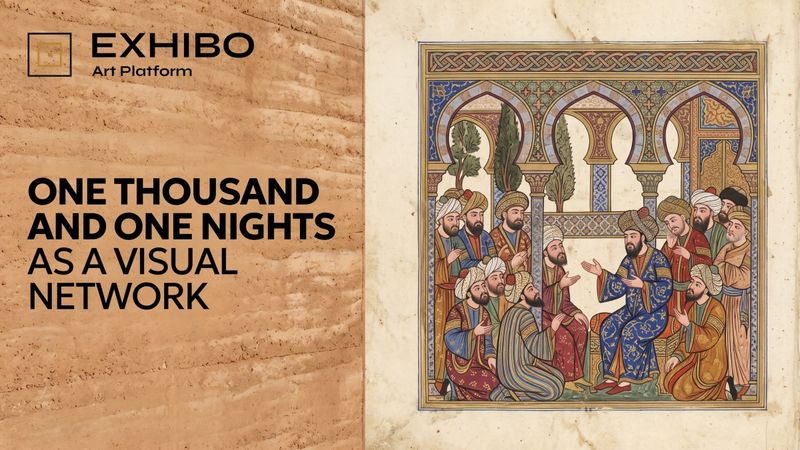
One Thousand and One Nights as a Visual Network
The book that taught Europe to picture the East arrived with no pictures at all. Three centuries of illustrators — Dutch, Egyptian, Persian, French, German, Iraqi — each gave it a face, and every face was a self-portrait.
Contemporary Istanbul Expands Footprint and Eyes Anatolian Markets
Founder Ali Güreli outlines spatial upgrades, Asian focus, and proposed fiscal incentives for the growing fair