
Exhibo Editorial
The Self-Portrait: A History
Mirrors, signatures and a free model: how painters made themselves the sitter from van Eyck’s 1433 panel to photography
A self-portrait is a likeness the artist makes of their own face or body. The sitter and the maker are the same person, or claim to be. Museum teaching treats that claim as a distinct practice, not a subset of court and civic portraiture. Portraiture’s job is to make another person useful: ancestor, donor, ruler, spouse. Self-portraiture’s job is to make the maker visible as a professional, a pious witness, a marketable type, or a body available for study when models cost money.
This guide follows the conditions that produced the independent self-image in European workshops, the visual habits that mark one, the painters who treated the practice as a career-long task, four works you can stand in front of, the mutations into print, allegory and photography, the critics who called the habit vanity or autobiography, and the residue left in collections. Famous-face rankings belong elsewhere. Frida Kahlo appears once as a twentieth-century example, not as the article. For the wider map of genres, start at Genres and Symbolism in Art. Holdings for the works below sit in the museums directory.
The conditions that produced the practice
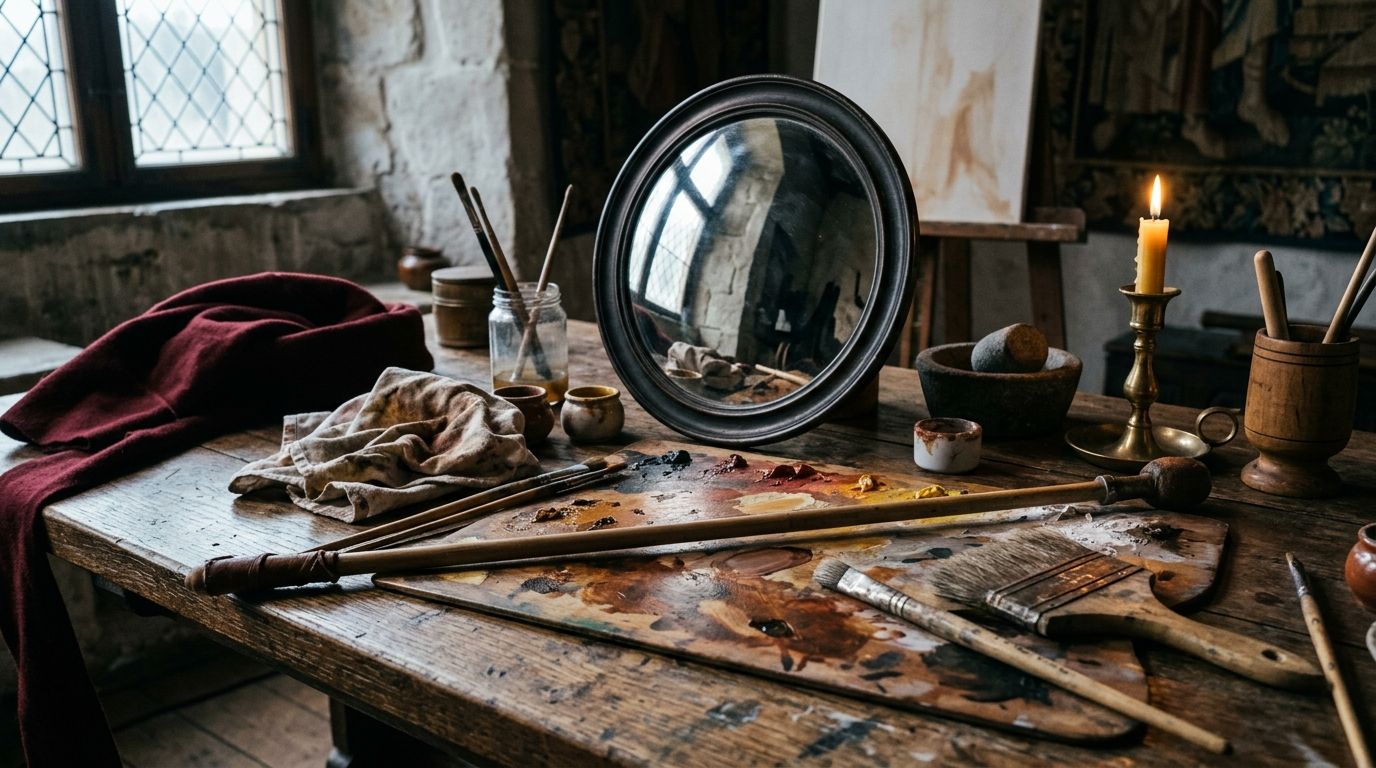
A self-portrait needs a surface, a trained hand and a way to see oneself. Before cheap, clear glass, that last requirement was the bottleneck. Polished metal and small convex glasses showed a warped, dim field. Venetian and northern glassmakers in the later fifteenth century made larger, flatter looking-glasses more common in prosperous houses. Painters still used convex barber’s glasses when they wanted a compact studio interior, as Parmigianino did on a turned wooden disc about 1523-24. The mirror is a tool, not a metaphor until later writers make it one.
The second condition is a reason to spend panel and pigment on yourself. Medieval makers appear as tiny donors or as signatures in stone: a mason’s face on a capital, Ghiberti’s bronze head in the frame of Florence’s Baptistery doors. Lorenzo Ghiberti (1378-1455) placed his likeness among the prophets on the Gates of Paradise (1425-52, Museo dell’Opera del Duomo, Florence) and signed the work as admirable art by his own hand. That is authorship inside a civic commission. Jean Fouquet’s enamel roundel of about 1452–55 (Musée du Louvre), gold on black copper about six to eight centimetres across, is often named among the earliest surviving independent European self-images. The Louvre records that it once decorated the frame of the Melun Diptych, so “independent” is contested: it is a signed painter’s head that lived on another work’s border, not a gallery panel made for its own sake. Van Eyck’s 1433 London panel is earlier if you accept the self-portrait identification.
Oil on wood then gave a face that could travel as a portable object. Jan van Eyck, salaried painter to Philip the Good of Burgundy, dated the London Portrait of a Man 21 October 1433 and wrote his motto on the original frame. Independent likeness of living people was already a paid genre in the Netherlands. Turning that genre on the painter himself advertised skill to patrons who might never sit. A workshop also needed heads. Students copied the master’s features. Rembrandt’s shop later used that drill so often that the Rembrandt Research Project stripped many “self-portraits” from the autograph list. The National Gallery of Art in Washington still cites about 80 images in paint, drawing and print as his; the National Gallery in London uses the same round figure across the 40-year career, more than any peer of his generation. Counts move when attribution moves.
Money sits under the romance. Vincent van Gogh told Theo in September 1888 that if he could paint the colour of his own head he could paint other heads; the Van Gogh Museum records more than 25 of the known painted self-portraits from the Paris years 1886-88, when models were scarce and canvas dear. He painted some on the reverse of earlier studies. The “free model” is a workshop fact before it is a psychology.
A third condition is a public that wants the artist as a type. Charles I collected painters’ self-images. Vasari’s Lives taught readers to look for the maker’s face. Print multiplied a head faster than oil. Those markets, not an awakening of interiority, explain why the independent self-portrait thickens after 1400 in Europe.
Definition and characteristics
Tate and Art UK treat a self-portrait as a representation of the artist by the artist, in any medium. The claim can be secure (a signature that says “I painted myself”), probable (mirror-crane of the neck, reversed collars, a painter’s tools), or conventional (a face in a crowd that later catalogues identify from other images). The National Gallery titles van Eyck’s 1433 panel Portrait of a Man (Self Portrait?) because no second confirmed likeness of Jan exists. Probability is part of the definition.
Characteristics recur. The head occupies enough of the field that you read the picture as about this person. Gaze often meets you because the painter looked at a glass while working; slight divergence of the eyes, as in the London van Eyck, can record looking at each eye in turn. Costume may be Sunday cloth, studio rags, antique dress or an allegorical gown. Attributes name the trade: palette, brushes, maulstick, easel, a convex glass, a fur collar that quotes a master’s prosperity. Scale ranges from Fouquet’s enamel to full-length canvases. Medium matters. An etching of Rembrandt pulling a face is a tronie, a study of expression sold as a print, as much as a document of mood.
The practice splits into jobs that overlap.
| Period | Job of the self-image | Typical format | Anchor work | Where to see it |
|---|---|---|---|---|
| 1425-52 | Authorship inside a civic commission | Gilded bronze head in a door frame | Ghiberti, Gates of Paradise | Museo dell’Opera del Duomo, Florence |
| 1433 | Skill, motto, probable independent likeness | Oil on oak, original inscribed frame | van Eyck, Portrait of a Man (Self Portrait?) | National Gallery, London |
| c. 1452–55 | Signed painter’s head on another work’s frame | Gold on black enamel, copper roundel | Fouquet, self-portrait (Melun Diptych frame) | Musée du Louvre |
| 1500 | Front-facing claim on making and piety | Oil on limewood | Dürer, Self-Portrait with Fur-Trimmed Robe | Alte Pinakothek, Munich |
| c. 1523-24 | Demonstration piece for a papal court | Oil on convex wooden disc, 24.4 cm | Parmigianino, Self-Portrait in a Convex Mirror | Kunsthistorisches Museum, Vienna |
| 1548 | Woman at the easel, signed age 20 | Oil on oak | Catharina van Hemessen, Self-Portrait at the Easel | Kunstmuseum Basel |
| c. 1638-39 | Painter as allegory of Painting | Oil on canvas, 98.6 × 75.2 cm | Artemisia Gentileschi, La Pittura | Royal Collection |
| 1669 | Late flesh, market and study | Oil on canvas, 86 × 70.5 cm | Rembrandt, Self Portrait at the Age of 63 | National Gallery, London |
| 1886-89 | Cheap model, colour drill, illness recorded | Oil, sometimes on reused canvas | van Gogh, Paris and Saint-Rémy heads | Van Gogh Museum; Courtauld; others |
| 1977-80 | Identity as a series of roles | Gelatin silver prints | Cindy Sherman, Untitled Film Stills | Museum of Modern Art, New York |
The table maps functions. It is not a ranking of famous self portraits.
Independent panel, inserted face, allegory
Independent panels and canvases present the artist as the sole or dominant sitter. Dürer’s three painted self-portraits (1493 Louvre; 1498 Prado; 1500 Munich) belong here. So do Rembrandt’s late heads and van Hemessen’s Basel easel picture.
Inserted faces put the maker inside another subject: a bystander in a biblical crowd, a reflection in armour or a convex mirror, Velázquez at the easel in Las Meninas (1656, Prado). That last picture is a court group portrait that includes the painter. The sibling essay on portraiture owns the household geometry. Here the point is narrower: inclusion can function as a signature without making the whole work a self-portrait in the strong sense.
Allegorical self-portraiture fuses the person with a personification. Cesare Ripa’s Iconologia described Painting as a woman with wild hair, a mask pendant and changing-colour drapery. Artemisia Gentileschi could occupy that figure in a way male painters could not. The Royal Collection’s Self-Portrait as the Allegory of Painting (c. 1638-39) is both a likeness and a claim that the art and the woman are one body. Later painters used saintly, apostolic or historic dress the same way: Rembrandt as the Apostle Paul (1661, Rijksmuseum) is a self-portrait and a history picture at once.
How you decide the sitter is the maker
Signatures help and mislead. Van Hemessen wrote in Latin that she painted herself in 1548 at the age of 20. Dürer wrote that he portrayed himself in appropriate colours aged twenty-eight. Van Eyck wrote that he made the panel on a named day, which is authorship of the object, not proof of the face. Catalogue titles with a question mark are honest.
Optical clues: a raised drawing arm that would be the left in life because the mirror reverses it; a collar fastening on the “wrong” side; a neck craned toward an unseen glass. Workshop clues: the same head on student copies; a stock of etched expressions. Documentary clues: inventories that already call a picture a self-image, as the 1655 Amsterdam inventory of Alathea Talbot appears to do for the London van Eyck. When two of those classes agree, curators drop the question mark. When they do not, you live with the doubt.
Key figures who set the terms
Patrons and collectors created demand. Burgundian and Italian courts paid for skill on display. Rudolf II absorbed Parmigianino’s convex disc into the imperial collection in 1608. Charles I owned self-portraits, including one by Rembrandt. Print publishers sold etched heads to buyers who would never commission an oil.
Among painters, a short European sequence still organises rooms. Jan van Eyck (d. 1441) showed that oil could make a signed, dated, close head that later owners read as the artist. Albrecht Dürer (1471-1528) treated the independent self-portrait as a public statement in three painted versions and in drawings from adolescence onward. Catharina van Hemessen (1528-after 1567) is, on present evidence at Kunstmuseum Basel, the earliest known woman to paint herself at the easel with palette and brushes. Sofonisba Anguissola (c. 1532-1625) repeated the easel type and carried it to the Spanish court. Artemisia Gentileschi (1593-1652 or later) made the allegory of Painting occupy her own features while in London.
Rembrandt van Rijn (1606-1669) turned repetition into a practice. Early Leiden etchings grimace and costume-play; Amsterdam oils of the 1630s sell a prosperous master; late canvases in London, The Hague, Kenwood and the Frick thicken paint until skin is a relief. Students copied the type, which is why counts of “eighty” mix autograph work with shop versions. Joshua Reynolds and later academicians still ranked portraiture below history painting; self-portraiture inherited that snobbery and also paid the rent.
Vincent van Gogh (1853-1890) produced, on the Van Gogh Museum’s count, no fewer than 35 painted self-portraits, most in Paris (the museum says over 25 from 1886-88; Art UK’s 2022 survey counts 27 of 35 as Paris pictures), plus drawings that some FAQ totals take to 39. One studio photograph of him at nineteen survives; the painted heads are how the public knows the face. Frida Kahlo (1907-1954) built a twentieth-century vocabulary of costume, injury and Mexican Catholic and folk signs around her own features. Self-Portrait with Thorn Necklace and Hummingbird (1940, Harry Ransom Center, University of Texas at Austin) is the example this article will use, not a life story. Cindy Sherman (b. 1954) removed the fiction of a single authentic face: the Untitled Film Stills (1977-80) are self-portraits in which the person is a genre.
Women are not a coda. Van Hemessen, Anguissola, Gentileschi, Judith Leyster (self-portrait, National Gallery of Art, Washington), Élisabeth Vigée Le Brun and Kahlo used a genre academies would pay women to practise, because the sitting could happen without a male nude model and without a history-painting commission. The nude as a problem belongs in the nude in art history.
Mirrors, reversals and the left hand
A self-portrait is an optical problem before it is a confession. The painter looks at a glass, then at the panel, then back. Each glance costs alignment. A convex glass, the kind a barber kept, squeezes a room into a disc and swells whatever sits near the surface. Parmigianino had a turner make a wooden hemisphere, then painted what the glass showed: a huge foreground hand, a receding studio, a gilt frame slipping in at the rim. The Kunsthistorisches Museum records that he took the disc to Rome about 1524 as a gift to Clement VII, a job application in oil. Vasari, writing later, treated the lustre of the glass as the point. The face on that disc is less distorted than the hand. He protected the likeness and let the tool display itself in the flesh that held the brush.
Flat glass reduces that circus and introduces another error: left and right change places. A cloak that buttons on the sitter’s right will appear to button on the left. A painter’s working hand, if shown as the hand nearest the viewer, may be the left in life. Catalogues sometimes use that reversal as evidence, with caution, because a painter can correct it. Van Eyck’s mismatched eyes, the National Gallery suggests, record the habit of studying each eye in turn in the glass. Rembrandt’s etchings, printed from a plate, reverse the face again, so an etched self-portrait is a mirror of a mirror unless he compensated on the copper.
None of this requires a theory of the self. It requires a room with a glass, enough light to model a forehead, and time. Sitters who paid for portraits would not hold a grimace or a three-hour stare. The painter’s own head would. That is why the cheap-model argument and the optical argument are the same argument. The body in the glass is the one that stays.
Four works to stand in front of
Close looking beats a numbered list of celebrity faces. The four pictures below occupy different jobs: a probable independent likeness with a motto; a frontal claim modelled on Christ icons; a late head that later viewers read as confession; a woman who is both painter and Painting. Dates and locations follow museum records. You could swap in Parmigianino’s disc, van Hemessen’s Basel panel, or a Paris van Gogh and still learn the practice. These four keep Bruges, Nuremberg, Amsterdam and London in one conversation and stay visitable.
Each work rewards time with costume, inscription and the handling of paint. Read them as objects with jobs, not as windows onto a private soul that the archive cannot show.
Jan van Eyck, Portrait of a Man (Self Portrait?), 1433
The National Gallery’s panel measures 26 × 19 cm, oil on oak, original frame carved from the same wood at the sides. The upper inscription gives the motto Als Ich Can in Greek letters, a pun on Eyck and a Flemish saying the Gallery glosses as “as I can [but not as I would]”. The lower line in abbreviated Latin states that Jan van Eyck made the object on 21 October 1433. The man wears a piled red chaperon and a fur-trimmed houpelande. The Gallery notes that the background is now dark over a lost blue, and that the sitter’s shoulders are narrowed so the head dominates.
The case for self-portraiture is optical and documentary, not a second confirmed face. The sitter cranes forward as if at a glass; the eyes do not quite agree. A 1655 inventory of pictures from the Arundel-Talbot circle appears to list a portrait of Jan van Eyck by his own hand. Earlier, Peeter Stevens thought he had seen a “Duke of Barlaumont” dated 1433. The Gallery keeps the question mark and still calls the identification almost certain. What the picture does, whoever sits, is advertise oil’s command of stubble, vein and cloth on a portable panel a court painter could show.
Stand close enough to see the dabs that make the beard: darker brown first, then lighter, some mixed with a little blue on the chin. That is workshop speed, not microscopic labour. The frame’s squeezed letters for October show a planner who ran out of space. Authorship here is a date, a motto and a face that later centuries needed to be Jan’s.
Albrecht Dürer, Self-Portrait with Fur-Trimmed Robe, 1500
The Alte Pinakothek in Munich holds the limewood panel (67.1 × 48.9 cm, inv. 537), bought from Nuremberg in 1805. The museum’s Latin inscription in English runs: Dürer of Nuremberg portrayed himself in appropriate colours aged twenty-eight. The pose is frontal, hair falling in ringlets, right hand at the fur, a format the Pinakothek compares to icons of Christ the Saviour with a blessing hand. The year 1500 sits with the AD monogram. Scholars have linked the date to humanist millennial talk around Conrad Celtis; the museum text stresses seeing and making: the gaze and the hand.
This is the last of three painted self-portraits. The 1493 Louvre picture holds a thistle; the 1498 Prado picture shows a dressed young man after the first Italian journey. Munich drops fashion display for a hieratic axis. The fur is a craftsman’s luxury and a quotation of sacred painting. Dürer does not include brushes. Status here is theological and civic: a Nuremberg painter who can occupy a format reserved for the Redeemer without ceasing to be a particular man with a parted beard.
The panel spent generations on public view in Nuremberg before the Bavarian purchase. It was already a civic relic of the city’s famous son. That afterlife is part of the work’s meaning. A self-portrait can become a local monument.
Rembrandt, Self Portrait at the Age of 63, 1669
Oil on canvas, 86 × 70.5 cm, National Gallery NG221, signed and dated, bought in 1851 from the Midleton sale. The Gallery identifies it as one of three self-portraits from the months before Rembrandt’s death in 1669. X-rays show he first painted himself as an artist at work, hands open around what seems a brush, then closed that motif so the face would hold you. Light hits the high forehead, the nose, the pitted brow. The robe and folded hands stay sketchy. Paint on the face is thick: a loaded swirl under the right eye, coagulated blotches on the forehead, translucent greys, pinks and yellows stacked like skin.
Nineteenth- and twentieth-century viewers read confession, weariness, a man facing death. The Gallery’s own wall logic is cooler. Seventeenth-century ideas of the mind were not ours. A painter in his sixties could study ageing flesh on a model who would sit without complaint, then sell the result to collectors who already prized artists’ heads. Charles I had owned a Rembrandt self-portrait. The look in the eye may be professional attention.
Compare this canvas with Kenwood’s Self-Portrait with Two Circles (c. 1665), where the painter holds tools before two drawn circles, a claim on craft that NG221 suppressed. Together they show that “late Rembrandt” is a set of choices about whether the trade remains visible.
Artemisia Gentileschi, Self-Portrait as the Allegory of Painting, c. 1638-39
The Royal Collection’s canvas (RCIN 405551, 98.6 × 75.2 cm) is the one work with a secure attribution from Gentileschi’s London stay at the court of Charles I and Henrietta Maria. She leans forward, brush and palette in hand, hair loosened, a gold chain with a mask, drapery that shifts colour. Ripa’s personification of Painting supplied the attributes. A female painter could wear them on her own face. Male colleagues could paint La Pittura as another woman; they could not be her.
The picture entered Charles I’s collection, left it in the Commonwealth sale, and returned after 1660. It is a court object and a theoretical object. Energy in the pose, the foreshortened arm, the dark ground, all insist that making is physical work. If van Eyck’s motto is modest skill and Dürer’s inscription is a named age, Gentileschi’s claim is ontological: the art has her features.
Read this beside van Hemessen’s small Basel oak of 1548, where the twenty-year-old sits at an easel with a maulstick and writes that she painted herself. Ninety years apart, both pictures put tools in the field. Gentileschi adds allegory. The easel type and the allegory type are two solutions to the same problem: how a painter proves the sitter is the maker.
How the practice spread and mutated
Once independent heads existed, shops copied them, prints sold them, and academies taught students to draw their own faces because the model was free. Italian and Netherlandish types crossed the Alps in both directions. Dürer’s prints taught Italy a northern linear pride; Venetian oil taught Germany softness. Women in family workshops inherited the easel composition as a respectable demonstration of competence. Anguissola’s self-portraits at the easel and with a spinet travelled as gifts. Judith Leyster’s Washington self-portrait turns in the chair as if interrupted, a Dutch comic timing that still names the trade.
Print changed the economics. Rembrandt’s etched tronies reached buyers who never entered the studio. Later, lithography and photogravure put van Gogh’s straw hat into bedrooms that had never seen the canvas. The self-portrait became a reproducible face of “the artist” as a social type: solitary, marked, intense. That type is a modern product. Seventeenth-century sitters had other reasons.
Photography, from 1839, stole cheap likeness the way it stole court portraiture’s monopoly on resemblance. Painters kept the self-image because oil could still invent a person photography had not fixed.
Easel pictures, prints and the serial face
The easel self-portrait is a demonstration: here are my tools, here is my hand, here is the work in progress (often a blur, because a second portrait inside the portrait is a trap). Van Hemessen, Anguissola, Leyster and Gentileschi all use it. Courbet’s The Desperate Man (c. 1843-45) mutates the type into a Romantic outburst, hands in the hair, eyes wide, still a professional display of how far expression can go. Qatar Museums now owns the canvas; from October 2025 it has been on long loan at the Musée d’Orsay, with a later destination at the Art Mill Museum, Doha. Confirm the hang before you travel.
Serial self-portraiture is a second mutation. Rembrandt’s decades, van Gogh’s four concentrated years, Kahlo’s repeated costume and injury, Sherman’s film stills: the meaning sits between images. One Kahlo canvas is a symbolic construction; the series is a maintained persona. Self-Portrait with Thorn Necklace and Hummingbird (1940) places a dead hummingbird, a cat, a monkey and thorns against leaf and butterfly. The picture is iconography as much as likeness. It is not a biography in paint, and this article will not write one.
Andy Warhol’s 1986 silkscreened self-portraits (Andy Warhol Museum, Pittsburgh, and other versions) treat the face as a celebrity unit, repeated and dyed. The mutation is mechanical: the artist is a brand the shop can reprint. Cindy Sherman’s Untitled Film Stills refuse even that stable brand. She is the actress, the lighting, the genre. The self-portrait survives as a question about whether a self is available to portray.
After the camera
Once anyone could fix a face, painters used distortion, costume and refusal. Picasso’s self-images shatter planes. Bacon borrowed from photographs and from van Gogh. Performance and video made the body the medium; the still photograph of the action then re-entered museums as a self-portrait. Smartphone “selfies” inherit the cheap-model logic van Gogh named, without the oil, the motto or the guild. Academic papers that line up Renaissance heads with phone photographs find shared three-quarter angles and arm’s-length distortion. The comparison is real as optics and thin as history. A 1433 panel with a carved motto is not a social-media post.
Museum exhibitions keep restaging the lineage. The National Portrait Gallery’s Self Portrait: Renaissance to Contemporary (2005-06, with the Art Gallery of New South Wales) is one standard survey. Later hangs, including Smithsonian and NPG education pages, still start from Dürer and Rembrandt because those names organise loans. The practice spread because workshops, prints and then cameras made the artist’s face a portable commodity.
Critics then and now
Academic theory in the eighteenth century placed history painting at the top and portraiture below, as Reynolds’s Discourses taught students at the Royal Academy. Self-portraiture sat even lower in that scale when it looked like vanity, and rose when it could be recast as study or as allegory. Vasari had already praised Parmigianino’s disc as a marvel of intellect. Praise and suspicion travel together.
Nineteenth-century writers invented the wounded genius. Van Gogh’s bandaged-ear canvases (Courtauld; a related private Bandaged Ear and Pipe) and the Oslo 1889 head became evidence in a medical romance the Van Gogh Museum resists: he painted to practise heads and, after December 1888, to work toward recovery, not to stage pity. Rembrandt’s late flesh became “honesty” in a Protestant key. Both readings say more about the critic’s century than about the studio.
Twentieth-century psychoanalysis treated the self-portrait as a symptom. That habit over-reads costumes and under-reads markets. Feminist art history recovered van Hemessen, Gentileschi and Kahlo from anecdotal footnotes and asked who was allowed to sit as Painting. The recovery is archival, not a mood. Postmodern criticism, with Sherman as the exhibit, treated the authentic self as a costume shop. Each school leaves a useful caution. Vasari’s wonder at illusion, Reynolds’s rank-order, the National Gallery’s warning against existential angst in 1669, and Sherman’s serial roles can sit in one history without a winner.
A current confusion is commercial. Search “self-portrait” and you meet a fashion label, school assignments and phone photography. “Famous self portraits” returns listicles and print shops. This essay stays with the historical practice. The clothing brand is a homonym.
What the practice left behind
Museums now hang artists’ faces as a way to introduce a school: Dürer in Munich Room I, Rembrandt in London and Amsterdam, van Gogh in a dedicated museum that holds the family group of Paris heads. The self-portrait is a pedagogical shortcut. Visitors recognise a person and then learn a technique.
It also left a contract. Later painters who refuse likeness still owe the genre an answer: why this body, why this repetition, why these tools. Conservation science left another residue. X-rays of NG221, the National Galleries of Scotland’s 2022 finding of a hidden van Gogh head on the reverse of a canvas, and the National Gallery’s note that van Eyck’s background was once blue, all remind you that the “self” is a layered object.
What did not survive as a single origin story is the “first” self-portrait. Egyptian sculptors, medieval masons, Ghiberti’s bronze, Fouquet’s enamel and van Eyck’s dated panel are different jobs. PAA boxes that ask who invented the form want a name. Give them a sequence.
The leftover for the viewer is practical. When you stand in front of a self-portrait, ask what the picture had to do in its first room: prove skill, sell a print, occupy an allegory, practise colour, fill a royal collection of artists’ heads. Then look at the paint. The history of self portraiture is a history of labour that used the nearest body.
FAQ
Who painted the first self-portrait?
No single inventor exists. Ancient makers included their own features in reliefs and tomb programmes. In surviving European objects, Ghiberti’s bronze heads on the Florence Baptistery doors (north door and Gates of Paradise, 1425-52) are early, signed, civic self-images. Fouquet’s Louvre enamel of about 1452–55 is often called among the earliest independent roundels, though it sat on the Melun Diptych frame. Van Eyck’s 1433 London panel is among the earliest oil candidates, with a catalogue question mark. Dürer’s 1500 Munich panel is the first that later museums treat as an iconic independent statement. “First” depends on whether you mean inserted, independent, painted or signed.
Who invented the self-portrait as a genre?
Workshops in the fifteenth-century Netherlands and German cities, together with Italian painters who needed demonstration pieces, turned occasional likenesses into a repeatable product. Better glass, oil technique, Vasari’s biographies and collectors who wanted artists’ heads (Charles I, Rudolf II) made the genre durable. It is a craft history, not a patent.
Why did Rembrandt paint so many self-portraits?
The National Gallery cites about 80 images in paint, etching and drawing across forty years, more than his contemporaries. Motives the Gallery lists include practice in expression and light, enhancement of a professional image, and sale to collectors. The Rembrandt Research Project reduced older counts of painted autograph heads to something over forty, because students copied the master’s face. Late pictures such as NG221 also let him study ageing skin on a patient model.
Why did van Gogh paint himself?
The Van Gogh Museum is blunt: he needed to practise people, models cost money, and in Paris he was poor. He wrote to Theo that painting his own head would train him for other heads. No fewer than 35 painted self-portraits are known; most date from 1886-88 (over 25 in Paris on the museum’s own count). After he injured his left ear in December 1888 he made two bandaged-ear pictures and related heads. Totals that reach 39 include drawings. The museum frames the bandaged pictures as work toward recovery, not a bid for pity.
What is the most famous self-portrait?
Search engines and listicles cycle Dürer 1500, Rembrandt’s late heads, van Gogh’s bandaged ear or straw hat, and Kahlo’s thorn necklace. Fame here means reproduction count, not a scholarly prize. A responsible answer names the job of each picture and sends the ranking impulse to a different kind of article.
Is a selfie a self-portrait?
A phone image of one’s own face fits the broad glossary sense of a self-portrait. The European practice this article maps is a workshop product with patrons, inscriptions and museum afterlives. The selfie inherits the cheap-model problem and the arm’s-length distortion of a convex glass. It does not inherit Dürer’s Latin claim or Gentileschi’s Ripa attributes unless someone puts them there.
Who is the fashion brand Self-Portrait?
A contemporary clothing label. It has no bearing on the art-historical practice. If you searched for garments, you have the wrong page.
Where can I see important examples in person?
London: van Eyck NG222 and Rembrandt NG221 at the National Gallery; van Gogh’s Bandaged Ear at the Courtauld; Gentileschi in the Royal Collection when displayed (Hampton Court and Buckingham Palace hangs rotate). Munich: Dürer, Alte Pinakothek. Amsterdam: Rembrandt and van Gogh museums. Basel: van Hemessen. Vienna: Parmigianino. Florence: Ghiberti’s doors in the Opera del Duomo museum. Check current display before you travel; self-portraits go out on loan.
Related reading
Ana Vaz: The Camera is the Body at Mudam Luxembourg
Mudam stages the inaugural major institutional survey of the Brazilian filmmaker's interdisciplinary practice
An immersive exhibition reimagines cinematic perception through embodied filmmaking, ecological inquiry, and postcolonial critique.
Lovis Corinth: Then Came Berlin!
How a mid-life relocation ignited a German modernist revolution
An expansive survey at the Berlinische Galerie traces how Lovis Corinth's 1901 move transformed him into a cornerstone of early twentieth-century avant-garde practice.
Bridging Japanese Craftsmanship and Contemporary Design
How international makers engage with Tokai's industrial heritage at the V&A
An exploration of how global designers collaborate with Japanese artisans to fuse ancestral techniques with modern conceptual frameworks.