
Dubai · United Arab Emirates
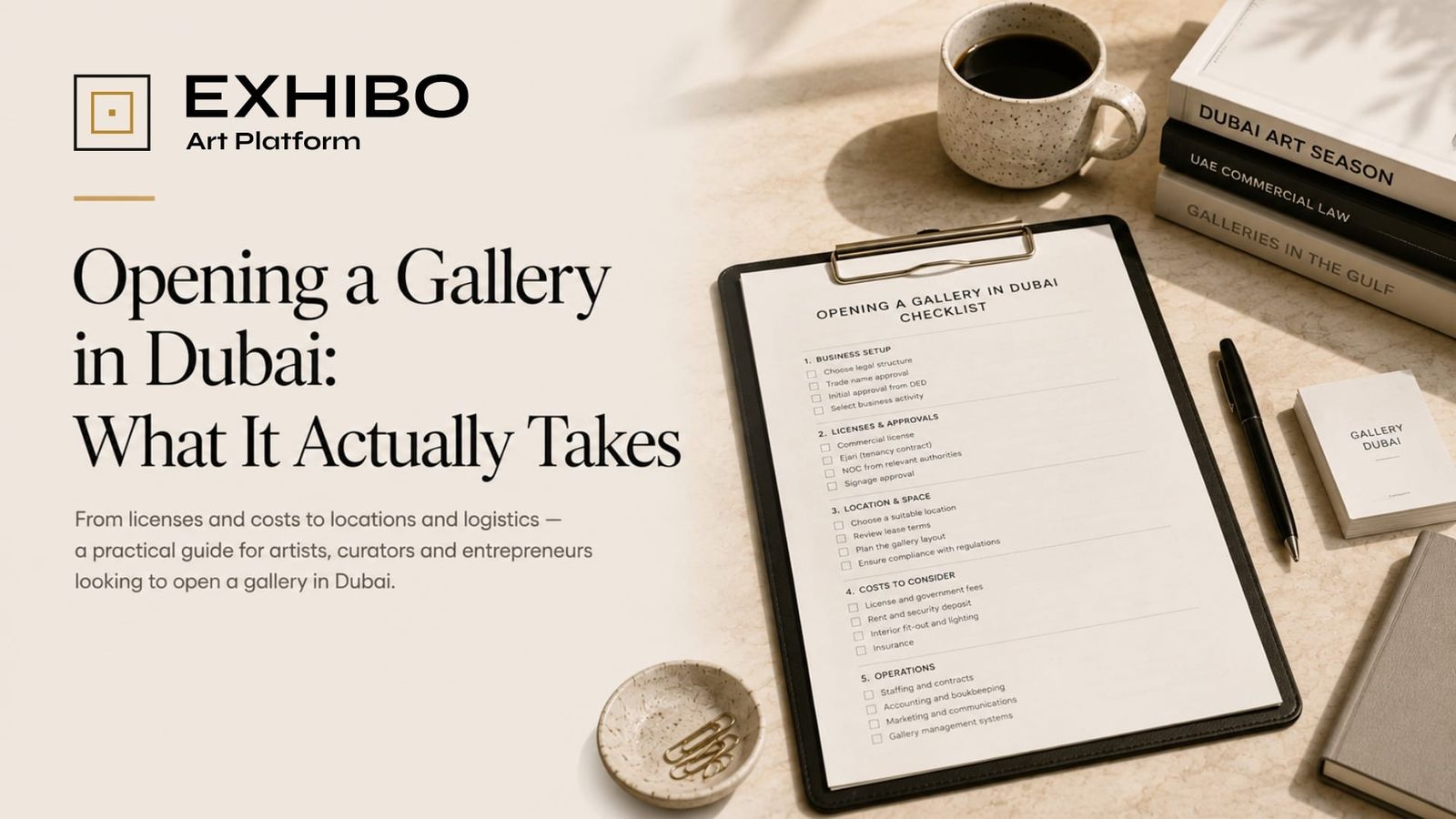
Opening a Gallery in Dubai: What It Actually Takes
This guide is the honest version of what it takes.
Dubai will sell you the dream of opening a gallery very efficiently. Within a week you can have a trade licence, a flexi-desk address and a company name on a certificate. What nobody sells you quite as smoothly is the harder half: the rent on a credible space, the slow work of building a collector base, the margins that get eaten by costs, and a market that is real and growing but also young, cyclical and, in 2026, navigating genuine disruption. Both halves are true at once, and pretending otherwise helps no one.
This guide is the honest version of what it takes. It walks through the licence and the choice between mainland and free zone, where galleries actually set up and what space costs, how the gallery business model really works, what the UAE's customs and freeport rules mean for moving art, and the market conditions you are stepping into right now. The aim is not to talk you out of it — Dubai is one of the most interesting places in the world to open a gallery — but to make sure you go in seeing the whole board.
Why Dubai, and why now
Start with the case for. Dubai sits at the centre of a regional art market that has matured fast. Christie's reports that sales of modern Middle Eastern art tripled in value between 2020 and 2024, and the UAE's art import and export market is projected to pass US$2.5 billion in 2026. This is not a speculative bubble inflating in a vacuum; it is a market with institutions, fairs, auction houses and a deepening base of regional collectors behind it.
The city also offers a genuinely rare combination of advantages for a gallerist. The population is overwhelmingly international and affluent, which means a mobile, globally-minded collector audience on your doorstep. The tax environment is light. The logistics are improving quickly, with new freeport infrastructure and customs reforms aimed squarely at the art trade. And Dubai has something money cannot buy quickly: Alserkal Avenue, a credible, internationally respected art district that took nearly two decades to build and gives the city a centre of gravity most emerging art markets lack.
The honest counterweight is timing. The first half of 2026 has been hard on the Gulf art world. Regional conflict forced Art Dubai to postpone its 20th edition to May and run a scaled-back "special edition" of around 50 galleries, down from roughly 120, with art freight in and out of the region badly disrupted. Collectors have turned cautious, footfall is softer, and several international galleries pulled out of the fair. None of this is permanent, and the gallery community has responded with notable solidarity. But anyone opening now should plan for a market that is resilient rather than booming.
The licence: what you legally need
Every gallery in Dubai needs a trade licence, and the good news is that the licensing itself is one of the most straightforward parts of the whole venture. The art-gallery activity is well established, and several authorities will license it quickly. The real decision is not whether you can get a licence, but which kind.
The licence does not, by itself, make you a gallery. It makes you a legally trading company permitted to deal in art. Everything that actually constitutes a gallery — the space, the programme, the artists, the collectors — sits on top of it. Treat the licence as the easy administrative foundation, not the achievement.
Mainland versus free zone
The first fork in the road is mainland or free zone, and it shapes a lot of what follows. A mainland licence, issued by Dubai's Department of Economy and Tourism (the DED), lets you trade directly anywhere in Dubai, sell straight to UAE-based clients without restriction, and take a physical retail or gallery space anywhere in the city. For a gallery that wants a public-facing space in, say, Alserkal Avenue or Al Quoz and walk-in collectors, mainland is usually the natural fit.
A free zone licence is issued by one of the emirate's free-zone authorities and tends to be cheaper and faster to set up, with simpler ownership and visa processing. Meydan Free Zone, for instance, licenses arts and gallery activities from around AED 12,500, a package that bundles the trade licence, a flexi-desk, the lease agreement and a few business activities. Dubai South prices comparable art-related licences in the region of AED 12,000 to AED 20,000 a year. The trade-off is that free-zone companies face restrictions on trading directly in the mainland market, which can matter for a sales-driven gallery.
There is no universally correct answer, and the right choice depends on your model. A gallery built around a physical Al Quoz space and direct local sales leans mainland; an operation that is more online, advisory or event-based, or that wants the cheapest possible entry point while it tests the water, may start in a free zone. Many founders take local setup advice on this specific point before committing, because switching later is costly.
Costs, structure and the fine print
Beyond the headline licence fee, budget for the structure around it. A sole establishment registered through the DED, suitable for a single owner who wants to employ staff and hold a physical space, typically runs from AED 15,000 to AED 25,000 once registration fees and initial approvals are included. An LLC structure costs more but gives stronger legal standing if you are taking on partners, staff or higher-value commercial work.
The licence is also only the first line of an annual cost stack. Visas for you and any staff are processed through your chosen authority and priced per the package. A physical space brings Dubai Civil Defence fire-safety compliance — emergency exits, extinguishers, signage — which a warehouse gallery conversion has to meet. There may be additional permits depending on what you do: staging a large public opening or an exhibition with performance elements can require separate approvals from Dubai Municipality or other bodies.
One practical note specific to galleries: licensing the entity is cheap relative to running it. The figures above are real and modest, which is exactly why the licence is the wrong place to focus your anxiety. The numbers that will actually determine whether your gallery survives are the rent, the staffing and the cost of moving and showing art — covered below.
Permits beyond the trade licence
The trade licence covers your right to deal in art, but a working gallery often needs a few approvals on top, and missing them causes more headaches than the licence ever will. The most common is fire-safety sign-off from Dubai Civil Defence for any physical space, which a warehouse conversion has to satisfy before it opens its doors.
Public events add another layer. A large opening, a launch that draws a crowd, or an exhibition with live performance or music can require separate permissions from bodies such as Dubai Municipality or the relevant cultural authority. These are routine, but they take time, and planning a splashy opening without factoring them in is a familiar rookie error.
If you intend to run a recurring programme of events, talks or fairs, it is worth understanding which approvals are one-off and which recur. Building that calendar of permissions into your operating rhythm early saves a scramble before every opening, and it is exactly the sort of operational detail that separates a gallery that runs smoothly from one that lurches from show to show.
Where galleries set up, and what space costs
Location in Dubai is not just an address; it is a statement about what kind of gallery you intend to be, and it carries real cost consequences. The city has a handful of recognised creative districts, and being inside one buys you credibility and footfall that an anonymous business-park unit cannot.
Alserkal Avenue, in the Al Quoz industrial area, is the most prestigious art address in the UAE and home to the country's serious commercial galleries and foundations. The wider Al Quoz district around it offers the same raw, high-ceilinged warehouse aesthetic at a range of price points, and Dubai Culture's Al Quoz Creative Zone is actively developing the area as an integrated creative hub with streamlined licensing and permits. Other options include Dubai Design District (d3), a purpose-built creative precinct, and organisations like Tashkeel that provide studio and community infrastructure.
As a rough guide to rent, gallery and studio units in Al Quoz commonly run from around AED 40,000 to AED 120,000 a year for spaces between roughly 500 and 1,500 square feet, with location, size and finish driving the spread. A prime Alserkal Avenue unit sits at the upper end and beyond. This is the cost line that most often decides a gallery's fate, so it deserves the bulk of your financial planning. A sensible early move is to share a larger space or take a modest unit and grow, rather than over-committing to a flagship space before you have the programme and collectors to fill it.
How the gallery business actually works
Licence secured and space sorted, you still have to run an actual gallery — and the economics here surprise people who come from other businesses. A gallery rarely owns most of what hangs on its walls. The dominant model worldwide, Dubai included, is consignment: the artist retains ownership, the gallery shows and sells the work, and the two split the proceeds.
That split is the heart of the gallery's income, and it must always be explicit and in writing. The common global standard is a 50/50 division of the retail price, though other arrangements exist depending on the artist's stature and what the gallery brings. A proper consignment agreement does more than set the percentage: it caps the discounts a gallery can offer, states who absorbs them, defines any exclusivity (and over what geographic radius), and clarifies who pays for shipping, insurance and production for fairs. Vague or purely verbal terms are the single most common source of disputes between galleries and the artists they represent.
The economics behind the walls
A few realities sit underneath that model that every new gallerist should price in before signing a lease:
Representation is a long game. Building a roster of artists who trust you, and a base of collectors who buy from you repeatedly, takes years rather than months. Early sales are slow and relationship-driven.
Margins are tighter than they look. A 50% share sounds generous until rent, staff, shipping, insurance, fair costs and marketing come out of it. Established UAE galleries openly cite rising costs eating into already tight margins.
Fairs are expensive and not guaranteed. A booth at a major fair can cost more than a small gallery's monthly overheads, and a red flag in any arrangement is being asked to pay booth fees you did not expect. Notably, Art Dubai's 2026 special edition waived stand costs and charged a capped percentage of sales instead — a sign of how fair economics flex under pressure.
The throughline is that the headline numbers flatter the reality. A gallery is a high-overhead, slow-revenue business in which a few good sales a year can carry you, and a quiet season can hurt. Going in with a cash buffer and modest fixed costs is worth more than any single sale.
Being found is part of the business
There is one cost that barely appears on a spreadsheet but quietly decides how fast a new gallery grows: discoverability. A gallery that cannot be found by a collector searching online, or by an AI assistant answering "which galleries in Dubai show emerging regional artists", is effectively invisible no matter how strong the programme on the wall.
This is where a new Dubai gallery has more leverage than it realises. A fast, well-structured website is the baseline, but a profile on a credible, high-authority art platform does something a young gallery cannot do alone: it lends the authority and search visibility of an established, frequently-crawled source. Collectors browsing the platform encounter your artists, and search and AI engines treat a well-ranked listing as a trustworthy description of who you are and what you show.
Exhibo is built for exactly this stage. Unlike the older incumbents, which are invitation-only, it uses open registration, so a newly licensed Dubai gallery can claim a profile and become discoverable to collectors, curators and journalists from day one — and a press room with regional and international distribution sits alongside it for when there is a show worth announcing. For a gallery still building footfall, that visibility is among the cheapest growth it can buy.
Staffing and the cost of expertise
The last piece of the model people underestimate is people. A gallery is a relationship business, and relationships are run by humans — someone to greet a walk-in collector, manage the artists, handle the admin of consignment and shipping, and keep the programme moving while the founder is travelling to fairs and studios.
Early on, many founders try to do all of this themselves, and for a small operation that can work. But it has a ceiling. A founder who is also the registrar, the press office, the salesperson and the installer is a bottleneck, and the moments a gallery most needs to be sharp — a fair, an opening, a serious collector enquiry — are exactly the moments one person cannot cover alone.
Budget honestly for at least some support as you grow, whether part-time, freelance or shared. Wages in Dubai are a real line item, and the temptation to run lean indefinitely is strong, but the galleries that scale are usually the ones that brought in help before they were drowning rather than after.
Moving art: customs, VAT and the freeport advantage
One area where Dubai has quietly improved is the logistics of moving art across borders, which historically made the Gulf more complex than established hubs like London or New York. For a gallery that will import and export work — and almost all of them do — this matters as much as the licence.
The freeport and duty-waiver advantage
The headline development is the rise of freeport infrastructure. A freeport facility at Dubai South Free Zone allows artworks to be stored without being subject to VAT or customs tax, including an airfield zone that falls outside the jurisdiction of any customs authority and offers owners considerable flexibility for storage and holding.
Across the border in the same federation, Abu Dhabi has launched a customs duty waiver programme for art aimed at collectors, family offices and institutions, explicitly to reduce friction at the point of import. The intent is plain: to bring the UAE into competitive alignment with London and New York as a place to acquire, hold and move work.
Fine art also benefits, internationally, from frequently being classified as "informational material", which has spared it some tariff regimes that hit other high-value collectibles like jewellery. For a Dubai gallery moving work in and out for shows and fairs, these reforms are a genuine, if under-used, advantage.
What it still costs to move work
None of this removes the need for proper handling. Shipping, insurance, customs clearance, framing and storage all add real cost to every work that moves, and they are easy to underestimate when you are budgeting around the licence and the rent.
2026 has been a sharp reminder that logistics can stall entirely — art freight in and out of the region was badly disrupted by regional conflict earlier in the year, with major airlines suspending flights and shipments halted for weeks. A gallery that depends on moving work to survive learned that dependency the hard way.
A new gallery should build relationships with specialist fine-art shippers early, understand the VAT position on its sales, and treat logistics as a core operational competence rather than an afterthought. The freeport and duty-waiver reforms tilt the field in your favour, but they reward galleries that actually understand how to use them.
Insurance, storage and the unglamorous protections
Beyond getting work from A to B, a gallery has to keep it safe while it sits on the wall and in the back room, and this is where new operators tend to cut corners they later regret. Insurance that covers work in transit, on display and in storage is not optional for a serious gallery, and consigning artists will increasingly ask whether you carry it.
Storage is the other quiet cost. Not every work is hanging at once, and a gallery needs somewhere climate-appropriate to hold the rest. The freeport facilities are useful here for higher-value or in-transit work, but day-to-day stock still needs proper racking, climate control and security in or near your space.
These are the least exciting line items in a gallery budget and the easiest to defer, which is precisely why they catch people out. A single damaged work that was not properly insured or stored can cost more than a year of premiums, and it can cost something harder to rebuild: the trust of the artist who consigned it.
A realistic cost and decision summary
Pulling the threads together, the table below sketches the main decisions and rough cost lines for opening a gallery in Dubai. Figures are indicative and move with packages, providers and the market, so treat them as a planning starting point rather than a quote.
Element | Typical range / option | Notes |
|---|---|---|
Free-zone licence | From ~AED 12,500/year | Cheaper, faster; some mainland-trading limits. Meydan, Dubai South et al. |
Mainland (DED) licence | ~AED 15,000–25,000+/year | Trade freely across Dubai; needed for a public retail space and direct local sales. |
Legal structure | Sole establishment or LLC | LLC costs more, gives stronger standing for partners/staff/high-value work. |
Space (Al Quoz / Alserkal) | ~AED 40,000–120,000/year | 500–1,500 sq ft; Alserkal prime units higher. Usually the largest cost. |
Fit-out & compliance | Variable | Civil Defence fire safety; gallery lighting, walls, climate control. |
Sales model | Consignment, commonly 50/50 | Must be in writing: split, discounts, exclusivity, fair costs. |
Logistics | Per shipment | Shipping, insurance, customs; freeport storage VAT/duty-free. |
Discoverability | Low / ongoing | Website + a credible art-platform profile (e.g. Exhibo) for search and AI visibility. |
The pattern in that table is the real lesson: the costs you can pay once and forget — the licence, the company — are small. The costs that recur and compound — space, logistics, the slow build of a programme and an audience — are where galleries are made or broken. Plan your budget around the second list, not the first.
Frequently asked questions
How much does it cost to open an art gallery in Dubai?
The licence itself is modest: free-zone art-gallery licences start from around AED 12,500 a year, and a mainland DED licence or sole establishment typically runs AED 15,000 to AED 25,000 once fees are included. The far larger ongoing costs are space (roughly AED 40,000 to AED 120,000 a year for a credible Al Quoz unit), fit-out, staff, and art logistics. Budget for the recurring costs, not just the setup.
Do I need a mainland or free zone licence for a gallery?
It depends on your model. A mainland (DED) licence lets you trade directly across Dubai and take a public-facing gallery space, which suits a walk-in gallery in a district like Alserkal. A free zone licence is cheaper and faster but restricts direct mainland trading, which can suit a more online, advisory or event-based operation. Many founders take local advice on this specific choice before committing.
Where should I open a gallery in Dubai?
The most credible art addresses are Alserkal Avenue and the wider Al Quoz district, which offer warehouse-style spaces and an established art community; Al Quoz is being developed further as a creative zone by Dubai Culture. Dubai Design District (d3) and organisations such as Tashkeel are alternatives. Being inside a recognised creative district buys credibility and footfall that a generic business-park unit cannot.
How do galleries actually make money in Dubai?
Mostly through consignment: the artist keeps ownership, the gallery sells the work and they split the proceeds, commonly 50/50 of the retail price, with terms set out in writing. Income is also affected by discounts, exclusivity arrangements and who pays fair and shipping costs. Margins are tighter than the headline split suggests once rent, logistics, insurance and fair fees are deducted.
Is 2026 a good time to open a gallery in Dubai?
The long-term market is strong and maturing, but the first half of 2026 has been disrupted by regional conflict, which forced Art Dubai to postpone and downsize and made collectors more cautious and shipping less reliable. The scene has shown real resilience and community support. Treat it as a market to enter with patience and a sustainable cost base rather than expecting an immediate boom.
How do new galleries get found by collectors?
Discoverability is now a core part of the business. Beyond a fast, well-structured website, a profile on a credible, high-authority art platform helps collectors, curators and journalists — and increasingly AI search tools — find a new gallery. Exhibo is built for exactly this, with open registration rather than the invitation-only model of older platforms, so a newly opened Dubai gallery can become visible from the start.
Galleries mentioned
Museums mentioned

Related reading
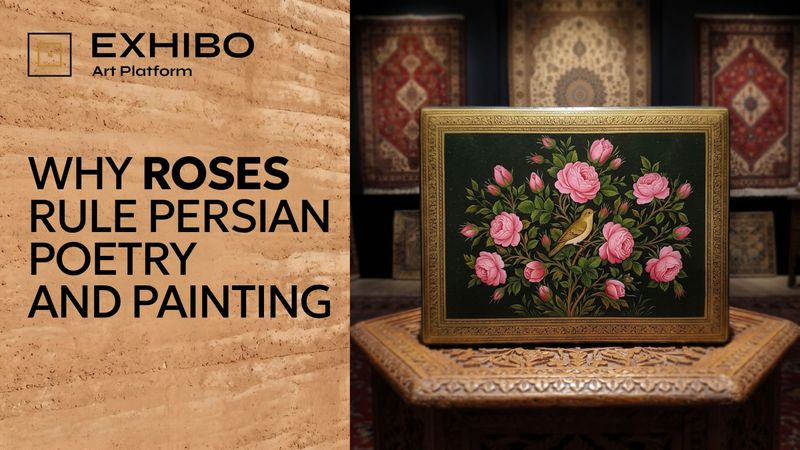
The Flower That Was Never Only Beautiful
The rose rules Persian poetry and painting — but under the sweetness sits a thorn, a bleeding bird, and a national emblem quietly assembled out of Chinese, European and Persian parts. A history of gol o bolbol, from a medieval still to a Dubai gallery.
Gol o bolbol — the rose and the nightingale — is among the most beautiful images in a thousand years of Persian art, and in modern Persian it also means sweet, empty talk. Under the tile, the picture is darker: a bird singing in blood for a flower that will not answer and will not last.
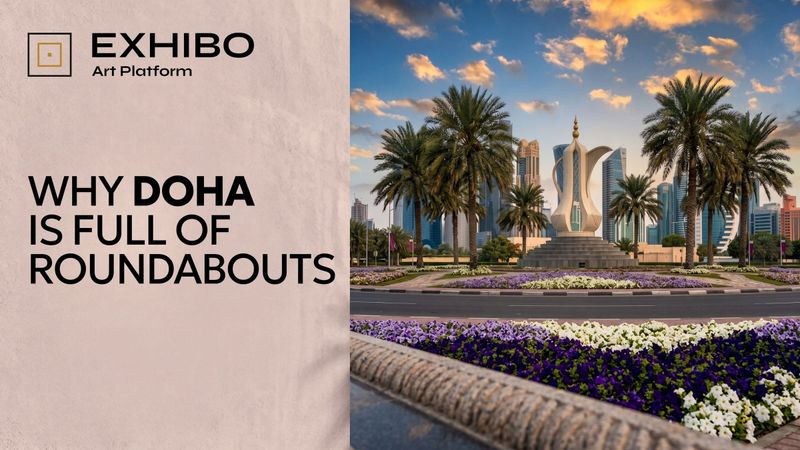
Why Doha Is Full of Roundabouts
An old circle at a crossroads, sharpened by British road engineering, became the way an Arabian city found its way and remembered itself — and it took the bulldozers to reveal it.
In a city where a landmark was more useful than an address, Doha's roundabouts became its navigation, its landscaping and its national image all at once. Now they're being torn out for signalled junctions — and the affection for them arrived, as one scholar put it, only posthumously.
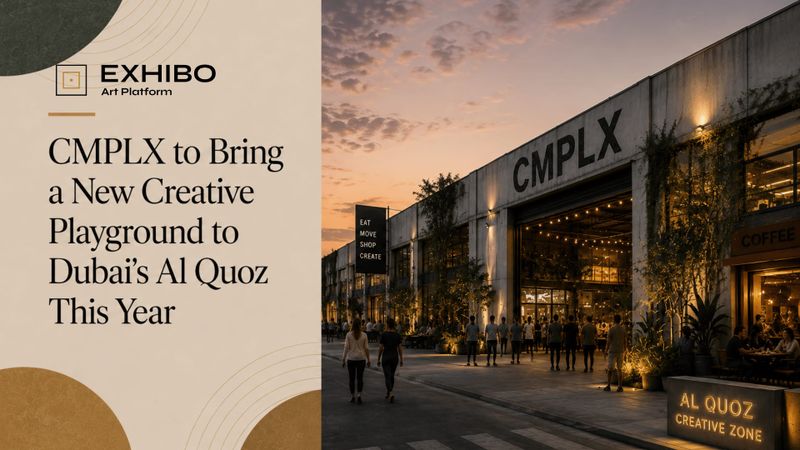
CMPLX to Bring a New Creative Playground to Dubai's Al Quoz This Year
A seven-warehouse lifestyle hub combining food, wellness, retail and creative studios is set to open in Al Quoz Creative Zone by the end of 2026, adding a new anchor to the neighbourhood built around Alserkal Avenue.
CMPLX, a new warehouse-style lifestyle destination combining food, wellness, retail and creative studios, is set to open in Dubai's Al Quoz Creative Zone by the end of 2026 — adding a fresh anchor to a neighbourhood already defined by Alserkal Avenue's galleries and cultural spaces.