
Damascus · Syria
Ali Baba Was Never an Arabian Folktale
There is no Arabic manuscript of Ali Baba older than its French translation. The most famous "Arabian folktale" in the world was assembled at a writing desk in Paris — and its true hero was a slave woman written out of her own title.
Oxford, September 1908. Duncan Black MacDonald, an American scholar of Islam over from Hartford, is handed the still-handwritten catalogue of the Bodleian's additional Arabic manuscripts, compiled years earlier by a professor named Hermann Ethé. He runs his finger down it and stops. There, listed among the acquisitions, sitting on a shelf since 1860, is an Arabic manuscript of "The Story of Ali Baba and the Forty Thieves."
This should not exist. For two centuries "Ali Baba" had been the great embarrassment of Arabian Nights scholarship — one of the most beloved tales in the collection and the one for which, as MacDonald himself put it, absolutely no Oriental trace had ever been found — the possibility, even, that it existed as an Oriental story at all had been denied. Some scholars had begun to suspect there was no Arabic original because there had never been one. And here it was, in Arabic, in Oxford, catalogued and waiting since 1860. MacDonald published it in the Journal of the Royal Asiatic Society in 1910, Arabic text and English translation side by side, with an opening flourish about what it would do to Sir Richard Burton — who had spent years feuding with the Bodleian's authorities — to know the thing had been lying in that same library all along.
It took a few years and then MacDonald himself and later others, worked out that what he had found solved nothing. The manuscript was in the hand of a man who signed as Yūḥannā Wārisī. That turned out to be Jean Varsy, a French Arabist and merchant, a pupil of Silvestre de Sacy, whose family ran a trading house in Rosetta before the collapse of the French position in Egypt sent them fleeing. Whatever the manuscript was, it was not the ancient Arabic ancestor of the tale: it was written by a Frenchman, in the nineteenth century, more than a hundred years after Galland. What exactly it was has been argued over ever since. Muhsin Mahdi, assembling his critical edition of the Nights, made the influential case that Varsy had simply retranslated Galland's French back into Arabic — a fake ancestor, an Arabic costume sewn for a story that had never worn Arabic before. Katia Zakharia, in two studies for the journal Arabica, reopened the file: Varsy was a far more capable Arabist than Mahdi allowed and the manuscript's language does not prove a back-translation as cleanly as the verdict assumed. The case is, properly speaking, still open.
Which is stranger and better, than a clean forgery. The document that was supposed to settle where Ali Baba came from instead made the question harder to ask. It is either a French orientalist's back-translation or a French orientalist's Arabic retelling of something he had read or heard — and no one can securely say which. Either way, it is not an origin. It is one more person, a century downstream, manufacturing an Arabic past for a tale that had never quite had one. The birth certificate did not close the mystery. It became part of it.
The long-sought original had turned out to be younger than the thing it was supposed to explain. And the reason anyone needed one is the whole story.
The manuscript that was meant to prove where Ali Baba came from instead proved how hard it is to say the tale came from anywhere. It did not restore an origin. It dissolved the idea that there was one to restore.
The tale with no original
Here is what is not in dispute. No Arabic manuscript of "Ali Baba" is known to predate its first appearance in French. The tale enters recorded history in the last volumes of Antoine Galland's Les Mille et Une Nuits, published between 1704 and 1717, the twelve-volume translation that gave Europe the Arabian Nights — and it enters through the back door, in the volumes Galland filled after he had run out of manuscript to translate.
He had a source, but not a written one. Galland had been working from a fifteenth-century Syrian manuscript, three volumes sent from Aleppo and by 1709 he had a problem: the manuscript ran out. It ended, as the oldest manuscripts do, well short of a thousand and one nights — a number he seems to have taken literally — and his publisher, impatient, had already padded one volume with tales lifted from a rival Orientalist. Galland needed stories. And in the spring of 1709, in Paris, a young man from Aleppo named Hanna Diyab — a Maronite Christian who had travelled to France with the collector Paul Lucas and whose own story this series has told elsewhere — sat with him over a series of evenings and supplied them. On the fifth of May it was the tale of the lamp, the one we call Aladdin. On the twenty-seventh of May it was this one. Galland wrote a summary in his diary that night: six pages of notes on a story he titled, in French, Les finesses de Morgiane, ou Les quarante voleurs exterminés par l'adresse d'une esclave — the cunning of Morgiana, or the forty thieves destroyed by the skill of a slave.
Note the title. We will come back to it.
From those six pages Galland built a tale of thirty-six. That is the ratio the scholar Aboubakr Chraïbi established when he laid the diary notes beside the published story: Galland amplified, elaborated, cut — he dropped, for instance, the detail of food stored in the robbers' cave — and produced the "Ali Baba" the world knows, a piece of early-eighteenth-century French prose worked up from an oral telling by a Syrian, set down by a Frenchman, in Paris. The earliest text of the most famous Arabian folktale in the world is French and it is younger than the Palace of Versailles.
This is the point where it would be easy to reach for the wrong conclusion — that Ali Baba is a fraud, a European invention smuggled into an Arab book, a fake. It isn't, quite and the truer version is more interesting. Pull the tale apart and every piece is old. The cave that opens to a spoken word, the band of forty robbers, the clever servant who outwits them — each of these existed, in one form or another, long before Diyab opened his mouth in Paris. What no earlier record preserves is this particular assembly of them into this particular tale. As Paulo Lemos Horta puts it, each component — the magic cave, the troupe of thieves, the clever slave-girl — existed in another form before Diyab, but his telling to Galland "was the first instance in which these elements were brought together to fashion a new tale." Diyab may well have been performing something he had heard; we cannot see behind his telling. What we can see is that the version the world inherited is an authored thing — folk material, shaped, on a particular evening, by a particular young man and shaped again by the Frenchman writing it down.
Ali Baba is not a transcription of a folktale someone found. It is a composition built from folk material and a night's telling — which is not the same thing and the difference is what the word "folktale" quietly hides.
Which forces a question the tale's fame usually lets us skip: what do we actually mean when we call something an Arabian folktale?
What a folktale is and is not
A folktale, in the loose sense the word carries when we say "Ali Baba is an Arabian folktale," conjures a story that lived in the mouths of a people, passed down and worn smooth by retelling, belonging to everyone and no one, eventually written down by a collector who found it already there. That popular picture — the Grimms walking the German countryside with a notebook — was never quite how folklore worked, not even for the Grimms, who rewrote heavily and took tales from literate, middle-class tellers. Folklorists long ago gave up the idea that oral and literary transmission are separate streams; they braid constantly. But the popular picture is the one doing the work when the phrase "Arabian folktale" gets stamped on Ali Baba and against that picture the tale genuinely misbehaves. The motifs of Ali Baba are genuinely folkloric and genuinely everywhere. Folklorists have never been able to file the tale under one number. In the Aarne–Thompson–Uther index the cave that opens to a spoken word is one type — 676, "Open Sesame" — and the band of robbers undone by a clever servant is another, 954, "The Forty Thieves." Ali Baba is filed under both. Either way, the tale we call Ali Baba fuses two independently widespread patterns into one unusually memorable structure. And the patterns belong to no single country: documented variants of the tale-types turn up across Europe, the Middle East, Africa and Asia — a Russian study published in 2023 traces the "Open Sesame" type through tales recorded in China in the second half of the twentieth century, many of them carrying elements already found in medieval Chinese sources. That does not mean the Chinese were telling Ali Baba. It means the international patterns Ali Baba is built from have roots almost everywhere. The bones of the story belong to the world.
The problem with "the Arabian folktale Ali Baba" is not that it is too European to be Arab. It is that almost every word of the phrase is doing work the tale cannot support.
What we cannot do is point to the specific Arabic oral telling that Galland's Ali Baba came from. It may have existed — Diyab was a Syrian who had grown up around storytellers and related tales were certainly current in the region: the Victorian orientalist Edward Henry Palmer reported hearing a very similar story from the Arabs of Sinai and folklorists have catalogued Arabic variants of the "Open Sesame" type from Jerusalem, Morocco and Egypt. But none of these can be securely shown to be the ancestor of Galland's tale rather than its descendant and none was written down before him. The honest statement is narrow and strange: no documented Arabic version of Ali Baba can be shown to precede the French one. The oral world that might have held it is real and unrecoverable and silent.
Even the Victorians who loved the tale could not place it. Richard Burton, translating the Nights in the 1880s, thought Ali Baba so unlike the rest that he exiled it to his supplemental volumes rather than the main body of the work and guessed its origins were Greek Cypriot. He was almost certainly wrong about Cyprus, but right about the strangeness: he could feel that the story did not sit where the label said it did.
The distinction matters and it cuts the opposite way to the easy reading. The problem is not that Ali Baba is too European to be Arab. The problem is that "the Arabian folktale Ali Baba" is a category error — a literary tale, composed from folk parts by a named young man on a named date, wearing the costume of an anonymous oral one. Diyab almost certainly drew on things he had heard, in the coffeehouses of Aleppo and on the road; storytelling is a borrowing art and he was a borrower of genius. But what Galland published was not a recording. It was a composition. The label "folktale" does to Ali Baba exactly what the Varsy manuscript did — supplies, after the fact, an anonymous communal origin the tale never actually had.
Some of the parts, at least, had counterparts as real as the roads Diyab travelled. Banditry was not an Oriental fantasy but an ordinary hazard of Ottoman Syria and the wider region — caravans robbed on the passes, hoards cached in the hills, brigand captains feared in some villages and half-admired in others. Diyab had crossed those roads himself, with Paul Lucas, through country where armed men taking what they liked was a fact of travel, not a wonder. The story transforms that fact into folklore: the thieves are real enough to recognise and fantastical enough to fit inside a magic cave, the number forty doing the work numbers do in tales rather than in police reports. That is exactly the mixture a good storyteller works in — real danger, impossible door — and it is why the tale feels rooted even when its roots run to a diary in Paris rather than a manuscript in Damascus.
The Nights have always invited this. The collection never had a single stable text; its surviving Arabic recensions preserve layers of a much longer history of adaptation, borrowing and recomposition, a book that was never finished and never fixed — which is precisely why a Frenchman could add to it in 1712 and another Frenchman could forge an Arabic addition to it a century later and no seam would show. Ali Baba slipped in because there was no wall to climb over.
And then it did something stranger than slip in. It went home. Once Galland's version had entered European print and become famous, Ali Baba began to circulate in Arabic too — not as the simple return of an ancient Arabic original, but through the tangled manuscript and print traditions that grew up around the Nights in the nineteenth century, as presses in Calcutta, Breslau, Bulaq and Beirut set competing versions of the collection into type. A tale that had left the Arab world (if it was ever quite there) as an oral fragment came back to it as printed text, read in Arabic as one of the tales of the Arabs' own great book — its foreign manufacture invisible under the familiar script. The forgery, if that is what it was, had in a slower sense come true: after enough retellings, Ali Baba really was an Arabic tale, because Arabs were now telling it. Origin is one thing. Belonging is another and slower and harder to forge.
Whose tale it actually is
Now, that title in Galland's diary. The cunning of Morgiana, or the forty thieves destroyed by the skill of a slave. Not Ali Baba. Morgiana.
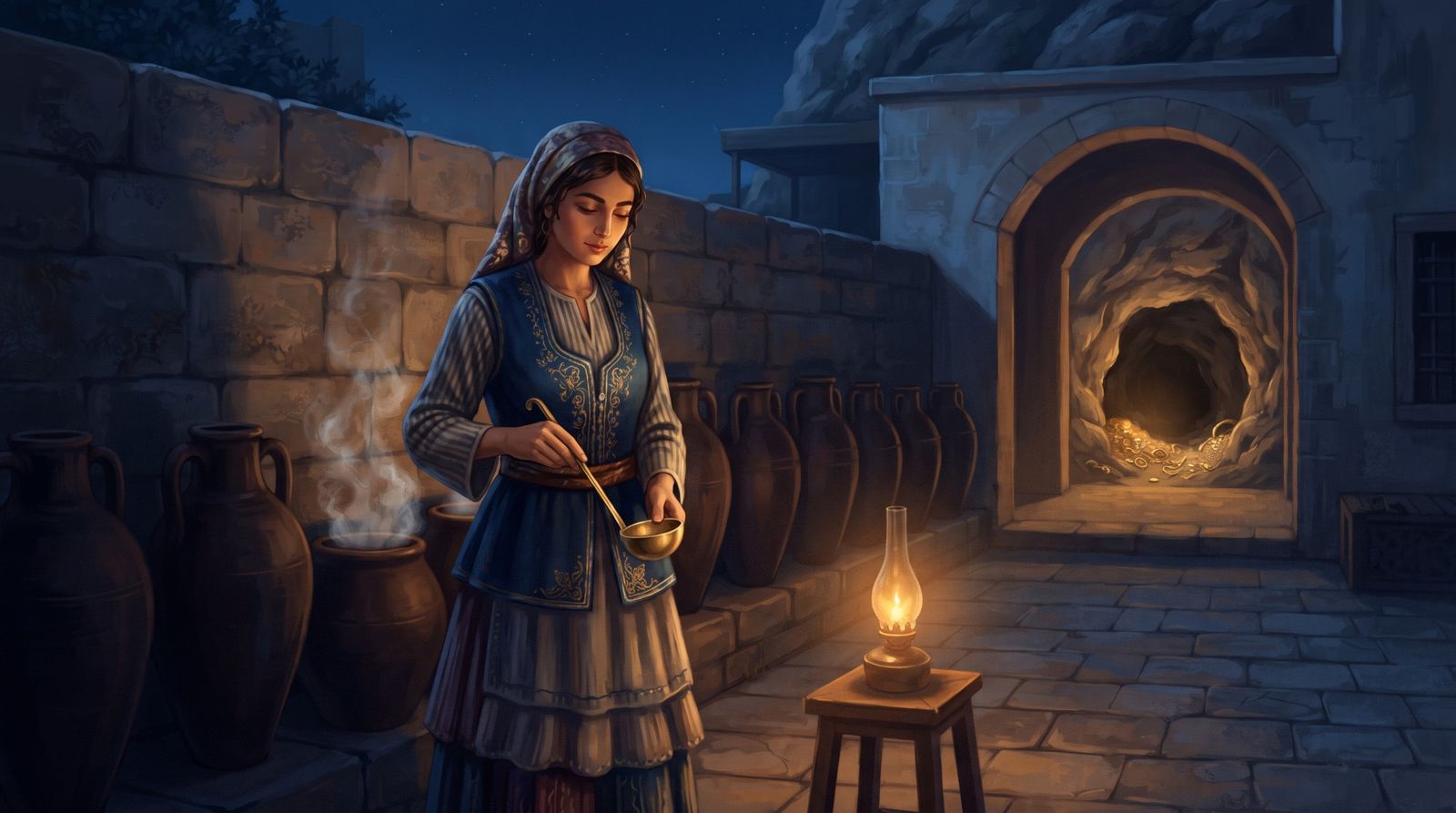
Go back to the story and see who does what. Ali Baba is a woodcutter who gets lucky: he overhears the password, opens the cave, carries home the gold. After that he mostly stands still and is frightened. Everything that saves him is done by Morgiana, the enslaved woman in his dead brother's household. When Ali Baba's greedy brother Cassim is caught in the cave and hacked into quarters by the thieves, it is Morgiana who manages the cover-up — buying medicine to fake an illness so the death will surprise no one, then hiring a blindfolded tailor to stitch the dismembered body back together for burial. When a thief chalks a mark on Ali Baba's door to find it again, it is Morgiana who spots the chalk and marks every door in the street to match, so the house vanishes into its neighbours. When the robbers' captain smuggles his men into the courtyard hidden in oil jars, it is Morgiana who finds them and kills them where they crouch, ladling boiling oil into jar after jar. And when the captain returns in disguise to murder Ali Baba over dinner, it is Morgiana who dances for the guest, slips the dagger from her belt at the turn of the dance and puts it through his heart. She kills, by the story's own arithmetic, very nearly all forty of them — thirty-seven in the jars, then the captain on the floor. Her reward is her freedom and then marriage to Ali Baba's son: the enslaved woman erased from the title is first made free and then brought into the family, which is the tale's own quiet acknowledgment of who earned it.
The most famous Arabian folktale in the world is the story of an enslaved woman who outthinks and outfights an army of bandits and we have named it after the man who watches her do it.
The renaming happened slowly and you can watch it happen in print. An English edition from 1820 still carries her on the cover: Ali Baba, or, The Forty Thieves, destroyed by Morgiana, a female slave. She is right there in the title, credited with the destruction, into the nineteenth century. Then, tale by tale, edition by edition, she slides off the cover and into the supporting cast, until the story belongs, in every child's collection, to Ali Baba alone. The tale lost its heroine the way it gained its origin — quietly, by consensus, without anyone deciding. (When Yasmine Seale became the first woman to translate the Nights into English, three centuries into the tale's life, part of what she was translating was how much of it had always belonged to women who were rarely credited for it.)
She was in the title in 1820 and gone from it by the nursery. The tale lost its heroine the way it gained its origin: quietly, by consensus, without anyone deciding.
So the phrase comes apart in the hand. Three labels we have repeated so often they now sound like facts — Arabian, folktale, Ali Baba — and not one is as simple as it looks. The tale is Arabian at one remove and by adoption; a folktale only if you loosen the word until it means "made of folk parts"; and Ali Baba's least of all, since the woman who saves everyone had the title first and lost it.
A name that would hold anything
Once a story has no fixed origin, it turns out, it can go anywhere and become anything, because there is no original to betray. Ali Baba became, of all things, a fixture of the British Christmas.
By the late nineteenth century "Ali Baba and the Forty Thieves" was one of the three great subjects of English pantomime, alongside Aladdin and Sinbad — the Victoria and Albert Museum lists all three as the tales the Nights handed the English stage. At Drury Lane in 1886, a production of The Forty Thieves ran from half past seven until one in the morning and put, at one point, five hundred people on the stage. In 1898 the same theatre staged it with Dan Leno, the greatest clown of the age, as a character called Abdullah and a man named Johnny Danvers as Ali Baba — while the "principal boy," by the iron convention of panto, was played by a woman in tights and the older comic woman by a man. On the English stage the tale about a misnamed heroine became a carnival of deliberate misnaming, everyone in the wrong costume and the wrong gender and the audience roaring because that was the point. W. S. Gilbert, of Gilbert and Sullivan, had a hand in a burlesque Forty Thieves in 1878. When cinema arrived, the tale was there almost at once — the earliest known film adaptation was French, Ferdinand Zecca's for Pathé in 1902, seven scenes and nine minutes — and it has since been remade across very different national cinemas, from Hollywood to Bombay to a Soviet-Tajik co-production.
None of this is corruption of an original, because there is no original to corrupt. A tale with a fixed home resists travel; you can get it wrong. Ali Baba cannot be got wrong, because there is no right. The empty space where its origin should be is exactly what let it fill up, over and over, with whoever was telling it — a French salon, a Cairo press, a Drury Lane stage at midnight, a Bombay soundstage. The name is a suitcase with nothing nailed inside it. That is a weakness if you want authenticity and a superpower if you want to travel.
Open sesame
There is one part of the tale everyone remembers and it is the part that gives the whole game away. Iftaḥ yā simsim. Open, sesame.
No one has securely explained why sesame. The word itself is old and plain enough — simsim, the sesame seed, a staple of the medieval kitchen, its name travelling from Semitic languages into Greek sēsamon and on into every European tongue. What no one can account for is why that word became the word that moves mountains. The theories are guesses: that the sesame pod bursts open of its own accord when ripe, scattering its seed, so the plant was already a small emblem of a sealed thing springing open; that sesame oil was the prized, costly oil of the region, so the seed carried a whiff of hidden wealth; that the choice is simple euphony, a good sound for a child to shout. (A tempting theory linking it to the Greek syssēmon, a prearranged signal, founders on the fact that syssēmon and sēsamon are two different words.) Take your pick. The most famous password in any language turns on a seed and the reason the seed was chosen is lost.
The tale itself seems to know this. Its cruellest turn is about exactly this — a word that will not stay put. When Cassim, Ali Baba's brother, gets into the cave and the door seals behind him, he cannot get out, because he cannot remember the word. He stands in the dark before the stone running through the pantry of his memory — open barley, open wheat, open chickpea — every grain but the right one and the door stays shut and the thieves come back and kill him for it. The engine of the plot is a man who forgets a magic word and dies of it. A story with no recoverable origin, whose most famous word no one can quite explain, turns on the terror of losing the one word that opens the door. You could not invent a better emblem for the thing itself.
The plot turns on a man who forgets the magic word and dies for it. A tale with no recoverable origin, whose spell no one can fully account for, is itself about the panic of losing the word that lets you in.
And it did not stay in Arabic, or in French. Like the tale around it, the phrase went out into the world and kept moving and — this is the part I find hard to get over — it came home. In 1979, a consortium of Gulf educators bought the rights to Sesame Street from its American producers for two and a half million dollars and made the first Arabic co-production of the show. They called it Iftaḥ Yā Simsim. Open Sesame. It premiered in Kuwait that September, ran for years across the Arab world and taught a generation of children to read their own language through Muppets, on a show named for the password of a tale a Syrian had carried to Paris two hundred and seventy years before.
The spell Diyab gave Galland had become an American children's franchise sold back to the Arab world under its own oldest name.
The spell comes home
There is a coda and it is the reason this tale belongs to this series rather than to a footnote.
In 1990, Iraq invaded Kuwait. Among the very many things the war disrupted was Iftaḥ Yā Simsim: its Kuwait City studio was damaged, the production broke up and the programme disappeared from the air. What the war took here was not one country's property but a shared thing — a show made by Arabs, for Arab children, in Arabic, across the whole region. It went dark and stayed dark, for twenty-five years, through the war and the long unsettled years after it, while Western programmes, often dubbed or subtitled into Arabic, increasingly filled children's screens across the region. A place that had lost its art to war is a story this series has met before; here the loss was a children's show whose whole purpose had been to teach the language the imported screens were eroding.
In 2015 it came back. A production company in Abu Dhabi, Bidaya Media, working with the Gulf states' education bureaus and the show's American parent, rebuilt Iftaḥ Yā Simsim from the ground up and put it back on the air across the region — new puppets, new streets, the same name, aimed now at teaching proper Arabic to children raised on imported screens. The managing director, explaining why it mattered, said the thing plainly: we live in a conflict-ridden part of the world and there is so much we can do to educate the children who will build a better one.
Sit with the shape of that. A tale assembled from folk material by a young man from Aleppo; written down and reshaped by a Frenchman who never named him; furnished, a century on, with an Arabic manuscript that scholars still cannot agree is source or copy; filed as an anonymous folktale; titled after the wrong character; its magic word untraceable to a reason; carried out of the Arab world and sold back to it as an American brand; interrupted by a war; and rebuilt, in Abu Dhabi, so that Arab children could learn Arabic from it. At no point in that long chain was there a single, settled Ali Baba whose authority everyone was merely preserving. There was only the handing on — the borrowing and reshaping and renaming and rebuilding, each generation opening the cave and taking what it needed.
Which is, in the end, a more honest thing to be than a folktale. A folktale pretends it was always there. Ali Baba never pretends. Every version of it wears its making on its face — the French sentence, the missing woman, the password no one can trace, the studio damaged and the show built again. It is not the record of a story the Arab world once told. It is a record of how stories actually travel: no original, no owner, no fixed home, just the next person to say open and the door swinging wide.
Museums mentioned

Places mentioned

Related reading
The Real Aladdin: The Story That Belonged to No Country
Aladdin has no Arabic manuscript older than its French translation. Behind the gap stands a young man from Aleppo, catalogued for a century as anonymous.
The Seal of Solomon: The Object That Grew Around One Word
The Qur'an never mentions a ring. What grew in that gap instead: a demon, a seal, seven signs nobody can trace, a thousand years of amulets, and a star that ended up on a flag.
Records in Sand: Bahariya, Dakhla, Kharga, Farafra and the Deep Desert
A dinosaur known from photographs, a rebel’s temple built into a medieval town, a day of water sold in demotic — and a desert that was not blank.