
Marrakech · Morocco
Majorelle Blue: How a Painter (Almost) Trademarked a Colour
How a French painter lent his surname to a blue that Morocco had been dyeing, firing and painting for centuries — and what that tells us about who gets to own a colour.
There is a wall in Marrakech that stops people mid-sentence.
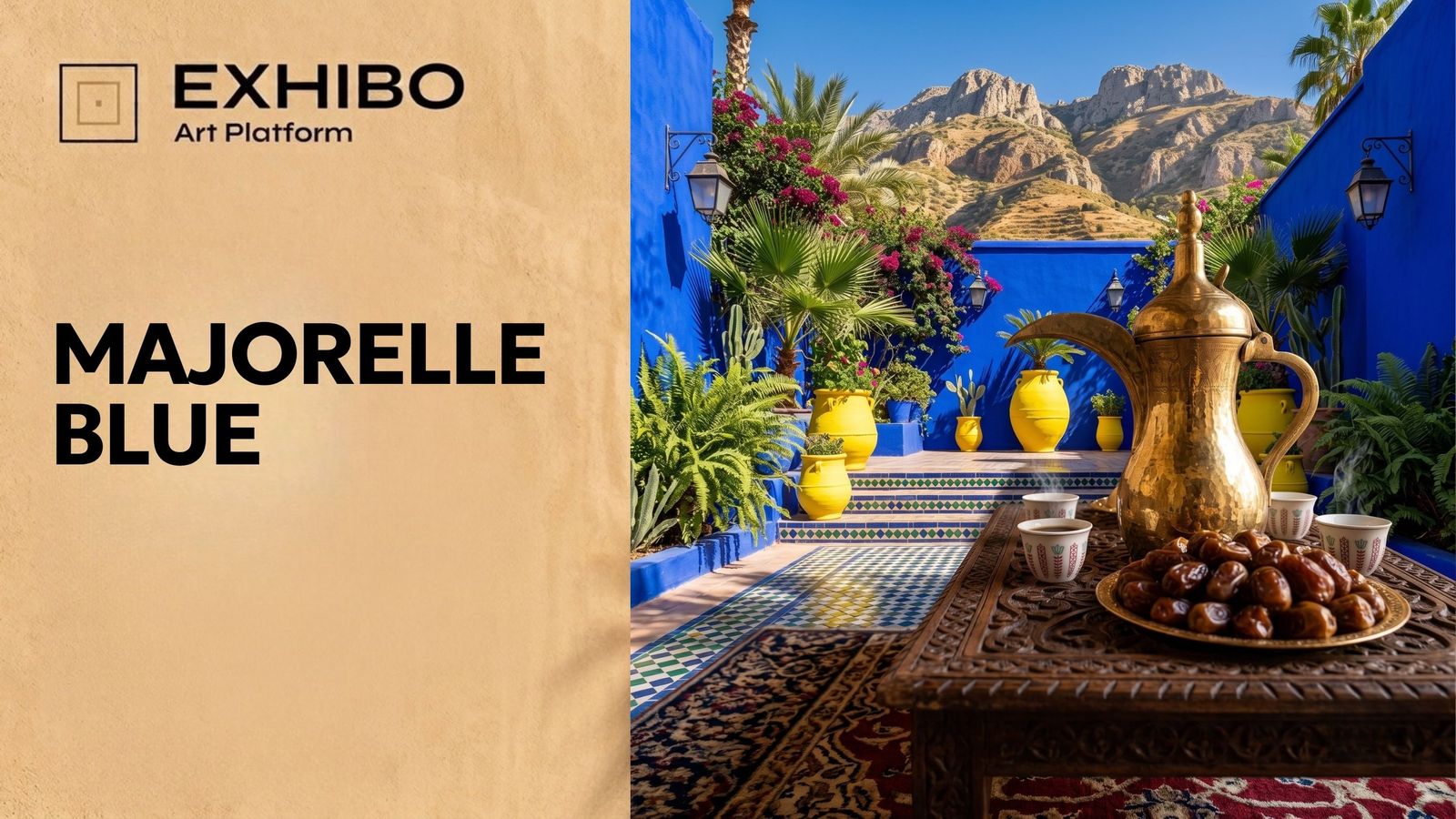
It is nothing structurally — a garden wall, a doorframe, the flank of a small cubic studio in what used to be a palm grove on the edge of the city. But it is painted a blue so saturated, so unreasonable, that at noon, when the light comes down hard and white, the wall seems to hum. Tourists reach for it. They photograph the blue against the green fronds, against the terracotta pots, against their own hands, and they leave believing they have seen the invention of a man named Majorelle.
They have seen a blue that was already deep in Morocco's visual language before he arrived. That is the first thing to get straight, and almost every version of the story gets it wrong.
The painter's son who wanted the light
Jacques Majorelle was born in Nancy in 1886, into the one household in France where colour and material were literally the family trade. His father was Louis Majorelle, one of the great Art Nouveau furniture designers of the École de Nancy, and Jacques grew up among cabinetmakers, marquetry inlayers and draughtsmen — people who thought for a living about how a surface catches light. He was pushed toward architecture, lasted three years, and left it for painting.
Then his health sent him south. Reportedly a weak chest; the prescription, in that era, was warmer, drier air. He spent roughly 1910 to 1914 near Cairo, painting the Nile from a boat, and came back changed — not by Egypt's monuments so much as by what the sun did to colour there. In 1917 he went to Morocco, then a French protectorate, and — by the garden foundation's own account — settled in Marrakech at the invitation of General Hubert Lyautey, the Resident-General, who was also from Nancy and liked to keep artists near him. Within a year, Casablanca's press had, by most tellings, crowned him "the painter of Marrakech."
It matters, plainly and without drama, that Majorelle arrived inside the machinery of empire. He did not stumble into Morocco as a free-floating aesthete. He came under a colonial administration, recommended by its most powerful soldier, free to buy land and move through a country that was not being run by the people who lived in it. That is part of the historical chain by which a French painter came to lend his surname to a colour already rooted in Morocco. Hold that thought; we will need it later, and the man who inherited the garden will say it out loud better than any critic could.
In 1923 he bought a palm grove at the city's edge. Around 1930 he built a villa there; in 1931 he commissioned the architect Paul Sinoir to design an Art Deco studio of startling modernity, a cube dropped into a garden he was assembling like a painting — a long central pool, cacti and yuccas and bamboo and bougainvillea hauled home from his travels, a place he called his botanical "laboratory." He worked on it for forty years and, near the end, called it his most beautiful work. He was not wrong. But it was the studio's paint that made him immortal, and he didn't get to that until 1937.
The blue that was already there
The cube was white first. Then, in 1937, Majorelle drowned it in an intense, violet-leaning ultramarine — and the Fondation Jardin Majorelle dates the birth of "Majorelle Blue" to that act. The internet has since pinned the colour to a hex code, #6050DC, a precision Majorelle never specified and would not have recognised; the "real" Majorelle Blue has no official definition, no standardised entry, nothing but a wall and the memory of a wall.
Where did he get it? Everywhere. He said as much, and so does everyone who looks. The blue was in the zellige tilework, in the surrounds of kasbah windows, in the doors of adobe houses, in the burnouses and turbans of Amazigh men, in the indigo veils of the Tuareg who traded up from the southern Sahara. He did not invent this blue. He concentrated it. He took a colour Morocco had been living inside for centuries, scraped it off the tiles and the cloth and the doorframes, and poured it over a single building until it became a brand.
Why Morocco was already blue
It is worth stopping on that phrase — had been living inside for centuries — because it is easy to wave past, and the whole argument rests on it.
Morocco did not need a Frenchman to discover blue. It had at least three of its own, from three different materials, long before Majorelle arrived. There was indigo, the plant blue: fermented from Indigofera, dipped into Atlas wool fifteen or twenty times until the fibre went blue-black, and — in many Amazigh traditions — carried a protective charge against the evil eye, dyed into the veils of the Tuareg and the cloaks of mountain men. There was the cobalt of Fassi pottery, the deep bleu de Fès painted freehand on a white tin glaze since the city's Andalusian craftsmen brought the technique across after 1492 — a blue that, combined with white, read as purity and sky, and turned up on the walls of mosques and the rims of fountains. And there was the blue of zellige, the cut-tile mosaic, geometry chiselled and set into plaster until a courtyard became a diagram of paradise.
That last association is not decorative. The classical Islamic garden is an image of paradise made on earth — water, shade, symmetry, enclosure — a form in which blue already carried long associations with water, sky and the paradise it promises. When Majorelle built a walled garden around a long central pool and drowned its architecture in ultramarine, he was, whether he theorised it this way or not, working inside a visual grammar that generations of Moroccan and Islamic craftsmen had spent centuries refining. He brought a modernist's cube and a European's pigment. The idea that blue belongs in a garden, and that a garden can be a small rehearsal of heaven — that was already there, in the ground, waiting.
But this is also where the painter in him earns his reputation, and where it becomes unfair to say he merely painted a wall. What made the garden unforgettable was never the blue alone. It was the orchestration: cobalt set against the grey-green of the cacti and the deep green of the bamboo, against terracotta and the hard Moroccan light that sets the whole thing vibrating — a garden, as more than one visitor has put it, composed and coloured like a painting. He made the colour decisions at the scale of architecture that he had spent a career making on canvas, pushing complementaries to their maximum until the greens read almost neon against the blue. (Saint Laurent, decades later, would sharpen the effect further, painting pots in vivid yellow and other tones to counter and complement the Majorelle blue.) The blue is what people remember, but the blue works because of everything set around it. He did not invent the colour. He did, unmistakably, compose the place.
So when he "made the blue his own," he was concentrating something that Moroccan hands had been making, dyeing, firing and setting for a very long time. Which is the part the brand tends to forget.
And here the story opens onto something much older even than Morocco's blue, because the pigment he reached for was itself one more chapter in a long history of European industries and artists reshaping colours that had originated somewhere else.
Ultramarine — the deep, luminous blue at the heart of Majorelle's — was for most of art history the most expensive colour on earth. It came from lapis lazuli, a stone mined for nine thousand years from essentially one place: the Sar-e-Sang valley in Badakhshan, in what is now Afghanistan. Ground, kneaded, washed for days to separate the blue lazurite from the grey, it reached Europe by sea and by Silk Road, which is why its name means, in Latin, beyond the sea. By weight it was worth more than gold. Painters reserved it for the robe of the Virgin; patrons specified in contracts exactly how much of it a picture would contain. It was the colour you spent a fortune to signal that something mattered.
Then, in 1828, a French chemist named Jean-Baptiste Guimet won a national prize for synthesising it — for producing, in a French factory, a chemically equivalent synthetic ultramarine at a fraction of the price. One of the world's rarest pigments had become an industrial material, and a French name was attached to the process that made it. That was a full century before Majorelle stood in front of a white cube in Marrakech.
So when we tell the story of a European taking a blue that belonged to somewhere else and attaching himself to it, we are not describing something Majorelle started. We are describing something he rhymed with.
What it actually means to "trademark a colour"
Here is the line you will read on nearly every plaque, in nearly every guidebook, in the Wikipedia entry and the ten thousand blog posts downstream of it: Majorelle trademarked the colour, savvily, before his death in 1962.
It is a wonderful line. It is also, in the way it is almost always told, not true.
Start with the law, because the law is where the myth quietly dies. A colour, as a colour, is close to impossible to own. You can — sometimes — register a single shade as a trademark: Tiffany's robin's-egg box, UPS brown, Owens-Corning's pink insulation. But that protection is narrow and strange. It attaches only to a specific category of goods, only after you have spent years and fortunes teaching consumers to read that shade as your brand, and it never means you own the hue itself. Outside your aisle of the shop, anyone may use it freely. Cadbury lost its purple. General Mills could not hold yellow for a cereal box. Nobody owns a colour the way you own a coat.
Which is exactly what the Centre Pompidou says, plainly, about the most famous "owned" blue of all. When Yves Klein registered International Klein Blue in 1960, he did not patent the colour — under French law, the museum notes, a colour cannot be owned. What he registered, via a dated envelope at the patent office, was a process: a particular way of suspending ultramarine in a resin binder so the pigment kept its powdery intensity. Klein didn't own blue. He owned a recipe for holding it still.
Now look again at Majorelle, with that lens. What is actually registered — and this took a real court fight to establish — are the names. The company and foundation that run the garden hold the trademarks "Majorelle" and "Jardin Majorelle," and in 2018 the Paris Court of Appeal upheld their right to keep the garden's name against a claimant descended from the painter's second wife. The name is a brand, defensible in a courtroom. The colour is another matter entirely — and here the record thins to almost nothing. No public document establishes anyone owning "Bleu Majorelle" as a hue the way one owns a registered logo; the claim gets repeated far more often than it gets sourced. And the most telling detail of all is a silence: even the Fondation's own website, describing its own signature blue, never once uses the word trademark. It says only, "known today as Majorelle blue."
So the true shape of it is smaller and stranger than the legend, and better. No painter trademarked a colour before dying in 1962. A brand was built, decades later, around a name — and the blue rode along with the name, the way a scent rides along with a perfume house. A colour that had belonged to no one in particular, spread across tiles and cloth and doorways, became attached to one estate and one man. Not by owning the blue. By owning the story of the blue.
That is the part worth sitting with. Because the people who live around that garden have been sitting with it for a long time.
Whose blue
Walk ten minutes from the garden in any direction and you are back inside the un-owned version of the colour. Blue doors. Blue boats hauled up on the sand at the old ports. Blue in the rugs, the kaftans, the tiles. In Chefchaouen, a whole town runs blue — for reasons that turn out to be less ancient and more argued-over than the postcards suggest, owing as much to the twentieth century and the camera as to any founding legend. In many Amazigh traditions indigo carried protection, dyed into wool over fifteen or twenty dips until the blue-black held. Morocco's older blue was a plant, warm and lived-in. Majorelle's was a mineral, electric and applied. Both are called, loosely, Moroccan blue.
Moroccan artists notice who ended up with his name on it. In one report gathering their voices, the painter Samir Ghoudrani — who grew up walking distance from the garden and only lately learned of the trademark — put the discomfort as cleanly as anyone: it is like wanting to own not just a song, but the sound. The visual artist Zakaria Ramhani goes further, describing Majorelle Blue as an appropriation of ultramarine, adding that "colours are in nature, for the eyes that can see it," and that Majorelle "was protected by colonisation." And then Ramhani concedes, in the same breath, that the estate is a genuine asset to Morocco. That concession is worth as much attention as the critique: both are held at once, by the same person — the taking and the gift, in one sentence, unresolved. The essay's job here is not to hand down a verdict but to let the people who live with the colour say what it costs them and what it gives.
You do not have to adjudicate that to feel its weight. You only have to notice that the man who inherited the garden felt it too, and said so.
The designer who saved it, and named the taking
By the time Jacques Majorelle died — a car accident, repatriation to Paris, 1962 — the garden was already going. Divorce and money troubles had forced him to sell off pieces of it; the paint was peeling; the pool was greening over. It might simply have vanished under a hotel.
It didn't, because two men had seen it in 1966 and never got over it. Yves Saint Laurent, born in Oran in French Algeria, and his partner Pierre Bergé had come to Marrakech that February — a week of rain, then the sun — and fallen for the city completely. When they heard, in 1980, that the Jardin Majorelle was about to be bulldozed for development, they bought it to stop that happening. They renamed the villa Villa Oasis, moved in, poured in gardeners and an irrigation system, ran the plant count from around a hundred and thirty-five species to three hundred, and turned Majorelle's blue studio into a museum. This is not a small thing to credit, and it should not be credited grudgingly: the garden exists to be argued over at all because Saint Laurent refused to let it die.
And Morocco poured straight back into his work. He said, in 1983, in words the museum now hangs on its own walls: "In Morocco, I realized that the range of colors I use was that of the zelliges, zouacs, djellabas and caftans. The boldness seen since then in my work, I owe to this country... This culture became mine, but I wasn't satisfied with absorbing it; I took, transformed and adapted it."
I took, transformed and adapted it. Translators have rendered that verb anywhere from the gentle "transformed" to the blunt "took" to, in one version, "annexed" — a spread of English that is itself a small essay on how the era saw such things. But the sentence, in every version, does something rare. It names its own appropriation, from the mouth of the person doing it, without apology and without pretending it was anything else. Saint Laurent did not claim Moroccan colour had always been his. He said he came, he saw, he took, and he made it into something the world would call his. Whatever you think of that, it is not a lie, and the honesty is its own kind of respect.
When he died in 2008, his ashes were scattered in the garden. The street outside was renamed for him. In 2011 the old studio became the Berber Museum, some six hundred pieces of Amazigh jewellery, textile and tool — much of it collected by Saint Laurent himself — which is to say the estate now actively elevates the very culture the blue was lifted from. In 2017, next door, the Musée Yves Saint Laurent Marrakech opened, four thousand square metres of brick and terrazzo and zellige by the architects Studio KO — its opening exhibition hall painted, of course, Majorelle Blue, hung with thirty of Majorelle's own paintings borrowed from Moroccan collections. Bergé died weeks before it opened.
The garden today draws enormous crowds — estimates of annual visitors generally run somewhere between 700,000 and 900,000 — and it is routinely named among Morocco's most-visited sites. Which has produced the last irony the story had left in it: the serenity Majorelle designed — a cool blue refuge, a visual glass of water in a city of red earth — is now the thing tourism most threatens. By 2019 the Fondation was unlocking a previously sealed "secret garden" and rationing entry by timed ticket, trying to give people back the quiet that the fame had taken.
The wall, again
Go back to the wall.
Stand in front of the blue at noon, when it hums, and you can hold the whole thing in your eye at once: a colour from an Afghan mountain, made cheap by a French chemist, seen on Moroccan tiles by a French painter, poured over his studio, wrapped in his surname, defended in a Paris court, inherited by a couturier who admitted he took it, and sold now — in the garden shop, in a tin — under the name of a man who found it rather than made it.
And then walk out. Ten minutes in any direction, on a door nobody photographs, on a boat pulled up on a beach, on the hem of a kaftan drying in a window, is the same blue. No hex code. No trademark. No plaque. No surname. Just blue, in the sun, belonging to no one, which is the only way a colour has ever really belonged to anyone.
Majorelle got a garden and a name in the dictionary. Morocco kept the blue.
Museums mentioned
Related reading
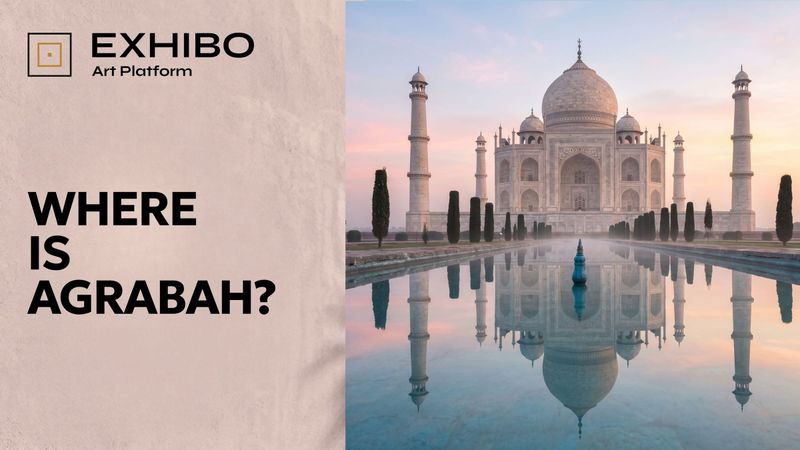
Where Is Agrabah? The City Disney Assembled From Real Places
Agrabah was going to be Baghdad. A war made it fictional — and then Disney built it back out of real places, from a tomb in Agra to a valley in Jordan that usually plays Mars.
The Sultan's palace where Princess Jasmine feels trapped has the silhouette of the Taj Mahal — which is not a palace at all, but a tomb. That is how Agrabah works. Disney's fairy-tale city was going to be Baghdad, until the Gulf War made the name impossible; the studio invented a place that could not be found on a map, then quietly rebuilt it out of real ones — Isfahan and Agra, Marrakesh and Mandalay, a Jordanian desert that has played both Arabia and Mars.
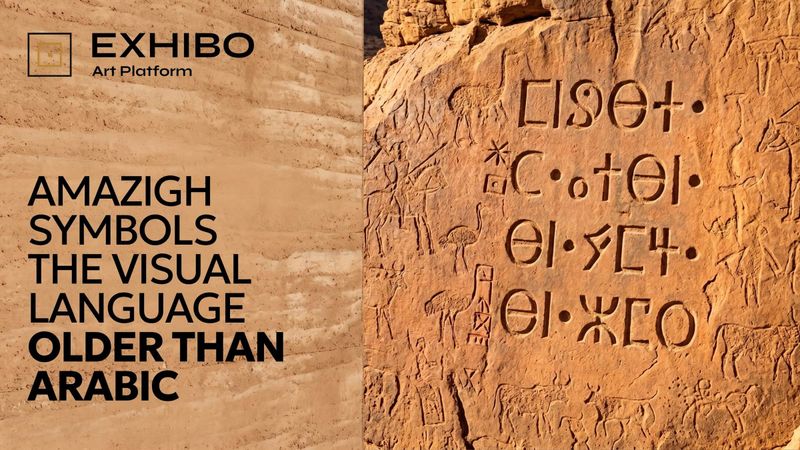
The Visual Language Older Than Arabic
How one of North Africa's oldest writing traditions survived conquest, colonial classification and the loss of its readers — and why, for much of it, we still cannot say what the marks mean.
A flat rock in southern Morocco is covered in a script you can see is writing and still cannot read a word of. It belongs to the Amazigh — a visual language older in North Africa than the Arabic alphabet, carried onto skin and wool and silver, nearly erased, and now reassembled into an alphabet on ministry walls. This is the story of what survived, what didn't, and why almost everything we "know" these signs mean was added later.
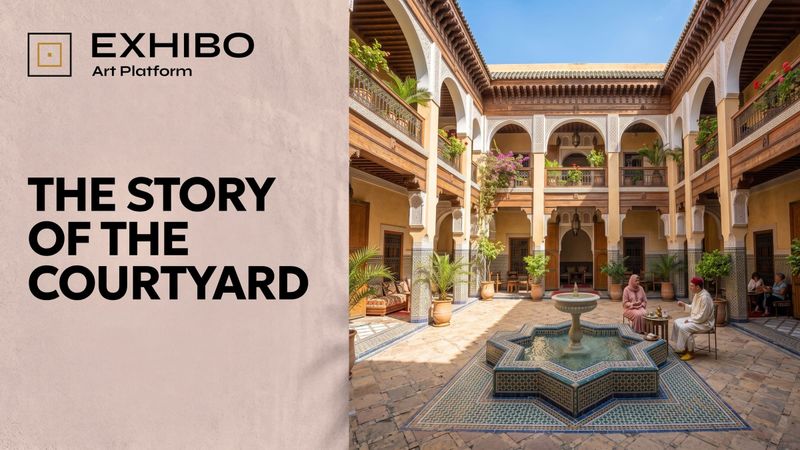
Why North African Cities Turn Inward: The Story of the Courtyard
A courtyard plan far older than Islam turned North African houses — and the medinas built from them — to face inward. Climate and religion only half-explain why, and what finally displaced the courtyard says the rest.
The blank walls and inward courtyards of Fez, Tunis, Algiers and Cairo are usually explained by heat or religion. Both are true; neither is the whole story. The clue is in what eventually pushed the courtyard out of the modern city.