
Tehran · Iran
UNESCO Names 25 New Heritage Sites Amid Global Conflict
Busan committee recognises landmarks across Iran, Lebanon, Palestine and beyond, while emergency protocols highlight sites under threat
A Global Roster of Heritage Amid Conflict
The forty-eighth session of the World Heritage Committee concluded in Busan on 29 July, finalising a highly contested roster of twenty-five new inscriptions. Several nominations emerged from regions currently navigating armed conflict, triggering immediate placements on the Danger List and drawing sharp diplomatic reactions from multiple governments.
Alamut and the Iranian High Ground
Despite escalating military tensions, Tehran's cultural delegation attended the proceedings to celebrate the acceptance of the Alamut Castle complex. Nestled within the Alborz mountains near Qazvin, this fortified network functioned as the strategic and scholarly heart of the Nizari Isma'ilis between the eleventh and thirteenth centuries. The nomination encompasses several subsidiary fortresses, including Lambesar and Sirkuh. Hamideh Choubak, who oversees the site's heritage foundation, emphasised that preserving the complex's original character remains paramount. Historical records indicate the location hosted Persian polymath Khwaja Nasir al-Din Tusi and attracted academics from across Asia and the Middle East, cementing its reputation as a vital crossroads for medieval scientific exchange. The approval elevates Iran's official tally to thirty properties.
Palestinian and Lebanese Sites Face Emergency Measures
Diplomatic friction intensified regarding Sebastia, a West Bank archaeological zone boasting over four millennia of continuous settlement. Overruling Israeli objections, the committee utilised emergency protocols to grant it World Heritage status while simultaneously recommending Danger List inclusion. Palestinian officials highlighted ongoing land seizures and restricted conservation access as primary threats. The designation marks Palestine's sixth recognised property.
Similarly, Lebanon's Mount Amel Castles received emergency protection following centuries of Crusader, Mamluk, and Ottoman modifications. Five fortresses across southern Lebanon now share this status. Samar Karam, representing Lebanon's antiquities directorate, pointed out that armed forces currently occupy three fortresses, effectively blocking routine conservation visits. The broader regional instability, compounded by recent bombardments damaging Tyre's archaeological infrastructure, has prompted urgent calls for international conservation support. Lebanon now holds seven listed sites.
Broader Inscriptions and Historical Markers
Beyond the Middle East, the committee recognised diverse cultural and environmental landmarks. France's Normandy coastline received recognition for its D-Day landing beaches and associated wartime memorials, commemorating the 1944 Allied operations that reshaped European history. Other cultural additions span the Aalto Works in Finland, the Amazonia Theaters in Brazil, and the ancient Buddhist ruins at Sarnath in India. Natural landscapes honoured include Jordan's Aqaba Marine Reserve and the Okefenokee refuge in the United States. Greece's Mount Olympus area stands as the sole mixed property.
The committee also placed four additional locations on the Danger List: South Sudan's Boma-Badingilo migratory habitat, Ukraine's Taurica Chersonese, and Suriname's historic Paramaribo centre.
The remaining cultural roster features remarkable diversity, from the modernist architecture of Gdynia and Tashkent to the historic medinas of the Comoros and the colonial agricultural estates of São Tomé and Príncipe. Asian heritage receives further recognition through the porcelain production hubs of Jingdezhen, the Mongolian Xiongnu burial complexes, and the sacred rock formations of Kazakhstan's Mangystau region. Meanwhile, the natural category highlights ecological resilience, encompassing the UAE's Wadi Wurayah watershed, Denmark's Eocene fossil deposits, and Brazil's Amazonia Theaters, which blend environmental preservation with cultural performance spaces. These additions demonstrate the committee's ongoing effort to document human ingenuity and ecological diversity across disparate geographies.
Editorial Reflection
This year's selections underscore a recurring tension within international heritage preservation: the desire to safeguard human achievement against the backdrop of geopolitical instability. Emergency procedures now serve as a necessary mechanism to highlight sites facing imminent destruction, yet they also expose the limitations of diplomatic frameworks when military realities intersect with archaeological preservation. As monitoring becomes increasingly difficult in occupied or conflict-ridden zones, the global community must translate symbolic recognition into tangible conservation funding and access guarantees.
Galleries mentioned
Museums mentioned
Related reading
Where Is Agrabah? The City Disney Assembled From Real Places
Agrabah was going to be Baghdad. A war made it fictional — and then Disney built it back out of real places, from a tomb in Agra to a valley in Jordan that usually plays Mars.
The Sultan's palace where Princess Jasmine feels trapped has the silhouette of the Taj Mahal — which is not a palace at all, but a tomb. That is how Agrabah works. Disney's fairy-tale city was going to be Baghdad, until the Gulf War made the name impossible; the studio invented a place that could not be found on a map, then quietly rebuilt it out of real ones — Isfahan and Agra, Marrakesh and Mandalay, a Jordanian desert that has played both Arabia and Mars.
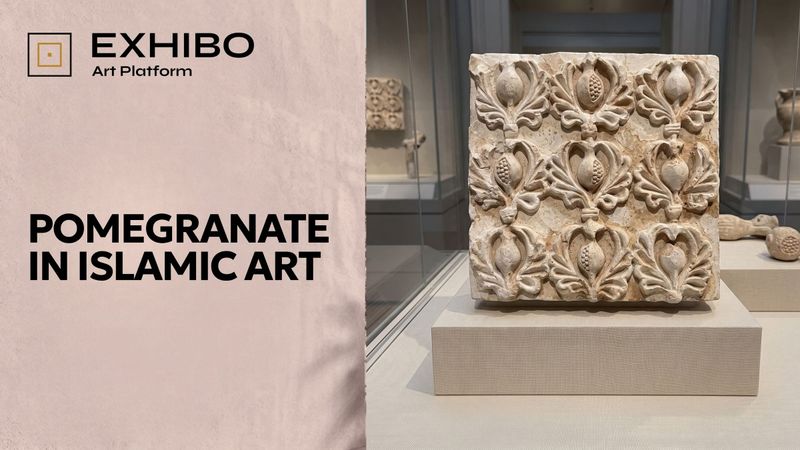
The Fruit We Are Sure We Recognize
How the pomegranate became one of the most confidently named motifs in Islamic ornament — and one of the least confidently identified — across a thousand years of tile, silk and stucco, with meanings we mostly attached later.
A slab of sixth-century plaster in the Met shows a fruit you recognise at a glance: a pomegranate, and surely it means paradise. Hold that certainty up to the light and it dissolves. Across a thousand years of tile, silk and stucco, the pomegranate is the shape we name most confidently and identify least — blurring into the artichoke and the palmette, its meanings attached by later viewers, its very name partly a nineteenth-century invention

Why Disney Made the Genie Blue
The long material and colonial history behind the most recognizable blue body in popular culture.
Almost everyone remembers that Disney's genie is blue. Fewer ask why. The answer runs backward through five thousand years — Egyptian blue standing in for lapis, cobalt on a Mongol palace, the eye that guards against envy, the last color most languages learned to name, and a layout artist photographing Isfahan just before a war — to a color that was rarely, in this part of the world, quite what it claimed to be.