
Siwa · Egypt
Answers in Salt: Siwa and the Oracle of Ammon
Siwa’s oracle, Alexander’s horned coin, a dynamited temple and a bride’s silver disc — and the salt water now rising under the palms.
In the winter of 331 BCE a small column of Macedonians walked south-west from the Mediterranean coast into sand and at least two of the men in it later wrote down how they found their way. They agreed on almost everything. They did not agree on the animals.
Ptolemy, the general who would become king of Egypt, said the army was led by two snakes that spoke, there and back. Aristobulus, an engineer on the same march, said it was two ravens. Arrian, writing four and a half centuries later with both books open in front of him, set the two versions side by side, allowed that some divine help was likely and conceded that the disagreement made the details uncertain. About what happened inside the temple at the end of the march he says even less: Alexander asked his questions and heard, as he himself said, what his heart desired.
Two witnesses. One road. A snake and a bird.
Even the famous greeting comes in two versions. Most writers, Plutarch reports, said that the priest of Ammon hailed Alexander as the son of the god. But some said the priest, wanting to be friendly in Greek, meant to say "O paidion" — "my child" — and, in his foreign pronunciation, ended the word with an s, so that it came out as "O pai Dios", "son of Zeus" and Alexander was pleased with the slip. A title that shaped an empire, in one telling; a mispronunciation, in the other.
That is a fair way into Siwa, because almost everything that matters here has come down to us twice, in versions that do not quite fit. A temple dated by one reading of a cartouche and redated by another. A god's horn read as a crown, as a conquest and as the two ends of the earth. A festival of reconciliation with two founders. A bride's necklace described in one metal by the scholar who published it and in another by the museum that owns it. The desert keeps the objects. The stories about them multiply.
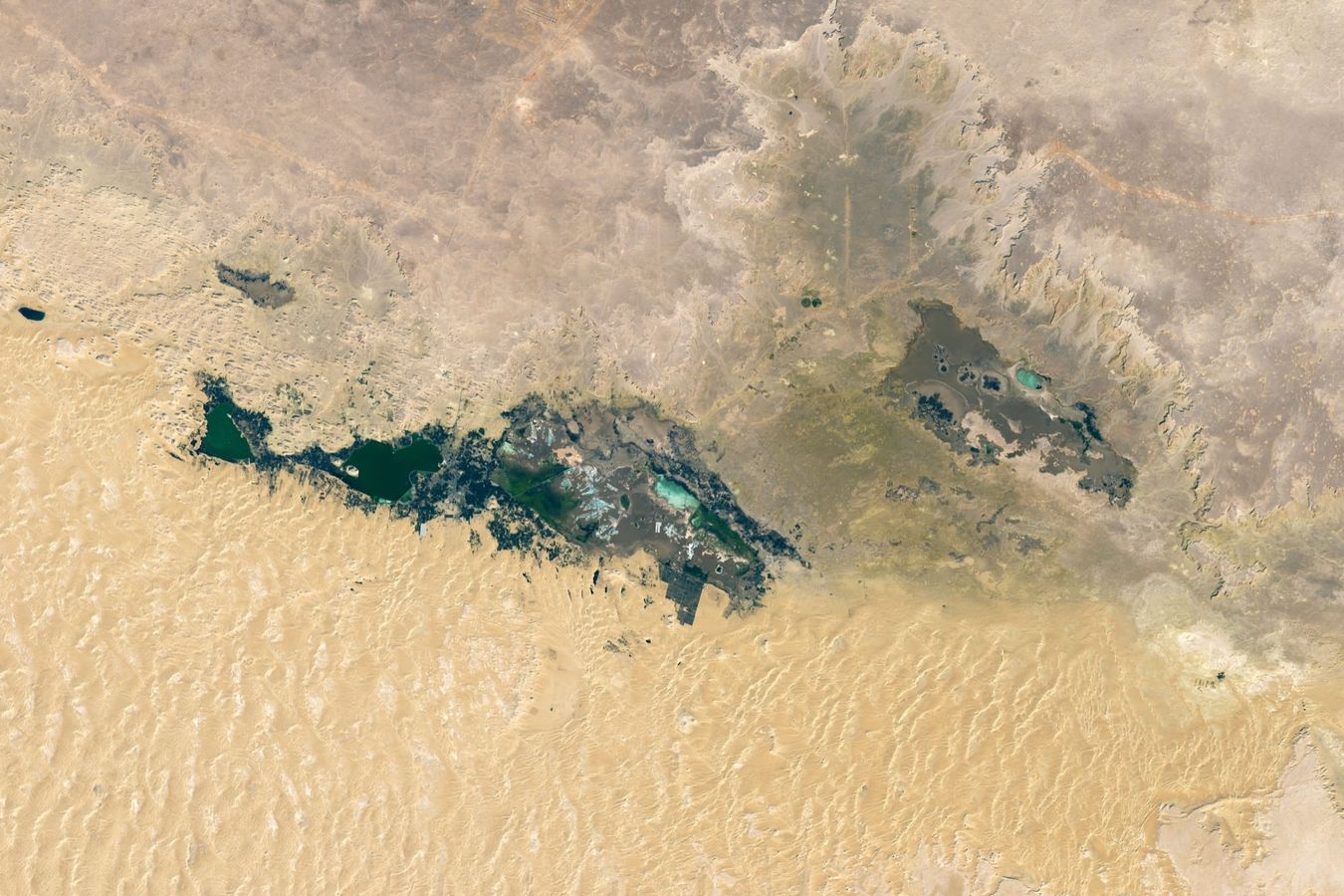
On a map, Siwa sits some three hundred kilometres south of the Mediterranean, five hundred and fifty west of the Nile and about forty-five from the Libyan border, in a depression below sea level. The other great oases of the Western Desert — Bahariya, Farafra, Dakhla, Kharga — lie to the south-east in a long arc towards the Nile and they are the subject of the second piece in this pair, Records in Sand. Between Siwa and them there is mostly sand; the Great Sand Sea runs south from Siwa towards the borders of Libya and Sudan.
If you are reading this from Cairo, Marsa Matruh, Mut or anywhere else in the region, much of what follows is not antiquity at all but neighbourhood: Siwi is still spoken over breakfast in the oasis, the October full moon still brings people to the foot of Gebel Dakrur and the water table under the olive groves is a matter for this year's harvest, not for a museum label.
This piece walks through that landscape the way the series has walked through the others — text, object, place, object — and it tries to keep three things apart that are usually blended: what a source says, what a scholar reads into it and what I see when I put the two next to each other. Where the sources disagree, the disagreement stays in. It is usually the most interesting thing on the page. And the story does not stop in antiquity: it runs through an Arabic novel, a Cairo modernist's watercolour and a younger painter's canvases named after olive jam, all of which are waiting further on.
A god above the salt
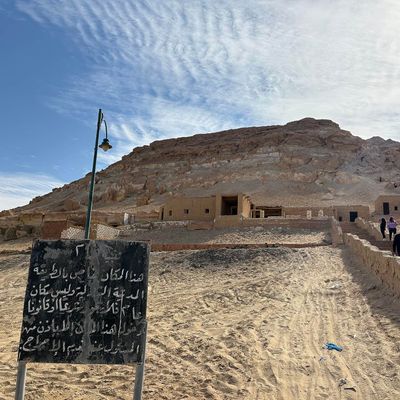
Aghurmi is a rock outcrop a few kilometres east of modern Siwa town and on top of it, inside a ring of collapsing mud houses, stands what is left of the temple of the oracle. It is small. The first European known to have reached it since antiquity, the English traveller William George Browne in 1792, is said to have found it too small to matter — a disappointment many visitors have repeated since, standing in a stone room that once decided the fate of cities.
Who built it is the first of the doubles. The German expedition of Georg Steindorff read a damaged cartouche in the sanctuary as Achoris, a king of the Twenty-ninth Dynasty. If that were right, the temple post-dated the Persian conquest and Herodotus's story of Cambyses sending an army against the oracle would be an anachronism. In 1938 the Egyptian archaeologist Ahmed Fakhry cleared the walls of the inner chamber and identified the builder as Amasis, of the Twenty-sixth Dynasty. That is where the scholarship now stands: the UCLA Encyclopedia of Egyptology dates the temple to the time of Amasis, citing Klaus Kuhlmann's monograph on the sanctuary. One cartouche, two readings, a century of difference.
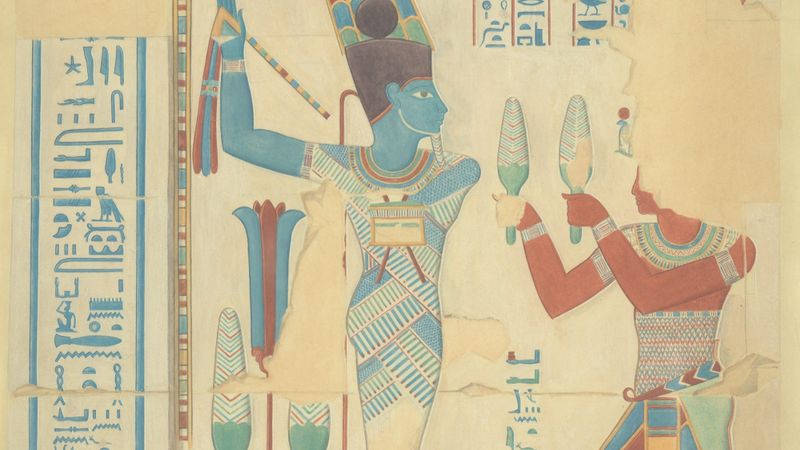
On the east wall of the sanctuary Amasis offers bread to Amun, Mut and other gods. On the west wall stood the ruler of the oasis, a man named Sutekh-irdis. His figure has gone, but his title can still be read: according to Livius, king of Upper and Lower Egypt and chief of the lands in the desert. Jona Lendering, who writes Livius, reads the pairing as showing the local ruler not as Amasis's subject but as his equal and the building as one that does not look much like an Egyptian temple at all; in the same reading, Amasis built it as a political gesture to the Libyan tribes who had helped him to the throne. This is an interpretation, not a finding. But it points at something the Greek sources half-remember and the Egyptian ones are quiet about: the cult of Ammon in the oasis seems to have had a local, Libyan dimension before and alongside its identification with the Egyptian Amun. Livius puts it carefully — in its account he was venerated by Libyan tribes and identified by the Egyptians with Amun of Thebes, who also wore a ram's horns; how and when those two identities met is not something the evidence lets anyone narrate step by step. A connection with the Phoenician Baal Hammon has been proposed on the strength of the name alone and Livius is candid that it is only a hypothesis.
How did the oracle begin? Herodotus asked and got three answers.
The priests of Zeus at Thebes told him that Phoenicians had carried off two priestesses; one was sold into Libya and founded the oracle there, the other into Greece, where she founded Dodona. The priestesses at Dodona — he gives their names, Promeneia, Timarete and Nicandra — told him instead that two black doves had flown out of Thebes and that the one which reached Libya told the Libyans to make an oracle of Ammon. And then Herodotus, having recorded both, turns to the reader with the phrase that makes him Herodotus: but my own belief about it is this — and offers a third, rationalising version in which the "doves" were foreign women whose speech sounded like birdsong.
Three foundations for one shrine, set down in a single passage by a man who did not feel obliged to choose.
The oracle's reputation in the Greek world was not a matter of Alexander's visit. It was old by then. Herodotus has Croesus of Lydia testing it alongside Delphi. Kimon of Athens sent to it shortly before his death; the oracle gave Alcibiades a misleading promise that he would take Syracuse and Athenian faith in it survived even that. Pindar dedicated a statue of Ammon in Thebes and sent the Ammonians of Libya a hymn. Pausanias, travelling in the second century CE, says he saw that hymn still carved on a triangular slab beside an altar dedicated by Ptolemy son of Lagus. Its opening lines, a German archaeological study notes, have come down to us; the rest is lost.
Where was the slab? The passage sits in Pausanias's description of Boeotian Thebes and the natural reading places it there. A classic study of Athens and the oracle nevertheless reads it as something Pausanias apparently saw on his own visit to the oasis sanctuary. A poem cut in stone and two scholars who cannot agree on which desert — or which city — it stood in.
By the time of the geographer Strabo, around the turn of the era, the shrine was fading. Divination in general, he writes, was held in greater honour in the past; the Romans were content with the Sibylline books and Etruscan haruspicy — reading the future in the entrails of animals — and so the oracle of Ammon, once highly esteemed, was now nearly deserted (Strabo, Geography 17.1.43). In the same breath he warns that the historians of Alexander added much flattery to what they recorded. Plutarch, a century later, adds a scene. In his dialogue on the decline of oracles a traveller, Cleombrotus, has just come back from Ammon, unimpressed by most of what he saw except one story the priests told him: that their ever-burning lamp consumed less oil every year, which they took as proof that the years were growing shorter. His companions laugh. A shrine that once judged kings was now measuring time by its lamp oil. A source that testifies and cautions against its own witnesses in one paragraph: it is hard to ask for more.
A later voice is harsher. An epigram preserved in the Greek Anthology tells of a man named Gessius who, shortly before dying in a foreign land, recognised the oracle's deception and cursed his own trust in astrologers. The epigram is catalogued among the poems of Palladas, a pagan schoolteacher-poet of fourth-century Alexandria who wrote a great deal about a world he felt was leaving him behind. That is one poet's verdict on one man. I read it also as a sign of how long the shrine stayed in the conversation — long enough to be mocked.
A note on names
The oasis has worn many names and each belongs to a different reader. Greek and Latin writers called the god Ammon and the place the Ammonion. Early Arabic geographers used Santariya. By the fifteenth century, according to Salah Hassan, al-Maqrizi was already calling the people Siwan and their speech Siwi. The people themselves say Isiwan for the place and Siwi for the language — an Amazigh (Berber) language, usually described as the easternmost of its family and closest, a Bayreuth study notes, to the speech of Sokna and El Fogaha in Libya. In this piece Arabic, Siwi and Egyptian names appear in Latin transliteration only and where one name has several spellings (Bahariya, Bahriya; Dakhla, Dakhleh) I follow the spelling of the source being cited. None of these names is more correct than the others. They are layers, like the salt crust under the palms.
A coin from Nimrud
The object is a silver tetradrachm, 14.5 grams, in the British Museum under the number 1971,1208.2. It was struck at Parium, on the Asian shore of the Dardanelles, for Lysimachus, one of the generals who carved up Alexander's empire. It was not found anywhere near Parium. It came out of the ground at Nimrud, in northern Iraq — the museum's record gives the findspot as Trench 07, Level 6, North Room, excavation number ND.6191 — and was published in 1958 among the Hellenistic coins from the site. It came to London as a gift of the British Institute for the Study of Iraq and is not on display.

A tetradrachm of the same type, minted at Ephesus for Lysimachus, 297–281 BCE: Alexander with the horn of Ammon; on the reverse, Athena crowns the king's name. Not the Nimrud coin, which has no published image. Art Institute of Chicago, 1922.4924. Image: Art Institute of Chicago, CC0.
On the obverse is Alexander's head, diademed and curling out of the hair above his ear is a ram's horn.
That horn is the oracle travelling. Whatever was said to Alexander in the small stone room at Aghurmi, the men who inherited his power understood what it was worth. The coinage of Lysimachus put Alexander on the face of the money with the horn of Ammon and the image travelled wherever that kind of money went. This particular coin's route between the Dardanelles and the Tigris is unknown; that the type reached Mesopotamia, the Nimrud find shows. The art historical tradition that grew from it is sometimes called the Horns of Alexander and it ran through coins, sculpture, medallions, textiles and texts; a museum label at the Art Institute of Chicago explains them, on a coin of the same type, as the sign of Alexander's claim to be the son of Ammon, a claim the oracle at Siwa reportedly confirmed.
Follow the coin's path. A god first worshipped by desert tribes in an oasis of salt lakes in what is now western Egypt. A Macedonian king who goes to him and comes back, by his own account, content. A successor who stamps the god's horn onto a portrait of a dead man — in order, one reasonably supposes, to borrow his authority. A coin minted on the Dardanelles and lost on the Tigris. A museum drawer in Bloomsbury.
The ground it came from has had a harder century than the coin. In March 2015 militants of the self-declared Islamic State bulldozed Nimrud. Iraq's Grand Ayatollah Ali al-Sistani condemned the attack from the pulpit and Iraq's deputy minister of antiquities called the loss irreplaceable. Objects carried away from Nimrud long before — this coin among them — are now part of how the site is remembered.
The Two-Horned
It carried further than coins.
Surat al-Kahf, the eighteenth chapter of the Qur'an, tells of a figure called Dhul-Qarnayn — "the one with two horns" — who travels to where the sun sets and where it rises, meets peoples at the edges of the world and builds a barrier against Gog and Magog. Many readers of the Qur'an, over many centuries, have asked who he was. The question has not been settled and the way the tradition has argued over it is a better story than any single answer.
A good place to begin is a page. At the National Library of Israel there is an Iranian Qur'an of the early sixteenth century, catalogued as Ms. Yah. Ar. 910 and on folios 200 verso and 201 recto it carries verse 18:86 — the passage in which the traveller reaches the setting of the sun. It was shown in the exhibition Romance and Reason at New York University's Institute for the Study of the Ancient World, placed deliberately near objects from the Alexander tradition. The curators note that most commentators identified Dhul-Qarnayn with Alexander and that not all agreed.
Three positions show the range. The historian and exegete al-Tabari (d. 923) is summarised by the exhibition's curators as reading the "two horns" as the two horns of the world, East and West, which the conqueror had reached — the Alexander reading. Ibn Kathir, in the fourteenth century, distinguished two figures: a righteous Dhul-Qarnayn of the time of Ibrahim and a much later Alexander, the Macedonian — and held that the Qur'an meant the first; four centuries later the Moroccan scholar Ahmad Ibn Ajiba called them the "greater" and the "lesser" Dhul-Qarnayn and concluded, generously, that both had ruled from east to west. And in the twentieth century the Indian scholar Abul Kalam Azad argued, as a modern historical hypothesis rather than a classical commentary, for Cyrus of Persia, pointing to the horned crown on the relief of the Morghab plain at Pasargadae — a horn again, this time Persian — a reading an Iranian theologian has since judged unproven. These are not three answers to one question asked in one way: an exegete reading a verse, a scholar sorting traditions and a modern historian testing a candidate are doing different things. A modern commentary sums up the state of the matter with some candour: there are as many suggestions as there are commentators and no report of the Prophet settles it.
That is a long argument, held by serious readers, over a thousand years — and none of them needs the ram of Siwa to be true or false.
This piece stops there, deliberately. There is a well-worn Western argument, going back to nineteenth-century German philology, about where the Qur'anic story "came from" and it tends to be used less to understand a text than to score a point against it. It is not the subject here. What belongs in an article about Siwa is narrower and, I think, more interesting: a god's horn, drawn on a coin to legitimise a dead king, became one of the images through which a later civilisation argued — carefully, with itself — about what a righteous ruler looks like.
The temple that exists as drawings
A few hundred metres from Aghurmi, in the palm gardens, there is a fallen wall of carved stone and not much else. This is Umm Ubayda, the second temple of Amun at Siwa, built by Nectanebo II, the last native king of Egypt, in the fourth century BCE.
When the German traveller Heinrich von Minutoli came in 1820 it was still standing, more or less. His Atlas includes a view of the temple area as it looked that year — plate XI — and his artists copied the reliefs. The building had already been damaged, the usual accounts say, by an earthquake in 1811. What finished it was a government official. In 1897, according to Fakhry's account, the district commissioner of Siwa had what remained blown up with explosives to provide stone for a staircase in the police station and for his own house. Tourist websites sometimes give the year as 1896 and sometimes transfer the explosion to Aghurmi. The fallen wall in the gardens is, in a manner of speaking, what the dynamite missed.
So the temple of Nectanebo exists now mostly as drawings in a German atlas and as a few blocks in the dates. And Fakhry, looking at one of those drawings — a figure on the wall he could not match to any familiar deity — suggested it was perhaps an ancient god worshipped at Siwa before Amun took precedence. A guess, labelled as a guess, about a god known only from a copy of a wall that no longer exists.
The official had a name: Mahmoud Azmi. For a long time that was nearly all anyone knew about him. The Egyptian novelist Bahaa Taher tried to find more. "I read everything I could about Siwa and the western desert," he told an interviewer in London and found nothing, so the character had to be created from scratch. The result was Wahat al-Ghurub — Sunset Oasis — published in 2007, which in 2008 won the first International Prize for Arabic Fiction — a prize sponsored from Abu Dhabi, as Banipal noted in its review, with a guaranteed English translation built in.
In the novel the commissioner becomes Mahmoud Abd el-Zahir, an officer compromised by his sympathy for the 1882 Urabi revolt, sent to Siwa as a punishment, with an Irish wife obsessed with finding Alexander's tomb. The book is built as a sequence of monologues and one of the voices, interrupting to supply historical context, is Alexander's own. When the book was adapted for Ramadan television in 2017 — directed by Kamla Abu Zekry from a script by Mariam Naoum, with Khaled El Nabawy and Menna Shalaby — viewers in Egypt read Mahmoud's story, Mada Masr noted, against the revolution of 2011. The crew shot several episodes in Siwa before moving to Luxor and Fayoum, according to the Kuwaiti newspaper Al-Jarida and the opening titles follow the actors through the lanes of Shali, as Asharq Al-Awsat described them, to a mawwal from the south of Egypt sung by Wael El Fashny. The ruin that the rain made in 1926 became, ninety years later, the set of the story about the man who blew up the temple.
A nineteenth-century act of destruction, recorded in a line of an archaeologist's report, became the seed of an Arabic novel that let Alexander speak and then of a television series through which Egyptian television audiences could read a story about their own recent history. The temple is gone. It has been rebuilt twice — once in a German atlas, once in Egyptian fiction.
The king who was an Egyptian magician
There is a strange loop in Nectanebo's story and it runs through a book.
The Alexander Romance — a Greek collection of legends about Alexander, attributed in some manuscripts to his court historian Callisthenes and therefore now called Pseudo-Callisthenes — was one of the most widely retold texts of the pre-modern world. Ken Dowden, introducing his translation, counts eighty versions in twenty-four languages: an Armenian translation of the fifth century opened the way east, the story shaped Firdawsi and Persian manuscript painting and through Arabic it reached India and Indonesia. And it opens not in Macedon but in Egypt.
In the Romance, Nectanebo II, foreseeing that his kingdom will fall to the Persians, flees to the Macedonian court disguised as a magician. There he falls in love with Olympias, Philip's queen and with the help of dreams and potions visits her in the guise of Ammon. Alexander is born from that union. Years later the boy kills the old magician, who tells him, dying, whose son he is. The horns are part of the costume. In the Greek β recension, one of the ancient versions of the text (Book I, 7.1), as a recent study translates it, Nectanebo procures a fleece of the softest sheep's wool with the horns still attached, horns that shine like gold, together with an ebony sceptre, a white robe and a cloak like a serpent's skin. The god who visits the queen is a man in a ram's fleece.
Historically the legend cannot stand: the real Nectanebo was still ruling Egypt when Alexander was born and lost his throne to the Persians only in 342 BCE. But legends are not wrong in the way history can be wrong. They do other work. Philip Harland, reading the Egyptian material in the Romance, puts the effect memorably: in the legend, Egyptian wisdom becomes the cause of Alexander's conquests, the conquest of Egypt among them and Alexander turns, in a sense, into an Egyptian who conquered the world. That is Harland's reading and a persuasive one. The last native pharaoh is made the father of the foreign king who took his country and the oracle of Ammon becomes a family matter.
The man who built the second temple at Siwa is thus the man the legend made the father of Siwa's most famous visitor. I do not think anyone designed that symmetry. It simply accumulated.
You can see the legend painted. The British Library holds a French prose Romance made in Paris around 1420–1425, shelfmark Royal MS 20 B XX, with eighty-six miniatures by the painter known as the Master of the Royal Alexander. Its first owner we can name was Henry VIII, whose monogram "HR" is on the first leaf; it came to the British Museum in 1757 with the Old Royal Library.
Two leaves tell the story. On folio 4 verso Nectanebus is alone in his chamber, enchanting a basin of water — divining the fall of Egypt in its surface. On folio 11 recto the young Alexander, having been taught astronomy by the old man outside the city walls, pushes him into a pit.
A pharaoh bent over a bowl of water in a Paris workshop, painted for an English king who had, as far as we know, no interest in an oasis in the Libyan desert. The oracle's story has been a portable object for a very long time.
Salt of Ammon
Herodotus wrote about Siwa from a distance and still knew what it was made of.
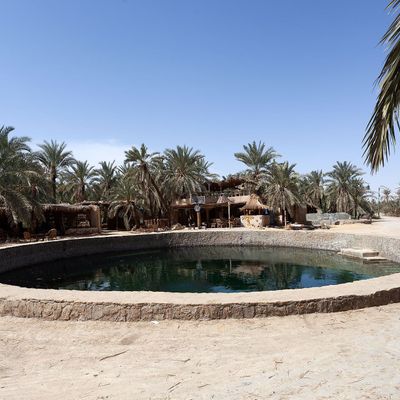
Beyond the coastal Libyans, he writes, runs a ridge of sand from Thebes to the Pillars of Heracles and along it, about every ten days' journey, there are hills of salt in great lumps and on the top of each hill a spring of cold sweet water shoots up out of the salt. The first of these, ten days from Thebes, belongs to the Ammonians. They have another spring as well, he adds, which is warm at dawn, cooler when the market fills, cold at noon — the hour when they water their gardens — and then warmer through the afternoon, until at midnight it boils and bubbles. They call it the Spring of the Sun.
Livius identifies it with the pool now called Cleopatra's Bath and calls Herodotus's description, with reason, exaggerated. His translator's note in the Loeb edition is blunter: Herodotus's distances between identifiable places are nearly always incorrect. One way of reading the spring — mine, not the sources' — is that a pool which stays at roughly the same temperature all day will feel cold against noon air and warm against the night and a traveller's report will record the feeling rather than the water. The boiling at midnight is harder to rescue. Let it stand as what it is: a spring that became a story before anyone measured it.
The presence of salt is not exaggerated. Siwa sits in a depression below sea level, ringed by salt lakes; the older houses are built from karshif, lumps of salt-crusted mud cut from the lake edges. The salt hills Herodotus described have a modern echo in the karshif from which the older Siwan houses were built.
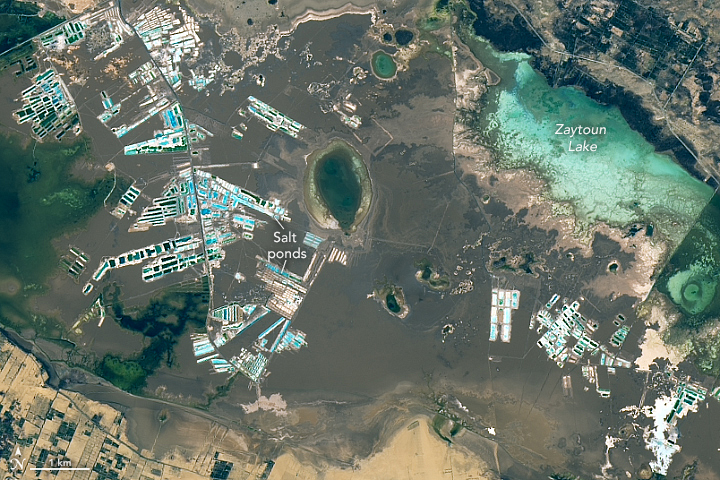
Salt-harvesting ponds on the edge of one of Siwa's lakes, 23 January 2023, Landsat 9. Image: NASA Earth Observatory / Lauren Dauphin, USGS Landsat data, public domain.
And the salt of Ammon went further than the town. Pliny the Elder, in the thirty-first book of his Natural History, describes a kind of salt he calls hammoniacum, dug from under the sand in the region of the temple. The name eventually entered European chemistry as sal ammoniac and in the eighteenth century "ammonia" became the name of the pungent gas associated with it — the dictionaries credit the Swedish chemist Torbern Bergman, in 1782. What travelled was a name, not a substance or a body of knowledge: the salt dug near the temple and the gas in a modern laboratory share a word, not a continuous history.
The chain has weak links and they are worth showing. What Pliny describes does not match the properties of ammonium chloride; already in the eighteenth century the Göttingen scholar Johann Beckmann concluded, as a nineteenth-century treatise summarises him, that the "sal ammoniac" of the ancients was only common rock salt. And Pliny himself offers a different etymology from the one the dictionaries repeat. The name has been derived from the temple of Ammon, from the Greek ammos, "sand" — the salt was dug from beneath it — and from a district of Cyrenaica called Ammonia; the three derivations do not agree. No scholarly consensus settles which came first. I like both directions — the god lending his name to a word for sand, or sand lending its sound to the god — but that is a pleasure, not a finding; the evidence does not choose.
There is a second chain and it is the one I like better. Pliny also lists among precious stones something he calls the Hammonis cornu, the horn of Ammon: a coiled, ribbed fossil that looked like the god's ram's horn. That is where the word "ammonite" comes from. And in 1874, crossing the Great Sand Sea south of Siwa, the German explorer Gerhard Rohlfs and his geologist Karl Zittel found an escarpment packed with Cretaceous marine fossils, including an ammonite Zittel described as new and named it Ammonite Hill. Later travellers coming from the north went looking for a prominent hill and found only a low scarp.
A ram-headed god; a coin with his horn; a fossil named for the horn; a hill named for the fossil, in the same desert the god came from.
Shali, or how a town dissolves
Walk into Siwa town today and the thing you see first is not a temple but a ruin that looks like melted wax: Shali, the old fortified town, a hill of mud-and-salt houses slumped into one another, with the minaret of the old mosque still upright among them.
Its founding date comes from a local source. The Siwan Manuscript — a chronicle kept by the head of the Abu Musallim family, the religious judge of the oasis and continued by his sons and grandsons, a copy of which was given to Prince Omar Toussoun in the late 1920s — records that after raids by Bedouin and Amazigh groups ("Berber" in the translations of the chronicle), the seven families left in the old settlement at Aghurmi moved and built a fortified village on a hill in 1203. Fakhry used the manuscript. Most accounts of Shali still rest on it.
The sources downstream of it round differently. Egypt's State Information Service has described the fortress as dating from the twelfth century in one place and the thirteenth in another. One later newspaper account, in Watani, wrote that it was built by the Mamluks — which cannot square with 1203, since the Mamluks came to power in 1250. A local chronicle gives a year; later retellings round it to a century and one newspaper turns it into a dynasty. Each of them is a source too, recording what the date had become by the time it reached them.
The material is the story. Karshif sets hard in sun and dry air. It does not like water. In 1926 it rained on Siwa for three days and the town on the hill began to dissolve. The rain accelerated an abandonment already under way, as families moved to newer houses on the plain and Shali became the shape you see now. A desert town undone by rain: it sounds like a riddle and it was the physics of salt and mud and of a town already ageing.
Between 2018 and 2020 part of Shali was restored with European Union funding, using the old technique. About three hundred Siwans worked on it and it reopened in November 2020. Inside the restored quarter there were plans for a permanent exhibition of photographs by Alberto Siliotti, Daniele Pellegrini and Arnaud Chicurel, first shown at the Italian Cultural Institute in Cairo and intended to move to Shali.
So a town that melted in 1926 is now held together partly by new salt-mud and partly by pictures of itself.
The tomb that keeps being found
Later sources — Diodorus and Curtius, writing centuries after the event — say that Alexander, before he died in Babylon in 323 BCE, expressed a wish to be buried at Siwa (Justin says the same). He was not; Ptolemy took the body to Memphis and then to Alexandria. The wish has been enough to keep a tomb in Siwa alive in the imagination. In 1995 the Greek archaeologist Liana Souvaltzi announced she had found it at Maraqi, west of the oasis. A Greek government commission visited the site and said it saw no evidence that the structure was even a tomb, that its style was not Macedonian and that the inscribed fragments did not say what she said they said. Egypt revoked her licence in 1997. In 2021 the head of Siwa's tourism department told Egyptian television there was evidence the tomb might be in the Maraqi area. The Egyptologist Robert Bianchi reported that Egypt's antiquities authority had officially recognised more than 140 searches for Alexander's grave; a later paper puts the figure at about 150. Bianchi also recalls another tradition about the burial: that Alexander wanted his body thrown into the Euphrates, so that he would seem to have vanished to join Ammon. We do not go looking here. Not because the question is forbidden, but because the claim has a way of swallowing everything around it — the oasis, its people, its own history — and turning Siwa into a frame for a Greek body. Siwa has enough of its own to show.
The bride's disc
In 1985 a woman in Philadelphia named Dora K. Plant gave the University of Pennsylvania Museum a necklace from Siwa, in memory of her sister. Two years later an art historian named Salah Hassan published it in the museum's magazine, Expedition, in an article that is still one of the most useful things written about Siwan adornment. He is very probably Salah M. Hassan, the Sudanese art historian who taught at the College of Fine and Applied Art in Khartoum and at the University of Pennsylvania before going on to Cornell and who has led The Africa Institute in Sharjah since its establishment in 2018 — the curator, among much else, of exhibitions on the Khartoum School and on the Egyptian Surrealists. An article about a Siwan bride's necklace, written in Philadelphia by a scholar whose later work was built in and for the region: the object has been in MENA hands for longer than its museum label suggests.
The necklace has two parts. The torque, which Siwans call aghraw, is a heavy ring of silver-copper alloy; it weighs 364 grams. Hanging from it is a disc, the adrim — 13.3 centimetres across, 119 grams, cut from sheet metal, backed with resin, engraved with a boss at the centre, a cross, hatched semicircles and eight-pointed stars. It slips on and off the torque. Hassan notes that necklaces of this type are reported to weigh up to two kilograms and that the torque alone can weigh 1.2.
The disc's meaning is in its removal. According to Hassan, a Siwan bride takes the adrim off on the eve of her wedding, at a spring and it is passed to a sister or another girl of the family. The torque stays. The disc marks a passage and the passage is marked by its absence.
Two things about that article need saying plainly. It was written, as Hassan himself says, in the "ethnographic present" — describing a traditional culture before the changes that were already under way when he wrote. And its title uses the label "virginity disc", a term from outside ethnography that reduces a layered wedding object to a single function. How Siwan women themselves describe it is not recorded in the article. Adrim is the Siwi word and what the object does in Hassan's account — mark the moment a girl becomes a bride, as it did in the 1980s — can be described without the label.
The necklace is in the Penn Museum's online catalogue as 85-19-1, in storage and the catalogue does not quite agree with the article written about it. Hassan describes an alloy of silver and copper; the catalogue says brass. Hassan writes adrim; the catalogue writes adrinn. He gives the donor as Dora K. Plant; the credit line reads Mrs. John Plant — the same woman, recorded under her married name in the museum's credit line. The catalogue, too, still uses the phrase "virginity disc".
There is an older Siwan torque in London and it carries a surprise. The Victoria and Albert Museum's 1103-1869 is a heavy silver aghraw, bought in Cairo before 1869 and catalogued at the time simply as "modern Egyptian". The curators now think it was probably made for the women of Siwa. On its front are three stamped marks: the Egyptian mark for silver of 800 standard and the tughra — the calligraphic monogram — of the Ottoman sultan. A bride's neck-ring from the desert edge, bearing the tughra of an Ottoman sultan in Istanbul. It can be seen by appointment at the V&A East Storehouse in London.
The necklace has companions now, in other cities.
In the Brooklyn Museum, accession number 2024.30, there is a black bridal tunic of the mid-twentieth century, bought before 1975, "likely in the Siwa Oasis" and given to the museum in 2024. Its catalogue gives its Siwi name as the decorated black shirt that makes us happy and says it is worn at the end of the seven days of a Siwan wedding. The front carries a sunburst of embroidery radiating from the chest, set with mother-of-pearl buttons.
In Leiden, the Textile Research Centre holds a white bridal dress and black headdress, TRC 1997.0275. The TRC describes the Siwan palette — black, dark green, orange, red, yellow — and says these colours are said to be those of ripening dates. That "said" is the right word to keep. It is a local explanation, carried by the people who wear the colours and it should be passed on as theirs. It is also a living one, which means it moves: after 2003, the TRC notes, the Siwan palette widened, as workshops supplying the international fashion market dyed new colours.
The women who do the work have occasionally been asked about it. Mabrouka Omar Bashir, an embroiderer who supervised a group of young unmarried women producing for a local NGO, told Reuters that the craft had nearly died once cheap outside textiles arrived with the road in 1985. Brides, she recalled, used to have around twenty embroidered veils and three heavy wedding shawls made for each wedding. Without the work, she warned, new generations would see the pieces only hanging in the bazaars and not know what they were for. It is one of the few places in the record where a Siwan woman explains Siwan dress in her own words.
The Zay Initiative, a dress collection based in the United Arab Emirates, holds a white Siwan bridal tunic and its braids under ZI500491 and ZI500491a. Its catalogue gives a Siwi name for the mother-of-pearl buttons that translates as the eye of the sun and explains them as a talisman that draws light and reflects it onto the wearer. Again, an interpretation — in this case one the collection has recorded and one that sits beautifully beside Herodotus's Spring of the Sun, if you want it to. I would not push it further than that.
Brooklyn, Leiden and the Zay Initiative each transliterate the dresses' Siwi names differently and a video catalogue made in Siwa in 2019 differs again. Siwi has no standard written form. The spelling wobbles because the language was not built to sit still on a label.
Look at how these things travelled. The V&A torque was bought in Cairo before 1869 and catalogued as "modern Egyptian". The Brooklyn tunic was bought "likely in the Siwa Oasis" some time before 1975 and given to the museum in 2024. The Penn necklace came from a private collection in 1985. None of the catalogue entries says who wore these things, who sold them, or whether a Siwan family chose to let them go. That is not an accusation; it is the ordinary silence of ethnographic collecting and it is worth naming. A wedding dress from a living community is not an antiquity. The women who embroider its successors are still working.
In Siwa itself, the House of Siwa Museum was built of karshif and palm wood with a grant from the Canadian government; visitors describe it as run by Siwans, with wedding dresses on the ground floor and a winter room upstairs. That matters more than any single object in a foreign drawer. The disc, the black shirt, the eye of the sun — they are also still at home.
Two founders, one moon
Every year around the full moon of October, people gather at the foot of Gebel Dakrur, a hill south of Siwa town, for three days of shared meals and nightly hadra, the Sufi ceremonies of remembrance. The festival is called the Siyaha, or Eid al-Solh, the feast of reconciliation and its most common local story says it commemorates a peace between the oasis's two old factions, the Easterners and the Westerners.
Who founded it? Two local traditions give it different founders and they share a date.
According to a version citing the Siwan Manuscript, the festival began in 1868, when Sheikh al-Tayeb Muslim gathered the people at Gebel Dakrur. According to the version recorded by the Egyptian heritage group Nawaya for Google Arts & Culture, it began in 1285 of the Hijra — the same years, 1868–69 — when a sheikh named Muhammad al-Madani came from Libya and distributed bread so that each person ate the bread of his neighbour. Behind the two names stand the two Sufi orders that shaped modern Siwa, the Sanusiyya and the Madaniyya — and behind them, Libya. After Muhammad Ali brought Siwa under Egyptian rule in 1820, the oasis, a Bayreuth study notes, remained strongly attached to Benghazi and the Sanusiyya ran its order from Jaghbub, the Libyan oasis a short journey to the north-west. A Libyan historian at the University of Tobruk describes Jaghbub as a station linking the Libyan desert to the Nile Valley through Siwa since antiquity. Today the main crossing between Egypt and Libya lies far to the north, on the coast at Sallum and a new official crossing near Siwa has been reported as approved by both countries. The festival remembers a time when the desert road between the two oases was simply a road. One way to read the two traditions — mine, not the sources' — is that a feast of reconciliation remembered through two founders is not a contradiction but what reconciliation can look like from the inside: each side keeps its own version of the handshake.
The French anthropologist Vincent Battesti filmed the ceremonies on 25–27 October 2015 and recorded something the tourist brochures leave out: the festival had not been held for five years, because the brotherhoods were ageing and because of security concerns after the January 2011 revolution. He edited his film, at the request of the people of Siwa, as a gift back to them.
A reconciliation feast that had itself to be reconciled back into existence. It came back.
Painters from Cairo, eyes from elsewhere
Siwa has also had its painters from Cairo. Inji Efflatoun — modernist, communist, feminist, imprisoned under Nasser from 1959 to 1963 — renewed her interest in painting, according to Mathaf's curators, after journeys to Luxor, Nubia and the Egyptian oases, where she sketched people at work inside their houses. A small watercolour called Siwa Oasis II was shown in Cairo in 2024 at the Safarkhan Gallery and offered in London in May 2025 from a private collection in Dubai; the auction house dated it to about 1960 and in the same sale presented it as an example of the luminous style she developed after leaving prison — which would place it after 1963. There is a chronological tension inside the catalogue: "about 1960" may simply be approximate, or the stylistic description too broad and the sheet alone does not settle it.
A younger Cairo painter, Lina Osama, has been going to Siwa since 2009, partly through artists' residencies in the oasis run by the Egyptian Ministry of Culture in 2009 and 2018. An exhibition of her Siwa paintings took its title from the oasis's olive jam: sour fruit made sweet with sugar, a taste the exhibition text reads as the sweetness and bitterness found side by side in life there. According to her own biography, one of her paintings is in the Amazigh Heritage Museum in Morocco.
Other artists have come to Siwa from outside. The photographer Nathalie Mohadjer's ongoing series Fatma (2022–) began when a Siwan woman waved to her from a window and invited her in. The series is framed, in its own description, around Siwa as one of the most traditional societies in the Middle East — a framing worth reading critically, because it is one of the oldest outsiders have brought here. In Doha, the exhibition Amazigh Hair Couture at M7 (October 2025 – January 2026) set Siwa within a wider Amazigh world stretching from Morocco to Egypt, curated by artists with roots in that world. That is a different gaze and a Gulf audience was the one to receive it.
Where to see it
In Siwa: the temple of the oracle at Aghurmi, the fallen wall of Umm Ubayda in the palm gardens, the restored quarter of Shali, Cleopatra's Bath, Gebel Dakrur and the House of Siwa Museum. Abroad: the British Museum holds the coin from Nimrud (1971,1208.2, not on display), the Art Institute of Chicago a tetradrachm of the same type (1922.4924), the British Library the Romance of Alexander with Nectanebo's miniatures (Royal MS 20 B XX), the Brooklyn Museum the black bridal tunic (2024.30), the Penn Museum the aghraw with its disc (85-19-1), the V&A East Storehouse in London, by appointment, the torque with the Ottoman tughra (1103-1869), the Textile Research Centre in Leiden a white bridal dress (1997.0275) and the Zay Initiative in the UAE a bridal tunic (ZI500491).
Getting there
Siwa lies about 750 kilometres from Cairo and 300 from Marsa Matruh, on a paved road that runs south across the desert around the western end of the Qattara Depression. Buses run from Cairo and Alexandria and from Marsa Matruh; expect military checkpoints and keep your passport to hand. The mild season runs roughly from October to April; summer temperatures pass 40°C. The Siyaha at Gebel Dakrur follows the October full moon, so its dates move each year — ask in Siwa. The oasis has guesthouses and, among others, the eco-lodge Adrère Amellal, built of local materials. The track from Siwa to Bahariya requires a security permit and a four-wheel-drive vehicle and has at times been closed to foreigners.
The water under the palms
Come back to Siwa and to the present tense.
In 2016 the UN's Food and Agriculture Organization listed Siwa as a Globally Important Agricultural Heritage System. Its description is a set of numbers: about 280,000 date palms, some 25,000 tonnes of dates a year — roughly 2% of Egypt's — and 27,500 tonnes of olives. It praises the ingenuity of Siwan farmers and it is right to.
The immediate problem is not simply a lack of water. It is too much irrigation water, of the wrong quality, in the wrong place. Siwa is a closed basin below sea level. For generations its springs were enough. Since the 1990s the number of wells has grown sharply; irrigation water pumped from deep aquifers runs off the fields with nowhere to drain and collects. NASA's Earth Observatory, drawing on decades of satellite monitoring, notes that the area of the salt lakes and of waterlogged land rises in step with agricultural activity. The water brings salt to the surface; waterlogged, salted soil stresses the roots and the palms and olives weaken in it.
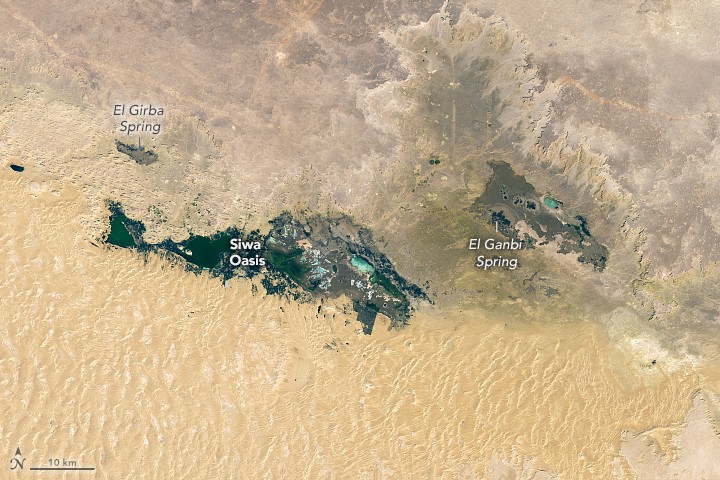
The Siwa depression on 23 January 2023: cultivated land (dark) pressed against the salt lakes that grow with irrigation runoff. Landsat 9. Image: NASA Earth Observatory / Lauren Dauphin, USGS Landsat data, public domain.
How bad it is depends, as usual, on whose number you take. The study NASA cites, by N. H. Moghazy and J. J. Kaluarachchi in the Alexandria Engineering Journal, tells the story in two movements. Between 1980 and 1998 badly designed wells raised the volume of excess water by about 336 per cent and by 2000 the salt lakes covered 21,348 acres, 89 per cent more than in 1987. Then management stepped in: from 1998 to 2012 excess water fell by about 95 per cent and the area of the lakes shrank by 24 per cent. The salt, however, stayed. Groundwater salinity more than doubled between 1996 and 2013 and olive and date yields fell by about 46 and 55 per cent between 2000 and 2011, with net revenue down by more than 60 per cent. Fewer lakes, saltier water: the crisis did not move in one direction. The rise itself has been measured for decades: a study in the Journal of Arid Environments found the subsoil water rising about 1.3 centimetres a year in 1962–77 and 4.6 a year from 1977 and named the causes as unmanaged agricultural expansion, excess irrigation and the lack of a drainage system. An investigation by Afaq magazine and the Arab Reporters for Investigative Journalism network, published by Maan, measured the lakes on Landsat images: Lake Siwa itself grew by 724 per cent in area between 1990 and 2021, the lake at al-Maraqi by 483 per cent, while the lake at Abu Shuruf shrank by 79 per cent; the total area of open water in the oasis rose by 58 per cent. Its period and its method are not those of the engineering study and the two sets of figures should be read side by side rather than as one line. The same investigation records the responses — elders meeting President Mubarak in 1996 and President al-Sisi in 2018, limits on the number of wells (which were then dug deeper) and in January 2022 a new project to pump drainage water out of the oasis through a concrete tunnel to Ain al-Janbi. In the summer of 2025 a reporter for Muwatin interviewed more than twenty farmers, some in Amazigh, some in Arabic and heard the same thing from all of them: the water had turned salty and the drainage was killing the groves. One family, the Baghis, had held eighteen acres of dates and olives for more than a century; a lake formed by drainage from newly reclaimed land took about ten of them and salt ruined the rest. The eldest son, Omar, described the family's life in one line: "We are perpetually combating the lake and agricultural drainage." Muwatin itself traces the lakes to reclamation on the oasis's edges since the 1970s — by small investors and by companies that together reclaimed more than 30,000 acres — and argues that government initiatives, including the national "1.5 million feddans" programme, have intensified the crisis. That is the investigation's conclusion, drawn from farmers' testimony and satellite images; the ministries concerned have their own figures and the causal chain is exactly what the argument is about.
Hold that beside the rest of this piece for a moment. A town built of salt, undone by three days of rain in 1926. A spring that Herodotus said boiled at midnight. A lake that has grown more than sevenfold in a generation, beside another that has shrunk. In Siwa, water has always been the thing that makes and unmakes.
The language is under a gentler pressure and here too the sources disagree in a useful way. UNESCO classes Siwi as "definitely endangered", a category based on evidence of reduced transmission to children as a mother tongue. The linguist Valentina Serreli, who worked in the oasis, disagreed: in her observation Siwi remained dominant. Estimates of the number of speakers range from 15,000 to 25,000. The linguist Valentina Schiattarella deposited recordings made in 2012–13 in the Endangered Languages Archive in London, among them speech from women, which had been out of reach of male researchers and the first collection of Siwi folktales. She notes that the people call their language, in her transcription, žlan n isiwan and that some of the recordings come from Qara. In 2018 she recorded a folktale nearly eight minutes long, told by a man in his thirties to a room of children and adults in his brother's house. She also points out that a Siwan anthropologist, Fathi Malim, had already published Siwi tales and proverbs in 2001 — in Arabic translation. Whatever the classification says, the language is being recorded by people who can hear it spoken, some of them from inside the oasis.
North-east of Siwa, on the rim of the Qattara Depression, lies one of the smallest inhabited oases in Egypt, Qara. Its people speak Siwi; the linguist Valentina Schiattarella made two of her recordings there. How far it is from Siwa depends on whom you ask — about 100 kilometres in a Bayreuth study, 110 in the first book devoted to the oasis, by the Egyptian archaeologist Mohamed Kenawi and Francesca Simi, 130 in the linguist's archive notes — and so does how many people live there: Kenawi and Simi give about 700. It is easy to leave it out when counting Egypt's oases. It is worth counting.
The research continues in Siwa itself. According to Roger Bagnall, the regional director of antiquities, Abdel Aziz el-Demery, has led new work suggesting that Siwa is not as poor in inscriptions as it long seemed — until recently the oasis offered little more than a few graffiti, fragments and a statue base of Hadrian from Aghurmi, now in the Graeco-Roman Museum in Alexandria. And a Sufi festival that lapsed for five years has come back and a French anthropologist's film of it has been given back to the people who appear in it.
So this is where the oracle's oasis stands in the autumn of 2026. A rock above the salt lakes with a small temple on it, dated by a cartouche read twice. A coin in London, a manuscript in the British Library, a black wedding shirt in Brooklyn, a neck-ring stamped with a sultan's tughra. A novel in which Alexander speaks Arabic. A festival with two founders under one moon. A lake that keeps rising.
The god of Siwa was famous for giving answers people could carry away and argue over. That has not changed. What has changed is who is asking — and, more and more, the questions are being asked from inside the oasis, in Siwi, about the water.
Galleries mentioned
Museums mentioned



Places mentioned
Related reading
Records in Sand: Bahariya, Dakhla, Kharga, Farafra and the Deep Desert
A dinosaur known from photographs, a rebel’s temple built into a medieval town, a day of water sold in demotic — and a desert that was not blank.
Ouarzazate: How a Moroccan Town Became Hollywood's Desert
An army, the film industry and a solar plant all came to Ouarzazate for what its landscape could offer. Each saw the land as empty in its own way and each left something out.
Ali Baba Was Never an Arabian Folktale
There is no Arabic manuscript of Ali Baba older than its French translation. The most famous "Arabian folktale" in the world was assembled at a writing desk in Paris — and its true hero was a slave woman written out of her own title.