
Marrakech · Morocco
Ouarzazate: How a Moroccan Town Became Hollywood's Desert
An army, the film industry and a solar plant all came to Ouarzazate for what its landscape could offer. Each saw the land as empty in its own way and each left something out.
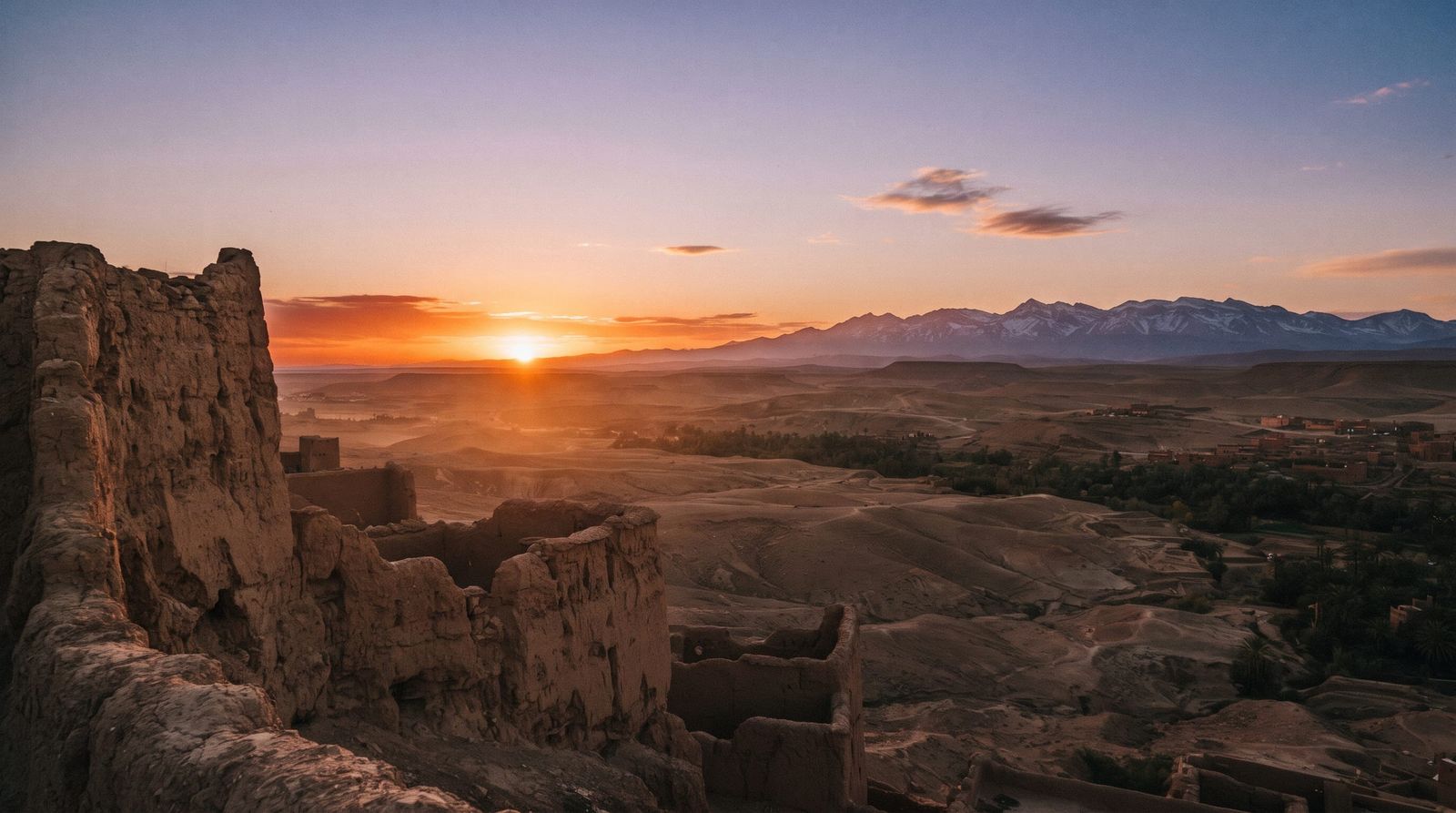
Stand on the low hills west of Ouarzazate in the hour before sunset and turn slowly and you can see most of the town's history in a single sweep.
To the north, the High Atlas, snow on its upper ridges for much of the winter. Below it, the long road coming down from the pass, the one that carries almost everything and everyone into this town. To the east, the earthen bulk of the Kasbah Taourirt, tower behind tower and beyond it the pale scar of a wadi with a palm grove running along its bed. Closer, behind a fence by the Marrakech road, a cluster of pharaonic columns, a plaster Roman arch, a fibreglass fighter jet parked in the sand as though it had landed there by mistake. Further out, past the airport and the military land, a flat expanse that catches the late light in thousands of curved mirrors and in the middle of it a single concrete tower, its tip glowing. And to the south-east, if the year has been kind, a long sheet of water, the reservoir that waters the oases downstream and cools the solar plant.
A kasbah, a film studio, a solar plant, a reservoir. Four quite different things, built in different centuries, by different people, for different reasons. But stand there long enough and you start to notice what they have in common. Every one of them is here because someone looked at this landscape and saw something in it that could be used: a position, a passage, water, light. And whoever built each of them noticed some things about this plateau and not others.
This is a piece about a town that has repeatedly been defined from outside by what it could offer — a position to an army, a blank horizon to the film industry, sunlight and space to the energy transition — and about what each of those ways of seeing left out. All three, at one point or another, described the land here as empty. They did not mean the same thing by it and the differences matter as much as the resemblance.
A name older than the town
Ouarzazate is a name that existed long before there was a town to carry it. In the oldest uses, it referred not to a settlement but to a district: colonial administrators in the 1920s still described it as a wide tribal space of villages and gardens along a river, at the meeting point of valleys coming down from the Atlas — the Drâa, the Dadès, the routes north to Marrakech and west to the Souss. The name is usually glossed, in local guides and in the planning documents of the town itself, as War-Zazat, "without noise" in Tamazight. It is a lovely etymology and probably a folk one; other readings tie the word to the riverbed it first named. Either way, the town that now carries it is far younger than the word.
There was power here before there was a town. The Kasbah Taourirt, on its rise above the wadi, has older origins that oral tradition places in the seventeenth century; in the nineteenth it was taken over and greatly expanded by the Glaoui, the family who ruled much of southern Morocco until the end of the French Protectorate, as they extended their reach from their mountain stronghold at Telouet over the valleys of the south. It was a residence, a court, a granary, a fortified neighbourhood for the families and craftspeople who served it. It was not a town. Ouarzazate, before the twentieth century, was a district of villages and fields, a crossing point for caravans moving between the Sahara and the Atlas passes. People lived here. They farmed, herded, traded, built. What there was not was a centre.
Then, in 1927, the French commander of the Marrakech region secured the agreement of the Pasha of Marrakech, Thami El Glaoui, to install a military post and a native-affairs bureau in the district. In April 1928, according to the town's first guidebook, a unit of Moroccan goumiers marched south from Telouet to garrison a hill above the wadi. Within a decade there was a town.
The pieces arrived in quick succession. By the end of the 1920s, the CNES geographers note, the place had an airfield and a large barracks, soon followed by the administrative services that made it the hub of the region; the geographer Andreas Kagermeier, in his study of the military posts of southern Morocco, dates the founding of the town as a post to 1928. And meanwhile the road. It had been requested in 1923 by General Daugan, commander of the Marrakech region and begun in October 1925. The archive of documents from the period assembled by the historian Jacques Gandini records that it was built by public works engineers with labour drawn from the Foreign Legion, opened as far as the Tizi n'Tichka pass in November 1928 and reached Ouarzazate by the end of the year.
The French geographers who study it now are blunt about what that means. Despite its Amazigh name, the CNES study of the region notes, Ouarzazate is a colonial creation: the kasbah is old, but the urban fabric around it grew from a French decision to put a military post between the mountains and the desert. You can still read that decision in the plan. The town's main street, Avenue Mohammed V, runs like a supply line. Its northern edge is defined not by hills or water but by military land and the airport. Across the wadi, roughly a kilometre and a half away, the neighbouring commune of Tarmigt has grown from a cluster of older villages into the town's extension, so that the built-up area now spills across the boundary between the two; together, the two communes hold well over 120,000 people — around 79,000 in Ouarzazate itself and some 47,000 in Tarmigt, according to the 2024 census. The planners who studied "Greater Ouarzazate" in 2018 were careful to map the old ksour that the modern town grew around: the earthen villages of the oasis were never erased, only absorbed. Walk off the avenue into some of the older quarters and you can still find their walls, folded into the town that was supposed to have been built on nothing.
The colonial authors had no doubt about what they had achieved. The first guidebook to the town, published in 1938, summed up the decade in a single proud sentence: between 1926 and 1936, "a town has been created on arid hills", a town that was already self-sufficient, "a miracle of bold achievements and persevering courage."
Arid hills. Hold onto that phrase, because the next hundred years of Ouarzazate's history are, in one way or another, a series of people arriving to look at those hills and see only what they had come for.
The kasbah in the middle of the new town
There is a small irony in the way the town grew up around Taourirt. The kasbah had been built as a centre of power over the valleys, a place from which a family controlled land, water and the movement of caravans. The new town was built as a centre of power too, by a different authority with the same ambitions. For a while the two coexisted: the Glaoui were the Protectorate's partners in the south and the post was installed with the Pasha's blessing, in effect next door to his family's kasbah. After 1956, with the end of the Protectorate and the fall of the Glaoui, the kasbah lost its political function while the town that had been planted beside it kept growing. Parts of it were altered, parts subdivided, parts left to weather.
And then something unexpected happened. In 1989, a state centre for the conservation and rehabilitation of the architectural heritage of the Atlas and sub-Atlas regions — CERKAS — was set up and it was set up here, in Ouarzazate. The colonial new town, the place with no old centre of its own, became the headquarters of the institution responsible for protecting the old earthen settlements of the whole south. Between 2011 and 2016 its specialists worked with the Getty Conservation Institute in Los Angeles on a conservation and rehabilitation plan for Taourirt, stabilising its walls with traditional earthen techniques and creating a method meant for similar sites across the region.
So the town its founders claimed to have built from nothing on arid hills now looks after the oldest thing in it. The kasbah is no longer the seat of a lord. It is a museum, a conservation site, a neighbourhood where some families still live in the unrestored lanes, a backdrop that tourists photograph on their way to the studios. It has become, like the rest of Ouarzazate, something that people come to look at.
The light that nobody had to build
What the army needed from Ouarzazate was position: a road, a junction, a hill to watch from. What the film industry needed was something else and the town happened to have it in an abundance almost nowhere else could match.
It is a matter of air. The town sits at more than 1,100 metres, on a plateau on the dry side of the High Atlas and the mountains catch most of the weather coming in from the Atlantic. The result, as AramcoWorld put it in a long profile of the town's film business, is that clear mountain air funnels down from the High Atlas and it rarely clouds over, let alone rains. For a cinematographer, that sentence is close to a promise of money. A day lost to cloud on a large production can cost hundreds of thousands of dollars; a location where you can plan on sun, day after day, month after month, is a location where the schedule holds. Add to that a landscape that can be almost anything — dunes within reach, bare mountains on the horizon, a green ribbon of oasis, earthen villages that look like a thousand-year-old idea of the East — and you have the reason why, from early on, film crews started coming.
The first great production to use the area's light, by most accounts, was David Lean's. In 1962 he shot desert scenes for Lawrence of Arabia here, taking advantage of what AramcoWorld called the site's crystal-clear atmosphere. Lean's Arabia was assembled from many places; Ouarzazate was one of the pieces. Morocco's relationship with the camera was older still: Moroccan film histories often begin with The Moroccan Goatherd, a short attributed to the Lumière company and dated to 1897, though the details of that early footage remain uncertain — a specialist at the Institut Lumière has said no such film appears in the company's catalogue. As a founding story, it already contains, in miniature, the way foreign cameras would look at this country for the next century.
The cameras came for the sky and the sky had one more quality that turned out to matter. On film, emptiness reads as time. A plateau with nothing on it reads as the ancient world, or as the edge of the world, or as somewhere very far away. It does not read as a place where people live. Which is why, for the film industry, the most valuable thing about the land around Ouarzazate was precisely the thing the 1938 guide had celebrated: the sense that there was nothing on it yet.
A factory for anywhere
If the light was given, the industry had to be built. For two decades after Lean, crews came and went, using the landscape and the kasbahs and leaving again. Then, in 1983, a Moroccan entrepreneur named Mohamed Belghmi saw the need for a permanent production base and built Atlas Studios, a few kilometres west of town on the road to Marrakech.
The early years show how thin the local base was. When The Jewel of the Nile came in 1985, AramcoWorld records, 20th Century Fox flew in its own camera crew, assistants, grips, animal handlers and even caterers. The town supplied the backdrop. Everything else arrived by plane.
That is the part of the story that has changed most. By 2017 — according to the studios themselves — about 80 per cent of film staff on productions here were Moroccan, many of them graduates of film-technician courses at the local cinema school and production and scriptwriting classes at the Faculté Polydisciplinaire. The town had grown a second studio in the mid-2000s, CLA, created as a partnership between the Italian studio Cinecittà, the producer Dino De Laurentiis and the Moroccan investor Saïd Alj; both are now held by his group, Sanam Holding. In 2008 the town opened a film commission, which its director described to AramcoWorld as the second-oldest such body on the continent after South Africa's. In 2017 the producer Khadija Alami opened a third complex, Oasis Studios, near the Fint oasis, the same palm grove that had served as a backdrop for Lawrence and Prince of Persia.
The film commission's job was to sell all this and its director, Abderrazzak Zitouny, did not undersell it. "I sold our region's beauty like I was selling a dream," he told AramcoWorld. The commission's argument was partly beauty and partly arithmetic: Morocco's VAT exemption, low costs for hotels, drivers and extras and a single filming permission valid anywhere in the country. "Try doing that in Paris or Dubai," Zitouny said. Combined, he reckoned, a production could be made here for half the cost of the United States or Europe. The pitch, in other words, was never only the landscape. It was the landscape plus everything that made it easy to use.
What all this produced is something close to a factory for anywhere. "Walk past ancient Egypt and then turn left at Tibet," Amine Tazi, general manager of Atlas and CLA, told AramcoWorld, giving directions across the studio lot. He was not exaggerating. The sets — "a virtual planet of plaster, plastic and polystyrene," as the magazine described them, held together with strips of wood and metal — can be transformed in days. The same Luxor set has been dressed as Constantinople, Jerusalem, Mecca and Persepolis. For the Saudi television series Omar, about the second caliph of Islam, the production reused an existing set to stand in for Damascus and then, Tazi said, built a replica of the Ka'bah in the desert next door. For Kingdom of Heaven in 2005, he equipped some 3,000 Moroccan soldiers with spears and sandals for a running battle across an imagined Palestine: the studios hold a government licence that allows them to draw on the army for extras.
Walk further into the lot and the details start to accumulate, as they did for AramcoWorld's reporter. A hangar-like storeroom the length of two buses holds abacuses, leather moneybags, brass bowls and scrolls from pretty much any century a script might need. In the props department, staff polish Saracen swords and Roman shields that began life in some earlier production and will now serve an Indian historical epic. At the animal training centre, seventeen staff look after two dozen camels and donkeys and a stable of horses; one albino stallion, the trainer Brahim Rahou explained, had carried Daenerys Targaryen in Game of Thrones. Nothing here is thrown away. Antiquity is a stock and it is recycled.
The list of what Ouarzazate has played reads like a world atlas edited by someone who had never been anywhere: Rome, Egypt, Judaea, Afghanistan, Westeros. The most striking case of all may be Tibet. When Martin Scorsese could not film Kundun, his life of the Dalai Lama, in Tibet, the production came here and Lhasa was rebuilt in the desert. Its production designer built the entrance to the Norbulingka palace and its walled gardens on the shore of a large reservoir about forty minutes from town, hiring Moroccan carpenters, plasterers and sculptors who did the work "the old-fashioned way." Hundreds of exiled Tibetans travelled to Morocco to act and appear in the film, alongside Moroccan and Amazigh extras who at times brought the crowds to a thousand. The Tibetans, as one member of the crew recalled, kept saying how much the place reminded them of home.
If a landscape is empty, you can fill it with anything. But the factory is not empty and that is what the visitor to the studios today notices first. Outside the lot, as AramcoWorld found, ironworkers hammer out swords and shields; seamstresses on the street sew tunics and togas. The driver who takes you to the set doubles as an extra; the barber moonlights in hair and make-up. Tazi's own figure was that when a production is shot wholly within Morocco, around 30 per cent of its budget is spent locally, on everything from hotels and meals to helicopters. In 2014, the NBC series A.D. The Bible Continues employed about 600 local artisans for half a year. A Ouarzazate native named Naceur Oujri has appeared as an extra in more than 150 films made in his home town.
The semi-desert around the town, Tazi said, has no oil or gas, "just excellent natural and human resources." The order of that phrase is worth noticing and so is the second half. The landscape came first. The people built the industry on top of it.
The cinema city without a cinema
There is a paradox at the heart of all this and the people who work in Ouarzazate's film industry were the first to name it.
Abdelali Idrissi, a prop master and art director, co-founded the Ouarzazate International Film Festival in 2016 because, as he put it, the town's film workers often did not have the means to watch the films they had helped to make. "Essentially," he told AramcoWorld, "we are a cinema city without any cinemas."
He meant it literally. The town's two cinemas, Le Sahara and L'Atlas, had both closed between 2003 and 2004, as La Gazette du Maroc noted at the time — just as CLA's new studios were opening on the edge of town. For long stretches the place that had stood in for half the world on screen had nowhere to show itself those screens.
Idrissi's festival made do with pop-up screens across town, with screenings in the local prison ("The prisoners told us to come back next year!") and for 220 schoolchildren in Aït Benhaddou, many of whom, Idrissi said, had seen Brad Pitt and Angelina Jolie filming in their kasbah but had never watched a film set in their home town. In its first edition the festival drew about 5,000 viewers. When he went looking for money for screens and sound systems, he found no takers among the studios or the commission. The money came at the last minute from somewhere else entirely: a donation from a Saudi solar energy developer, ACWA Power.
That name is the hinge of the rest of this story. Because by then, on the other side of town, the light that had brought the film crews was being harvested for something else.
The second harvest
Drive east out of Ouarzazate, past the airport and about ten kilometres out the road runs alongside something that looks, from a distance, like a lake that has frozen at an angle. It is the Noor complex, one of the largest concentrated solar power sites in the world: roughly 580 megawatts of capacity across four plants and more than two billion dollars of investment, built in stages over the past decade.
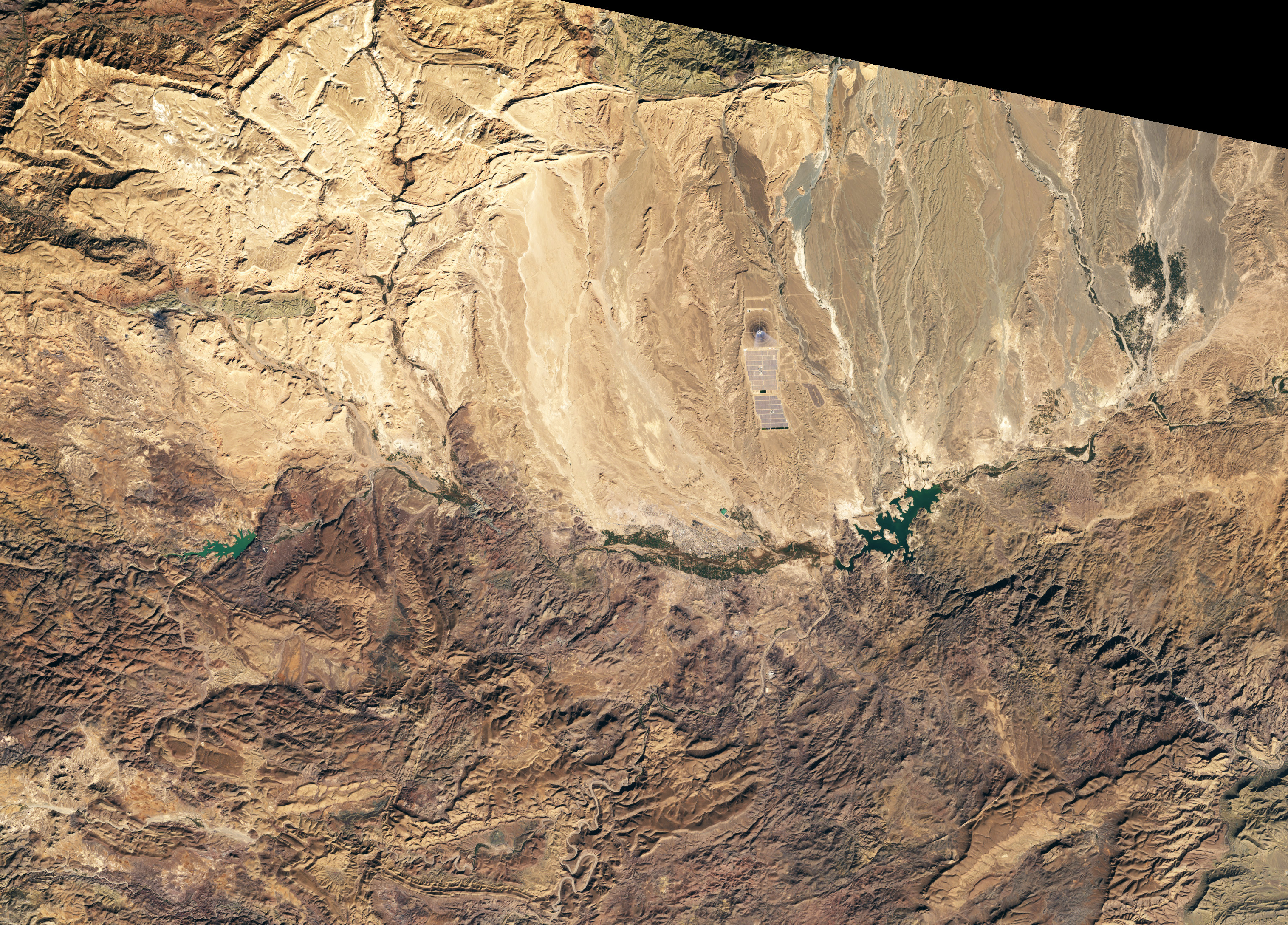
The first plant, Noor I, came online in February 2016: 160 megawatts produced by some half a million curved mirror panels, arranged in parabolic troughs about twelve metres high and spread over 480 hectares, focusing the sun onto pipes of oil that drive turbines and store heat for after dark. Noor II followed with a further 200 megawatts of the same parabolic-trough technology. Noor III is the tower — a 150-megawatt plant in which thousands of heliostat mirrors track the sun and reflect it onto a receiver at the top, heating molten salt to around 565°C so that it can keep generating after sunset. Noor IV, a smaller photovoltaic plant, completed the set. The Moroccan agency MASEN led the programme, with international development banks among the financiers and ACWA Power as the main private developer of the later phases.
Why here? The official answer, in a case study of the first phase, is almost word for word the answer the film industry would give. Ouarzazate was chosen, it says, because of its excellent solar resources, the availability of water for cooling, its accessibility for heavy equipment and its proximity to the power grid. Sun, water, a road, a connection to the outside world. A century after the airstrip and the Tichka road, some of the same qualities that had made the colonial post possible and the film studios viable were now making the town useful to the energy transition. That is a resemblance, not a chain of cause. The post did not produce the studios and the studios did not produce the solar plant; each came for its own reasons — the film industry for light, low costs, permits and a growing pool of crews, the energy planners for irradiance, a grid connection and international finance. What the earlier layers did was make the place reachable and make it easier for each newcomer to describe it in terms of what it offered.
The same light, harvested twice. Once by cameras, which turn it into images of places that are not here. Once by mirrors, which turn it into electricity that leaves along the wires. In both cases what is exported is something the town has in abundance and cannot keep.
And in both cases, as it turns out, the light is easier to capture than to hold. Noor III has had a troubled life. Technical problems, according to a Reuters report cited by Hespress, stopped its output for about a year from summer 2021. In February 2024 a leak was detected in its hot molten-salt tank and the plant stayed offline for fourteen months and resumed operations on 21 April 2025, with a second, redesigned tank under construction to make it more resilient. Morocco's next large solar projects, meanwhile, are being built with photovoltaic panels and batteries rather than mirrors and molten salt. The tower is still the most striking thing on the plateau. It may also turn out to be a monument to a technology the country is increasingly moving beyond.
The empty land that was not empty
Here the story stops being only about light and that is where it has to be told carefully.
The land on which Noor stands was not empty. It was held under collective title by the Amazigh tribal confederation of Aït Oukrour, in the rural commune of Ghessate. It was pasture. It was the ground from which local families gathered plants and fuel and across which their herds moved. In 2010, in a deal brokered by the Ministry of the Interior, it was transferred to MASEN for one dirham — about ten US cents — per square metre. Research published by Harvard's Weatherhead Center estimates that some 8,000 people in the surrounding villages lost access to the collective pasture as a result. The money from the sale was not paid out to them but deposited in an account in the community's name, managed by the Ministry of the Interior for development projects in the area. The legal mechanism that made the transfer possible was the dahir of 1919, a colonial-era law that placed Morocco's collective lands under the tutelage of the state.
The language used to describe the site often treated it as wasteland. A peer-reviewed study in the journal Land, based on fieldwork among the communities around the plant, records how local people disputed that classification: for the many local actors who used it, the researcher wrote, the land "was certainly not wasteland." The study's authors went further, describing the way a 'win-win-win' narrative around green energy can work to hide the loss of common resources, particularly for women, whose livelihoods depended most on what the plateau yielded. The Algerian researcher and activist Hamza Hamouchene has gone further again, describing the project as an example of green grabbing — the appropriation of land and resources for environmental ends — a reading echoed by other researchers who note that the 3,000-hectare site was acquired under colonial-era laws on collective land.
The other side deserves the same precision. The project's backers and the state do not dispute that the land was collective; they argue that the transfer was legal, negotiated with the community's representatives and accompanied by investment that the area would not otherwise have seen. The World Bank's own completion report records that building the complex created 8,504 jobs during construction, including 6,077 for Moroccans, of whom 2,383 were local hires in the Ouarzazate region — temporary work, mostly; once built, the complex employed 234 people in 2022. Morocco's energy minister, Leila Benali, told parliament in 2024 that MASEN had carried out more than 236 local development projects worth over 250 million dirhams, benefiting more than 130,000 people across its sites, including nine projects to improve access to drinking water around Ouarzazate. Roads now reach villages they did not reach before. Agricultural programmes have been run in Ghessate with the NGO Agrisud.
Both accounts can be true at the same time and that is the uncomfortable thing about the plateau. A national project can be genuinely transformative for a country's energy future and genuinely costly for the specific people whose pasture it now covers. The new roads are real. So is the loss of the commons. What the official story calls compensation, the critics call a substitute: a set of projects decided elsewhere, replacing a set of uses that had been decided locally. Part of what makes the argument hard to settle is that it runs on several questions at once. Whether the transfer was legal: under Moroccan law, it appears to have been. Whether the people who actually used the land had a real say in it, as opposed to being represented by intermediaries: that is what the critics dispute. And whether what they received is a fair exchange for what they lost: no single figure can answer that and the people of Ghessate are unlikely all to give the same answer.
It helps here to be precise about what "empty" has meant on this plateau, because it has not always meant the same thing. For the colonial authors of 1938, it was a boast: arid hills on which a town had been made to appear, a description that left out the ksour, the fields and the kasbah already there. For the film industry, it is a visual quality: a horizon without fences or telegraph poles, which a camera can turn into any place and any century. For the solar plant, it became an administrative and legal category: land classified as unproductive, held collectively and therefore available to the state on terms the state could set. These are different mechanisms with different consequences. A cinematic blank costs no one their pasture. A legal one can.
What links them is not a single policy but a way of looking. Cinema has long tended to treat the Arab and Amazigh desert as a blank stage for other people's stories and the solar plant did not borrow that habit from Hollywood; it is older than both. The camera notices the horizon and misses the pasture. The planner notices the irradiance and the grid. What neither sees easily is the use that leaves no building behind.
One basin, many straws
If the land is one part of the story, water is the other. It connects every part of the view from those hills and drought is what turns it from background into a question: when there is not enough, who draws first — the fields, the town or the turbines?
The reservoir behind the El Mansour Eddahbi dam, completed in 1972 on the Drâa just east of town, is one of the reasons the modern town can function on this scale. It supplies irrigation to more than 20,000 hectares of farmland in the basin, the oases strung out along the Drâa to the south. It was, until recently, the source of the town's drinking water. It is where Kundun's Tibetan palace stood at the water's edge. And it supplies the water Noor draws for cooling and for washing its mirrors. Downstream, the long chain of palm groves that runs south through Agdz and Zagora towards the edge of the Sahara depends on what the dam releases; these are some of the oldest cultivated landscapes in Morocco and in dry years they feel every decision made upstream.
Concentrated solar power uses water and in a semi-arid basin every cubic metre counts. Noor I uses wet cooling. Partly because of the water question, MASEN required the later plants, Noor II and III, to use dry cooling, which is more expensive but uses far less. At the design stage, the African Development Bank's environmental assessment estimated the whole complex's consumption at about 2.5 to 3 million cubic metres a year, with the dry-cooling choice saving several million more; actual use depends on how hard the plants run and how much the mirrors need washing. Against the capacity of a large reservoir, that is a small share. Against the reservoir in a drought, it looks different.
And the drought has been long. The Drâa basin, according to a 2024 study, is going through an exceptionally long drought — the longest in its recorded history, by the study's measure: over the 23 years from 2000 to 2023, fourteen were years of drought. Nationally, 2023 was the driest year in at least eight decades. In March 2020, as the reservoir ran low, the national water and electricity office brought into service a new 220-million-dirham project to supply the town from a different dam, the Sultan Moulay Ali Cherif, upstream on another river: 40 kilometres of treated-water pipeline, enough to secure drinking water until 2035 for some 140,000 people. The list of places it serves reads like a summary of this whole story. The town of Ouarzazate. The centre of Ghessate and the surrounding villages. The communes of Aït Zineb and Tarmigt. Taznakhte. And the Noor Ouarzazate solar park.
That list is the whole of the town's present in one sentence. The same pipe that brings drinking water to the villages whose land became the solar park also brings drinking water to the solar park — separate from the reservoir water the plant draws for its industrial needs.
Some reporting has blamed the plant's water use for the reservoir's decline; the evidence for that is weaker than the drought itself, which has emptied reservoirs across the whole country. The more honest observation is simpler. Farms, homes, studios and turbines reach the water by different channels — canals, a drinking-water pipeline, an industrial intake — but all of them draw on the same small and vulnerable basin. When the rains finally came back in the winter of 2025–26, the government reported national reservoir levels climbing above 55 per cent by the end of January, a level not seen since 2019, with the biggest gains in the wetter north. It was relief for all of them at once — and a reminder of how much depends, here, on the sky doing something other than shine.
A town at the mercy of other people's decisions
There is one more thing the light cannot do, which is guarantee that anyone will keep coming for it.
Ouarzazate's film industry depends on decisions made far away, by people who have never had to think about the town's economy. In 2019, according to figures published by Le360, 21 foreign productions shot in the region, bringing in 796.5 million dirhams. In 2020, with the pandemic, there were three, one of them left unfinished. The investment of foreign productions fell by 73.5 per cent in a year. For a town where, as one studio manager put it some years earlier, besides tourism there is not much else, that was not a dip in a statistic. It was a winter.
The recovery has been strong. Morocco as a whole drew 48 foreign film and television productions in 2025, investing more than 1.16 billion dirhams, according to the national film centre; counting every foreign format, the total passed 1.21 billion, against 497 million in 2017. But the fragility has not gone away. When the American administration floated a tariff on films made abroad in 2025, an executive at Atlas Studios told the newspaper LesEco that about 30 per cent of the studio's activity depended on American productions. Even the biggest productions arrive on terms negotiated elsewhere. Ahead of Gladiator II, talks over renting an existing set at Atlas dragged on for months and the producers threatened to move the whole shoot to Malta. They stayed; the Moroccan part of the production, according to Médias24, eventually cost around thirty million dollars and mobilised 3,200 local people over seven months of preparation for two weeks of filming, filling hotels, restaurants and transport in a town still recovering from the pandemic. Twenty years earlier, Al Jazeera had reported that more than half of Ouarzazate's residents relied on the film industry in one form or another. A shoot that leaves is not an abstraction here.
The town has spent a century selling its light to other people. It has also spent a century depending on those people's weather — their markets, their politics, their pandemics, their tariffs. The light does not change. Everything else does.
The town answers back
In November 2023, Ouarzazate was designated a UNESCO Creative City of Film, one of only five new cities of film that year. What UNESCO's citation emphasises is telling. It notes that the city hosts between 15 and 20 productions a year, but it puts the weight on something else: the town's commitment to making film a source of local development and social inclusion, workshops to make the sector accessible to young people and those from disadvantaged backgrounds, synergies with local crafts. In other words, not the landscape, but the people working in it.
The same note runs through how the town's own professionals now describe themselves. In the summer of 2026, Christopher Nolan's The Odyssey — part of which was shot in the region, with the ksar of Aït Benhaddou standing in for Troy — opened around the world, after a production that Morocco's film centre recorded as spending more than 252 million dirhams in the country, the largest foreign production spend in Morocco in 2025. Talking to the Moroccan press afterwards, Abdelmoula Amekassou, a local civic figure, insisted that the town's reputation could not be put down to the beauty of its landscapes alone: Ouarzazate, he said, had built a human and technical capital now recognised worldwide. Zineb El Idrissi, who worked in the costume department, put it more simply. The town's renown, she said, "rests as much on the quality of its human resources as on the richness of its natural settings."
That is a quiet but significant shift — in how the town describes itself, at least. For most of a century, the selling point was the empty land. Now the people who live there are saying, in their own voices, that they are the selling point. Whether that changes who owns the studios, who sets the rates and where most of the money ends up is a harder question and its answer is still being written.
The shift is visible in the numbers too. Moroccan productions are no longer only an afterthought to the foreign ones: the country's own producers invested close to 600 million dirhams in national films in 2025 and more than 27 Moroccan features were shot in 2023, against 19 the year before. And Moroccan audiences are showing up for them: in 2024, according to the national film centre's annual report, the seven most-watched films in Moroccan cinemas were all Moroccan, with Gladiator II — shot partly a few kilometres from Ouarzazate — in ninth place. The ambition is no longer just to host. It is to make.
The state is betting on the same idea. On 26 June 2026, Morocco's minister of culture launched construction of the Cité internationale du cinéma: 10.49 hectares and 240 million dirhams of investment, with a 3,000-square-metre sound stage, post-production and training facilities among its plans. If it is completed as planned, it will serve as a one-stop shop for productions coming through and the minister was careful to say that it is meant to complement the town's private studios rather than compete with them. Its gestation was not smooth; earlier in 2026, delays had prompted questions in parliament and fears that the project might quietly move north to the outskirts of Rabat. Its defenders, as Le360 reported, cast the decision to keep it in Ouarzazate as a matter of territorial justice: the town, they insisted, is not just a backdrop.
Other gaps remain. The town was included in a national programme to open 150 new cinema halls in smaller cities, launched in 2024, precisely because it had been left without one. The cinema city has, at times, been without a cinema and is still finding its way to being a city that watches as well as one that is filmed.
Back on the hill
Go back to the low hills west of town, at the same hour and turn slowly again.
The kasbah is still there, its unrestored lanes still home to families, scaffolding on its walls again: after the 2023 earthquake it joined the national programme to repair damaged monuments and on the day the new film city was launched, the minister went on to inspect the restoration work at Taourirt. The studio's plaster columns are still there and somewhere behind them a crew is building the next antiquity out of the last one. The mirrors are still there, tilting to follow the sun and the tower, working again. The rains of 2026 have come back to the reservoirs. And at the entrance to town, where that road meets the avenue the French laid out as a supply line, a new building site.
From up here, almost everything you can see was put on this plateau because someone, at some moment, looked at it and saw a resource: a position, a light, a sun, a set of arid hills with nothing on them. That was never quite true. There were ksour and gardens along the wadi before the redoubt, the herds of Aït Oukrour on the plain before the mirrors, ironworkers and seamstresses in the town before the studios, families in the kasbah before the conservators. The land was never empty. It only looked that way from far enough away.
What has changed, slowly and only in part, is the distance. None of this has yet settled who owns what is built on the plateau, or who keeps most of what it earns. But the people building the next sets are from here. The people sewing the costumes, training the horses, rigging the lights are from here. The schoolchildren who watched Brad Pitt filming in their kasbah are old enough now to be making films of their own, if they choose. The town that was founded to be looked at is learning, unevenly and against the weight of a century, to look back.
The light is the same as it was in 1928, when a company of goumiers climbed a hill above the wadi to build a post on what its founders would soon call arid, empty ground. The town's first guidebook records, almost in passing, what was already standing there: the ruins of an old kasbah called Irherm n'Ougellid, the King's Fortress, which had held the passage for centuries. The French built their post on the hill, folding a last fragment of its old wall into the buildings of the military stores. The hill was never empty either. The question was always who the light was for.
Related reading
Filmed, but Not Recorded: The Arab World’s Missing Film Locations
Wikidata knows Gladiator was filmed in Morocco. It doesn’t know where.
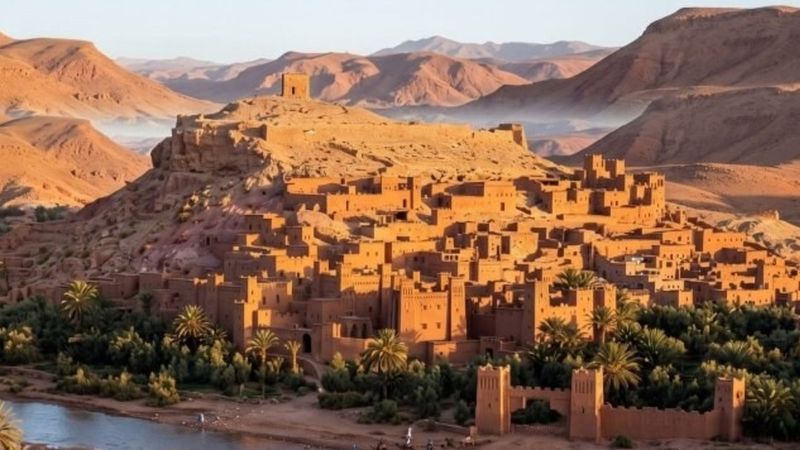
Gladiator and Game of Thrones: Inside Aït Benhaddou
The earthen ksar that has played Rome, Jerusalem and Yunkai survives only because people keep rebuilding it. What cinema films as eternity is, wall by wall, a work of constant repair.
Where Is Agrabah? The City Disney Assembled From Real Places
Agrabah was going to be Baghdad. A war made it fictional — and then Disney built it back out of real places, from a tomb in Agra to a valley in Jordan that usually plays Mars.