
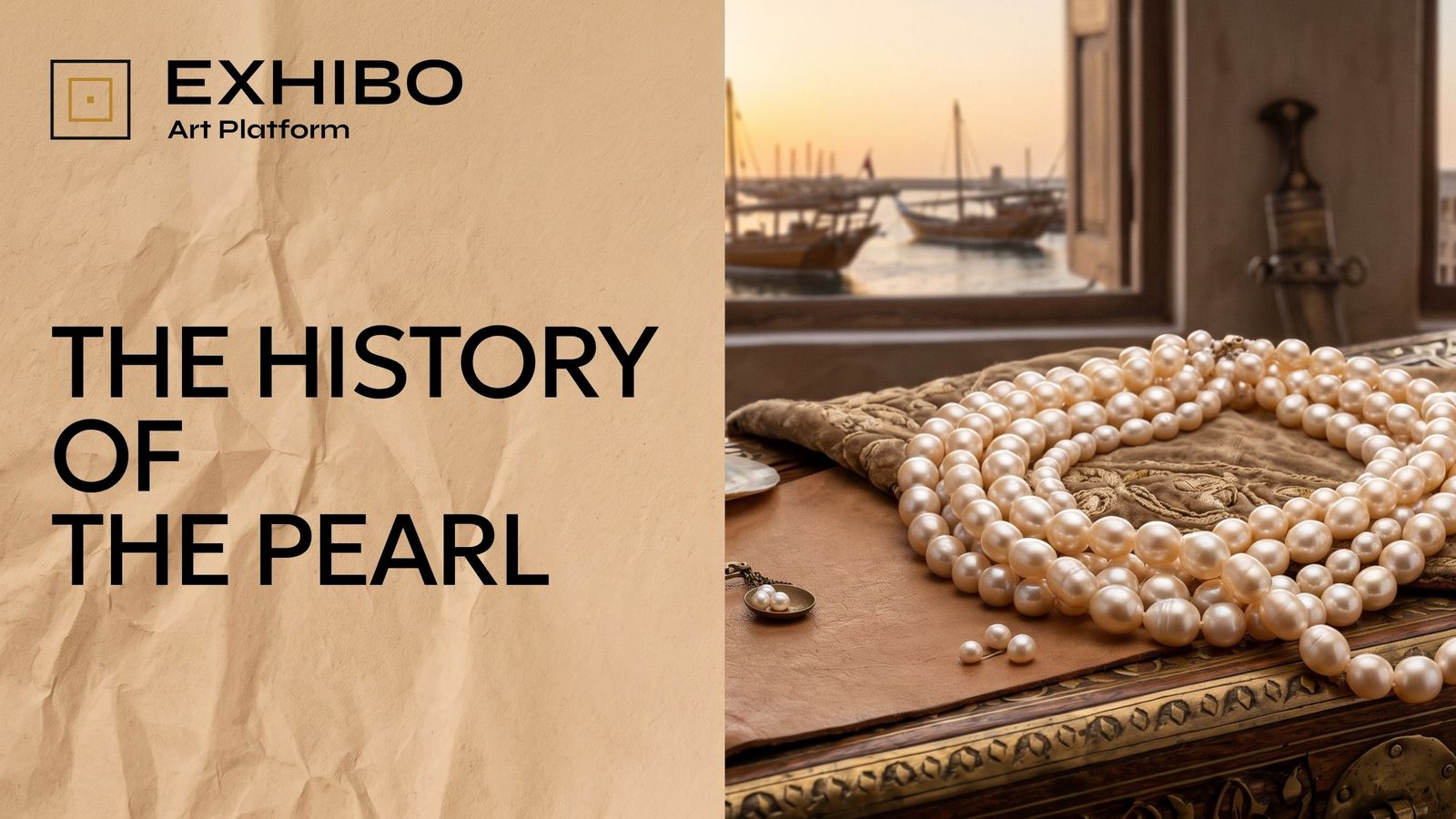
Manama · Bahrain
The Sea That Came Before the Oil: The History of the Pearl
Eight thousand years before the first barrel, the Gulf had already built a global economy — out of an oyster, a held breath, and a rope.
There is a small, drilled bead sitting in a museum in Abu Dhabi that is roughly eight thousand years old. It was pulled out of the ground on Marawah Island, from a Neolithic layer radiocarbon-dated to somewhere between 5,800 and 5,600 BCE, and when it first went on public view it did so inside a Louvre Abu Dhabi exhibition with a title that gets the whole thing right in three words: 10,000 Years of Luxury. A pearl. Not a coin, not a weapon, not a tool. Someone, eight millennia ago, drilled a hole in a small lustrous thing that did nothing, fed no one, killed nothing — and kept it.
That is where this story starts. Not with oil. Long, long before oil.
Because the thing worth sitting with, if you live here — as I do — is that the Gulf had a global luxury export, a labor system, a financial architecture, a body of song, and a set of cities that owed their existence to a single product, and all of it was in place and running for thousands of years before a single barrel came out of the ground. There were other ways to live along this coast, of course — fishing, date palms, herding, and the long-haul trade that moved goods between India and Mesopotamia. But the pearl was the dominant export economy, the one that set the rhythm of the year and reached the furthest into the world.
Older than writing
The bead on Marawah is not an isolated marvel. It sits at the head of a line that runs, more or less unbroken, for seven or eight thousand years.
Drilled pearls turn up in Neolithic graves up and down this coast — at Umm al-Quwain, in the Emirates, and across the water at sites in Kuwait and eastern Saudi Arabia — placed with the dead, valued enough to bury. The German archaeologist who dug the Saudi coast reported that something like ninety percent of the shells his team pulled from the ground were pearl-oyster shells. People were not eating these oysters in those numbers. They were opening them, looking.
And once you start looking for the pearl in the old texts, it is everywhere. The Epic of Gilgamesh, written down in Mesopotamia across the water from these beds, has its hero tie stones to his feet and sink to the seabed to seize a "flower of immortality" — a scene that many historians of Gulf pearling have compared to the weighted descent later used by the divers themselves, who worked in almost exactly that way four thousand years on. By the first century, Pliny the Elder had declared pearls the most prized possession in Roman society and named the pearls "round Arabia on the Persian Gulf" as specially praised. The tenth-century Arab chronicler Abu Zayd Hassan described the diving method of his own day; his account is virtually identical to what a British officer would write down a thousand years after him. Almost nothing about the technique changed, because almost nothing needed to. A man, a breath, a stone, a rope, and the dark.
This is the deep time that most tellings skip. Before the oil, yes — but also before Islam, before Rome, before alphabetic writing existed. The oyster beds off Bahrain were already old when Gilgamesh was young.
The oyster that made the map
Read the standard histories of this region and you will find the same phrase, worn smooth from repetition: before oil, there was the pearl. True. But it undersells the scale. The archaeologist Robert Carter, whose Sea of Pearls: Seven Thousand Years of the Industry that Shaped the Gulf is the closest thing this subject has to a foundational text, makes a sharper claim. The pearl did not just fund the Gulf. As Carter argues, pearling shaped the very settlement geography of the coast — it drew the map.
Look at where the towns are. Doha. Al Wakra. Zubara. Dubai. Muharraq. A whole cluster of settlements across what is now Qatar — Fuwairit, Al Khor, Ruwais, Jumail — appears in the historical and cartographic record in the eighteenth and early nineteenth centuries, and they appear for one reason. The oyster beds were offshore, and people built where they could reach them. The pearl boom is not a chapter in the history of these cities. For many settlements, the oyster beds are the reason a fishing anchorage or a cluster of huts grew into a town of consequence.
By the late nineteenth century, something close to the entire coastal population of the Gulf — an estimated 60,000 people, stretching from Kuwait down along the coast of Saudi Arabia to Bahrain, Qatar and Oman — was involved in pearling. In the most pearl-dependent communities, by some accounts, it accounted for the overwhelming majority of local income. Not a sector of the economy. In those settlements, nearly the whole of it.
And at the center of it, for centuries, sat one island. Muharraq, in Bahrain, off the northeast of the main island, was the Gulf's pearling capital — the largest fleet, the most divers, and a society in which virtually everyone was involved in either pearling itself or the trades that fed it. Merchants, creditors, boat owners, boat builders, captains, divers, haulers, sail-makers. An entire civic ecology organized around a five-month window in the sea.
What the pearl was worth
Here is the fact that reorders your sense of the whole thing.
For most of recorded history, the pearl was the most valuable jewel in the Western and Indian Ocean worlds — able, gram for gram, to rival or exceed fine diamonds of comparable weight. As late as 1893, the rule of thumb among dealers held that above a certain size, a pearl was simply equal to a diamond of the same weight, and for the finest large stones it went higher; by some accounts, a good natural Gulf pearl could fetch several times a diamond of equal weight in the early twentieth century. This was not a regional curiosity traded in a local souk. This was one of the most concentrated stores of value on Earth, and the people who dealt in luxury at the highest level knew it. In 1912, Jacques Cartier — that Cartier — sailed to Bahrain himself. He called it the most important mission of his entire trip to the East: to study the pearl market at its source and open a direct line to it. The pearls of the Gulf ended up in the treasuries of India and Persia, in Ottoman collections, and around the necks of the industrial rich of Europe and America.
The numbers the nineteenth-century travelers left behind should be read as impressions rather than audited accounts — the historians who use them are careful to say so — but they gesture at the size of it. In 1829 James Buckingham put Bahrain's annual pearl revenue at around £200,000. A generation later, the British official Lewis Pelly counted some 1,500 pearling boats working the Bahrain season and reckoned their yearly profit at £400,000 — and that was one island's fleet in one year.
Money at that scale, extracted from the sea by lung power alone, does not come without a system. And the system is where the story stops being romantic and starts being human.
The necklace and the mansion
If you want a single image for what a Gulf pearl was worth at the peak, here is the one everyone reaches for, and it earns its keep.
In 1917, in New York, Pierre Cartier — Jacques's brother — acquired the mansion at 653 Fifth Avenue that is still the Cartier building today. The centerpiece of the arrangement was not cash. It was a double-strand natural pearl necklace — 128 pearls, 55 on the shorter strand and 73 on the longer — handed over, along with a token sum of money, in exchange for a Gilded Age mansion on the most expensive avenue in America. (The full deal was more tangled than the legend — it involved cash and financing as well as the pearls — but the pearls were the heart of it.) The necklace was valued at a million dollars; the building, at slightly less. A string of matched pearls was worth more than the building it was traded for. Each of those 128 pearls had been collected by hand, one at a time, by a diver holding his breath somewhere in the warm shallow water off Bahrain or the Trucial Coast. Assembling enough that matched had taken years.
This was not one jeweller's eccentricity. It was a global procurement system, and the Gulf sat at the source of it. The pearls moved from the beds to the brokers to the great entrepôt of the trade — Bombay, the principal international hub where the world's pearl merchants sorted and priced and redistributed the Gulf's harvest onward to Paris, London and New York. The Indian appetite ran deepest of all: pearls were treasured most in India, woven into the ceremonial dress of the maharajas, strung by the thousand into pieces like the legendary Baroda pearls — a Gulf-sourced strand later remade by Cartier that sold at Christie's in 2007 for more than seven million dollars. The Cartiers were not even alone in the field; the Rosenthal brothers had already built their own trusted lines to the pearl sheikhs of Bahrain. When Jacques Cartier sailed to Bahrain in 1912, he was not discovering a market. He was going, at last, to the source of one that already reached his own front door.
The season, and the men in it
The word, locally, was ghaus — the dive; the long summer season was the ghaus al-kabir, the great dive. It ran roughly May to September, and it took the men out for months at a stretch. The boats had names too — the boum, the sambuk, the jalboot — and they sailed out from Manama, Muharraq, Doha, Dubai, Lingah, crews of forty and more packed onto a single deck.
Consider what the diver actually had. A nose clip — al fitam — a hand-carved "Y" of wood or tortoiseshell. Leather caps, khabat, for the fingers against the coral. A woven basket at the neck. A stone roped to a noose he slipped over his foot to drag him down fast, and a second rope at his waist, held above by his partner. That was the whole apparatus; everything else was lung and nerve. He would drop to the bottom, work the seabed for sixty to ninety seconds, then jerk the rope to be hauled up — and on a good day make as many as fifty such descents. The odds inside the shells were long past cruel: estimates range from perhaps one in a thousand down to, by DANAT's own reckoning, one in ten thousand holding a pearl worth anything at all.
It was brutal work, and the body kept the receipt. Ruptured eardrums. Salt-scarred eyes — divers went half-blind from the brine. Shark and ray and jellyfish. The bends, though no one yet had the word for it. And the divers were not paid a wage; they took a share of the season's proceeds once the catch was sold, which is the small hinge on which the whole darker story turns. The work ran on its own strict social order — the nakhoda, the captain and often the boat's owner, at the top, and beneath him a descending ladder of divers, haulers, apprentices, down to the boys who started at ten. When the boats came back, a second cast took over: the tawwash, the pearl merchant-broker, haggling with the captains over the year's catch, sorting the pearls through graded brass sieves, holding a single flawless bead up to the light and turning a season's suffering into a price.
None of this happened in silence. Every pearling dhow carried its own musician. The work songs of the divers — the fidjeri tradition — set the rhythm for hauling anchor and pulling rope, and held the crew's spirit together through the long weeks offshore. On land, the waiting had its own rituals. In the Emirates, families hung cloth flags — bayraq — on their houses to signal that they were watching for their men. In Bahrain, women gathered at the shoreline to perform before the sea — speaking to it, striking the water with palm branches — until the sails appeared on the horizon.
You can feel, in details like that, why the pearl never really left. The economy died. The songs and the flags did not.
The part that is harder to hold
There is no honest history of Gulf pearling that stops at the flags on the houses. The same system that produced the songs also produced a form of bondage, and it would be a poorer, more evasive story to leave that out.
The mechanism was debt. A diver took an advance against his share of the season's catch, and against next season's, and the accounting was kept by the people he owed. In practice this could harden into something the historians who study it — chiefly Matthew Hopper, whose Slaves of One Master is the key work — describe as debt bondage: an arrangement in which the uncertainties of a bad season, an illness, a poor catch, were made to settle on the diver's own body, which then served as the security for the merchant's wealth. There were papers, the barwa, recording what a diver owed and the terms on which he might be transferred from one captain to another. A man could, in effect, become bound to a creditor through a debt he had little hope of clearing. And a substantial share of the diving crews — by Hopper's estimate between a quarter and a half — were of African origin, brought into the Indian Ocean world through a trade that the pearl's global value helped sustain. This was part of the wider Indian Ocean economy of the age, of a piece with bonded and unfree labor systems from Ceylon to East Africa; it was not unique to any one port or ruler. But it was real, and it was here.
What matters, and what tends to get flattened in both the romantic and the accusatory tellings, is how the region moved through it and out of it. The manumission record — the archive of enslaved and indebted men formally seeking and securing their freedom — is not a footnote to the collapse. It runs right through it. Requests for manumission processed along the Arabian coast reached their peak in the 1930s, exactly as the industry was falling apart, and the men bringing those cases were, overwhelmingly, pearl divers. The end of the pearl and the end of this labor system happened in the same breath. And the states that emerged afterward built abolition into their foundations: forced labor was outlawed, the practice ended, and today it is the Gulf's own cultural institutions — the Qatar Digital Library, digitizing and publishing the colonial-era files on slavery and manumission for anyone to read — that have chosen to make that record public rather than bury it. There is something to be said for a region that keeps the archive of its own hardest chapter open. The honest thing is to tell the whole arc: the bondage, and the freedom that the same generation fought its way to.
How it ended
People will tell you the pearl died because of one man in Japan. It is a good story and it is not quite true.
The man exists. Kokichi Mikimoto, the son of an udon-shop owner in Toba, spent decades learning to make an oyster produce a round pearl on command. By the 1920s he was turning out cultured Akoya pearls in commercial volume; in 1927 he opened on Fifth Avenue. By the middle of the 1930s, Japan had scaled from a handful of farms to hundreds of them, producing millions of pearls a year, nearly indistinguishable from natural ones and a fraction of the price. That did real damage. Of course it did.
But the deeper historians — Carter, and Kjell Ericson, who has done the closest work on the Japanese side — are wary of the single-villain version. The catch line, endlessly repeated, that Mikimoto killed the Gulf was, Alexander McNabb notes, popularized by a young British official's report and then copied down by writers for decades, obscuring a messier truth: the market had been undermining itself for years before 1929. What actually brought the industry down was a convergence. The two decisive blows were global: the Great Depression gutted the luxury markets of Europe and America, and demand for a non-essential gem simply evaporated, while the cultured pearl arrived at exactly that moment of weakness and undercut whatever was left. Oil was the local accelerant rather than a cause of the crash: the discovery of it in the Gulf pulled labor and capital toward the derricks just as the trade needed hands, and there are accounts of drilling disturbing some of the beds. The world market died first; oil simply gave the men who had worked it somewhere else to go.
Three blows, close together, on a market already wobbling. No single invention killed the pearl; a whole world economy came apart. By the early 1950s, traditional pearling had all but vanished from the waters of the Gulf.
The human cost of that collapse was severe and is often skipped past. The debt did not vanish when the pearls stopped selling — it curdled. Divers who had borrowed against future catches were left owing money against a season that would never come, and captains who could no longer feed their crews began, in some cases, to release them. Families abandoned coastal pearling villages. The social order that had the nakhoda at its top was overturned. There were years of real hardship before the new economy arrived. Even before the worst of it, the strain was visible enough that in 1932 the ruler of Bahrain, Shaikh Hamad, moved to reform the diving system and its conditions — one of the first official attempts to put the industry, and the men inside it, on a sounder footing. What the region's rulers did next — the pivot, most famously in Dubai, toward geography and trade as the surviving asset — is the beginning of a different essay. But it is worth naming that the modern Gulf did not spring from oil alone. It was built by people who had already, once, built a global industry from nothing but breath and the sea, and who had just watched it die.
The Gulf came early. It was not alone.
It is easy, from here, to imagine the pearl as a purely Gulf story. It wasn't. It was a world story, and the Gulf was its largest chapter but not its only one.
Across the Indian Ocean, the Gulf of Mannar, between southern India and Sri Lanka, ran a natural-pearl fishery for more than two — by some readings three — millennia, passing through Tamil dynasties, then Portuguese, Dutch and British hands. The Ceylon fishery was famous for its administrative precision; the colonial treasuries kept careful ledgers of what came out of the sea. That fishery, too, eventually died — the great seasonal harvests were abandoned in 1925, the last of it flickering out by the 1980s. The Red Sea produced pearls into the twentieth century. And on the far side of the world, the pearls of Venezuela's Margarita and Cubagua helped finance Spain's colonial expansion in the sixteenth century.
Nearly every one of these great natural fisheries followed the same curve — abundance, over-extraction, exhaustion, and the arrival of the cultured pearl. The Gulf's version is simply the one that ran longest, reached furthest, and left the deepest mark on the place it came from. There is a small linguistic fossil of that primacy still in use: the trade term "Oriental pearl," which once meant any fine saltwater pearl, now refers specifically to the natural pearls of the Persian Gulf. The Gulf didn't just supply the market. For a while, it was the standard.
The return
Here is the part that surprises people, including people who live here.
The pearl is coming back. Not as the backbone of anything — no one is going to fund a country on oysters again — but as something deliberately, and rather beautifully, kept alive.
Bahrain has been the most single-minded about it. By its own account — the claim comes from DANAT, the national pearl institute — it is the only country in the world that bans the trade in cultured pearls by law, keeping its jewellery counters natural-only. The prohibition is usually traced to 1928, when the Japanese product was first flooding the market; the enforcement today runs on later legislation, Decree-Law 10 of 1990 as amended, under which imported pearls are held on arrival and sent to the lab so that only natural ones are cleared into the country. The logic is almost defiant: if the cultured pearl is what broke the natural-pearl trade, then Bahrain will be the one market on Earth where only the natural pearl is sold. In 2017 the government turned that stance into a full revival plan, and its old in-house gem lab was spun out into DANAT, the Bahrain Institute for Pearls and Gemstones — part laboratory, part testing house, part guardian of the story, able to tell a natural pearl from a cultured one under X-ray. DANAT also does something quietly moving: it gathers the descendants of the merchant families Jacques Cartier once dealt with, closing a loop a century wide.
And the diving itself has come back, under license and in a form the old nakhoda would find astonishing. Bahrain began issuing pearl-diving licenses again in 2017, and DANAT reports that 2021 saw them granted, for the first time, to women. The men who spent the season half-blind from the brine, bound by debt, would not have imagined it — a history not erased, but reopened on new terms.
Across the water, the revival took a different and gentler shape. In Ras Al Khaimah, a man named Abdulla Al Suwaidi — grandson of Mohammed, one of the last pearl divers in his family — grew up on his grandfather's stories and, in 2004, built the region's first cultured-pearl farm as a tribute to him. He tells of watching the old man vanish under the water for minutes at a time and surface clutching something luminous, and being convinced, as a boy, that his grandfather was half fish. His farm now grows pearls in thirteen colors and opens its floating pontoons to visitors, who take a traditional boat out under the Hajar Mountains to learn how the thing was done — and how it is done now. It will never be an industry again. It does not need to be. It is a way of keeping a grandfather in the water.
Where the pearl lives now
The economy is gone. The pearl is not.
In Bahrain, the whole thing has been made walkable. In 2012, Pearling, Testimony of an Island Economy was inscribed on the UNESCO World Heritage list — the body called Bahrain's beds the last remaining complete example of the cultural tradition of pearling and the wealth it generated when the trade ruled the Gulf. It is a serial site knitting together three offshore oyster beds, a stretch of Muharraq's shoreline, the Bu Maher fort the boats once set out from, and seventeen historic buildings threaded through the old city. In effect it is an open-air museum: a roughly three-kilometer path — renovated under the crown prince as part of the same revival push — running through the streets of Muharraq, lit by pearl-shaped lamps, with a spare concrete entrance pavilion by the Swiss architect Valerio Olgiati and the Siyadi house as its keystone. Bahrain has long been known, with considerable justification, as the "Pearl of the Gulf" — a center of the trade for much of the industry's recorded history. The UNESCO citation puts the deeper point plainly: the pearling economy subsided in the 1930s, but the narrative it produced remains the most significant source of Bahraini cultural identity to this day.
Go looking, and you find that almost every country on this coast now tells the story in its own way, through the objects it has chosen to keep. That eight-thousand-year-old bead sits at Louvre Abu Dhabi and the Zayed National Museum. A pearl merchant's former home has become a museum on Delma Island. Fifteen floors up a bank in Deira sits one of the finest collections of natural Gulf pearls in the world — over fifty kilograms of them, at the Emirates NBD Pearl Museum, the life's work of the late Sultan Ali Al-Owais, given to the people of the UAE so that a way of life now lost would still be understood. In Sharjah there are rope weights and oyster baskets and full dhow replicas at the Maritime Museum; in Umm Al-Quwain, a "Sea Chamber" that smells faintly of aged wood and salt inside the old fort. And in Doha, the pearl is written into the founding story of the whole nation at the National Museum of Qatar. Every summer, at heritage festivals across the coast, men in historic dress climb into painted boats and dive again — not for a living now, but to keep the memory in the body.
The thing worth keeping
I keep coming back to that drilled bead in Abu Dhabi. Eight thousand years old. Older than writing in most of the world. Someone valued a beautiful, useless thing enough to keep it, and that impulse turned, over millennia, into an industry that fed cities, crossed oceans, entangled empires, produced both extraordinary wealth and real suffering, and then died almost overnight — leaving behind songs, a walking path, a set of museums, a licensed diver who is now sometimes a woman, and a story the region tells itself about who it was before the oil.
The Gulf is often narrated as a place with a short history and a long future. Stand at the edge of one of those oyster beds off Muharraq and the opposite feels truer. The future here is being built at speed, yes. But it is being built by the descendants of people who already did this once — who had already helped build one of the world's great luxury trades out of nothing but breath, rope, and a small lustrous thing pulled up from the dark.
The oil came second. The knowledge of how to build a world from the sea came first.
Related reading
Why Doha Is Full of Roundabouts
An old circle at a crossroads, sharpened by British road engineering, became the way an Arabian city found its way and remembered itself — and it took the bulldozers to reveal it.
Filmed, but Not Recorded: The Arab World’s Missing Film Locations
Wikidata knows Gladiator was filmed in Morocco. It doesn’t know where.
56 English Words With Arabic Roots: Art, Colour, Fabric and Architecture
Azure lost a letter, alcohol was once eye make-up, and a sofa was a carpeted platform. A field guide to the art words English borrowed from Arabic — and how sure we can be about each one.