
Exhibo Editorial
Humidity and Temperature Specs for Art
Relative humidity bands, temperature limits and ASHRAE types for paintings, with monitoring and material exceptions
The ideal humidity for artwork is a stable mid-range band, not one fixed number. For most paintings on canvas or wood, institutional guidance clusters around 40–60% relative humidity (RH) with a central target near 50%, and temperatures in about 16–25°C. Fight daily swings harder than you chase a perfect set-point. Stay out of the danger bands: under about 35% RH paint and sizing grow brittle; over about 65–70% RH mould risk climbs. Icon’s 2023 UK guidance treats 35–65% RH as a safe, sustainable band for most materials in a well-maintained building when drift stays slow.
This page is the climate-specs sibling in the Caring for Art series. Racks, wrapping and room choice live in how to store paintings. Agents of deterioration and risk framing live in preventive conservation. Ultraviolet fading belongs with does sunlight damage paintings (S7-08, pending). Hot-humid display walls belong with hanging and climate display guidance (S6-07, pending). Freeports and bonded warehouses belong with freeport art storage (S24, pending). Named museum collections that publish conservation practice sit in the museums directory.
Why humidity and temperature damage art
Canvas, wood, paper, size, ground and paint each take up and release moisture at different rates. Relative humidity is the share of water vapour the air holds relative to what it could hold at that temperature. When RH rises, hygroscopic layers swell. When RH falls, they shrink. A painting is a sandwich of materials glued and stretched together. Uneven movement opens cracks, lifts paint, warps panels and twists stretchers. Stefan Michalski and the Canadian Conservation Institute (CCI) describe that mechanical story as the core RH risk for paintings; heat and cold sit beside it as chemical-ageing and handling risks.
Temperature changes the chemistry and the RH dial at the same time. CCI Notes 10/4 place the comfortable set-point for paintings anywhere in 16–25°C. High temperatures over about 30°C with high humidity soften paint and varnish so dirt sticks. For each rise of about 5°C, many chemical decay rates roughly double; that rule of thumb appears throughout CCI’s ASHRAE commentary for chemically unstable twentieth-century materials. Cold makes acrylic films glassy. CCI flags acrylic paintings as crack risks below about 5–10°C, especially when you handle or ship them in winter.
Stability beats a glamorous mid-point you cannot hold. A room that sits at 48–55% RH all year with slow seasonal drift is kinder than a room that hits 50% at noon and 30% at midnight. Proofed-fluctuation thinking, summarised in Michalski’s Getty roundtable paper and carried into ASHRAE and CCI risk language, says an object already weathered to a given swing may tolerate that swing again. New extremes still cut fresh damage. Undamaged contemporary works have no such history; treat every large new swing as novel.
Mould and corrosion set hard outer limits. NPS Appendix L on easel paintings treats RH under 35% as embrittling and over 65% as mould-encouraging. CCI Notes 10/4 place mould risk around 70–75% RH, worse in cool pockets against cold exterior walls where local humidity sits higher than the room average. Still air and damp plaster make those pockets. Metals and some glasses want drier microclimates than oil paintings; a mixed room that holds 50% RH for canvas can still corrode archaeological iron. That is why museums separate materials and use sealed cases, not why private owners should abandon a mid-range band for ordinary paintings.
Measure before you chase a set-point
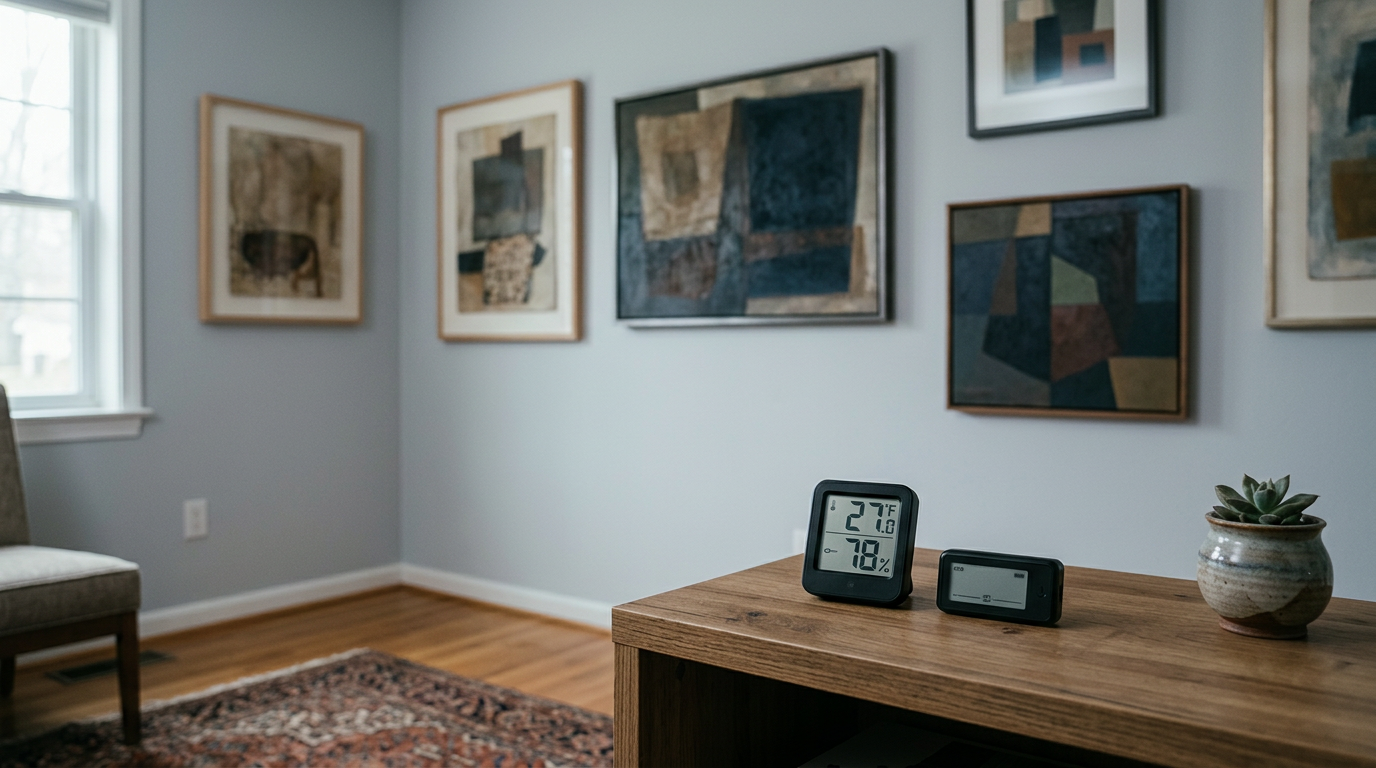
You cannot manage what you have not logged. The Northeast Document Conservation Center (NEDCC) treats monitoring as the foundation of any preservation programme. A room that “feels fine” at noon may hit 30% RH on a cold January morning or 70% after rain. Buy instruments that record temperature and RH over days and weeks, then read the graph before you buy equipment that humidifies, dehumidifies or cools.
Place a logger before you move valuable works into a candidate room. Park one unit for a fortnight in the proposed space. Note overnight lows, afternoon peaks, and what happens when you cook, shower or open windows elsewhere in the building. If the room already holds art, keep the logger running through a full heating season and a humid summer if you can. One week of mild weather tells you almost nothing about January desiccation or August damp.
What to buy and where to place it
A calibrated digital hygrometer with data logging beats a cheap dial that never leaves the packaging accuracy claim. Museum-grade loggers such as Onset HOBO temperature/RH units sold through UK distributors often run from about £180–£300 for Bluetooth or USB models; light-and-CO2 variants cost more. Consumer thermo-hygrometers with memory start lower, often under £50, but need periodic checks against a known reference. Aim for RH accuracy within about ±2–3% if you will make control decisions from the numbers. Place sensors at painting height, away from radiators, sunny glass, exterior walls and dehumidifier exhaust. One logger in the middle of the room and one near a cold exterior wall will show the space gradient that mould loves.
Calibrate or cross-check. Salt-test kits and manufacturer calibration services exist for serious programmes; for a private room, compare two instruments for a week and discard the odd one out. Replace batteries on schedule. Export CSV or app graphs monthly. Loan agreements and insurers often ask for logged evidence after a claim; a screen photograph of today’s reading is weak proof.
How to read a fortnight of logs
Look first at the daily range, then at the seasonal mean. A daily RH swing of more than about ±10% inside 24 hours exceeds the Bizot Green Protocol starting band for many hygroscopic loans. ASHRAE type AA and A1 short-term limits sit tighter still, at ±5% RH. If your spare room swings 25% between dawn and evening, portable equipment or a better room comes before any debate about 48% versus 52%. Temperature swings matter because they drag RH with them: roughly 3% RH per 1°C when moisture content of the air stays fixed and the object surface has not yet equalised.
Compare the room mean to the guidance bands in the tables below. A winter mean of 32% RH with a humidifier still fighting means the building envelope or the set temperature is wrong. CCI Notes 10/4 note that lowering a thermostat from 22°C to 18°C can raise RH by as much as about 12% in an unhumidified winter room. Cooler air holds less moisture absolute, so the same moisture content reads as higher RH. That paired dial is why you never treat temperature and humidity as independent knobs.
Flag danger hours, not only averages. Hours above 65% RH in stagnant corners, or nights below 30% RH beside a radiator, drive the risk even if the weekly average looks polite. ASHRAE type C language, as CCI summarises it, cares about not staying continually above 65% RH for longer than the mould-growth window on the ASHRAE graph. Private owners translate that as: cut damp pockets and stagnant air as soon as the log shows them.
Microclimates buffer what the room cannot
A sealed frame, a display case or a well-closed cabinet slows the RH the object feels relative to the room air. CCI’s climate guidelines treat microclimate enclosures as the most reliable way to cut short spikes and to protect precious works when HVAC fails. Response times vary with leakage, buffer mass and object size. A framed painting with glass or acrylic glazing and an impermeable backing board can take days to equalise with a room swing; a leaky frame with millimetre gaps equalises in hours. CCI tables on response times for framed works and archive boxes make the point: gaps dominate. Foam stripping, sealed Coroplast or acrylic backs, and spacer strips that leave a small air gap belong to climate strategy as much as to housekeeping.
Silica gel and other buffering materials extend that lag when you load them correctly for the case volume. CCI Technical Bulletin 33 remains the standard reference for passive RH control with silica gel. Overloaded or poorly conditioned gel can drive the wrong RH. Under-sealed cases leak so fast that gel does little. Private owners get most of the benefit from glazing plus a sealed backing board on canvas paintings before they invent gel trays. Deep rack and wrap choices stay in how to store paintings; the climate job of those boards is to dampen daily RH noise while the room holds the seasonal mean.
Microclimates also resolve mixed-material conflict. A steel cabinet with conditioned gel can keep archaeological iron dry while the gallery outside sits near 50% RH for paintings. A parchment or panel that needs tighter RH can live in a case tuned to its band without forcing every oil on canvas into the same box. Institutions use that logic for loans to smaller venues: the case carries the specification when the host building cannot. At home, the same logic means you improve the room to a holdable mid-range, then isolate the exceptions, rather than chasing ASHRAE AA for an entire flat.
Specs by material and guidance source
The search for an “ideal humidity for artwork” returns competing numbers because institutions answer different questions. Loan uniformity once favoured 50% RH and about 21°C. Energy cost and building damage pushed the field toward wider bands, historic averages and risk management. The Smithsonian Institution’s 2016 Declaration on the Collections Preservation Environment states that tightly controlled 70°F (about 21°C) and 50% RH is no longer an appropriate default for all collections spaces. CCI’s Climate Guidelines resource replaces older universal museum advice with ASHRAE types of control and local baselines. Icon’s November 2023 guidance note tells UK collections that 35–65% RH in a well-maintained building is proven safe and sustainable for most materials, with cooler winters preferred.
Use the tables as starting bands and danger fences. Sensitive objects still need conservator-set exceptions. Bizot’s own 2023 refresh states that 40–60% RH and 16–25°C with ≤±10% RH per 24 hours have no fundamental scientific magic; they are a practical starting point, not a new rigid creed. More sensitive works need tighter control. A conservator’s evaluation sets those exceptions.
Reading the institutional bands for paintings
Paintings on canvas or wood sit near the centre of institutional consensus. CCI Notes 10/4 give the safest RH as a stable level between 40% and 60%, with lending practice often targeting a central value near 50%. Temperature set-points sit anywhere in 16–25°C. The Bizot Green Protocol (2023 refresh) proposes the same 40–60% RH and 16–25°C band for many hygroscopic objects, including canvas paintings, with daily RH fluctuations of no more than ±10%. NPS Appendix L recommends 18–24°C and 40–55% RH for easel paintings, warns under 35% RH as embrittling, and treats over 65% RH as mould risk. Older Smithsonian Museum Conservation Institute exhibition and storage boxes around 45% ±8% RH and 70°F ±4°F remain useful as a narrow institutional band, not a private-home obligation.
| Source / guidance | Temperature | Relative humidity | Short-term / notes |
|---|---|---|---|
| CCI Notes 10/4 (paintings) | Set-point anywhere in 16–25°C | Stable 40–60%; often ~50% central for loans | Lower thermostat in winter can raise RH without humidifiers; mould risk ~70–75% RH |
| Bizot Green Protocol (2023) | Stable 16–25°C | Stable 40–60%; ≤±10% RH / 24 h | Starting band for many hygroscopic works; tighter for sensitive objects; conservator evaluation required |
| Icon guidance note (2023, UK) | Cooler winters preferred; stores closed in winter can go above 5°C | 35–65% RH for most materials in a well-maintained UK building | Drift within the band OK; large rapid variations not; panel paintings and parchment need specialist advice |
| NPS Appendix L (easel paintings) | 18–24°C (64–75°F) | 40–55% set-point band | Under 35% embrittling; over 65% mould; keep close to chosen set-point |
| NPS Ch. 4 (general collections) | Often ≤24°C (75°F) | Typical set-point 45–55%; ideally ±5% | Do not allow RH as high as 65%; seasonal drift possible in temperate zones |
| Smithsonian 2016 declaration | No single default | No single default | Tight 70°F / 50% RH rejected as universal set-point; space-by-space risk and sustainability |
| NEDCC (general collection spaces) | Public/work ~18–22°C, ≤24°C | Often 30–60% for mixed paper spaces | Dedicated stores can run cooler; paintings still need RH stability |
| UK GIS model form (non-national, historic published band) | 16–24°C; max cycle 4°C / 24 h | 40–65% weekly band; max cycle 10% / 24 h | Arts Council England reviewing GIS toward risk management rather than fixed numbers; verify current loan text |
ASHRAE control types for mixed rooms
Mechanical engineers who design museum HVAC use the ASHRAE Handbook chapter on museums, galleries, archives and libraries. CCI has adopted those types of control (AA, A1, A2, B, C, D) and published plain-language tables. The 2019 and 2023 editions stress historic annual averages and seasonal adjustments over a universal 50% / 20°C. Types are performance envelopes, not quality medals. CCI warns against saying “my system is AA most of the time”: mechanical damage follows the worst hours, and each type applies year-round.
| ASHRAE type (CCI summary of ASHRAE 2023) | Long-term outer limits | Short-term fluctuations (plus space gradients) | Seasonal adjustments (from annual baseline) | Collection risk note (CCI) |
|---|---|---|---|---|
| AA | 10–25°C; 35–65% RH | ±2°C; ±5% RH | Temp ±5°C; RH no change | No mechanical risk to most objects and paintings; aspirational; rare to meet year-round |
| A1 | 10–25°C; 35–65% RH | ±2°C; ±5% RH | Temp +5 / −10°C; RH ±10% | Small risk to high-sensitivity objects; no mechanical risk to most paintings |
| A2 | 10–25°C; 35–65% RH | ±2°C; ±10% RH | Temp +5 / −10°C; RH no change | Same low risk band as A1 for most collections |
| B | ≤30°C; 30–70% RH | ±5°C; ±10% RH | Temp +10 / −20°C; RH ±10% | Tiny risk to most paintings; moderate risk to high-sensitivity objects; common for historic buildings |
| C | ≤40°C; 25–75% RH | Rarely >30°C; not continually >65% RH longer than mould-growth window | Not specified beyond outer limits | Moderate risk to most paintings; high risk to vulnerable objects |
| D | Prevent damp | Focus on avoiding persistent damp | Not specified | Prevents the single largest climate risk worldwide in Michalski’s framing: mould |
| Temporary exhibit / unpacking (loan-aligned) | 16–25°C | Max ±10% RH in 24 h | RH band 40–60% | Matches Bizot-style loan starting band in CCI’s temporary-space table |
Private owners do not need to brand a spare room “ASHRAE A1.” Translate the table: pick a baseline you can hold, dampen daily spikes, keep RH out of mould and desiccation extremes, and use sealed frames or cases as microclimates when the building cannot. CCI treats microclimate enclosures as essential for precious RH-sensitive objects even when the room HVAC is good, because systems fail.
Edge cases that break the mid-range rule
A mid-range band suits mixed oil-on-canvas collections. Several material groups refuse that compromise. Icon’s 2023 note names archaeological iron and copper, panel paintings and parchment as examples that need specific RH control. Separate them, or put them in buffered cases, rather than forcing the whole house to the needs of the most fragile object.
Panel paintings and thin wood respond faster to RH than thick canvas on a heavy stretcher. Rapid swings crack gesso and paint along the grain. Conservators often specify tighter RH bands and slower acclimatisation after travel. If a panel has lived for decades in a particular historic-house climate, Icon and BS EN 15757 thinking both warn that a sudden “improvement” to a new average can do more mechanical harm than leaving the historic baseline alone. Measure the history before you rewrite it.
Acrylic paintings dislike cold handling more than they dislike a slightly cool store. CCI Notes 10/4 flag polymer films that turn glassy below about 5–10°C. Do not flex, roll or uncrate acrylics while cold. Warm the sealed package slowly before you open it. High heat softens acrylic surfaces so dust embeds; keep works off radiators and out of direct sun for thermal reasons as well as light (light detail belongs in the UV sibling).
Paper, photographs and acidic modern media often prefer cooler and sometimes drier storage than comfort-level galleries. ASHRAE cool, cold and frozen storage subtypes exist for archives; they need purpose-built envelopes. Do not park photographs in an unsealed box in a humid basement and call the painting RH band a success. Metals and weeping glass want low RH microclimates that would embrittle paintings; silica-gel cases and sealed cabinets solve that conflict without drying the whole building.
Condensation risk appears at climate boundaries. Opening a cold crate into a warm humid room puts dew on paint and varnish. CCI describes a controlled return: wrap loosely but completely in plastic with blotting paper or cotton sheeting as a moisture buffer, then equalise over weeks. That protocol belongs to climate management as much as to packing. Full crate logistics sit in the shipping and packing guides; the rule here is thermal and moisture equalisation before exposure.
Hot-humid display environments, monsoon seasons and coastal rooms push buildings past what portable dehumidifiers can hold. Specs for living with art on those walls belong in the pending hot-climate display piece (S6-07). Freeport vaults advertise museum mid-points with security and customs wrappers; the climate physics match this article, but the legal and tax layer belongs in freeport coverage (S24). Do not treat a brochure “climate-controlled” self-storage unit as museum RH control unless the operator shows year-round logs.
Works on paper with pastel, charcoal or soft ground, and unvarnished contemporary paintings with absorbent surfaces, pick up dirt faster when RH and temperature soften the surface. High humidity plus high temperature is the combination CCI Notes 10/4 flag for sticky varnish and paint. Keep those works in the cooler part of the comfort band and out of kitchens and bathrooms where steam spikes RH for hours. If a bathroom extract or a tumble dryer vents into a corridor that feeds the art room, the logger will show it; fix the air path before you blame the dehumidifier.
What museums and lenders do now
Museum practice has shifted from a single gold set-point toward risk management, sustainability and loan-specific agreements. The Bizot Group’s Green Protocol refresh (2023) asks museums to review loan requirements, storage and display with carbon footprints in mind, and to take a “greener option first” attitude. The numeric band remains 40–60% RH and 16–25°C with ≤±10% RH per 24 hours for many hygroscopic classes, with conservator overrides for sensitive works. CIMAM and AAMD circulate the protocol text; AIC sustainability briefings summarise the same figures for North American readers.
UK national heads of conservation issued an environmental statement endorsing risk-based requirements that balance care, access and sustainability. Icon’s guidance note supports institutions without in-house conservators: hold 35–65% RH with slow drift, cool winters, and specialist advice for exceptions. Arts Council England’s Government Indemnity Scheme advice has been under review to move away from fixed RH and temperature numbers toward conditions that mirror the lender’s historic environment for short loans. Older published GIS model bands (about 40–65% RH and 16–24°C with daily cycle limits) still appear in legacy paperwork; always read the current loan agreement.
Professionals monitor continuously, set alarm thresholds, and maintain microclimates. Display cases, sealed frames with backing boards, and silica-gel buffers dampen spikes when the air-handling plant fails. CCI Technical Bulletin 33 on silica gel remains the classic passive-control reference. Loan couriers and registrars ask for environmental histories of galleries before they release works. Private owners who lend to museums will face those questions; owners who only hang at home still benefit from the same monitoring habit when insurers ask what “climate-controlled” meant.
Conservators and preventive specialists set exceptions after examination. Icon’s Conservation Register lists accredited preventive conservators. AIC Find a Conservator covers the US. A visit produces written parameters for a specific object, not a generic blog target. That document is what you hand to an HVAC contractor or a storage facility.
What monitoring and climate control cost
Monitoring is cheap compared with treatment or loss. A usable data logger for a private room often costs about £50–£300 depending on accuracy and wireless features; UK museum suppliers list HOBO MX-class temperature/RH loggers around £180–£300 including VAT bands that shift with promotions. Calibration services and cloud subscriptions add annual fees for institutional networks. A fortnight of logging before you buy a dehumidifier saves you buying the wrong machine for the wrong room.
Portable control sits in the next band. Domestic dehumidifiers and humidifiers with humidistats commonly run from under £100 to several hundred pounds. Running cost depends on climate and electricity price; a unit that fights a damp basement all summer will dominate the bill. CCI Notes 10/4 describe an interior room as a humidified zone in winter, with surrounding non-humidified rooms buffering exterior walls, then a swap to dehumidification when summer RH climbs past about 60%. Keep air moving if humidity stays high. A humidifier without a humidistat can push a small room into the mould band overnight.
Room-scale HVAC and whole-house humidity control jump into thousands of pounds for equipment and design, and more for purpose-built envelopes. CCI’s energy survey note on Canadian heritage facilities suggests institutions with the highest climate control can use about two to three times more energy than those with basic human-comfort control. Seasonal setbacks, deadbands between heating and cooling, and microclimates instead of tightening the whole building are the sustainability levers ASHRAE 2019/2023 and Bizot both push. Private owners rarely need museum AA performance; they need a holdable mid-range and proof in the logs.
Professional fine-art storage sells climate continuity as the product. Facilities often quote mid-points near 21°C / 50% RH with continuous monitoring, backup power and retrieval protocols. Monthly fees vary by city, footprint and handling; ask for logged RH and temperature data across a year, not a brochure claim. Ordinary self-storage labelled “climate-controlled” often means air conditioning for human comfort. If the operator cannot show summer RH staying below about 65% and winter RH above about 35%, treat the unit as short-term holding at best. Racks and contracts for those spaces belong in the storage guide; the climate test belongs here.
Budget in staff or owner time. A logger that nobody downloads is décor. Institutions schedule monthly graph reviews and alarm responses; private owners can set a calendar reminder to export data and glance at max/min. After a flood, heatwave or heating failure, pull the graph the same day. Conservators and insurers read timelines. A gap in the record during the event that damaged the painting weakens your position even if the set-point looked perfect on paper the month before.
When to call a conservator or engineer
Call a paintings or preventive conservator when you see climate damage, not only when you want a set-point. Fresh cracking, cupping paint, warped panels, mould bloom, soft sticky varnish after a heatwave, or condensation fogging inside glazing are examination jobs. Photograph front and reverse, note the room’s logged extremes, and bring the logger graph to the appointment. Icon and AIC directories are the hiring routes. Treatment of mould on paint, consolidation of flaking, and panel structural work are studio jobs; climate repair alone will not reverse losses.
Call a building or HVAC professional when the logs show the room cannot hold a safe band with portable equipment. Persistent RH above 65%, winter RH stuck below 30% despite humidification, large daily swings, or wet exterior walls point to envelope and plant problems. Condensation in walls from over-humidification in cold climates damages buildings; ASHRAE and CCI both treat that as a reason to use seasonal adjustments and realistic RH targets. An engineer who understands museum or archive briefs will ask for the collection risk, not only human comfort set-points.
Call before you change a long-stable historic climate for a “better” modern average. Icon and BS EN 15757 logic both treat sudden shifts as mechanical risk for acclimatised organic materials. A preventive conservator can help you decide whether to hold the historic baseline, widen control slowly, or isolate sensitive pieces in cases. Call before you lend: lenders will ask for environmental data, and a week of frantic logging after the loan request looks weak beside a year of quiet records.
Stop short of DIY chemistry and sealed experiments you cannot reverse. Do not bake paintings near heaters to “dry” them. Do not run open trays of water as humidifiers next to bare canvas. Do not tent a mouldy work in plastic without advice. Specs tell you what to hold; they do not license home treatment of damage. For cleaning and structural repair paths, use the conservator-led guides in this series. For the science framing of agents of deterioration, use preventive conservation.
FAQ
What is the ideal humidity for artwork in a private home?
Aim for a stable band near 40–60% RH for most paintings, with Icon’s wider 35–65% UK guidance as the outer fence in a sound building. Keep daily swings modest (Bizot’s ≤±10% RH in 24 hours is a practical ceiling for many hygroscopic works). Temperature in about 16–25°C suits human-occupied rooms. Log first, then humidify or dehumidify to the band you can hold.
Is 50% relative humidity always required?
No. Fifty percent became a loan-uniformity convention, not a law of materials science. CCI, Smithsonian, Icon and Bizot all reject a single universal default. Many collections do well with a stable historic average inside a mid-range band. Sensitive metals, panels, parchment and archaeological materials still need tighter or different targets set by a conservator.
How much daily humidity swing is too much?
Bizot’s 2023 starting guideline caps fluctuations at ±10% RH within 24 hours inside the 40–60% band. ASHRAE AA and A1 short-term limits sit at ±5% RH for precision-controlled spaces. Private rooms that swing 20–30% between night and day need better buffering, equipment or a different room before finer set-point debates matter.
What temperature should artwork be kept at?
CCI and Bizot place comfortable set-points for many paintings in 16–25°C. NPS easel-painting guidance uses 18–24°C. Cooler storage slows chemical ageing for many materials; Icon notes that closed winter stores can sit above 5°C. Protect acrylics from cold handling below about 5–10°C. Avoid local overheating from radiators and sun patches above about 30°C with high humidity.
Does air conditioning protect art?
Air conditioning for comfort does not guarantee museum RH control. Cooling can lower RH or create damp cold surfaces depending on the system and the outdoor climate. Ask for logged RH as well as temperature. Dehumidification, humidification and air circulation often matter more than the thermostat alone.
When does mould become a climate emergency?
Treat sustained RH above about 65%, and cool damp pockets near exterior walls, as urgent. NPS and National Archives guidance keep collections below 65% RH to reduce germination risk. CCI places higher mould risk around 70–75% RH. Lower humidity, increase air movement, find leaks, and call a conservator if mould is on the art. Do not scrub paint yourself.
Should every medium share one climate room?
Mixed collections compromise. Paintings often want mid-range RH; corroding metals want drier microclimates; some plastics and photographs want cooler stores. Use sealed frames, cabinets and silica-gel cases for exceptions rather than forcing the whole building to the most fragile object’s needs.
Where do storage logistics and UV fit?
Racks, wraps, backing boards and home-versus-offsite choices sit in how to store paintings. Light and ultraviolet fading sit in the pending sunlight-damage guide. This article stops at setpoints, monitoring, material exceptions and the cost of holding the room.
Galleries mentioned
Museums mentioned
Exhibitions mentioned

Related reading
Olga de Amaral: Weaving the Infinite
A transatlantic survey tracing six decades of textile innovation across architecture and craft.

A Rare Market Appearance: Hilma af Klint's Geometric Masterwork Heads to Stockholm
A tightly guarded abstract canvas enters the secondary market, challenging established price benchmarks and highlighting sustained institutional momentum.

A Marketing Mismatch Over Impressionist Iconography
Why a Eurostar campaign overlooks a major London loan