
Exhibo Editorial
How to Store Paintings Long-Term
Climate bands, sliding racks, safe wrapping and home-versus-offsite choices drawn from museum collection-storage practice
Store paintings upright, off the floor, on racks or padded blocks, in a dark room that holds a stable mid-range climate. Aim for about 40–60% relative humidity and about 16–25°C, then fight the swings more than you chase a single perfect number. Fit canvas works with frames and sealed backing boards before they go in. Wrap for dust and water only after you have kept packing material off the paint film. Skip attics, unconditioned basements and ordinary self-storage units that heat and chill with the weather.
This page belongs to the Caring for Art series. It covers climate, racks, wrapping, and the choice between a prepared room at home and a professional fine-art store. The science behind agents of deterioration sits in preventive conservation. Detailed humidity and temperature tables for mixed collections will sit in a sibling guide on ideal humidity for artwork (S7-09, pending). UV fading belongs with does sunlight damage paintings (S7-08, pending). Hanging on display walls is a separate display topic (S6-10, pending). Freeports, bonded warehouses used for deferred duties, belong with freeport art storage (S24-03, pending). For named museum collections that publish storage and conservation practice, use the museums directory.
Why long-term storage fails
Paintings fail in storage for ordinary reasons. Canvas, wood, size, ground and paint each take up and release moisture at different rates. When relative humidity swings, the layers pull against one another. Cracks open, paint lifts, panels warp, and stretchers twist. Heat speeds chemical ageing. Cold makes acrylic films glassy and brittle. Dust and flyspeck settle on unprotected varnish. Water from a pipe or a flood reaches anything sat on the floor. Light still fades pigments in a store room if you leave fluorescent tubes on for weeks.
Museums treat storage as the default life of most works. Only a fraction of a painting collection hangs at any moment. Private owners reverse that ratio: most works hang, a few go into a spare room. The physics do not care which ratio you keep. A painting that spends five years in a garage ages differently from one that spends five years on a sliding mesh screen in a monitored vault. You buy longevity by removing agents of deterioration, not by hoping a dark cupboard is "dry enough."
Physical force does as much damage as climate. A stack that slips, a wire that presses into canvas, or a frame corner that digs into another painting's face creates losses that climate control cannot reverse. The Canadian Conservation Institute (CCI) and the U.S. National Park Service (NPS) both treat orientation, separation and floor clearance as non-negotiable parts of painting storage. Climate without a rack system still leaves you abrading paint when you dig for a work at the back of a lean.
Pollution and biology join the list. Urban sulphur compounds and indoor cleaning fumes attack varnish and some pigments. Flyspecks etch acidic spots into soft surfaces. Wood-borers hollow stretchers and panels from the inside. Mould blooms when RH climbs past about 70–75% in still air, in cool pockets against cold exterior walls where local humidity sits higher than the room average. CCI Notes 10/4 treat cleanliness, closed windows and regular inspection as the first pest controls. You cannot fog a store full of paintings with household insecticide and call the problem solved.
Choose and prepare the room
Long-term storage starts with the room, not the wrap. CCI Note 10/3 asks institutions to dedicate a store to collections, lock it, and keep non-collection clutter elsewhere. You do not need a museum title to copy the logic. Pick an interior room with no exterior walls if you can. Perimeter walls run colder in winter and wetter when insulation fails. Attics swing hot and dry. Basements flood and stay damp even when the rest of the house feels fine. Overhead pipes drip. Vibration from plant rooms and busy corridors transfers into stretchers.
The Northeast Document Conservation Center (NEDCC) treats monitoring as the foundation of any preservation programme. Buy a data logger or a calibrated hygrometer that records temperature and relative humidity over days and weeks. Park one unit in the proposed store for a fortnight before you move paintings in. Note overnight lows, afternoon peaks, and what happens when you cook, shower or open windows elsewhere in the building. A room that "feels fine" at noon may hit 30% RH on a cold January morning or 70% after rain.
Security, access and fire risk
A good store is dull to visit. You want a lock, a short inventory list on the door or screen, and a clear path so you never tip a painting to get past another. Keep food and drink out. Pest management fails when crumbs invite silverfish and rodents into a room full of sized canvas and wood. Smoke is pollution; open fireplaces and smoking rooms are incompatible with painting storage. Check that sprinklers or smoke detectors serve the space, and ask an insurer what documentation they want before you claim for stored works.
Access frequency shapes risk. A store you enter weekly for rotation needs bright task lighting on a timer or switch you turn off every exit. CCI Notes 10/4 note that office-level light (about 300–500 lux) is acceptable for retrieval if it stays off most of the time. Continuous light is the problem. UV belongs in the fading guide; for storage, the practical rule is dark when empty, lit only while you work.
What to refuse as a store
Refuse garages, garden sheds, uninsulated lofts and standard self-storage cages without verified climate data. "Climate-controlled" self-storage often means air conditioning for human comfort, not museum-grade RH control. Ask for logged ranges across a year, not a brochure claim. If the operator cannot show summer RH staying below about 65% and winter RH staying above about 35%, treat the unit as a short-term holding bay at best. A spare bedroom with a closed door, a dehumidifier in summer and a humidifier in winter often outperforms a cheap unit next to a loading bay.
Orient, rack and separate paintings
Paintings in good condition store best vertically, right way up. Horizontal stacks crush lower frames and transfer weight into paint films. NPS Appendix L on curatorial care of easel paintings is blunt: never stack paintings horizontally. Temporary wall leans are a last resort, not a plan. If you must lean works while you build racks, place them on skid-proof padded blocks at least 7–10 cm (about 3–4 in.) off the floor, separate each painting with rigid board larger than the largest work, keep stacks to four or five pieces, and cordon the lean so people cannot brush past.
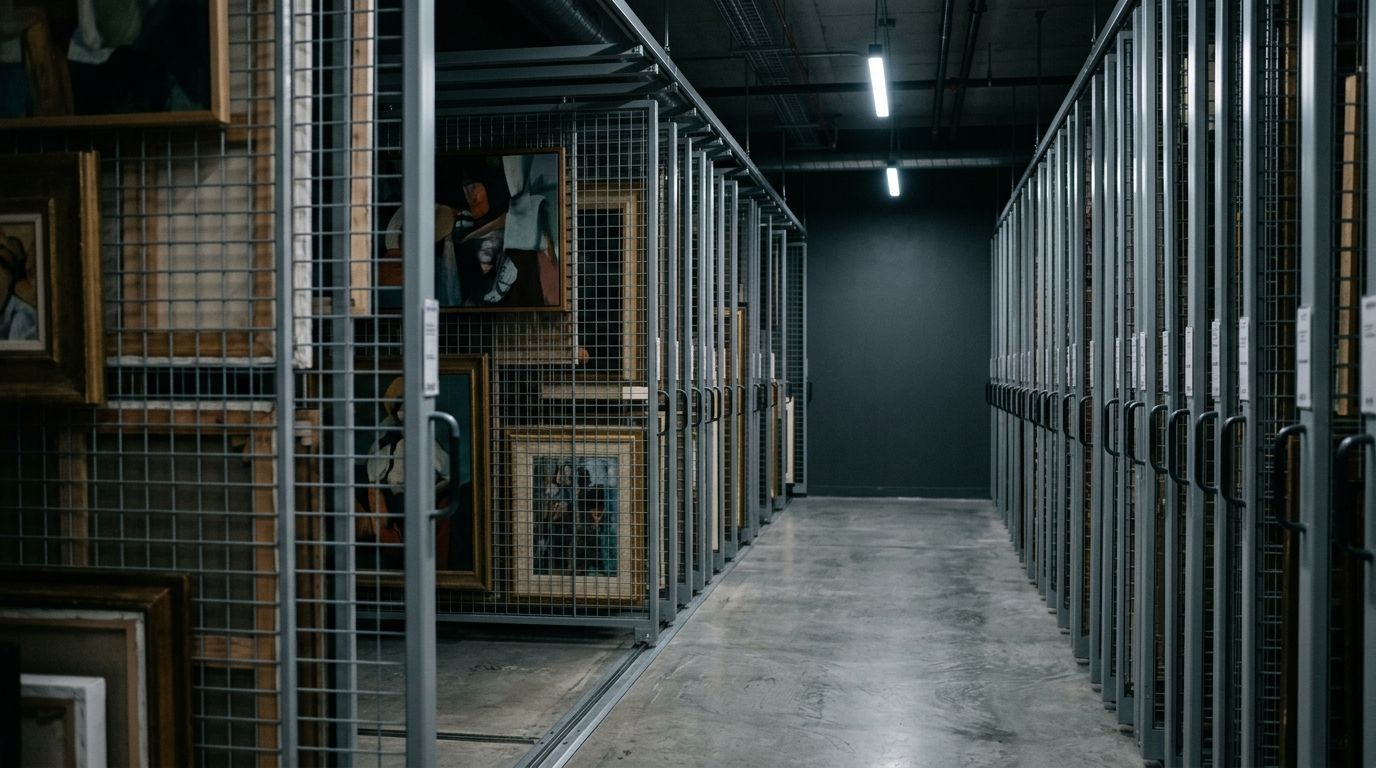
Sliding mesh screens are the museum default for framed, hangable works. CCI Note 10/3 describes pull-out screens on overhead and floor tracks, hangers fixed to the frame rather than the stretcher when the frame is the stronger member, and two people for medium and large works. Fixed wall-mounted screens work in smaller rooms. Powder-coated or galvanised steel resists corrosion better than raw iron mesh. Label each screen bay so you find a painting without lifting three others.
Slotted shelves and flat storage
Slotted vertical shelving suits smaller framed works and mixed sizes when screens are out of budget. Line shelf bases with twin-wall corrugated plastic so mouldings do not scrape. Separate works in one slot with cardboard or archival board. Do not overcrowd. Horizontal shelves or drawers hold paintings that must lie flat: active flaking, severe structural weakness, unstretched canvas, or works on card and panel without stretchers. Paint side up. Soft covers that never rest on the paint film. Oversized works need custom cradles; stop and ask a conservator or fine-art handler before you invent a system.
Backing boards before the rack
Fit canvas paintings with sealed backing boards before long-term storage. CCI Note 10/10 treats backing boards as preventive conservation for almost every painting on stretcher or strainer. Twin-wall polyethylene sheet (products such as Coroplast), acrylic sheet or sealed hardboard create a micro-environment behind the canvas that slows short-term RH swings and blocks punctures from hooks, fingers and stray wire. Leave a small air gap with spacer strips. Seal with foam stripping firm enough to limit leakage without bowing the stretcher. Clear acrylic keeps inscriptions visible. Synthetic board plus a sheet of 4-ply matboard adds a hygroscopic buffer for dry winters.
Unframed contemporary works with painted edges need a handling-travel-storage (HTS) frame: a temporary outer frame that takes the hangers and keeps wrap clear of the paint. CCI Notes 10/3 and 10/16 describe that route. Do not hang unframed canvas from picture wire that can dig into the reverse.
Wrap, back and buffer without trapping damage
Wrapping protects against dust, dirt and water. It does not replace climate control. CCI Note 10/3 recommends wrapping and sealing paintings in polyethylene or Mylar sheeting for storage when condition allows. Visibility through clear film helps you invent without opening every package. Fragile impasto, lifting paint and soft varnish argue against contact wraps; use a rigid HTS frame or a custom Coroplast box instead, then seal the outer enclosure.
Never let bubble wrap, foam or film touch the paint surface. Art UK's collections guidance and NPS Appendix L both warn against tight plastic against paint. Build a stand-off: rigid board or HTS members hold film away from the face. Corner protectors belong on frames, not pressed into paint. Washed cotton muslin dust covers work when film is wrong, provided fabric does not rest on the image.
Acclimatising after a move
CCI Notes 10/4 describe a controlled return when a painting has lived in a very different climate. Wrap the work loosely but completely in plastic with blotting paper or cotton sheeting inside as a moisture buffer, then let it equalise over weeks rather than hours. Opening a cold crate into a warm humid room invites condensation on paint and varnish. Acrylics are vulnerable below about 5–10°C, where the polymer film turns glassy; CCI flags winter travel and cold stores as cracking risks for acrylic paintings.
Light, dust and pollution in the store
Keep the store dark. Cover racks with polyethylene if overhead pipes exist. Close windows. Avoid storing near radiators, kitchen extractors and newly painted rooms still off-gassing solvents. Glazing in the frame plus a sealed backing board buffers short-term RH swings and blocks some dust; that is storage hygiene as much as display practice. Deep UV and lux budgets for display belong in the sunlight-damage sibling. In storage, darkness is the cheap win.
Climate targets you can actually hold
Museum climate advice has moved away from a single magic set-point of 21°C and 50% RH for every collection. The Smithsonian Institution's 2016 declaration on the collections preservation environment states that tightly controlled 70°F and 50% RH is no longer treated as an appropriate default for all spaces. Risk management, building fabric and energy use now shape specifications. For paintings, the practical consensus still clusters around a mid-range band with limited daily swings.
CCI Notes 10/4 give the safest RH for paintings on canvas or wood as a stable level between 40% and 60%, with institutions often targeting a central value near 50% for loan uniformity. Temperature set-points in the ASHRAE and CCI guidance sit anywhere in 16–25°C for human-comfort zones. The Bizot Green Protocol (2023 refresh), endorsed in museum loan practice and discussed across conservation networks including AIC-facing briefings, proposes 40–60% RH and 16–25°C with fluctuations of no more than ±10% RH per 24 hours for many hygroscopic objects, including canvas paintings. NPS Appendix L recommends 18–24°C (64–75°F) and 40–55% RH for easel paintings, warns under 35% RH as embrittling, and treats over 65% RH as mould risk. Older Smithsonian Museum Conservation Institute guidance reported exhibition and storage boxes around 45% ±8% RH and 70°F ±4°F; those figures remain useful as a narrow institutional band, not a private-home obligation.
Stability beats perfection. A room that holds 48–55% RH all year with slow seasonal drift is kinder than a room that hits 50% at noon and 30% at midnight. CCI and ASHRAE risk categories (AA through D) rate short-term and seasonal swings; most painting collections should aim for no less than Level B control in institutional language. Private owners translate that as: pick a set-point you can hold, dampen daily spikes, and keep RH out of the mould and desiccation extremes. Full table depth for mixed media and ASHRAE categories belongs in ideal humidity for artwork (S7-09, pending). The table below is a working summary for painting storage decisions.
| Source / guidance | Temperature | Relative humidity | Notes for painting storage |
|---|---|---|---|
| CCI Notes 10/4 (paintings) | Set-point anywhere in 16–25°C | Stable 40–60%; often ~50% central | Lower thermostat in winter can raise RH without humidifiers |
| Bizot Green Protocol (2023) | Stable 16–25°C | Stable 40–60%; ≤±10% RH / 24 h | Starting band for many hygroscopic works; tighter for sensitive objects |
| NPS Museum Handbook App. L | 18–24°C (64–75°F) | 40–55% | <35% embrittles; >65% mould risk |
| Smithsonian MCI (reported institutional box) | ~21°C ±2°C (70°F ±4°F) | 45% ±8% (about 37–53%) | Historic SI box; SI now rejects one default for all collections |
| NEDCC (general collection spaces) | Public/work: ~18–22°C (64–72°F), ≤24°C (75°F) | Often 30–60% for mixed paper spaces | Dedicated stores can run cooler; paintings still need RH stability |
| Practical home target | ~18–22°C if occupied; avoid >30°C | Hold mid-40s to mid-50s; keep out of <35% and >65–70% | Monitor; use dehumidifier / humidifier seasonally |
Danger boundaries matter more than branding. CCI Notes 10/4 place mould risk around 70–75% RH, in cool pockets against exterior walls. High temperatures over 30°C with high humidity soften paint and varnish so dirt sticks. Rapid moves between climates crack brittle layers. Proofed fluctuation theory says paintings already weathered to a given swing may tolerate that swing again, but new extremes still cut fresh damage. Undamaged contemporary works have no such history; protect them as if every swing is novel.
Portable equipment can hold a mid-range band when the building lacks full HVAC. CCI Notes 10/4 describe an interior room as a humidified zone in winter, with surrounding non-humidified rooms acting as a buffer to the exterior walls. Swap to a dehumidifier when summer RH climbs past about 60%. Keep air moving with fans if humidity stays high; stagnant damp is where mould settles. Local control only works if you maintain the machines and read the logs. A humidifier left running without a humidistat can push a small room into the mould band overnight. Lowering the thermostat from 22°C to 18°C can raise RH by as much as about 12% in an unhumidified winter room, which is why CCI treats temperature and RH as a paired dial rather than two independent knobs.
Home storage versus professional offsite
Home storage works when you control a room, monitor it, and limit the number of works. A closed interior room, racks or padded vertical slots, backing boards, dark hours, and seasonal humidity equipment can match museum practice for a small collection. Insurance and security still need attention: document condition with dated photographs, keep an inventory tied to rack positions, and tell your insurer which room holds art.
Professional fine-art storage exists for scale, security and climate continuity. Purpose-built facilities advertise continuous monitoring near classic museum mid-points (often quoted around 21°C / 50% RH with tight tolerances), art handlers on staff, vault access protocols, and backup power. Observer's 2025 overview of collector storage contrasts ordinary five-by-five self-storage (often under $100 per month in the US) with specialist vaults that start several times higher because climate, security and handling are the product. Arrow Fine Art Services publishes storage at $5.50 per square foot per month with a $175 monthly minimum (US example; verify current rates). London and UK operators usually quote by footprint, duration and handling rather than a fixed menu. Ask for logged RH/temperature data, fire suppression type, pest programme, and how retrieval is scheduled.
Offsite also means logistics. Every entry and exit is a handling event. Condition reports on intake and release protect you if damage appears later. Bonded freeport-style facilities add customs and tax complexity; the practical storage mechanics still look like racks and climate, but the legal wrapper belongs in the freeport article (S24-03, pending). For most private owners, the fork is simpler: improve one room at home, or rent space from a fine-art specialist when volume, travel or building risk exceeds what a spare room can hold.
Edge cases: panels, acrylics, damage and oversize
Edge cases break generic advice. Wood panels move across the grain with RH. Low winter humidity contracts the reverse faster than the painted face and can raise tents of paint. High humidity expands wood under a less responsive paint film and can open fine cracks across the grain. CCI Notes 10/4 describe both failure modes. Panels often need tighter RH control and slower seasonal change than flexible canvas. Enclosed framing with buffering materials helps sensitive panels; ask a paintings conservator before you seal a historic panel into an unventilated microclimate you cannot reverse.
Acrylic paintings tolerate ordinary room temperatures but crack when cold. CCI places acrylic glass-transition temperatures in about the 5–10°C range, higher than oil films. Do not store acrylics in unheated outbuildings. Warm a cold acrylic package gradually before unwrapping. Soft acrylic surfaces also pick up dirt and packing impressions; keep wraps off the face.
Flaking, water damage and pests
Active flaking stores flat, paint side up, with no pressure on the surface. Vertical storage of lifting paint invites losses every time you move the work. Water-damaged paintings need isolation and professional advice; mould stains and acid damage progress while you wait. Isolate any work with flight holes, frass or active insects. CCI biological-activity guidance starts with cleanliness and inspection; treatment belongs to a conservator, not a household insecticide fog.
Oversized and mixed-media works
Oversized canvases may need custom HTS frames, A-frame trucks for in-building moves, and floor plans that leave swing space. Mixed-media paintings with collage, plastics or found objects may off-gas or stick; separate them from other works and ask a conservator about enclosure materials. Unstretched rolled canvases are a temporary expedient with their own risks; long-term storage prefers flat or re-stretched solutions designed with a conservator.
What museum stores and fine-art facilities do
Museum painting stores look boring on purpose. Sliding screens, inventory barcodes, dark hours, filtered HVAC, and written retrieval procedures reduce improvisation. Conservators and collection managers set environmental specifications per space rather than one slogan for the whole building. Smithsonian practice now emphasises collaborative, sustainable parameters and monitoring data shared across facilities and collections staff. CCI ClimaSpec and related tools push institutions to match climate advice to object type and risk rather than copy a single set-point from a loan form.
Fine-art commercial stores borrow the museum kit: racking, climate logs, trained handlers, and chain-of-custody paperwork. They add client services: scheduled viewing rooms, packing for onward shipping, and insurance liaison. They do not replace condition assessment. A vault that holds 50% RH will still receive a painting with active flaking if nobody examined it on intake. Your job as owner is to demand condition notes and climate evidence, then keep your own photographs.
Registrars think in handling events. Every time a painting leaves a screen, risk rises. Good stores minimise unnecessary pulls. Label well. Photograph versos and hanging hardware. Record who moved what and when. That paperwork is storage practice as much as the dehumidifier is.
Institutional stores also plan the travel path. CCI Note 10/3 wants the route from store to gallery as direct as possible, without tight corners or stairs where a large frame must tip. Private owners can copy that: keep the store on the same floor as the rooms where works rotate onto walls, leave clear swing space in front of racks, and never park furniture in the retrieval aisle. Two people move medium and large paintings. Solo "quick" slides account for many corner chips. NPS handling notes add the basics that still fail at home: carry small works with two hands on the sides of the frame, never by the top rail alone, and never press fingers into the canvas reverse.
Costs and kit
Costs scale with how close you want to get to museum practice. A consumer data logger often sits in the tens to low hundreds of pounds or dollars. Twin-wall backing board, foam stripping and screws for one easel painting may cost less than a restaurant meal if you source materials yourself; a framer or conservator installing boards on a collection of twenty works will charge labour. A decent dehumidifier or cool-mist humidifier for seasonal control often lands in the low hundreds. DIY padded blocks and slotted plywood shelves cost materials plus finishing with acrylic latex paint as CCI suggests for sealed wood. Commercial sliding screens are capital equipment: expect institutional pricing once you add floor and ceiling tracks.
Professional storage quotes by footprint and service level. US specialist examples in trade press start around a few hundred dollars per month for small vault footprints and climb steeply for private rooms. Per-square-foot rates around $5–6 with monthly minima appear in published fine-art handler tariffs; treat them as order-of-magnitude, not a price list. UK quotes are usually bespoke. Add packing, transport and condition reporting as separate lines. Compare that annual total with the cost of improving one room at home and buying better insurance documentation.
Insurance sits beside rent. Some policies limit cover for works in self-storage or require named professional facilities. Read the schedule before you move paintings into a cheaper unit. Valuation updates and condition photos reduce disputes after a claim.
Budget time as well as money. A home store needs seasonal equipment checks, logger downloads and a visual walk-through after storms. A professional store needs scheduled retrieval windows and sometimes handling fees each time you pull a work for a weekend hanging. Collectors who rotate display frequently often keep a smaller set at home and leave deeper holdings offsite. Households that hang everything and store nothing still need a short-term rack plan for renovation dust, builders and temporary moves; packing for those moves belongs with the packing-for-moving sibling in this series rather than with long-term rack design.
When to call a conservator or registrar
Call a paintings conservator when you see active flaking, fresh cracks after a climate event, mould, soft sticky acrylic, warped panels, or pest evidence. Call before you key out a slack canvas in a dry room; CCI warns that keying during low RH can crack brittle paint when humidity returns. Call before you seal a damaged work in plastic. Call for oversized or structurally odd works that need custom storage furniture.
Call a registrar, collection manager or reputable fine-art storage firm when volume exceeds your room, when you travel for months, when your building cannot hold RH, or when security risk outweighs convenience. Ask for climate logs, handling protocols and sample condition reports. Icon (Institute of Conservation) in the UK and AIC Find a Professional directories in the US help you locate accredited conservators; museums listed in the museums directory often publish conservation contacts for public enquiries even when they cannot store private works.
Stop DIY when the problem is structural or biological. Storage design is preventive. Treatment is not. The series hub on caring for art points to shipping, packing for moves, insurance and conservation roles for the adjacent decisions.
FAQ
These questions track the decisions people make after they decide to stop leaning paintings in a hallway: climate numbers, self-storage claims, orientation, plastic wraps, acrylic cold risk, inspection rhythm, backing boards and when a vault fee beats a spare room. The answers stay short on purpose. Each one restates a rule from the method and climate sections above so you can check a single doubt without rereading the whole guide. If your case involves active damage, skip the FAQ and go straight to a paintings conservator. For UV fading, display hanging and freeport legal wrappers, use the pending sibling articles named in the opening.
What relative humidity should I use for storing oil paintings?
Hold a stable band between about 40% and 60% RH if you can, with many institutions targeting near 50%. CCI Notes 10/4 use that band for paintings on canvas or wood. NPS prefers 40–55% and flags under 35% and over 65% as danger zones. Daily swings matter; keep changes inside about ±10% RH per day when possible, per Bizot-style guidance.
Can I store paintings in a climate-controlled self-storage unit?
Only if the operator can show year-round logs that keep RH out of mould and desiccation extremes and temperature away from hot and freezing spikes. Many "climate-controlled" units track human comfort, not collection care. Prefer a prepared interior room at home or a specialist fine-art store when the paintings matter.
Should paintings be stored vertically or flat?
Store sound, framed paintings vertically on racks or screens. Store actively flaking, severely weakened, or unstretched works flat on shelves, paint side up. Never make a long-term horizontal stack of framed paintings.
Is plastic wrapping safe for long-term storage?
Clear polyethylene or Mylar can protect against dust and water when sealed around a frame or HTS frame so the film never touches paint. Tight plastic on soft or lifting paint is harmful. Fragile surfaces belong in rigid enclosures instead.
Do acrylic paintings need different storage from oils?
Both want stable mid-range RH and darkness. Acrylics need extra care in the cold: keep them out of unheated spaces and warm packages before unwrapping. Soft acrylic surfaces also mark more easily from contact packing.
How often should I check paintings in storage?
Inspect seasonally at minimum, and after any flood risk, HVAC failure or pest sighting. Check data-logger downloads monthly. Look for mould, insects, slack canvas, new cracks and packaging that has slumped onto paint.
Where should I put backing boards?
On the reverse of stretchers or strainers for canvas paintings, sealed enough to buffer short-term RH swings and block punctures. CCI Note 10/10 recommends them as standard preventive care. Historic frames may need a conservator's method so you do not damage ornament.
When is professional fine-art storage worth the fee?
Professional storage earns its fee if your building cannot hold climate or security, if the collection outgrows one room, or if works must leave the house for renovation or travel. Compare monthly vault cost with the combined cost of room upgrades, monitoring kit and insurance conditions.
Related reading
Olga de Amaral: Weaving the Infinite
A transatlantic survey tracing six decades of textile innovation across architecture and craft.

A Rare Market Appearance: Hilma af Klint's Geometric Masterwork Heads to Stockholm
A tightly guarded abstract canvas enters the secondary market, challenging established price benchmarks and highlighting sustained institutional momentum.

A Marketing Mismatch Over Impressionist Iconography
Why a Eurostar campaign overlooks a major London loan