
Exhibo Editorial
How to Handle Artwork
Gloves, two-person lifts, face-out carrying and padded rests, plus when household art needs trained specialist handlers
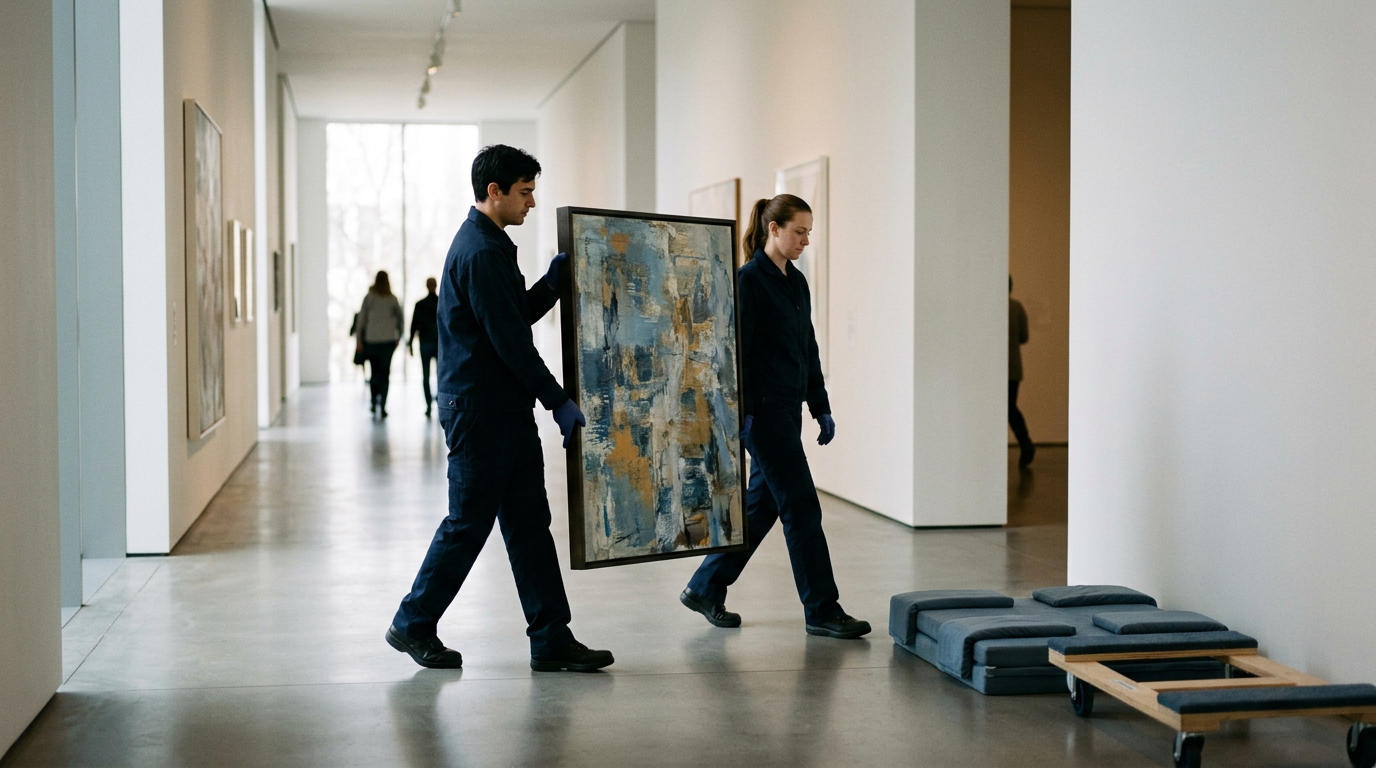
To handle artwork without avoidable damage, touch it as little as you can, plan the path before you lift, and use enough people for full control. Wash your hands or put on clean, well-fitting gloves suited to the material. Carry one work at a time by strong side members of the frame or stretcher, with the painted face towards the carriers. Never lift by the hanging wire, the top rail alone, or decorative corners. Rest the piece on padded blocks or a clean padded table only after you have prepared that spot. If paint is flaking, the frame is weak, the object is oversized, or you feel unsure of the weight, stop and call a conservator or trained art handlers before you move it.
This article stays on day-to-day handling: gloves, lifts, orientation and resting. Packing for a house move belongs with how to pack paintings for moving. Courier shipping belongs with how to ship a painting. Surface cleaning belongs with how to clean an oil painting. Career pathways for museum and gallery technicians sit at art handling as a career. For the wider care series, start at caring for art. Museum collections that model careful movement sit under museums.
Why Handling Damages Art
The Canadian Conservation Institute states a blunt fact that matches museum floor experience: most damage to paintings and frames happens during handling. Stains, finger oils, abrasion, dents, tears in canvas, scratched varnish and lost ornament on frames all concentrate in the short minutes when a work leaves the wall or shelf. Each lift multiplies chance. A painting that hangs undisturbed for ten years can fail in one stairwell because someone under-counted hands, misjudged weight, or set it down on a cluttered table.
Organic supports respond to the room as you move them. Canvas and panel change dimension with humidity. CCI basic-care notes warn that paintings crack more when dry (a heated flat in winter, a dry attic) or when cold air hits a warmer surface. A work that feels fine on the wall can become brittle the moment you carry it through a cold hallway into an unheated van. Vibration from stairs and doorframes transmits into stretcher bars and into any loose paint film. Pushing a finger into the reverse of a canvas leaves a permanent dent; pushing from the front abrades or flakes paint.
Frames fail at the mitres. Hold a framed painting by one side alone and the combined weight of glass, rebate and canvas pulls the corner joints open. Gilded or polished mouldings take fingerprints and moisture from bare hands. Contemporary works with painted edges treat those edges as part of the image; a clean handprint there is damage, not a temporary mark. Unframed stretchers twist if you lift only two corners of a large weak strainer. Loose stretcher keys drop behind the bars during a tilt and bruise the paint from behind.
People cause most of the damage. They carry two works at once to save a trip. They pass a painting hand-to-hand mid-stair. They wear rings that catch canvas. They rest a frame on its corner while they open a door. They leave keys, tape rolls and tools on the receiving table so the first set-down scrapes the rebate. CCI’s handling note lists the same cluster: underestimating weight, skipping assistance, skipping equipment, skipping a clear route, skipping a prepared landing spot, and manipulating the painting the wrong way. Domestic rooms produce those failures without any malice. The fix is discipline, not talent.
Assess the Work Before You Touch It
Spend minutes looking before you put hands on the object. Condition decides whether a DIY lift is sane. Photograph front, reverse, edges and any existing damage in daylight. Note flaking paint, cupping, tears, loose keys, cracked glass, weak mitres, projecting hanging hardware and missing backing boards. Write a short dated condition note. Insurers and professional handlers expect that record if something goes wrong later. CCI Note 10/13 asks you to check for flaking paint and frame instability before any move; if either is present, a conservator or technician should stabilise the work in place first.
Sort by risk. Stable framed prints and sound easel paintings with solid frames can leave the wall with two careful people. Works with insecure paint, detached canvas, past water damage, glass supports, friable pastel or charcoal, and any piece you cannot replace should wait for specialist advice. A backing board on a canvas painting reduces puncture risk from behind and buffers short humidity swings; CCI recommends one for travel fitness, and the same logic applies to a house rehang. If keys sit loose, secure them so they cannot fall between canvas and stretcher during the lift.
Measure height, width and depth including the frame. Check door widths and stair turns against those numbers before you lift. Clear jewellery, watches, scarves, lanyards and bags that can snag. Wash moisturizer residue off your hands; many museum leaflets prefer clean dry hands or gloves without cream underneath. Clear a path from wall to landing spot. Remove chairs, cables and pets. Designate one person to open doors and watch corners if the carriers cannot see both edges. Prepare the receiving surface first: padded blocks on the floor beyond traffic, or a padded table covered with clean polyethylene so frame ornament cannot snag felt. CCI is firm on this order: landing spot ready, then move. Reversing that order is how paintings end up propped against radiators and doorstops.
Build a mental inventory of handholds. For a framed painting, the strong side members of the frame take the load. For an unframed stretcher, the stretcher bars take the load; never press into the canvas. For sculpture, the heaviest solid mass takes the load, not handles, rims or projecting arms. National Museums Scotland and CCI both warn that decorative handles and knobs are often the weakest points. If you cannot name a safe handhold, you do not yet have a handling plan.
Gloves: Clean Hands, Cotton and Nitrile
Glove choice is one of the liveliest debates in collections care, and household advice still lags behind museum practice. For decades the public image of careful handling was a pair of white cotton gloves. Conservators and registrars now treat cotton as a limited tool: useful in a few settings, a hazard in others. Powder-free nitrile has become the default barrier glove in many institutions. Clean bare hands remain the better choice for some fragile paper and friable media where grip and touch matter more than a barrier. The decision follows the object and the risk, not a single rule for every wall.
Match the glove to the surface you will touch and to the risk you are trying to block. Skin oils and salts mark metals, polished stone, photographs and unvarnished paint. Dirt already on a reused cotton glove transfers faster than a freshly washed hand. A loose glove reduces dexterity and raises the chance that you drop or crush something. A glove that sheds fibres can snag pastel, gilt or openwork metal. The subsections below sort the common options so you can pick once per task and change gloves when they soil.
Cotton, bare hands and when dexterity wins
Cotton gloves block some fingerprints and look “museum-like,” yet National Museums Scotland now advises against them for most collections work because they do not form a complete barrier and they hold dirt when reused. Cotton reduces grip on smooth frames and glass. Threads catch on gilt, basketry, metal granules and friable media. Documentary Heritage and Preservation Services for New York summarises the same shift: cotton was the old standard for paper and photographs; research and practice have moved institutions toward nitrile or clean hands depending on the material.
Clean, dry, moisturizer-free bare hands give the best tactile feedback for handling fragile paper, soft bindings and some friable surfaces where a glove would abrade or snag. Wash and dry until no residue remains. Avoid hand cream before the lift. Change the plan if your hands sweat; then a thin powder-free nitrile glove is safer than a damp bare palm. For short examination of a stable glazed print, clean hands on the frame edges may be enough. For unvarnished contemporary paint, metals and photographs, prefer a barrier glove.
Nitrile, latex and what research now prefers
Powder-free disposable nitrile gloves are the workhorse recommendation across Met Museum handling guidance, National Museums Scotland leaflets and CCI’s comparative glove notes for heritage objects. Nitrile conforms to the hand, grips better than cotton on smooth surfaces, and blocks oils and many contaminants. Choose a close fit. Baggy gloves catch on projections. Avoid powdered gloves; powder transfers. Textured industrial gloves can leave patterns on soft surfaces; CAMEO and related AIC research prefer smooth powder-free grades for dry art handling.
Not every high-street nitrile pack is equal for sensitive metals. A 2021 Journal of the American Institute for Conservation study (Stephens et al.) tested nineteen latex-free powder-free nitrile brands for dry handling art. Many left visible residues or drove corrosion on metal coupons under accelerated ageing. Brands with lower chloride content performed better; Ansell BioClean Biotac and Showa 7500PF ranked among the safest in that test set. For home handling of paintings and frames, a fresh powder-free exam-grade nitrile pair from a reputable maker is a practical baseline. For polished silver, copper alloys or other chloride-sensitive metals in a serious collection, ask a conservator which glove batch they trust, or handle with clean hands only where the object allows.
Latex gloves appear in older manuals as an alternative. Many workplaces now avoid latex because of allergy risk. Vinyl gloves appear in some supplier lists; they often fit less well and tear sooner. CCI’s glove comparison table still lists cotton, nylon, polyethylene, latex and nitrile with trade-offs: cotton for breathability at the cost of barrier and grip; nitrile for barrier and dexterity at the cost of sweat build-up during long wear. Change disposable gloves when they sweat through, tear, or pick up dirt. Dirty gloves are worse than clean hands.
Method: Lift, Carry and Set Down
A safe lift is a short script you agree before anyone bends their knees. CCI Note 10/13 and museum object-handling leaflets converge on the same sequence: examine, plan route, prepare landing, assign roles, lift on a single command, carry without chatting through hazards, set down, then release. Rushing any step is how corners meet doorframes. The method below fits a stable framed or stretcher-mounted painting in a domestic room. Scale the people and equipment up for larger works; do not invent shortcuts that put pressure on canvas or glass.
Talk through the move out loud even when it feels obvious. Name who holds which side, who opens doors, where you will pause, and how you will rotate through a narrow landing. One person leads. That person gives the lift command and the set-down command. Everyone else waits for those words. If something feels wrong mid-carry, the lead says stop; you lower together onto the nearest prepared rest, not onto a random chair arm.
Two-person lifts and spotters
CCI states that most easel-sized paintings need two handlers, and that larger works need multiple handlers plus spotters. Each carrier places one hand along the lower edge or bottom corner and the other along the side toward the upper corner to balance the weight. Carry with the painted face toward the carriers so that if you stumble, a backing board (if fitted) meets the world before the paint does. Face-out also helps you see the surface you are protecting.
Never lift by the hanging wire. Never lift by the top rail alone. Never carry by one side only. Do not pass a painting from hand to hand; set it on padded blocks so the next person can take a controlled grip. One painting at a time. Smithsonian Museum Conservation Institute advice matches: large panels and canvases need two or more people; jewellery and watches come off before the lift. For anything that feels heavy, awkward or taller than you can see over, add a spotter whose only job is the path: doorframes, light fittings, stair rails, pets and people.
Use equipment when you have it. An A-frame trolley or padded cart removes minutes of hand-carrying and the fatigue that causes drops. CCI prefers moving equipment for heavy or oversized works. A household equivalent is a stable furniture dolly with upright padding and straps, used only if the painting is already protected enough that straps never touch paint. If the cart rattles, stop; vibration is a handling risk of its own. National Park Service painting care notes warn that an old rickety cart can shock a painting as much as a clumsy hand.
Small works, large works and unframed canvas
Small framed works for a short hop can travel with one firm hand on each side if the frame is sound and you can see your feet. For any distance through traffic, stairs or lifts, put the small work in a shallow tray or between rigid cards so a bump does not leave you juggling bare glass. CCI suggests wrapping small pieces in acid-free tissue between pre-cut card for corridor travel, with adhesive kept off the object.
Large framed works and large contemporary canvases need a team. Unframed canvases on weak strainers twist; CCI recommends a rigid backing before you move them, and transport on an A-frame with support along several vertical bars. Oversized and high-impasto works often live in handling-travel-storage (HTS) frames in museums: shallow box frames with rigid skins that take the handling load. Few homes own HTS frames, which is a cue to hire professionals rather than invent a plywood sandwich on moving day.
Unframed stretchers demand that every hand stays on wood. Palms against the outer edges as if both faces were freshly varnished. No fingertips in the canvas plane. Painted edges on modern works are part of the composition; plan grips that avoid those viewed edges. If you cannot hold the work without touching paint, stop and build a temporary handling frame or call handlers who already own one.
Orientation and Where the Work Rests
Orientation is the quiet half of handling. A correct lift still fails if you lean a canvas on its corner, stack frames face to face, or leave a painting horizontal face-up for hours so the fabric sags against stretcher bars. Decide face, tilt and rest before you leave the wall. Mark mental “this way up” from the hanging hardware and from any labels on the reverse. When you set a work down, match that orientation on purpose.
Carry paintings vertical unless a conservator has told you to keep a flaking work flat. National Park Service notes are clear: if loose paint is present, carry the painting flat; otherwise use the vertical two-hand side grip. Horizontal face-up travel for a sound painting is a last resort for clearance problems, not a comfort habit. Face-down short moves of unstable paint are a conservator’s instruction, not a household default.
Rest framed and unframed paintings on padded blocks so the lower edge does not crush ornament and so air can move behind the work. CCI Note 10/2 covers padded-block construction; at home, dense foam or felt-wrapped timber blocks of matched height work if they are clean and stable. Lean a work only against a clear wall with padding at contact points, never against a door that someone might open. Never stack paintings on top of each other. Face-to-face contact without a rigid separator abrades varnish and deposits. Back-to-back leaning with soft interleaving is how temporary holding bays work in galleries; copy that only with clean materials and short durations.
Keys and hanging wire need a last check when the work stands on its edge. Loose keys migrate during tilts. Projecting screw eyes catch other frames. Temporary tape over sharp hardware can protect neighbouring works in a holding bay; remove it before you rehang so adhesive does not bake onto finishes. If you must leave a painting overnight in a temporary spot, choose a climate-stable interior room away from radiators, exterior walls and direct sun. Handling ends when the work is secure again, not when your hands let go.
Handling Kit and Failure Modes
Buy for grip, clean contact and a prepared rest, not for theatrical white-glove aesthetics. The table below lists a domestic handling kit that mirrors museum logic without requiring a full registrar store.
| Item | Role in day-to-day handling | Use against artwork? | Common failure if misused | Typical UK/US retail range (verify locally) |
|---|---|---|---|---|
| Powder-free nitrile gloves (exam grade) | Barrier against oils and dirt; better grip than cotton | Yes on frames, metals, photos; change when soiled | Wrong size; powdered stock; reused dirty pairs | £8–£25 / $10–$30 per box |
| Clean cotton gloves (optional niche) | Short use where policy still requires cloth | Limited; avoid on friable media and polished metal | Fibre snags; dirt transfer; slip on glass | £5–£15 / $6–$20 per pair |
| Soft measuring tape and notebook | Record sizes and condition before lifting | No contact needed on paint face | Skipping notes before a multi-work rehang | £5–£20 / $6–$25 |
| Padded blocks or felt-wrapped timber | Temporary rest off the floor | Under frame/stretcher edges only | Uneven heights; dirty foam that dyes finishes | £15–£60 / $20–$80 DIY set |
| Clean polyethylene sheet | Cover padded tables so frames do not snag felt | Under objects, not pressed on paint | Wrinkled sheet that marks soft varnish under weight | £5–£20 / $6–$25 per roll |
| Soft brush (unused) | Dust stable frames before handling | Frames only if paint is sound | Brushing unstable paint; household dirty brushes | £4–£12 / $5–$15 |
| A-frame trolley or padded dolly | Reduce hand-carrying distance | With straps clear of paint faces | Rattling carts; straps on canvas | £80–£400 / $100–$500 (or hire) |
| Corner and edge protectors | Temporary protection if you must stage near traffic | On frame, not on paint | Hard board on ornate gilt | £6–£30 / $8–$40 per set |
| Flashlight or phone torch | Inspect reverse, keys and hanging hardware | Light only | Heat from worklights left close to surface | £0–£20 / $0–$25 |
| Step stool with wide stable base | Reach hanging points without stretching | Feet on stool, hands on art only when stable | Wobbly stools; one-handed lifts from height | £25–£80 / $30–$100 |
Skip newspaper as a rest surface, kitchen towels against paint, and “just hold it by the wire for a second.” Skip scented wet wipes on any art surface; cleaning is a separate discipline and belongs with a conservator when dirt is embedded. Skip stacking works “for a minute” on a bed or sofa; fabric fibres and body weight create dents you will not see until raking light hits the paint.
Edge Cases: Paper, Glass, Sculpture and Unstable Paint
Framed oils on stretchers are the default handling case. Homes also hold works on paper, glazed pastels, small sculpture, mirrors treated as art practice, and paintings with active flaking. Each format fails in a different place. A method that protects a varnished oil can abrade charcoal. A two-person vertical lift that suits a sound canvas can shower flakes from insecure paint. Rank the highest risk first and hire help when risks stack.
Read this section before you recruit a helpful neighbour. Friable media, ordinary float glass and top-heavy ceramics account for a large share of domestic handling disasters. The subsections below cover the formats that change grip, orientation or the decision to stop DIY.
Works on paper, pastels and photographs
Paper wants support across its plane. Carry mounted and glazed works upright like paintings if the package is rigid. Unglazed sheets travel in a rigid folder or between boards, horizontal, with no pressure on the face. Friable media (pastel, charcoal, soft graphite, chalk) must not slide inside a polyester sleeve; abrasion lifts the image. National Museums Scotland and NEDCC practice favour tissue interleaving and shallow boxes. Gloves for paper follow the debate above: clean hands often beat cotton; nitrile can be safer when oils would stain a photograph or coated paper. Never fan a stack of unmounted sheets like a deck of cards.
Photographs and polished metal-based processes fingerprint. Prefer powder-free nitrile and handle by edges. Keep sleeves and boards clean; a dirty barrier is still contact dirt. If a photograph is stuck to glass, stop. Separation is conservation work.
Glass, sculpture and mixed media
Ordinary float glass turns a bump into shards against the image. Carry glazed works with extra people and no sudden tilts. Tape on glass is a packing mitigation for transit, not a handling licence to be casual. Laminated glass and museum acrylic reduce shard risk; they still scratch and still need two safe hands. Spacers must keep glazing off media; if glazing already touches pastel or thick varnish, vibration during a carry abrades the image. Tell carriers that the face is glass so nobody presses a palm on the pane to steady the load.
Sculpture follows object-handling logic from CCI and Met Museum manuals: support the heaviest part, cradle with both hands, never lift by projecting arms, handles or rims, never slide the base across a table. Separate lids and loose parts before you move the body. Top-heavy ceramics need a second person and a clear flat landing. Polished metal takes imprint from dirty gloves and from foam; use tested nitrile or clean hands as the material demands. If a join flexes or an armature wobbles, stop DIY handling.
Flaking paint and emergency moves
Active flaking changes the entire script. Carry flat if a conservator or NPS-style guidance for loose paint applies. Do not brush flakes away; collect any detached pieces in a labelled bag for the conservator. Photograph before and after. CCI’s accident advice is to record circumstances, gather fragments and contact a qualified conservator. Many fine-art insurance policies exclude loss from unskilled handling; that clause alone is a reason to pause.
Emergency salvage (flood, fire risk, structural failure) puts human safety first. CCI’s handling note says art movement in a disaster can cause damage as bad as the event itself. Plan the route and the temporary refuge even when examination and wrapping are impossible. Stack small framed works on edge in temporary boxes with cardboard spacers if you must move many pieces in one pass. Round the corners of cardboard spacers so sharp points do not puncture canvas. Once out of danger, stop improvising and call professionals for the second move.
What Professionals Do Differently
Museum art handlers, gallery technicians and fine-art movers work from method statements. They examine condition with registrars, assign a lift lead, clear routes, stage padded rests, and log who moved what. They use A-frames, toe-kick jacks, travel frames and custom foam cradles that home cupboards do not contain. They refuse lifts that lack enough people. That refusal is the skill.
Professionals separate roles. A spotter does not also carry. A driver does not invent packing on the pavement. Conservators consolidate flaking paint before a scheduled move. Registrars write condition reports that travel with the object. Met Museum handling practice stresses advance study of materials, weight distribution and weak points, and conference with specialist conservators when properties are unclear. Domestic owners can copy the planning habits even when they cannot copy the equipment budget: one lead, prepared landing, one object, documented condition.
Career handling (museum installs, soft-packing for loans, crate work, tour logistics) is a trade with its own training paths and pay bands. That pathway is covered in art handling as a career. This article stays on what you do with your own walls and stairs. When a job needs soft-pack, courier paperwork or climate-controlled vehicles, you are no longer in pure handling; you are in packing and shipping, which have their own guides in this series.
Costs: DIY Kit Versus Hired Hands
Domestic handling materials are cheap next to a single damaged painting. A box of powder-free nitrile gloves, a roll of polyethylene, and a set of DIY padded blocks often sit under £50 / $60. A stable step stool and a borrowed furniture dolly cover many rehangs. Spend first on people time: two careful adults for an afternoon beats one tired person on a ladder.
Hired help spans a wide band. London-area “man and van” style art transport marketing often quotes from about £65–£100 per hour depending on crew size, with two-hour minima and extras for stairs and mileage; treat those figures as starting points from public rate cards, not as a survey. Specialist fine-art removers quote by survey: access, floor level, value, packing grade and distance. UK art technician freelance rates in industry surveys and talent reports often cluster around £18–£25 per hour for project technicians, while permanent museum technician salaries sit in broader bands (recent Cadogan Tate / SML reporting cites about £30,000–£45,000 for UK mid-level technician roles). Clients buy crew time plus vehicle and materials, so a half-day local install for a handful of works can land in the low hundreds of pounds; complex multi-storey moves with soft-pack run far higher.
Insurance changes the arithmetic. CCI notes that many fine-art policies exclude unskilled handling damage. A specialist mover’s transit cover and method statement can matter more than the hourly delta between a general remover and an art crew. Ask what training the crew has, whether they will soft-pack or only carry, and how they document condition at collection and delivery. Get the quote in writing against your inventory list.
When to Hire Art Handlers
Hire trained handlers when any of these apply: the work is larger or heavier than two people can control on your stairs; paint is unstable; the frame is ornate or weak; glass is large; the object is sculpture with awkward balance; the piece has high financial or irreplaceable personal value; the route includes tight turns, external scaffolding, or a public pavement; or your insurer requires professionals. Hire a conservator first when flaking, tears or structural failure are visible. Handlers move stable objects; conservators make unstable objects fit to move.
Stay DIY for small, stable, low-value works on a clear ground-floor route when you have enough people, a prepared landing, and the patience to do one piece at a time. Rehanging a sound framed print across a room is a reasonable home task. Clearing a three-storey townhouse of large canvases the night before exchange of contracts is not.
If packing for a house move is the next step after the lift, follow how to pack paintings for moving. If the work must travel by courier or carrier, use the shipping guide in this series. If dirt or yellowed varnish is the problem, do not invent a cleaning step during handling; stop and use the cleaning guidance, which leads with a conservator for anything beyond gentle dry dusting of a stable surface. For the series overview, return to caring for art. To see how public collections stage movement at scale, browse museums.
FAQ
Do I need gloves to handle every painting?
No. Match the barrier to the material. Powder-free nitrile suits many frames, metals and photographs. Clean dry hands suit some fragile paper where cotton would snag. Cotton gloves are no longer the universal museum default. Dirty gloves are worse than clean hands. Change disposables when they soil or sweat through.
How many people should move a typical framed painting?
Plan on two carriers for most easel-sized framed works, plus a spotter if the route has stairs, tight doors or poor sight lines. Larger works need more hands or a trolley. If you cannot see both edges and your feet, you need another person.
Should the painting face me or face away while I carry it?
CCI prefers the painted face toward the carriers so a backing board meets the world first in a mishap and so you can monitor the surface. Keep the work vertical unless a conservator has ordered a flat carry for loose paint.
Can I lift a painting by the wire for a short move?
No. Wires and their fixings fail. Top-rail lifts rack frames and open mitres. Use both hands on strong side members of the frame or stretcher.
What should I do if paint flakes during a lift?
Stop in a controlled way. Set the work down flat on a prepared surface if that matches loose-paint guidance. Collect fragments. Photograph. Call a conservator. Do not brush the surface clean or press flakes back into place.
Is it safe to lean paintings on the floor against a wall?
Short-term leaning on a clear wall with padding at contact points is common in galleries. Use padded blocks under the lower edge when you can. Keep the spot out of traffic. Do not stack works. Do not leave them against doors, radiators or exterior walls for long stays.
When does handling become a job for professionals?
When weight, fragility, value, access or insurance exceed a calm two-person plan. Unstable paint needs a conservator before any handler. Career and commercial handling roles are described in art handling as a career; packing and shipping sit in their own articles in this series.
Galleries mentioned
Exhibitions mentioned

Related reading
Olga de Amaral: Weaving the Infinite
A transatlantic survey tracing six decades of textile innovation across architecture and craft.

A Rare Market Appearance: Hilma af Klint's Geometric Masterwork Heads to Stockholm
A tightly guarded abstract canvas enters the secondary market, challenging established price benchmarks and highlighting sustained institutional momentum.

A Marketing Mismatch Over Impressionist Iconography
Why a Eurostar campaign overlooks a major London loan