
Exhibo Editorial
Art Handling as a Career
Art handler careers mapped across museums, galleries, auction houses and logistics firms: skills, pay and progression
An art handler job is hands-on collections work: packing and unpacking objects, installing and de-installing exhibitions, moving works between galleries, storage and trucks, and building the mounts, crates and gallery furniture that keep those objects safe. You may hold the title art handler, preparator, exhibition technician, art technician, collections technician or, in auction houses, porter. The workplace can be a museum, a commercial gallery, an auction house, a private collection, or a fine-art logistics firm that serves all of those clients.
Employers hire for care under pressure. You lift, climb, drive, measure and problem-solve while registrars, conservators and curators set limits on what the object can tolerate. The career sits beside museum jobs (pending) in the art careers series: less desk work than a registrar, less treatment than a conservator, more physical craft than most gallery front-of-house roles. This article stays with the occupation. Step-by-step packing technique belongs with caring-for-art guides; crate construction and shipping systems belong with collections logistics. Here the question is who does the work, how the job grew, what a week looks like, what it pays, and how people enter and advance.
What an Art Handler Does
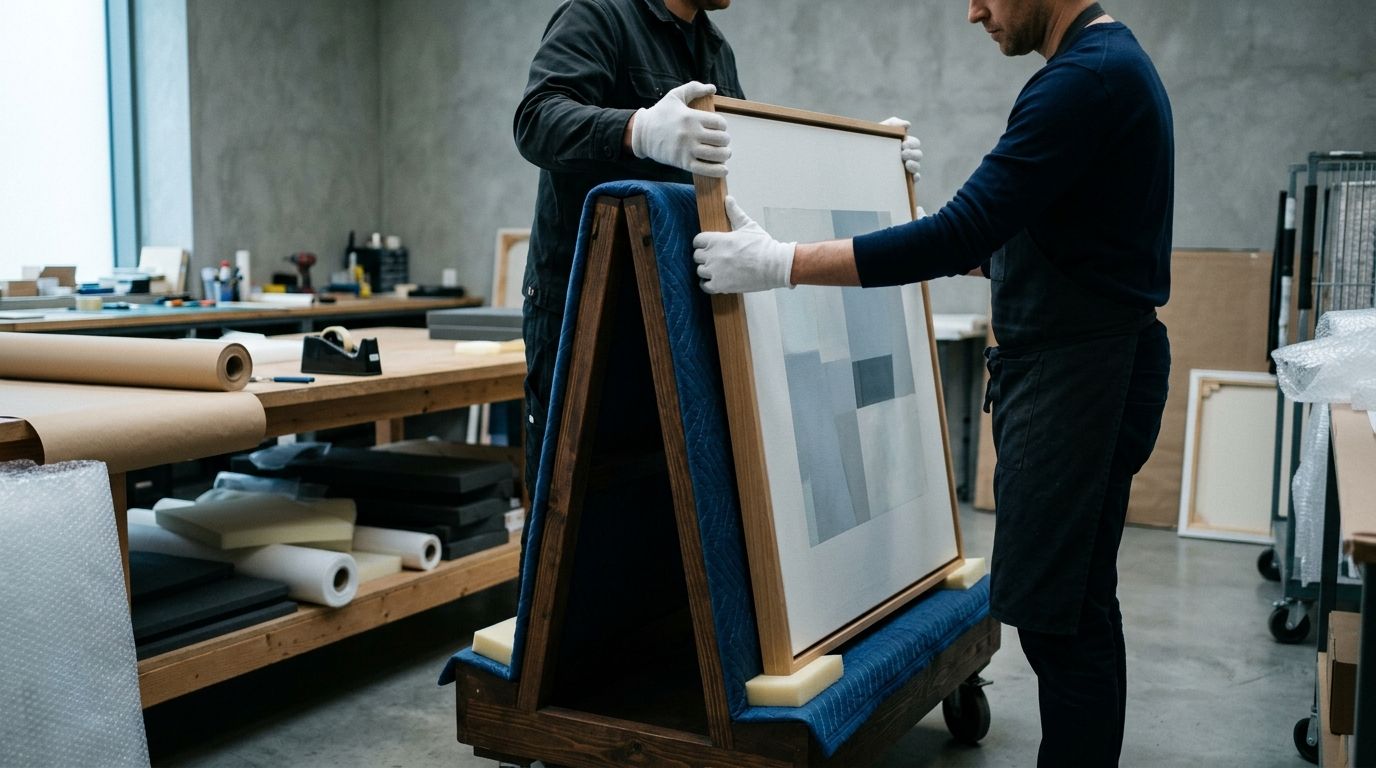
The Broad museum’s Diversity Apprenticeship Program toolkit defines an art handler as someone who works directly with art or cultural objects in museums, galleries or art shipping companies: packing and unpacking, installing and de-installing, and moving works between sites. Duties stretch with the employer. At a small gallery you may hang every show, build crates and drive the van. At a large museum you may specialise in gallery install one month and storage moves the next. Logistics firms split crews across warehouse, road and on-site install for museums, fairs and private clients.
Titles signal context more than a rigid hierarchy. In the United States, preparator often names institutional or gallery staff who combine handling with fabrication, mount-making and exhibition coordination. In the United Kingdom, technician, museum technician or art handling technician cover much of the same ground; auction houses still use porter for floor movement, photography set-ups and sale displays. Cadogan Tate and Sophie Macpherson Ltd’s 2025 Art Technicians Talent Report standardised four bands for comparison: Art Technician / Handler, Senior Technician / Handler, Preparator / Museum Technician, and Head Technician / Chief Preparator. The labels differ; the shared core is safe contact with objects under someone else’s ownership and liability.
You work inside a web of adjacent roles. Registrars own loan paperwork, location records and condition reporting systems. Conservators set treatment and handling limits. Curators and exhibition designers decide layout and narrative. Facilities and security control building access, lifts and loading docks. The handler turns those constraints into physical sequences: which wall first, which crate opens last, who holds the bottom edge, when the scissor lift moves. Mistakes write themselves into condition reports. Good habits stay invisible to visitors who only see a finished hang.
Museums, galleries and historic houses
Museum postings describe the role with striking consistency. The Museum of the City of New York’s art handler job description (reporting to the registrar) lists handling, moving and installing collection and loan objects; preparing mounts; assisting with packing, receipt and storage; documenting activity in the collections management system; overseeing temporary handlers; and maintaining woodshop and materials inventory. The North Carolina Museum of Art’s art handler / preparator bulletins add outdoor sculpture install, custom art-truck loading, courier travel, and the ability to lift around 50 pounds and work at height. Virginia Museum of Fine Arts postings stress custom crate interiors, framing and unframing, storage housekeeping, and tool and hoist competence. Across these institutions the handler executes collections policy with hands and tools.
Gallery work compresses the same skills into faster cycles. Commercial spaces change hangs for openings, art-fair booths and collector deliveries. Teams stay small. You meet artists, dealers and clients on site, often after hours. Historic houses and estate museums add another constraint: period interiors, fragile architecture and limited plant, so fabrication and handling must respect the building as carefully as the object. Flagler Museum’s preparator briefings (via AAM JobHQ listings) stress fine-art handling inside a nationally significant historic interior. Wherever the walls are older than the art programme, the job becomes half collections care and half site craft.
Auction houses, logistics firms and private work
Auction houses run intense, seasonal labour: intake, photography, viewing rooms, sale display, packing out. Porters and handlers move high volumes under short deadlines. In New York, Teamsters Local 814 represents art handlers at houses including Sotheby’s and Christie’s alongside commercial movers, a labour foothold that museum and gallery freelance markets often lack. Logistics and fine-art services companies (Momart in London, hasenkamp in Germany and its network, Crozier, Cadogan Tate, UOVO and peers) employ warehouse and road crews, crate shops, project coordinators and install teams. Their clients include museums that outsource packing and travel, galleries that need fair booth builds, and collectors who need storage and domestic moves.
Private collections, artist studios and corporate collections hire staff or regular freelancers for inventory moves, photography, and home installs. The Broad toolkit notes that handlers also work at university galleries and fabrication shops. Across these settings the legal and insurance frame changes, yet the physical grammar stays similar: plan the path, protect the surface, control the load, document the state before and after. If you want the craft of packing materials and crate design in depth, that belongs in dedicated packing and shipping guides rather than a career overview. The career question is which employer type fits your tolerance for travel, overtime and public-facing stress.
How the Profession Took Shape
Museums once treated packing and movement as shop or shipping-room labour under a registrar, carpenter or foreman. Nathan Stolow’s conservation writing in the 1970s and UNESCO’s Procedures and Conservation Standards for Museum Collections in Transit and on Exhibition (1981) argued that exhibition travel had outgrown improvised casework. Loan programmes grew after mid-century; international touring shows demanded better cushioning, climate buffering and documentation. Conservators pressed for involvement at the packing stage. Handlers and preparators became the people who translated those standards into foam, timber, straps and lift plans.
Professional networks followed practice. PACIN (Packing, Art Handling, and Crating Information Network) formed in 1989 to share methods across museums and commercial handlers. The group gained American Association of Museums (now American Alliance of Museums) Professional Interest Committee status in 1997 and later broadened its name to PACCIN (Preparation, Art handling, and Collections Care Information Network). Workshops at national and regional AAM meetings covered packing, airport security, rigging, materials and job definitions. Parallel research from bodies such as the Canadian Conservation Institute turned transit hazards (shock, vibration, drops, climate spikes) into measurable design goals for packaging. The Getty’s packing shops, profiled in press coverage of lead preparators such as Rita Gomez, show how large lenders turned crate design into a specialised craft with written unpack instructions for receiving museums. The trade still learns on the job, yet it now has a vocabulary, a literature and conference circuits.
Specialist firms built the commercial layer in the same decades. Momart began in London in September 1972 after artist Jim Moyes’s gallery install and transport work found a market; the firm later held a Royal Warrant for work with the Royal Collection (granted in 1993). Cadogan Tate dates its founding to 1977. hasenkamp, a German family logistics group, frames more than 120 years of art transport and storage experience and lists hundreds of employees across packing, project coordination and specialised engineering for difficult moves. US names in the same competitive set include Crozier Fine Arts (now part of a larger storage group) and regional crate-and-truck firms that feed museum loan traffic. These companies professionalised climate warehouses, courier protocols and project management that museums either staff in-house or buy as services. The art handler job today sits at the join between institutional collections departments and that commercial layer.
Day-to-Day Work
A quiet week in a museum art-handling shop can look like storage housekeeping, hardware inventory, light cleaning of casework, CMS location updates and fabrication for an upcoming hang. A loud week looks like a full gallery turnover: de-install overnight, condition checks with registrar and conservator, crate traffic at the loading dock, temporary walls, lighting aims, graphic installs, and a punch list that runs past opening. Logistics crews live more of their year in the loud mode: multi-site truck runs, fair builds, and warehouse receiving that never empties.
The Broad toolkit lists duties that recur across employers: loading and driving trucks; building crates or display furniture; installing audio-visual equipment; aiming lights; making mounts; preparing spaces for display. Physical stamina is not optional. Postings ask for bending, kneeling, standing for long stretches, ladder work, and lifting in the 50-pound range, often as a team using dollies, straps, A-frames and lifts. You also need the slower skills: reading a condition report, noticing a loose stretcher key, refusing a lift path that scrapes a doorframe, and saying so early enough that the plan can change.
Documentation sits beside the muscle. Many museum roles require comfort with a collections management system and basic photo records of packing states. Auction and logistics work adds waybills, seal numbers and client sign-offs. Communication runs horizontal (crew chiefs, temporary day labour) and vertical (registrar, curator, facilities). The best handlers keep a calm tempo when the dock is late and the wall colour is wrong. Panic damages objects faster than tight schedules do.
Install cycles and gallery time
Exhibition install is theatre with a safety brief. You receive drawings or walk the space with curators and designers, mark centres, confirm hanging systems, and stage works in order of dependency: large sculpture bases before delicate works on paper, wet paint walls before final object placement. De-install reverses the sequence and often reveals what the hang stressed. Temporary art handlers may join for peak weeks; permanent staff set the standard those temps must meet, as MCNY’s description makes plain.
Lighting, labels and casework finish the public face of the job. Handlers often place wall text, object labels and graphics, and they maintain dust and case cleanliness to museum practice. Interactive or AV components add cable management and structural checks. Outdoor sculpture programmes (common at campus museums and sculpture parks) layer weather, foundations, lift equipment and public access into the same day. Courier trips for loans take you on the road or into aircraft holds as the institution’s eyes on a crate. Those days feel less like gallery craft and more like guarded logistics: you watch seals, temperature loggers, forklift behaviour on the apron, and the moment a cargo agent wants to tip a case on its side. Institutions write courier duties into loan agreements because remote trust is expensive; the handler or registrar on the flight carries that trust in person.
Storage, transit and warehouse rhythms
Between shows, collection storage is the quiet engine of the job. You shelve, rehouse, pull for research or photography, and keep aisles clear for emergency egress. Off-site warehouses add truck time and climate discipline. Fine-art logistics warehouses run receiving, photography bays, crate fabrication and dispatch as a continuous operation. hasenkamp’s public materials stress custom packaging manufactories, climate-controlled depots and licensed air-cargo security screening that can pack at the museum so crates avoid extra airport handling. Momart and peers sell the same triad: transport, storage, installation.
Freelance handlers in cities such as New York and Los Angeles stitch together gallery day rates, museum overflow and logistics call-outs. Hours spike around art-fair weeks and September / May exhibition seasons. The Cadogan Tate / SML survey found that about one-third of technicians, staff and freelance, take supplemental work to bridge income gaps. That pattern is part of the job’s economic reality in expensive art capitals. For object-level packing recipes and material choices, use dedicated technique resources; the career skill is knowing which protocols your employer and insurer require, and refusing shortcuts that shift risk onto the object.
Skills, Tools and Physical Demands
The Broad guide’s profile of a good art handler is blunt: common sense, care, spatial sense, curiosity, problem-solving, and a preference for working around objects. Core skills include hand-eye coordination, manual dexterity, the ability to follow instructions and plan sequences, basic maths for measurements and load estimates, clear communication, and teamwork under physical load. Complementary backgrounds transfer well: carpentry, theatre stagecraft, construction, welding, automotive bodywork, sewing, jewellery, landscaping and food-service discipline around cleanliness and timing. Fine-art degrees are common (36 percent of Cadogan Tate / SML respondents held one) yet not required for entry; interest in materials often matters more than a specific diploma.
Tool literacy separates candidates. Hand and power tools for wood and plastics, clamps, levels, laser measures, vacuum lifters, dollies, A-frame carts, pallet jacks, forklifts, scissor and boom lifts, and soft packing materials appear across job ads. Logistics employers may require formal licences (forklift, MEWP / aerial work platforms, rigging) because insurance contracts demand them. Museums may train in-house on institutional equipment and collections procedures. Gallery shops sometimes expect you to arrive already competent and learn house style on the fly. Soft skills travel with the tools: you brief a temporary crew without shaming them, you tell a curator when a design conflicts with wall structure, and you keep a materials list current so the next install does not stall for lack of hanging cleats.
Physical demand is real and cumulative. Repetitive lifting, awkward carries through stairwells, kneeling for floor works, and long days in unconditioned loading docks wear joints and backs. Employers screen for the ability to lift stated weights and work at height; they also expect you to use team lifts and mechanical aids rather than heroics. Fatigue is a collections risk. Pace, hydration, gloves that match the object, and the discipline to stop an unsafe lift belong in professional practice. Hearing protection in crate shops, dust control when cutting foam, and respect for solvent rules near collections areas sit in the same safety frame. Diversity data still shows a skewed room: the Andrew W. Mellon Foundation’s 2015 Art Museum Staff Demographic Survey found art handlers about 85 percent white and more than 75 percent men. Apprenticeship programmes such as The Broad’s DAP exist in part to widen that pipeline, and AAM’s wider equity work keeps pressure on hiring managers who recruit only through closed friend groups.
Pay, Hours and Working Conditions
Pay varies by city, employer type and employment model. Treat board averages as orientation, then check live postings. Museum staff roles often trade lower cash pay for benefits and steadier schedules; logistics firms and large commercial galleries can pay more cash with heavier overtime; small galleries pay the widest spread, often below market. The Cadogan Tate / SML 2025 medians (survey plus 2024–2025 postings and candidate data; 163 records) give the clearest cross-market snapshot available to date:
| Role band | United States (median) | United Kingdom (median) |
|---|---|---|
| Art technician / handler | about $55,000–$66,000 / $30–$33 per hour | about £30,000–£35,000 / £15–£17 per hour |
| Senior technician / handler | about $65,000–$70,000 / $32–$36 per hour | about £40,000–£45,000 / £17–£19 per hour |
| Preparator / museum technician | about $60,000–$67,000 | about £40,000–£45,000 |
| Head technician / chief preparator | about $70,000–$90,000 | about £45,000–£50,000 |
Posted institutional examples sit around and below those bands depending on region and vintage. Museum of the City of New York listed $53,000 for an art handler role in a 2022 PDF posting. North Carolina Museum of Art recruitment ranges in recent state bulletins have opened near $31,200 with tops in the mid-$40,000s to about $50,000 depending on the bulletin. Live commercial ads in 2026 have shown rates such as $30–$34 per hour for art handler / driver roles at firms like UOVO. ZipRecruiter’s public aggregates for related titles (art installer / art handler) have clustered in the low-to-mid $40,000s nationally, which can lag specialist logistics medians. Freelance day rates in major cities often land higher on paper; Reddit and trade discussions commonly cite roughly $30–$50 per hour for experienced handlers in large US markets, without benefits.
Hours follow exhibition and fair calendars. Expect early calls, late strike days, weekend installs and travel. Museums may offer overtime policies, pensions or 401(k) plans, and cultural perks; logistics overtime can dominate take-home pay. Training access tracks employer type in the Cadogan Tate / SML data: about 60 percent of logistics technicians reported employer-funded training, versus about 35 percent in museums and about 25 percent in galleries. Formal training correlated with roughly 7 percent higher pay and 10 percent higher satisfaction in that sample. No figure here is a promise; cost of living in New York, Los Angeles or London can erase a headline median that looks solid on a spreadsheet.
How People Enter the Field
Most people enter through adjacent labour rather than a single credential. Museum and gallery assistants who help with installs, art-school graduates who build their own crates, carpenters who take a museum shop job, theatre technicians who switch venues, and warehouse workers who move into fine-art divisions all appear in hiring stories. The Broad toolkit emphasises transferable trades and argues for wider access beyond opaque title language. Degrees help for institutional competition and for fluent talk with curators, yet many strong handlers learn sequences from senior crew long before they learn art-historical periods.
Practical entry steps stay concrete. Build a short portfolio of installs you can discuss: photos of hangs (with permission), fabrication samples, and a CV that names tools and lift types you have used. Apply to fine-art logistics firms that run structured training; apply to museum temporary handler pools; watch AAM JobHQ, museum career pages, and specialist boards such as jobs.art. Network on active crews; many freelance days come by text from a lead who needs a fourth body who already knows soft packing. Apprenticeship and DEI pipeline programmes (DAP at The Broad is a documented model) exist in a few cities and deserve attention if you lack art-world contacts. Volunteer or short contract work at university galleries can supply supervised object contact when paid entry roles demand prior experience you do not yet have on paper.
Employers screen for reliability under collections rules. Can you follow a packing diagram? Can you stop when a conservator says stop? Can you arrive on time for a 6 a.m. dock call? Background checks are common around collections access. Driving licences matter for handler / driver hybrids. Clean driving records matter more when the role includes a box truck through city streets. You do not need a master’s degree to start. You do need proof that you treat other people’s objects as irreplaceable, because they are.
Progression: Preparator, Registrar and Adjacent Paths
Progression is real and uneven. Cadogan Tate / SML estimate roughly 10–15 percent earnings growth per experience tier (entry 0–3 years, mid 4–8, senior 9+), with pay growth often flattening after eight to ten years if you stay purely hands-on. Titles and ladders differ by sector. Galleries may move Technician → Senior Technician → Head Technician with limited formal rungs. Museums may publish Preparator → Senior / Head Preparator paths tied to collections compliance. Logistics firms promote through crew chief, project lead and operations management, with certifications as gates.
Two adjacent destinations attract handlers who want a different mix of desk and dock. Registrar and collections-manager tracks emphasise documentation, loans, rights and risk; handlers who already live in the CMS and condition-report workflow sometimes cross over, though registrar posts often prefer museum-studies credentials. Conservation is a separate professional path with graduate training; handlers support conservators daily but do not become conservators by packing alone. Exhibition design, mount-making specialism, art-fair project management and private-collection management are other exits that still use handling fluency.
Staying technical: senior handler to head of prep
Many people want to remain makers. Senior technicians lead crews, talk directly to clients or curators, and own the method for awkward installs. Head preparators and head technicians add budgets, hiring, health-and-safety policy, equipment planning and representation of the technical department in institutional meetings. The craft deepens into standards-setting: which hardware the museum allows, how temps are briefed, how near-misses get reported. PACCIN’s professional community and AAM collections-stewardship resources supply the language for that standards work.
Crossing into coordination and collections roles
Others move laterally into registrar assistant, exhibitions coordinator or logistics project coordinator roles where scheduling and paperwork outweigh daily lifting. Auction operations, insurance adjusting for fine art, and specialist courier management also recruit people who have stood beside crates in the rain. Map your next step against the wider museum jobs landscape (pending) rather than assuming a single ladder. Handling skills travel; job architecture does not always.
Regional Variation and Labour Context
Art-handler labour concentrates where collections, fairs and storage warehouses concentrate: New York, Los Angeles, London, Paris, and secondary hubs with strong museum or collector density. New York’s market mixes union auction-house work (Teamsters Local 814’s art-handler jurisdiction), large museum departments, and a deep freelance install economy that Artsy and labour organisers have covered as under-recognised and intermittently organised. Local 814’s public materials also note campaigns around art-storage employers such as UOVO. Museum unions (for example at major New York institutions) may cover handlers under broader technical or facilities units; coverage is employer-specific, not automatic.
Los Angeles combines studio fabrication culture, museum campuses and logistics warehouses serving West Coast fairs and private collections. Rates and overtime culture track film-adjacent labour markets more than East Coast auction calendars. London’s vocabulary leans “technician”; national museums, commercial galleries in Mayfair and St James’s, and logistics firms such as Momart and Cadogan Tate set much of the rate conversation. Continental Europe’s large movers (hasenkamp and ARTIM-network partners among them) hire packers and project staff for museum tours that cross borders and languages; air-cargo security licensing and customs brokerage become part of the skill set sooner than in a domestic US museum shop. Pay that looks equivalent on a currency converter can diverge sharply once rent enters the maths; the Cadogan Tate / SML report flags that problem for New York and London explicitly.
Outside major hubs, museum handler posts exist at state and university museums with lower cash pay, broader multi-hat duties, and sometimes stronger community stability. One person may hang the show, build the crate, drive the truck and update the database. Remote and regional work still demands the same object care; you wear more titles in one week. Search museums by city when you plan a move, then read the local employer mix: one large museum versus a thicket of galleries changes how freelance weeks fill. If the city has a fine-art storage cluster, logistics day rates may outweigh museum staff openings; if it has a single civic museum, staff benefits may matter more than headline hourly pay.
FAQ
Searchers who land on handler job ads still ask a short set of clarifying questions: daily duties, fitness requirements, pay, credentials, museum versus logistics employers, and how the role connects to registrar or preparator tracks. Answers below summarise this article’s career fence. They are not a packing manual; technique and crate specs belong with the caring-for-art cluster when those pieces publish. Cross-check any wage figure against the dated sources in the pay section before you treat it as current.
What does an art handler do day to day?
You move, pack, unpack, install and de-install artworks and related objects, often while building mounts or crates and operating lifts and shop tools. Museum days mix gallery install with storage work and documentation; logistics days mix warehouse, road and client-site install. The Broad’s handling guide and current museum job descriptions align on that core.
Do you need a degree for an art handler job?
No single degree is required. Many employers ask for experience with tools, installs and object care; fine-art or art-history study helps in some institutional competitions and is common in the workforce, yet carpenters, theatre techs and trained logistics staff enter regularly. Apprenticeship programmes and on-the-job training remain major routes.
How much do art handlers earn?
Medians in the 2025 Cadogan Tate / SML research cluster around $55,000–$66,000 for US art technicians / handlers and £30,000–£35,000 in the UK, with senior and head roles higher. Individual museum postings can sit lower, especially outside major metros; freelance hourly rates in large cities can sit higher without benefits. Always weigh local cost of living and overtime patterns.
What is the difference between an art handler and a preparator?
Overlap is large. Art handler emphasises movement, packing and install labour across museums, galleries and shippers. Preparator (common in the US) often signals institutional or gallery staff who also fabricate furniture, mounts and exhibition infrastructure and coordinate install standards. In the UK, technician usually covers the equivalent.
Is art handling a union job?
Sometimes. In New York, Teamsters Local 814 represents art handlers at major auction houses and has organised or campaigned around related employers; some museums cover handlers under staff unions. Much gallery and freelance work remains non-union. Check the specific employer’s bargaining status rather than assuming coverage.
How do art handlers progress in their careers?
Typical moves include senior / lead technician, head preparator or head technician, logistics project lead, or lateral shifts into registrar, exhibitions coordination or collections roles. Pay tends to rise with experience tiers, then plateau unless you take supervisory or specialist paths. Training and certifications speed advancement in logistics settings.
Where do art handlers work besides museums?
Commercial galleries, auction houses, fine-art logistics and storage firms, private and corporate collections, artist studios, university galleries and fabrication shops. Specialist shippers such as Momart, hasenkamp, Crozier and Cadogan Tate employ large technical workforces that serve institutional and private clients worldwide.
What physical demands should you expect?
Frequent lifting (often 50 pounds or more with team methods), ladder and lift work, kneeling, long standing, and irregular hours around installs. Employers expect mechanical aids and safe technique; the job still stresses bodies over years. Fitness, pacing and willingness to refuse unsafe lifts are part of competence.
Related reading

Gustave Fayet: Collector—Artist Designer
A comprehensive survey at the Fondation Louis Vuitton reuniting collected masterpieces with the designer's own studio practice.
The Paris institution expands its patronage series with a dual-focused examination of Gustave Fayet, bringing together hundreds of acquired works and restored creations to chart his impact on early modernism.

Mohammad Alfaraj: The Heart Is a Bird's Nest, the Brain Is a Spider Web
First European institutional solo explores cross-species kinship and domestic ecologies
Mohammad Alfaraj's latest showcase at the Delfina Foundation merges multimedia installations with regional folklore to reimagine shared habitats.

Vancouver Establishes Cultural Land Trust Amid Artist Housing Crisis
A new municipal framework seeks to secure long-term studio space and prevent creative displacement.
Vancouver's council has approved a structural mechanism to retain artists and nonprofits as soaring property costs threaten the city's creative sector.