
Exhibo Editorial
How to Pack Art for Moving
Surface barriers, corner guards, upright boxing for house moves, and when DIY packing should yield to fine-art handlers
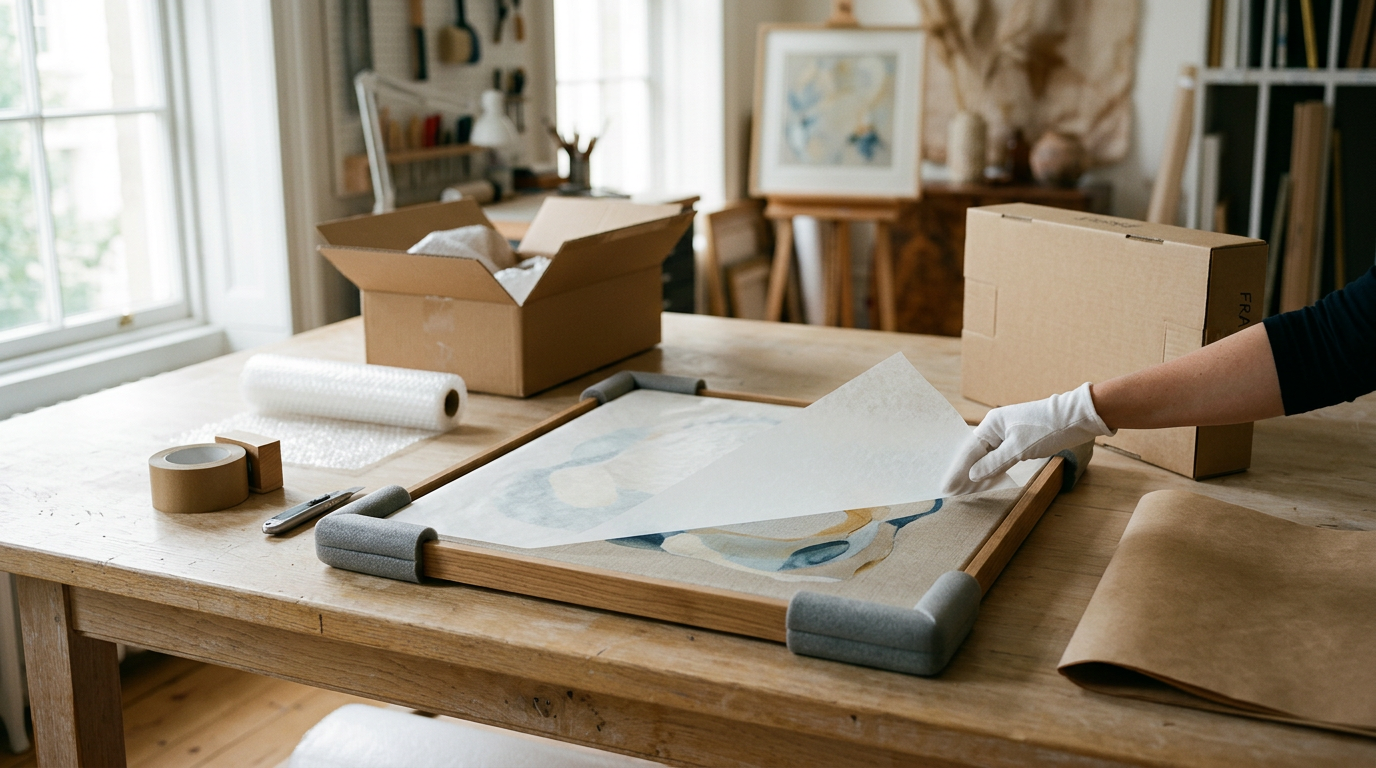
To pack paintings for moving, protect the face first, then the corners, then the whole package. Lay glassine or acid-free tissue against the painted or glazed surface, fit foam or cardboard corner protectors, sandwich the work between rigid boards, wrap in bubble wrap or closed-cell foam (never against bare paint), and stand the bundle upright in a snug picture or mirror box. Keep framed works vertical in the van. Do not stack other boxes against the face. If paint is flaking, the frame is fragile, the work is on glass, or the piece carries real financial or emotional weight, stop DIY packing and call a conservator or fine-art mover before you wrap.
This article stays on house-move and self-move packing: what you do in a living room before a removal van arrives. Courier shipping belongs with how to ship a painting (pending). Wooden crates and travel frames belong with the planned crates guide. International freight and customs belong with the international shipping article. Detailed lifting technique belongs with handling guidance. For the wider care series, start at caring for art. Museum collections that model careful transport sit under museums.
Why a House Move Damages Art
A house move stacks risks that ordinary furniture packing does not create. Paintings leave climate-stable walls, pass through stairwells, sit in vans that heat and cool, and share space with chairs, boxes and tools that shift. Shock, vibration, puncture, abrasion, water and rapid relative-humidity swings all hit the same object within a few hours.
Canvas and panel respond to humidity. The Canadian Conservation Institute notes that organic supports (wood, linen, ground layers) buffer short humidity swings when sealed with care, but a large temperature drop can still drive condensation under plastic. Acrylic paint softens in heat and can take an imprint from bubble wrap or fabric pressed against it. Oil paint with insecure adhesion sheds flakes if you tip a work face-down or brush a wrap across raised paint. Glass in a frame turns a drop into a shower of shards against the surface unless you contain it.
Panel paintings and joined wooden supports bring a second set of failure modes. CCI travel notes flag panels that can crack, loosen or separate at joints when vibration and poor handling meet humidity swing. Each plank can move at a different rate. A cardboard pack that flexes like a folder transmits that motion straight into the panel. Rigid face boards and a snug outer box reduce flex; they do not make a cracked panel fit to travel.
Corners take the first hit when a package catches a door jamb. Frames scissor under uneven pressure and strain the canvas. Soft packing that looks thick but leaves air gaps lets the work rattle; soft packing that is too tight presses the wrap into the paint. Household movers trained on sofas often lay pictures flat, lean them on corners, or stack cartons against the face. Your packing has to survive that culture even if you ride in the van yourself.
Time pressure makes the damage worse. People pack art at midnight with leftover kitchen paper because the van arrives at eight. Museums budget packing as a planned task with a clear surface, conditioned materials and enough hands. You can copy that discipline in a flat: schedule art for a daylight block, finish it before the general chaos starts, and refuse last-minute “just wrap it in a duvet” offers from well-meaning helpers.
Assess the Work Before You Buy Materials
Spend time looking before you cut cardboard. Condition decides whether DIY packing is sane or reckless. Photograph front, back, edges and any existing damage in daylight. Note tears, dents, lifting paint, loose stretcher keys, cracked glass, weak mitres and hanging hardware that sticks out. Write a short condition note with the date. Insurers and fine-art handlers expect that record if anything goes wrong later.
Sort the collection into three piles: works you will pack yourself, works that need a framer’s help (new backing board, better glazing, secure hanging hardware removed or taped), and works that leave the house only with a specialist. Flaking paint, detached canvas, past water damage, ivory or glass supports, pastel that sheds, and any object you cannot replace go in the third pile. CCI’s guidance on travel fitness is blunt: a painting that is unstable should not travel until a conservator consolidates or otherwise prepares it. A house move is travel.
Measure height, width and depth including the frame. Add space for corner protectors and at least two centimetres of cushioning on each face when you choose boxes. Check the reverse: a missing backing board leaves the canvas open to puncture from behind. CCI recommends installing a suitable backing board before wrapping for travel when the painting can accept one. If keys (wedges) sit loose in the stretcher, secure them so they cannot fall between canvas and stretcher and bruise the paint from behind.
Remove the work from the wall with two people for anything larger than you can control with one hand on a side member and one hand underneath. Clear a clean table or floor covered with a clean sheet. Keep food, pets and packing chaos out of that zone. Dust frames with a soft brush only if the paint surface is sound; do not wipe unvarnished or friable paint. Handling detail sits in the dedicated handling article; the rule for packing day is fewer lifts, slower lifts, one work at a time.
Build a simple inventory as you go: working title or description, dimensions, medium, estimated value band, pack method (DIY box / framer prep / specialist), and a photo filename. That list feeds insurance questions and stops a small work vanishing into a wardrobe carton. If a piece has a gallery label, certificate or condition report from a past sale, put copies in a folder that travels with you, not inside the picture box where water or crush can reach them.
Step Method: Pack a Framed Painting for the Van
The method below suits a stable framed painting or print under glass that you will load into a domestic removal van or your own car for a same-day or overnight house move. It follows the same logic museum leaflets and CCI wrapping notes use: face barrier, rigid front protection, sealed wrap, outer cushion, upright containment. Scale the materials up for larger works; do not invent shortcuts that put plastic or bubble wrap on bare paint.
Work in the room where the painting has lived if you can, so cardboard and tissue share a similar humidity history. CCI asks packers to condition hygroscopic materials in the same environment for at least a day when possible. On a rushed move that may mean opening supply packs the evening before and leaving them in the room overnight.
Surface barrier, glass and corners
If the frame holds ordinary (non-laminated) glass, decide whether to keep it. For a short domestic hop, many owners leave glass in place and tape it. Low-tack painter’s tape in an X across the pane, plus strips along the edges, helps hold shards if the glass cracks. CCI notes that tests have shown taped and untaped glass can still damage a painting when they fail, and that laminated glass or acrylic with proper spacers is safer for larger works. Tape is a mitigation, not a guarantee. Remove tape soon after the move so adhesive does not mark coatings. Never let tape touch paint, canvas or a gilt surface.
Cover the face. For glazed works, the glass is the face you protect next. For unglazed paintings, lay new acid-free glassine or smooth acid-free tissue over the paint so nothing abrasive reaches it. National Park Service museum guidance treats glassine as a short-term cover for paintings and friable surfaces, not as long-term storage wrap. Use fresh sheets; aged glassine turns acidic. Do not use newspaper. Ink transfers. Do not use a bath towel or felt against impasto; fibres catch.
Fit foam or cardboard corner protectors on all four corners so the protectors take impact instead of mitres and ornament. Commercial foam corners work for most domestic frames. Cardboard corners cut from double-wall board suit heavier frames if you size them so the face board cannot sag onto the paint. Fragile gilt or plaster ornament may need soft foam sleeves rather than hard cardboard. If the frame cannot bear contact, stop and talk to a fine-art packer; a travel frame belongs in crate territory, not a cardboard picture box.
Rigid sandwich, wrap and box
Cut two rigid boards (corrugated cardboard, foam board or multi-wall board) a little larger than the outer frame. Sandwich the corner-protected work between them so the boards, not the glass or canvas, take pressure. Tape the boards to each other at the edges; keep tape off the frame finish where you can. CCI’s wrapping sequence for framed paintings places a cardboard face protector, then a sealed polyethylene wrap, then an outer bubble or foam layer. For a house move, many packers use the cardboard sandwich, then bubble wrap bubbles-out, sealed with packing tape on the wrap only.
If you follow the fuller CCI seal, use clean uncoated polyethylene (about 2–4 mil / 50–100 µm). Wrap so overlaps sit on the reverse and tape the seams closed. Fold a tab of tape back on itself so later removal does not need a knife near the frame. Add the bubble or thin closed-cell foam layer outside that seal. The point of the plastic is short-term humidity buffering and splash resistance, not crush strength; the boards and box supply structure.
Wrap so nothing can shift inside the package. Mark FRONT and THIS WAY UP with a marker on the outer wrap. Slide the bundle into a picture box or mirror box with a close fit. Fill voids with crumpled acid-free paper, foam sheets or clean packing paper so the package cannot rattle. Do not force a too-small box; crushing the corners defeats the protectors. Do not leave a too-large box half empty; the work will act as a battering ram against the walls.
One framed work per box is the safe default. If you must double up small, flat, low-value pieces, wrap each as a complete unit and put a rigid divider between them. Label the box with contents, room destination and FRAGILE / THIS WAY UP on more than one face. Tell every person on the crew that art boxes stand upright and never go under other cartons.
Test the finished package on the table: press the face with a flat palm. If you feel the glass or stretcher give, add board stiffness or a deeper box. Tip the box fifteen degrees; if the contents slide, add fill. Those two checks catch most DIY failures before the stairwell does.
Materials and Failure Modes
Buy for contact chemistry and structure, not for supermarket “fragile” branding. The table below lists what earns a place in a domestic packing kit and what fails first when people improvise.
| Material | Role in a house-move pack | Use against artwork? | Common failure if misused | Typical UK/US retail range (verify in local shops) |
|---|---|---|---|---|
| Acid-free glassine | Short-term face cover for paint or soft media | Yes, new sheets only | Old glassine goes acidic; creases can scratch soft varnish | £8–£25 / $10–$30 per roll |
| Unbuffered acid-free tissue | Face cover, void fill, padding of projections | Yes for most objects | Wadded tissue abrades; tight wedges stress joints | £6–£20 / $8–$25 per pack |
| Painter’s low-tack tape | Temporary glass containment | On glass only | Adhesive residue; flexes glass on removal if ripped off | £4–£12 / $5–$15 per roll |
| Foam or cardboard corner guards | Take corner impact | On frame, not on paint | Undersized guards; hard board on ornate gilt | £6–£30 / $8–$40 per set |
| Double-wall corrugated / foam board | Face and back sandwich | Boards outside the face barrier | Soft single-wall sags onto paint | £10–£40 / $12–$50 for sheets |
| Bubble wrap or thin closed-cell foam | Outer cushion after barrier and boards | Never on bare paint or soft acrylic | Ferrotyping and imprint in heat; tape on frame finish | £8–£25 / $10–$35 per roll |
| Clean uncoated polyethylene | Moisture barrier wrap (CCI method) | Outside face barrier / boards | Coated “greasy” film; condensation in big temperature swings | £5–£20 / $6–$25 per sheet roll |
| Picture / mirror box | Upright outer shell | N/A | Oversize voids; crushed under stacked cartons | £8–£35 / $10–$45 each |
| Moving blanket | Extra van-layer over a boxed work | Over box, not as only pack | Blanket alone lets frames flex and corners bruise | £10–£30 / $12–$40 each |
Skip newspaper, packing peanuts as the only fill around a painting, cling film on paint, and mattress bags as the sole protection. US National Park Service packing guidance warns that plastic used as a preliminary covering can trap condensation when temperature falls; use plastic as a sealed outer barrier over a proper face cover, or follow CCI’s cardboard-plus-polyethylene sequence, and add insulation if the van will run cold or hot.
Edge Cases: Glass, Unstretched Canvas, Paper and Sculpture
Framed oils and acrylics on stretchers are the default house-move case. Plenty of homes also hold works on paper, bare canvases waiting for frames, mirrors mistaken for art packing practice, and small sculptures that share a shelf with books. Each format fails in a different place: glass shards, rolled paint films, abrasion of pastel, and point loads on ceramic feet. Museum packing leaflets treat those differences as material facts, not as optional tips.
Read this section before you buy one size of picture box for everything. A method that protects a glazed print can destroy a charcoal drawing. A tube that suits a flexible ink-jet canvas can crack an aged oil study. If an object combines risks (for example a pastel under ordinary glass in an ornate frame), rank the highest risk first and hire help when the risks stack. The subsections below cover the formats that trigger most DIY disasters on moving day.
Glazing, acrylic faces and works already under glass
Laminated glass and museum acrylic reduce shard risk compared with ordinary float glass. Spacers must keep glazing off the media; glazing pressed on a pastel or thick varnish abrades during vibration. If you own a large work under plain glass and the move is long or multi-day, ask a framer about swapping to laminated glass or acrylic before packing, or about removing the glass for the journey and refitting it later. CCI lists both options and warns that acrylic scratches and can still break into sharp pieces in rare impacts.
For glazed works on paper, keep the package rigid. Flexing cracks mounts and cockles sheets. Pack glazed works upright like paintings. For unglazed works on paper, National Museums Scotland and Northeast Document Conservation Center methods favour acid-free tissue or polyester sleeves for stable sheets, then a rigid folder or board sandwich. Friable media (pastel, charcoal, soft graphite) must not slide inside a polyester sleeve; abrasion lifts the image. Interleave with tissue and keep the stack horizontal inside a shallow box with no pressure on the face. Mark the box so nobody stands it on end under the belief that all art stands up.
Unstretched canvas and rolled works
Unstretched paintings tempt people to roll them. Rolling is a compromise for transport of some flexible contemporary canvases and large works on paper, and a bad idea for brittle paint, cupping, heavy impasto or any work whose ground will crack in a curve. If a conservator or the artist has already specified a roll direction and tube diameter, follow that brief. NEDCC guidance for large paper prefers a wide-diameter tube (often 4 inches / 10 cm or more) with the face outward or as specified, interleaving, and an outer tube. Do not roll a stretched painting off its stretcher as a moving-day shortcut; restretching is specialist work and you can crack paint at the turnover.
For a stretched but unframed canvas in good condition, keep it on the stretcher. Corner and edge protectors that hold the wrap off the paint face matter more without a frame rebate. Golden Artist Colors’ packing notes for unframed paintings stress that nothing should touch the paint surface and show cardboard corner-and-rail methods that create an air gap. Soft acrylics in warm weather pick up bubble texture; keep bubble wrap off the face with more discipline than you use for a hard, aged oil varnish.
Sculpture, ceramics and mixed media
Small sculpture, ceramics and mixed-media objects follow object-packing logic from museum manuals: support the heaviest part, pad projections with smooth tissue pillows (not crushed wads), prevent parts from knocking, and double-box when weight allows. Do not rest a ceramic on a single layer of bubble wrap and call the job done. A cavity pack in foam or a snug inner box inside a larger outer box with cushioning on all sides matches NPS practice. Top-heavy sculpture needs a custom foam cradle; that is specialist work. Metal with polished surfaces takes imprint from foam and bubble wrap; put tissue between object and plastic.
Hollow vessels need interior support so walls do not collapse under external foam pressure. Fill voids with tissue pillows shaped to the cavity, not with loose pellets that migrate. Detachable lids and parts travel in labelled bags taped to the outer box, never rattling beside the object. If a sculpture has a sharp armature or unstable join, stop DIY packing. Conservators and fine-art handlers build mounts that carry load through the strong axis; cardboard cannot invent that geometry on moving morning.
Load the Van Like the Package Matters
Packing ends when the box is sealed; risk continues until the work hangs again. Carry one painting package at a time unless you use a proper cart and straps. Australian War Memorial advice matches museum handling leaflets: carry vertical by strong side members, not by the top rail or by decorative corners. Put padded blocks on the floor if you must rest a frame while you open the van.
In the vehicle, stand boxed paintings upright along the long axis of the van where you can brace them. Wedge with blankets so the stack cannot tip, face to face or back to back with soft layers between boxes. Never lay a canvas painting face-up under other goods for the journey; prolonged horizontal face-up storage sags canvas against stretcher bars. Face-down packing for a flaking work is a conservator’s instruction for short moves of unstable paint, not a general van rule.
Keep art out of the boot of a hot car in summer and out of an unheated van overnight in winter when you can. CCI flags cold as a brittleness risk and recommends climate-aware vehicles for paintings. A domestic mover will not offer air-ride suspension; you compensate with thicker cushioning, tighter blocking and shorter exposure. Load art after heavy furniture has a stable footprint, so later items do not lean into the picture stack. Unload art early at the far end for the same reason.
On arrival, stage sealed boxes in an empty room away from open doors and wet floors. Unpack art before you fill rooms with furniture traffic. Let cold packages warm to room temperature before you open polyethylene, so condensation forms on the outside of the barrier rather than on the paint. Compare each work to your outgoing photographs before you hang anything. Fresh scuffs on a frame are easier to photograph for insurance while the crew is still on site.
Self-Pack Versus Ordinary Movers
You can self-pack stable, modest-value works if you control materials, labelling and where boxes sit in the van. You still need clear instructions for anyone who lifts them. Write THIS SIDE UP and FRAGILE ART / KEEP UPRIGHT on the box and say it aloud at the start of the load.
Ordinary household movers vary. Some crews follow picture-box rules; some treat a mirror box like any other carton. Ask specific questions before you book: Will you supply picture boxes and corner protectors? Do you pack art yourselves or expect owner-packed boxes? Where will art ride in the van? What insurance limit applies per item, and is it depreciated household cover or something closer to declared value? Standard moving cover often caps art at a low amount and pays by weight. That structure fails a painting.
A hybrid pattern works for many flats and houses: you pack the art; the crew loads only the sealed boxes under your pointing; high-value pieces travel in your own car. Another pattern: the mover’s packing team wraps decorative prints while a fine-art firm collects the three works that matter. Put the split in writing so nobody “helps” by re-packing your sealed boxes with newsprint.
What Packing and Specialist Moves Cost
Costs sit in three bands: materials for DIY, add-on packing from a household mover, and fine-art handling. Figures below are planning ranges from mover and fine-art logistics public guides in 2025–2026; get local quotes.
DIY materials for one medium framed painting often land between £25 and £80 (about $30–$100) once you own a roll of glassine, corner guards, boards, wrap and a picture box. A whole-wall collection multiplies boxes more than tools; buy boards and boxes per piece.
Household movers in the US often quote specialty packing as a 20–50% uplift on the portion of the job that involves art, or line-item packing fees per picture. Custom crating, when a general mover subcontracts it, often appears in the $150–$600 band for a simple crate and higher for complex builds. UK general movers may price picture packing per item; ask for a line item rather than a vague “fragile” surcharge.
Fine-art local moves in public UK courier guidance often cite about £150–£350 for a small soft-packed painting on a shared climate vehicle, and £400–£800 when crated on a dedicated run. Larger mainland UK dedicated moves with crew can run £600–£1,500 before insurance. US consumer fine-art moving guides often show about $150–$600 per piece for local specialist handling, $500–$3,500 for long domestic routes, and crate fees from a few hundred dollars upward. Collection moves sometimes land near 1.5–4% of appraised value when service is full-service. Transit insurance for fine art is often priced as a fraction of declared value (public UK examples in the region of 0.3–1.5% depending on route and security). Treat every number as a quote magnet, not a tariff.
Budget labour time as well as cash. A careful DIY pack of ten framed works can take an afternoon once materials are on site. Specialist collection of three high-value pieces may cost more per object and still save the move if it removes the works from a chaotic stairwell. Compare the fee to the cost of one irreparable corner hit, not to the price of a picture box.
When to Hire Fine-Art Movers
Hire specialists when the risk profile exceeds what cardboard and care can absorb. Value is one trigger: many advisers treat works above about $2,500–$5,000 (or a similar sterling threshold for your insurance) as default specialist jobs, and treat $50,000-plus works as non-negotiable white-glove moves. Risk factors override a low price tag: flaking paint, ornate historic frames, oversized canvases, sculpture, glass objects, pastels, irreplaceable family works, and any piece your insurer lists on its own schedule.
Use fine-art movers when the route includes stairs with no soft corners, a long motorway leg, overnight vehicle storage, multiple drop-offs, or installation at the far end. Use them when you need condition reports at collection and delivery, nail-to-nail insurance, or a climate-controlled vehicle. Museum loans and gallery transport already live in that world; a private owner with one serious painting can buy the same skill for a single afternoon.
Leave DIY for stable posters, open-edition prints under acrylic, and robust contemporary canvases with low replacement cost, packed with the method above. If you feel unsure while taping glass, that uncertainty is data. Call a conservator for condition questions and a fine-art packer for logistics. Courier-level shipping, export crates and border paperwork sit in sibling guides; for a house move, the decision is simpler: either you can stand the loss, or you pay people who move art every week.
FAQ
Can I pack paintings flat in a removal van?
Keep stretched paintings upright in transit when the paint and stretcher are sound. Flat packing under other goods lets weight press on the face or flex the stretcher. Conservators may instruct a short face-up carry for flaking paint so loose fragments do not fall; that is a clinical exception with soft support, not a van-loading tip for a whole collection.
Is bubble wrap safe on a painting?
Bubble wrap is an outer cushion after a face barrier and rigid boards. Direct contact risks imprint on acrylics in warm conditions, and can catch raised paint. Australian War Memorial and artist-materials guidance both warn against wrap that can touch the paint film. Glassine or acid-free tissue first; bubble wrap later.
Should I take glass out of the frame before moving?
For ordinary glass on a long or rough journey, removal or replacement with laminated glass or acrylic can reduce shard risk, at the cost of more handling. For a short move, many owners tape glass in place and pack with a rigid face board. Large panes and high-value surfaces favour better glazing or specialist packing. Follow the frame’s spacer design so glazing never rests on the media.
How soon should I unpack after the move?
Unpack art once rooms are safe to walk through and temperature has stabilised. If packages sat in a cold van, let them reach room temperature before you break polyethylene seals. Check condition against your outgoing photographs, remove glass tape, and only then hang. Leave silica gel gimmicks out of sealed packs unless a conservator designed the package; random sachets do not replace sound wrapping.
Will house contents insurance cover art in transit?
Often only up to low limits, sometimes with high pairwise caps or exclusions for owner-packed fragile items. Read the policy. Scheduled fine-art cover or a transit rider from a specialist insurer may be required. Fine-art movers often arrange nail-to-nail cover on declared values. Photograph condition and keep invoices so a claim has evidence.
What if paint is already flaking?
Do not wrap it like a stable painting. Contact a paintings conservator before the move. Loose paint needs consolidation or a custom support; DIY pressure and vibration shed more paint. Face-up soft moves and travel frames are specialist territory. A delayed move beats a permanent loss.
Can several framed prints share one box?
Only if each piece has a complete wrap of its own, corners are protected, and rigid dividers stop frames from grinding. One work per picture box remains the cleaner rule for anything with glass or sentimental weight. Shared boxes save money and raise claim disputes when something cracks.
Do I need a wooden crate for a local house move?
Most stable domestic paintings travel well in a proper picture box with internal boards and cushioning. Crates earn their keep for high value, long distance, soft-pack failure risk, sculpture and institutional requirements. Crating detail belongs in the crates and travel-frame guide; for local moves, buy specialist labour before you buy plywood you will use once.
Galleries mentioned
Exhibitions mentioned

Related reading

Olga de Amaral: Weaving the Infinite
A transatlantic survey tracing six decades of textile innovation across architecture and craft.

A Rare Market Appearance: Hilma af Klint's Geometric Masterwork Heads to Stockholm
A tightly guarded abstract canvas enters the secondary market, challenging established price benchmarks and highlighting sustained institutional momentum.

A Marketing Mismatch Over Impressionist Iconography
Why a Eurostar campaign overlooks a major London loan