
Exhibo Editorial
How to Ship a Painting Safely
A practical guide to packing methods, courier liability limits and deciding when a fine-art shipper is safer for domestic transit
To ship a painting safely, confirm it is fit to travel, photograph its condition, then pack so that nothing touches the paint surface and the package cannot shift inside its outer shell. For a small, stable, low-value work on a short domestic route, that often means a travel frame or sturdy frame, acid-free facing, sealed wrap, rigid boards, corner protection, and a double-walled carton with at least 50 mm of cushioning on every side. For anything fragile, oversized, high-value, or destined for a parcel network with many hand-offs, use a fine-art shipper with trained handlers and climate-aware vehicles. Carrier “declared value” is limited liability, not a fine-art policy.
This guide stays on that domestic decision: courier versus specialist, packing method, materials, edge cases, costs, and when to stop and call help. International customs and ATA Carnets belong with the planned guide on shipping art internationally. Custom crate engineering belongs with art shipping crates. Whole-house packing belongs with how to pack paintings for moving. Transit cover belongs with art insurance. For the wider care cluster, start at the caring for art series hub; to see where works live once they arrive, browse museums.
Why Transit Is Hard on Paintings
A painting in a gallery sits still. A painting in transit takes shocks, vibration, compressive loads, and swings in temperature and relative humidity that the Canadian Conservation Institute (CCI) lists as the main shipping hazards. Paint layers crack, cleave or flake. Canvas flexes against stretcher bars. Panel joints open. Glass shatters into the paint film. Soft surfaces pick up abrasion from wrap that should never have touched them.
Shock is the sudden hit from a drop or a slammed van door. Vibration is the continuous buzz of road and air freight that can loosen keys, fatigue old tacking margins and shed unfixed media. The National Gallery of Art’s Art in Transit programme, which still underpins museum packing courses run with AIC and PACCIN, treated those forces as measurable design inputs rather than bad luck. Packing that looks tidy but leaves a painting free to bounce inside a carton converts every kerb into a hammer blow.
Damage can appear days later. CCI’s travel notes warn that travel criteria are stricter than display criteria: a canvas strong enough to hang at home may tear under repeated loading and unloading. Cold makes many paint films more brittle; an unheated van in winter is a known risk. Relative humidity swings drive wood and canvas to expand and contract at different rates. A sealed wrap with conditioned cardboard can moderate short humidity changes; it cannot protect a painting left on a hot tarmac or in an unheated hold for hours. Museum and specialist literature treats every move as an episode worth planning, not as an errand.
You also ship into a human system. Parcel hubs tip, stack and drop packages. CCI’s hazard table rates parcel-courier networks as high to very high risk and advises packing for drops from heights up to about 2 m. Fine-art door-to-door networks sit at the other end of that spectrum: fewer transfers, trained handlers, and cargo that stays upright and strapped. Choosing the network is half the packing job.
Choose Courier or Fine-Art Shipper First
Decide the carrier before you buy foam. The network sets how many drops, tip-overs and climate shocks the package must survive. Pack for the worst leg, not the average day.
A national parcel courier (FedEx, UPS, DHL, Royal Mail and similar) suits small, well-framed or travel-framed works that you can double-box, that fit automated sorting, and that you can afford to lose or repair within carrier liability. Artists ship editions and modest oils this way every week. The trade-off is clear: lower cost, higher handling intensity, limited art-specific liability. FedEx treats many paintings as items of extraordinary value: US and common international conditions of carriage often cap declared value for artwork at about USD 1,000 per shipment or about USD 9.07 per pound (roughly USD 20 per kilogram), whichever is greater; UK/Europe Unique Item language commonly lands near £750 per shipment regardless of a higher declaration. UPS and other carriers apply their own caps and exclusions. Declared value raises a liability ceiling. It does not write a nail-to-nail fine-art policy, and claims still demand packing evidence and proof of value. Always read the current local service guide before you ship.
A fine-art shipper (firms such as Atelier 4, Cadogan Tate, Crown Fine Art, Momart and regional ICEFAT members) suits works that fail any of those courier tests: high value, fragile surfaces, heavy impasto, panel construction, oversized dimensions, glazed works you will not risk in a hub, or destinations that need white-glove pickup and hang. These companies pack and crate in-house, run climate-controlled vehicles with air-ride suspension on many routes, and staff trucks with art handlers rather than general freight crews. Atelier 4 describes shuttle networks between major cities as a middle path: scheduled climate-controlled runs shared with other art cargo, cheaper than an exclusive truck. Crown Fine Art’s technical notes stress that crate design starts from the object and the full journey, including door widths, vehicle size and airport handling. Cadogan Tate describes painting crates that hold the work in a protective frame so packing never bears on the paint film.
Regional art couriers in the UK often sit between those poles. Firms that run scheduled part-load vans move gallery stock and private sales with art handlers on shared routes at prices closer to a premium parcel than to a museum loan truck. They still expect you to soft-pack or to pay them to pack. They do not put your painting on a conveyor. That middle tier is useful when the work is too awkward for a cardboard carton but does not justify a bespoke exclusive vehicle.
Use this rule of thumb. If the work would upset you to replace, or if a conservator would refuse to let it travel without a travel frame and soft pack, get a fine-art quote. If it is a sturdy contemporary canvas under a few thousand pounds in value, short-haul, and you will pack it yourself to museum-adjacent standards, a courier can work. When in doubt, price both.
Prepare the Painting Before You Touch Packing Materials
Most transit failures start before the box. CCI’s Notes 10/15 and 10/16 assume you have already judged the painting fit for travel and recorded its condition. Skip that gate and even perfect foam only preserves a problem.
Walk the surface under raking light. Look for lifting paint, powdering, tenting cracks, loose keys, torn tacking margins, weak stretcher corners, and frames that scissor. CCI advises against travel for paintings with elevated or curling crack edges, paint loss, or powdering paint unless a conservator consolidates first. Test a loose canvas thread at the tacking edge: if it powders under a fingernail, the fabric may be too weak for transit. Hold the painting upright on a padded edge and gently rock the top; the canvas centre should move only slightly, not flop or ring drum-tight.
Document everything. Photograph the front, back, corners, labels and any existing damage in even light. Write a short condition note with date, dimensions (height × width × depth of the framed or travel-framed unit), medium and support. Insurers and carriers both lean on that file when a claim appears. Keep purchase receipts or appraisals with the shipment paperwork. The planned art insurance guide covers policy types; for this article, treat documentation as mandatory packing.
Stabilize structure, then add facing protection
Secure stretcher keys so they cannot lodge between canvas and bar. CCI describes a simple method: dab silicone or acrylic indoor caulk along the key edges after protecting the canvas reverse with a card, then cure for at least 24 hours before fitting a backing board. Fit a rigid backing board where the painting lacks one; CCI treats backing boards as a first reduction of out-of-plane canvas movement in transit. Reinforce weak stretcher corners with plates sized so screws never pierce the canvas. Do not “key out” a painting yourself to fix tension without conservation advice; wrong timing in the humidity cycle cracks paint.
If the work is unframed, or the frame is fragile, use a travel frame deep enough that wrap and boards touch only the travel frame. CCI’s handling-transportation-storage (HTS) frame design, developed with the National Gallery of Canada, keeps material off acrylic and other sensitive surfaces. Articulate fasteners (Oz clips and similar) avoid repeatedly screwing into the same stretcher holes. For international wood packaging later, ISPM 15 heat-treated timber matters; for domestic travel frames, plywood already reduces many pest-import headaches.
Face the paint with glassine or acid-free tissue only where the surface can tolerate light contact, or keep a rigid board spaced by the frame rebate so nothing rides the paint. Never put bubble wrap bubbles against paint or varnish. Soft pastels, charcoal and unfixed media need a conservator’s packing plan; the US National Park Service Conserve O Gram on packing framed two-dimensional objects excludes soft media from its small-framed method for that reason.
Glazing, hardware and the last checks before wrap
If the frame holds ordinary annealed glass, decide whether to replace it with laminated glass or acrylic for the journey, ship the glass separately, or tape the exterior with low-tack tape in full strips with pull tabs. CCI cites research showing taped and untaped glass can cause similar paint damage when shards form, so laminated glazing or removal is often wiser for larger works. NPS packing guidance for small framed works still recommends taping as a shard-control measure within its limited size range (no edge larger than about 40 cm). Remove protruding hanging wire that can dig into wrap; bag screws and D-rings and tape them to the reverse of the travel frame or crate paperwork, not to the paint.
Condition the packing materials in the same room as the painting for at least a day when you can. CCI notes that cardboard and other hygroscopic layers help buffer relative humidity inside a sealed wrap only if they start at a compatible moisture content. Pack in a clean, dry space. Wash hands or wear clean nitrile gloves for varnished or soft surfaces.
Pack Step by Step for Domestic Transit
Once the painting is stable and documented, pack in layers: primary wrap, rigid shell, cushioning, outer carton or crate, then labels. CCI’s five-step shipment note (20/3) and wrapping note (10/16) remain the clearest open museum procedures for this sequence. The method below is for a framed or travel-framed painting going by courier or short art-handler run. Soft-pack for a dedicated art van can stop earlier in the stack; parcel networks need the full shell.
Work on a clean table large enough for the painting plus wrap overlap. Keep scissors, carton tape, foam and boards within reach so you are not walking around with an unprotected face. If two people can share the lift for anything awkward, do that from the first pick-up off the wall. Rushing the wrap is how corners take hits before the carton exists.
Primary wrap and rigid sandwich
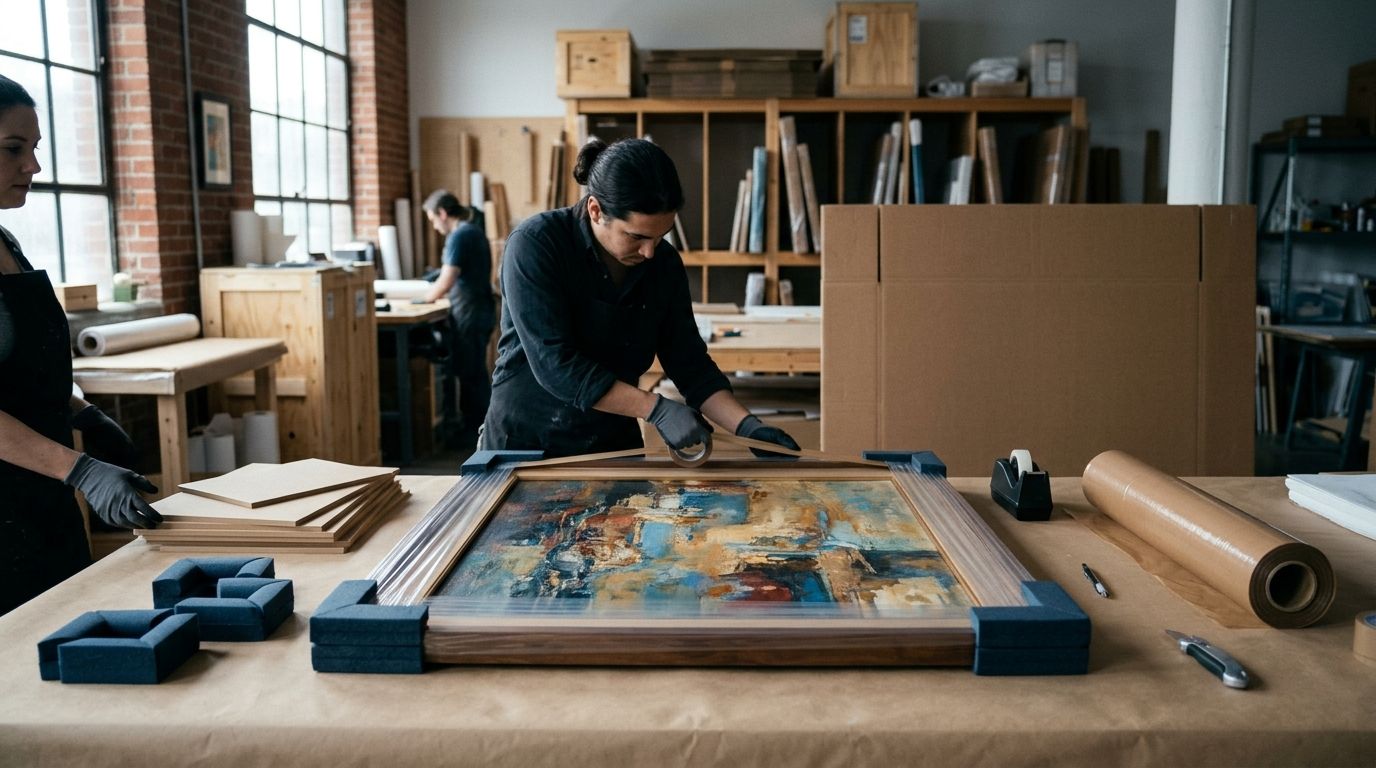
Lay closed-cell foam sheet or bubble wrap (bubble side out, away from the work) on a clean table, then a sheet of clean uncoated polyethylene large enough for an overlap of about 8 cm at the reverse. Cut rigid cardboard or corrugated board to the outer face of the frame; for better protection, score and fold the board so it wraps the sides without sagging onto the paint. Place the painting face-down on that board so the paint never meets cardboard. Add a second board on the reverse if you want a full cardboard “inner box,” filling edge gaps with non-abrasive material that cannot slip onto the surface.
Wrap the polyethylene tightly and tape every seam with carton tape folded back on itself for later removal. This sealed envelope lets the painting’s wood and canvas buffer short humidity swings, provided temperature stays fairly steady. CCI warns that if you expect temperature swings of more than a few degrees, add thermal insulation in the next layer. Mark front and back on the wrap. Add cushioned corner covers on fragile frames before the outer cushioning goes on.
Cushion, double-box, label and hand off
CCI’s cushioning guidance starts at 50 mm (2 in.) on all sides for many art shipments, rising to 75–100 mm for fragile items or high-hazard parcel networks. Parcel post may need 100 mm or more because of drop height. Use polyethylene foam (Ethafoam and similar) cut so the wrapped painting cannot migrate. Corners take the hits; protect them deliberately.
Slide the cushioned unit into a snug inner carton, then into a larger outer carton with another continuous foam or void-fill layer. Carrier damage claims often fail when the painting can rattle. Artists who ship regularly favour double-wall or tri-wall corrugated for the outer box. Specialized art cartons (Masterpak-style products) exist for mid-size framed works if you prefer a tested shell to improvisation.
Label orientation on multiple faces with arrows. Mark “glass” when relevant. Write unpacking notes: which face is front, whether laminated glass is taped, whether a travel frame must stay on until hanging. Photograph the packed exterior. For fine-art pickup, leave hanging hardware bagged and the condition report with the driver. For courier drop-off, choose a service with tracking, avoid weekend holds in hot or freezing vans when you can, and keep the tracking number with your photo set.
Unpack with the same discipline. Open the outer carton away from pets and clutter. Lift the painting by the travel frame or outer frame, never by the stretcher bar alone if you can avoid it. Compare the arrival state to your outbound photographs before you discard packing. Keep the materials for a return shipment when the sale or loan requires it. If you find new damage, stop handling, photograph it in place, and notify the carrier and insurer within their claim windows; do not attempt a home repair that destroys evidence.
If the route needs a wooden crate rather than a carton, stop DIY guesswork on high-value work and hire a crate shop. Travel frames, soft packs and full museum crates differ in cost and performance; the dedicated crate guide covers construction. ISPM 15 marks matter once wood crosses borders.
Materials and Specs That Earn Their Place
Buy materials for contact chemistry and mechanical performance, not for moving-day familiarity. The table below summarises common choices drawn from CCI wrapping and shipment notes, museum packing practice, and specialist shipper specifications. Thicknesses are starting points; raise them when the carrier network is rough or the object is fragile.
| Material | Typical use | Spec notes | Avoid / watch-outs |
|---|---|---|---|
| Glassine or acid-free tissue | Facing layer over paint or frame rebate | Unbuffered acid-free tissue preferred for buffering; glassine for short contact on stable varnish | Do not leave acidic kraft paper on paint; do not abrade soft media |
| Clean uncoated polyethylene (LDPE/HDPE), ~50–100 µm | Moisture and dust seal over cardboard sandwich | Tape should stick cleanly (oily “coated” film fails that test) | Never let poly touch paint without an interleaf |
| Closed-cell polyethylene foam (e.g. Ethafoam, Volara) | Corner pads, lining, 50–100 mm cushions | Volara for smooth non-abrasive contact; denser plank for mounts | Open-cell foam that holds moisture; foam that sheds grit |
| Bubble wrap | Outer cushion over sealed wrap | Bubbles face out; use over poly, not on paint | Direct contact with paint or delicate frames |
| Rigid corrugated / multiwall cardboard | Front/back boards; inner carton | Condition in the painting’s room ≥1 day when possible | Soft single-wall that sags onto the surface |
| Double-wall / tri-wall outer carton | Parcel-network shell | Size so foam stays compressed but not crushed | Oversize boxes that allow migration |
| Travel / HTS frame (plywood) | Unframed or fragile-frame works | Depth keeps wrap off paint; articulated fasteners preferred | Softwood that splinters; screws into canvas |
| Low-tack glass tape | Temporary shard control on annealed glass | Full coverage with pull tabs; remove soon after arrival | Leaving tape for weeks on coated glass |
| Stretch wrap | Holding boards and sealing outer layers | Over barrier layers, not as sole paint facing | Binding so tight that frames twist |
| Desiccant / vapour barrier | Longer sealed journeys | Place so packs never touch the object; follow shipper design | Random silica bags dumped on the face |
| Shock / tip indicators | Higher-value crates | Apply where handlers can see them | Treating indicators as a substitute for packing |
Two further CCI points belong beside the table. Typical packaging only buffers sudden temperature change for minutes to a few hours; when control matters, specify transport held roughly between 15°C and 25°C. For wooden crate interiors that will store works for long periods, paint with approved acrylic systems and allow about four weeks’ cure before use; avoid oil-based interiors that off-gas onto collections.
Edge Cases That Change the Method
Standard canvas-in-frame packing fails on several common objects. Change the plan rather than forcing the template.
Heavy impasto and soft acrylic surfaces. Texture that rises above the plane cannot take facing pressure. Use a deeper travel frame or slat/travel crate so materials bridge the high points. Acrylics and uniformly matte films mark easily; CCI flags them for zero finger contact.
Panel paintings and joined wood. Shock and humidity differentials open joints. Extra foam, orientation control, and often a specialist shipper are justified even at moderate values. Joined panels need more care than a single plywood panel of similar size.
Works on glass or ivory, and paint on metal. Adhesion and support fragility differ from canvas. CCI treats some glass-support paintings as questionable travellers. Get conservation advice before you book a courier.
Pastels, charcoal and unfixed drawings. Vibration sheds media. NPS packing notes exclude these from the basic framed method. A conservator may specify facing that never touches, or refuse courier travel altogether.
Oversized works. Door widths, stair turns and vehicle beds dominate the plan. Soft-pack and dedicated van often beat any carton. Measure the packed depth, not only the sight size.
Recent treatments and unstable paint. Fresh varnish, consolidant or structural work may need cure time before travel. If you are shipping a painting to a studio for treatment, ask the conservator how to support loose areas first.
House moves with many works. Batch packing, furniture trucks and storage layovers change labour and risk. Use the sibling guide on packing paintings for moving rather than repeating a single-piece courier method across a whole collection.
International legs. Export licences, customs values, ISPM 15 wood marks and airline holds add failure modes beyond packing. Keep this article’s methods for the physical wrap, then hand the route to international shipping.
What Professional Art Handlers Actually Do
A fine-art logistics team sells risk reduction, not cardboard. Expect a survey: dimensions including depth and weight, photographs of the reverse, questions about the framer, access at both addresses, and whether the work must stay vertical. Crown Fine Art’s crate guidance describes asking “unnecessary” questions that catch frame-versus-sight-size mismatches before a crate is cut.
In the warehouse, preparators build soft packs, travel frames or full crates from conservation-grade foams and timber. Cadogan Tate’s painting method typically mounts the work in a protective frame inside the crate so the paint film floats free of packing. Atelier 4 emphasises PACCIN-trained crate builders, climate-controlled trucks, air-ride suspension and handlers who often hold studio degrees. Vehicles may carry GPS logging and cargo alarms; shuttles consolidate museum and gallery freight on fixed city pairs.
On collection day, handlers condition-check against your report, photograph, pack on site or at the depot, strap the load so crates cannot tip, and deliver into a clean space for unpacking. Many quotes include installation. Access surveys matter as much as foam: a crate that fits the truck may not pivot on a landing. Crown’s technical writing makes that door-and-route check part of crate design, not an afterthought for the driver.
For loans between museums, registrars add courier accompaniment, seal protocols and venue-by-venue condition forms; the National Gallery of Art’s Art in Transit handbook remains the field reference behind those habits. Private collectors rarely need a full loan courier, but the same physics apply. A gallery sale across town may need only soft-pack and two handlers. A panel leaving a rural house for a coastal store may need a survey visit, a custom soft pack, and a climate-controlled vehicle booked around a heatwave.
Trade bodies such as ICEFAT link reputable firms across borders so a New York handler can hand to a London peer without reinventing packing standards. Ask any quote whether packing, transport, installation and transit insurance are itemised, and who holds the work overnight if a delivery window slips. Ask who builds the crate (in-house or subcontracted) and whether the quote assumes your packing or theirs.
What Shipping a Painting Costs
Prices move with size, distance, service level and season. Treat the bands below as planning ranges from public courier rate examples, UK art-courier marketing, and specialist commentary, not as quotes.
| Scenario | Typical service | Indicative cost band | Notes |
|---|---|---|---|
| Small unframed print or panel, domestic | Postal / economy parcel | About £15–£40 / US $20–$40 | Cover limits often low; packing still must be rigid |
| Framed painting ~40–60 cm, domestic ground | Courier with declared value | About £25–£80 / US $30–$100 before extras | Dimensional weight can exceed actual weight |
| Medium painting, UK art courier part-load | Specialist van shared with other art | About £60–£150+ | Handlers, not parcel hubs; route-dependent |
| Dedicated same-day fine-art courier (UK) | Exclusive vehicle | From about £50 upward; often higher for distance | Fuel, ULEZ, waiting time and two-person lifts add cost |
| Custom domestic crate + freight | Crate shop + carrier | Often US $200–$500+ freight alone for mid-size crates; crate build extra | Oversized and island routes cost more |
| White-glove fine-art door-to-door | Pack, transport, install | Hundreds to thousands | Value, stairs, crating and overnight storage drive the quote |
| Carrier declared-value add-on | Parcel liability increase | Roughly US $15–$20 per US $1,000 where offered (2026 FedEx fee schedules near that band) | Still subject to art caps and packing proof; not fine-art insurance |
Museum-grade names (Momart and peers) often start in the high hundreds for even modest jobs once packing labour is included. Shuttle shared loads sit between exclusive trucks and parcel rates. Always ask whether the price includes packing materials, stairs, congestion charges, waiting time and return of empty crates. A cheap line-haul that omits packing can cost more once you hire a second company to build the box.
Dimensional weight surprises courier users. Carriers bill by the larger of actual mass and a volume formula. A light painting in a deep foam carton can price like a heavy parcel. Measure the finished pack before you compare online rates. For US ground examples published by artists and fulfilment blogs, a small framed piece may land near US $20 to $30 before coverage, while a mid-size crated freight lane commonly lands in the low hundreds; treat those as order-of-magnitude checks against a live quote.
Budget separately for insurance. A home contents policy may exclude transit or cap art. Specialist transit or “nail-to-nail” cover is the usual fix for valuable works; details sit in the art insurance article. Under-declaring value to save premium is a common way to lose a claim.
When to Call a Conservator or a Shipper
Call a conservator before packing if you see unstable paint, tears, weak canvas, active flaking, a panel with open joins, soft media, or a painting fresh from treatment. CCI’s travel note is blunt: consolidate or refuse travel. A short studio visit costs less than a transit loss. For routine cleaning myths and when not to touch a surface, see the companion care guides in this series; treatment science sits elsewhere on the site.
Call a fine-art shipper when value, size, fragility or access exceeds a responsible DIY courier job. Stairs without lifts, crated works over a two-person lift, glazed antiques, and anything your insurer names as needing professional packing all qualify. Ask for ICEFAT or museum-client references if you are new to the vendor list.
Call both when a museum loan, estate dispersal or sale depends on condition at arrival. Registrars expect professional packing language and photo documentation. If a shipper’s surveyor refuses to take a work without conservation first, treat that as useful information, not as sales pressure.
You can pack a simple, sound painting yourself. You cannot undo a crushed corner on a sixteenth-century panel with better tape.
FAQ
How do I ship a painting with FedEx, UPS or Royal Mail?
Use only if the work is stable, modest in value relative to carrier art limits, and packed to survive hub drops: travel frame or sturdy frame, sealed wrap, rigid boards, 50–100 mm cushioning, double carton, orientation labels. Buy tracking. For FedEx, expect artwork extraordinary-value caps around USD 1,000 (or USD 1,000 / ~USD 9.07 per lb, whichever is greater) in many US and international tariffs, and Unique Item caps near £750 in UK/Europe guides; UPS and Royal Mail have separate limits. Photograph condition and packing. For glass, prefer laminated glazing or careful taping within the limits of your chosen method.
Is bubble wrap safe against the paint?
No. Keep bubble wrap outside a sealed polyethylene layer that itself sits over glassine, tissue or a spaced rigid board. Bubbles imprint varnish and pick up impasto. Closed-cell foam sheet is a better inner cushion when you need thickness beside the wrap.
Do I need a wooden crate?
Not for every domestic parcel. A well-built double-wall carton with thick foam can serve small, sound works on short routes. Use a crate for high value, heavy frames, international wood-pack rules, soft-pack limits, or any job a shipper specifies. Crate design depth lives in the art shipping crate guide.
How much does it cost to ship a painting UK to UK?
A small postal package may stay under £40. A shared art-courier run for a medium painting often lands around £60–£150 depending on mileage. Dedicated vehicles and museum-grade packing climb into the hundreds. Get written quotes with access notes; stair carries change the number.
Does declared value equal insurance?
No. Declared value adjusts the carrier’s maximum liability under its terms. Fine-art insurance is a separate contract that can cover nail-to-nail risk, subject to condition reports and agreed values. Read both documents; see art insurance.
Can I ship a wet or freshly varnished painting?
Wait until the surface is dry and stable enough that wrap cannot imprint or lift material. Ask the artist or conservator for a clear release-to-ship time. Rushing a wet painting into poly is a common way to glaze the paint film with texture it never had.
Should paintings travel flat or upright?
Prefer vertical orientation for most stretched canvases so the fabric does not rest on the paint film or press unevenly against stretcher bars. Pack and label so handlers keep that orientation. Panels and special constructions may need a shipper’s specified attitude; follow that instruction on every face of the crate.
What is the single most useful step before packing?
A dated condition report with clear photographs. Without it, you cannot prove pre-existing damage, and you cannot brief a shipper or conservator accurately when something goes wrong.
Galleries mentioned
Museums mentioned
Related reading

Rediscovering Morris and the Pre-Raphaelite Circle
How a Cambridge archive redefines Victorian craft and collaborative practice

Olga de Amaral: Weaving the Infinite
A transatlantic survey tracing six decades of textile innovation across architecture and craft.

A Rare Market Appearance: Hilma af Klint's Geometric Masterwork Heads to Stockholm
A tightly guarded abstract canvas enters the secondary market, challenging established price benchmarks and highlighting sustained institutional momentum.