
Exhibo Editorial
Shipping Art Internationally
Cross-border customs routes, ATA Carnets, UK export licences and Gulf import notes for exhibition and sale shipments
Shipping art internationally means treating the work as both cargo and a customs entry. Before the crate leaves, you decide whether the destination is temporary (exhibition, loan, fair) or permanent (sale, gift, relocation), then assemble the paperwork that proves identity, value, origin and legal export. Temporary routes often use an ATA Carnet so duties and import taxes stay suspended while the work returns within the allowed period. Permanent routes need a commercial invoice, correct HS classification, any cultural-property export licence, ISPM 15 wood marks on solid-wood packaging, and payment or accounting of destination duty and VAT where they apply. Carrier liability is not fine-art insurance. This is practical guidance, not legal advice; confirm thresholds and forms with the issuing authority and a licensed broker for your exact itinerary.
Domestic packing method, courier-versus-handler choice and foam thicknesses belong with how to ship a painting. Crate engineering belongs with the planned art shipping crate guide. Transit cover sits in art insurance. Deep cultural-property and restitution rules belong with the planned S8-12 piece; this article only flags where those rules stop a shipment. For the wider care cluster, start at the caring for art series hub; once works land in public collections, browse museums.
Why Borders Change the Job
A domestic move asks whether the painting survives shocks, vibration and humidity swings. An international move asks those questions and then asks whether a customs officer will release the crate. The painting becomes a declared commodity with a tariff heading, a value and a legal story about how it left one territory and entered another.
Three systems collide. Phytosanitary rules govern solid wood packaging under ISPM 15: untreated softwood crates can be refused, fumigated or destroyed at the border even when the art inside is fine. Cultural-property rules decide whether an object over a certain age and value needs an export licence from the country of departure. Fiscal rules decide whether the destination charges customs duty, VAT or both, and whether temporary admission or a free-zone hold can defer those charges. Miss any one and the work sits in a bonded warehouse while demurrage climbs.
Human process multiplies the risk. International consignments change hands at airports, trucking depots and bonded facilities. Fine-art shippers reduce those hand-offs; parcel networks multiply them. Customs may open a crate against the invoice list, so labels, seals and condition reports must survive inspection. Undervaluation to cut duty or carnet security invites delays and can clash with insurance written on a higher agreed value. Name artist, title, medium, dimensions, year, origin and a photo key on every line.
Temporary or Permanent: Decide Before You Pack
Choose the customs path before you book air freight. The path dictates documents, bonds, timelines and whether a sale abroad is even legal under the paperwork you hold.
Temporary admission covers exhibitions, museum loans, art fairs and previews where the work is expected to leave again within a fixed window. The standard instrument is the ATA Carnet (Admission Temporaire / Temporary Admission), issued by an authorised chamber of commerce and recognised across a large network of countries under the World Customs Organization’s temporary admission framework. A carnet suspends duties and import taxes for eligible uses, typically for up to twelve months from issue, provided every entry and exit is stamped and the goods return. US Customs and Border Protection’s carnet FAQs stress that the holder must present goods and carnet at export, foreign import, foreign re-export and home re-import; missed stamps can trigger claims of roughly 110% of the duty and tax that would have applied.
Permanent import covers sales, gifts, estate moves and any transfer of ownership that leaves the work in the destination country. You file a standard customs entry (or your broker does), pay or account for duty and VAT where due, and keep the commercial paperwork for audits. Original works classified under Harmonized System Chapter 97 often attract zero customs duty in the United States and the European Union, but VAT or sales tax still lands on many destinations. The United Kingdom taxes eligible art imports on a reduced valuation that produces an effective 5% import VAT under HMRC’s valuation rules.
Hybrid fair routes are common and fragile. Galleries ship to Art Dubai, Frieze or similar under temporary admission, then convert sold lots to permanent import while unsold works re-export on the carnet. That conversion needs a deliberate permanent entry; you cannot leave a sold work on a carnet. UAE exhibition manuals used by event logistics firms require duty and VAT regularisation on sold lines before carnet discharge.
Domestic transit after arrival follows the sibling shipping guide. This article stops at the border decision and the documents that clear it.
How an International Shipment Actually Moves
Think of the job as a sequence with gates. Physical packing sits inside that sequence; it does not replace it. A museum-grade soft pack still fails if the export licence is missing or the carnet list does not match the crate contents.
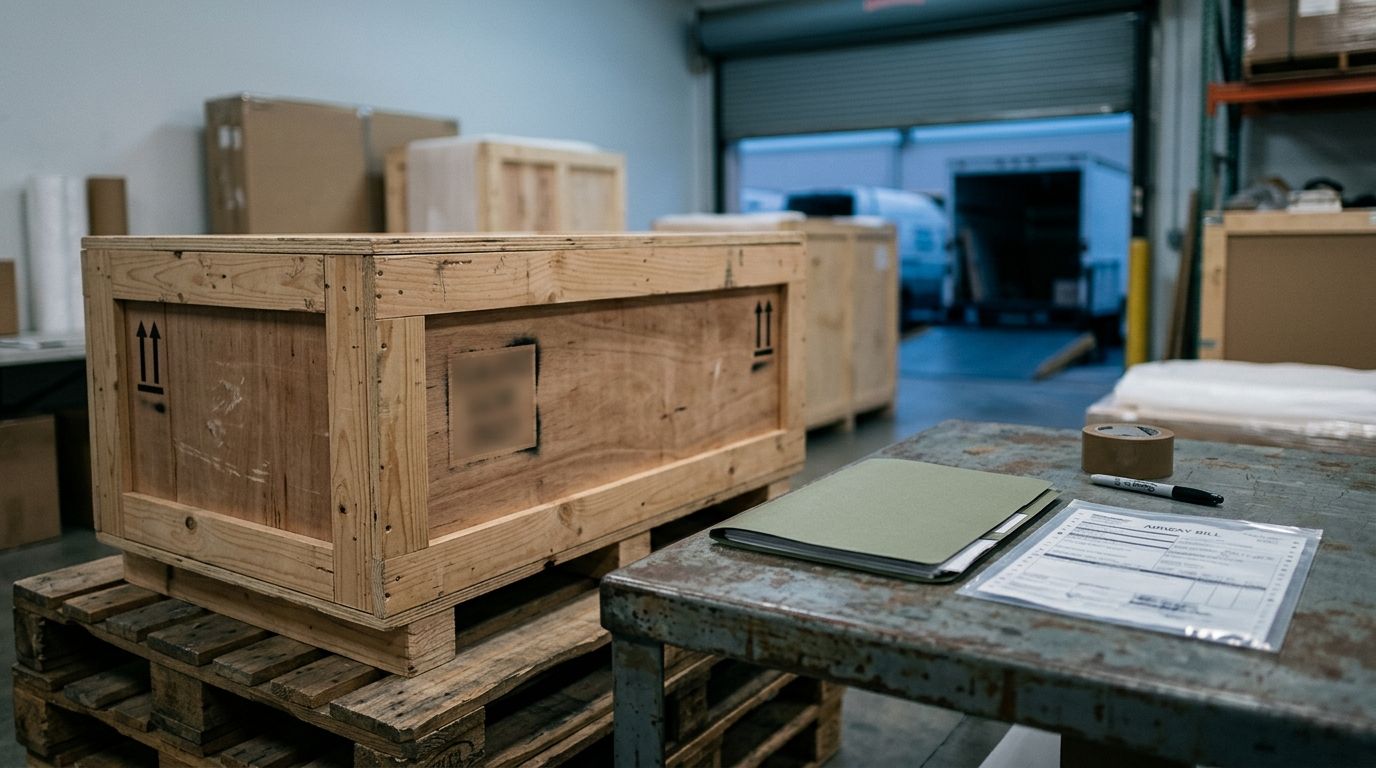
Start with a condition report and photographs of every face, including labels and existing damage. Agree an insurance value that matches the customs story, then instruct packing: soft pack for a dedicated art vehicle, travel frame plus carton for modest works, or a full wooden crate for air or sea freight. Solid wood thicker than 6 mm needs ISPM 15 treatment and the IPPC mark; plywood and other processed wood materials are generally exempt under the IPPC standard. Crate construction belongs in the crate article; unmarked softwood packaging invites border trouble.
Book the mode after the paperwork path is clear. Air freight dominates high-value art. Sea freight suits heavy sculpture when time allows. Road freight works inside the EU or for intra-GCC legs with climate control and brokers lined up. Hand-carries still need export permissions and destination import formalities.
Build the paper trail before the crate
Assemble a document pack that names the same object in the same words everywhere. The commercial or pro forma invoice lists seller and buyer (or lender and borrower), EORI or equivalent numbers where required, Incoterms if used, and a line for each work: artist, title, medium, year, dimensions, country of origin, HS code and value. Fine-art shippers such as Fine Art Shippers treat that descriptive density as non-negotiable for clearance. A packing list mirrors the invoice and adds crate marks, weights and photograph references. Certificates of authenticity, appraisals and provenance notes travel as supporting files, not as substitutes for the invoice.
For UK departures of cultural goods, check Arts Council England’s Export Licensing Online portal and the Open General Export Licence (OGEL) age and value tables before you assume a free exit. For US returns of temporary exports without a carnet, CBP Form 4455 registration before departure helps prove the work left the United States so re-entry is not treated as a new dutiable import. For EU and UK permanent imports, classify under Chapter 97 headings (9701 paintings and drawings executed by hand, 9702 original prints, 9703 sculpture, 9706 antiques over 100 years) and confirm whether reduced VAT treatments apply.
Book the carnet, export licence or temporary bond early. LCCI’s ecarnet process can issue quickly once security is arranged, but multi-country itineraries and high values slow security pricing. Arts Council individual licences take longer when expert advisers review national importance. Build calendar slack around Ramadan, major fairs and public holidays at Gulf and European ports.
Clear exit, transit and entry in order
At departure, the export declaration references any cultural licence or OGEL claim, the carnet if used, and the transport document (air waybill or bill of lading). Present the carnet for export endorsement. Photograph sealed crates and keep seal numbers with the paperwork.
In transit, avoid splitting a carnet consignment across multiple master air waybills when destination rules forbid split carnet entries; UAE guidance for exhibition freight has long warned that partial carnet shipments under one master waybill create stamping problems. Keep the original carnet with the courier or broker who will stand at each desk.
At arrival, the importer of record or broker presents the entry. Temporary goods enter under carnet or local temporary admission with a guarantee. Permanent goods clear with duty and VAT calculated on the customs value, usually price plus freight and insurance where the valuation method requires it. Inspect the work against the outbound condition report before you sign for delivery. If customs opened the crate, note that in writing and re-secure packing before onward road transport.
Re-export closes the loop. Stamp the carnet on exit. Keep copies of every voucher. Discharge security only after the issuing chamber confirms clean return. Permanent imports keep invoices and entry numbers for the retention period your tax authority demands.
Documents and Materials That Travel with the Work
The table below is a working checklist drawn from chamber carnet guidance, Arts Council and GOV.UK export notes, HMRC valuation manuals, ISPM 15, US CBP carnet FAQs and fine-art shipper document lists. Requirements vary by corridor; treat rows as planning prompts, not as a universal legal schedule.
| Document or material | Typical use | Who issues / supplies | Watch-outs |
|---|---|---|---|
| Commercial or pro forma invoice | Permanent sale or temporary loan valuation | Shipper / gallery / owner | Vague “mixed artworks” lines; values that contradict insurance |
| Packing list with photo keys | Customs inspection match | Shipper | Crate marks that do not match list numbers |
| ATA Carnet | Temporary exhibition / fair / loan in member countries | National chamber (e.g. LCCI in the UK) | Missed stamps; sales left on carnet; wrong Box C purpose |
| Temporary importation bond / local TA | Temporary entry where carnet unavailable | Destination customs via broker | Cash locks and short re-export windows |
| UK cultural export licence or OGEL claim | Export of qualifying cultural goods from GB | Arts Council England / OGEL self-use | Age/value thresholds; NI vs GB differences |
| Destination import permit / content approval | Restricted media, antiquities, heritage categories | Ministry / media / culture body | Antiquities and archaeological material |
| HS / commodity code (often Ch. 97) | Duty and VAT treatment | Broker / classifier | Misclassifying reproductions as originals |
| Air waybill / bill of lading | Transport contract and tracking | Carrier / forwarder | Carnet number omitted from AWB remarks |
| ISPM 15 marked wood packaging | Solid wood crates, pallets, dunnage >6 mm | Registered treatment facility | Unmarked softwood; treating ISPM as optional |
| Condition report and photo set | Claims and inspection baseline | Owner / registrar / shipper | Photos taken only after damage appears |
| Insurance certificate (nail-to-nail or transit) | Financial risk cover | Fine-art insurer | Assuming carrier declared value equals a policy |
| Certificate of origin (where required) | Preferential or Gulf documentary practice | Chamber of commerce | Mismatch with invoice origin statements |
| Power of attorney / broker appointment | Broker files entries in your name | Importer of record | Unsigned POA at a busy fair weekend |
International legs usually justify professional packing once value or fragility rises; the physical method remains the domestic guide’s facing, sealed wrap, rigid shell and cushioning. Specify climate control, vapour barriers and apron time in the shipper brief rather than improvising desiccants against paint.
UK Export Licences and Parallel Controls Abroad
If the work leaves Great Britain, cultural export control can apply even when the buyer is a private collector and the sale feels ordinary. GOV.UK guidance is blunt: you need a UK export licence to export objects of cultural interest from Great Britain to any destination outside the UK. Arts Council England administers the system for the Secretary of State for Culture, Media and Sport through Export Licensing Online.
Age and value decide the paperwork. Objects over fifty years old that sit at or above the OGEL value threshold for their class need an individual licence unless another open licence covers them. For paintings in oil or tempera (excluding portraits of British historical personages), the long-standing OGEL text sets that threshold at £180,000. Other classes (drawings, prints, textiles, archaeological material) use different figures. Always open the current OGEL PDF on the Arts Council site before you ship; thresholds and wording are revised. Temporary exports can still need licences. National importance review can delay or refuse a permanent export even after an application is lodged.
Northern Ireland follows different paths for some EU-related movements, with Arts Council still in the licensing seat. Moving cultural objects from Great Britain to Northern Ireland does not itself require the GB export licence used for third-country exits. From 28 June 2025, however, some movements into Northern Ireland from Great Britain can still need an EU-style import licence, importer statement or temporary-admission exemption under the Import of Cultural Goods rules administered for NI by Arts Council. If your itinerary threads NI, GB and the EU, get written confirmation from Arts Council rather than improvising from forum posts.
Other departure countries run their own regimes with age and value tests that do not match the UK tables. The United States generally does not mirror the UK’s broad painting licence system for contemporary exports, but archaeological and ethnological material can face cultural-property import restrictions at the US border. UNESCO 1970 illicit-traffic rules shape scrutiny everywhere; complete provenance for older works is risk management, not optional biography.
When the object is archaeological, ethnographic, or older than a century with thin paperwork, take specialist advice before you book freight. The planned cultural-property deep dive (S8-12) holds that detail.
Using an ATA Carnet for Exhibitions and Loans
An ATA Carnet is a passport for goods. One document, backed by a national guaranteeing association in the ICC World Chambers Federation chain, lets you enter and leave participating countries without paying import duty and tax up front for eligible temporary uses. Fine art for exhibitions and fairs sits squarely in the classic use case. Professional equipment for installation can travel on the same logic when the itinerary and category allow it.
Issuing fees are modest relative to high-value art; security is not. UK applicants commonly use London Chamber of Commerce and Industry’s ecarnet system. Published 2026 LCCI price lists put standard issuing fees around £270 including VAT for members and £444 including VAT for non-members, with express surcharges on top. Security comes as a refundable deposit, a bank guarantee, or a non-refundable Carnet Security Scheme premium priced from value, goods type and countries visited. US applicants use USCIB-appointed providers on the same fee-plus-security pattern. Complete files can issue in a couple of business days; museum-level security takes longer.
What a carnet covers and what it forbids
Eligible categories typically include goods for display at exhibitions and fairs, commercial samples and professional equipment. Consumables, goods intended for sale as the primary plan, and postal traffic (in many jurisdictions) fall outside. Qatar’s temporary-entry commercial guide states that Qatar accepts carnets for exhibitions and fairs only; Box C must name the exhibition and venue. UAE temporary-entry guidance likewise centres exhibitions, fairs and similar events, and notes that partial shipments are not accepted under the ATA Carnet system.
You must re-export within the period customs endorse, and in any case within the carnet’s validity (normally one year from issue). Selling a work while it sits on a carnet ends temporary treatment for that line: pay the destination’s permanent import charges and remove the item from the live carnet list under the procedure your broker and the guaranteeing association specify. Using a carnet does not waive export licences. Arts Council and chamber FAQs both warn that carnets and cultural licences are separate obligations.
Stamping discipline and common failure modes
Every border crossing needs the right voucher presented with the goods. Skipped home export stamps complicate return. Skipped foreign exit stamps look like the goods stayed abroad, which is when guaranteeing associations face claims. Keep the carnet with the person clearing each airport; never pack the only original inside a sealed crate.
List paintings so an officer can identify them: medium, title, artist, year if known, dimensions and marks. Generic “ten mixed canvases” invites detention. Mirror those lines on crate labels and the packing list. List every country at application so enough sheets exist.
When a carnet is unavailable, use local temporary admission with a cash or bank guarantee. Those programmes lock capital and rarely match multi-country carnet flexibility. Permanent import of a fair booth “to keep it simple” can mean paying VAT on works that leave unsold two weeks later.
Gulf Routes: UAE, Qatar and Saudi Arabia
Gulf destinations reward itinerary-specific planning. Duty schedules often look similar (commonly 5% on many permanent art imports in GCC practice), yet VAT, carnet acceptance, free-zone holds and content review change the real cost. A painting that clears Dubai under temporary admission is not automatically cleared for Riyadh or Doha; each border resets the fiscal clock and the documentary checklist. Dubai often acts as a regional hub for air cargo and climate-controlled road onward moves, but that only helps when the first UAE entry regime matches the final plan. A mainland permanent import into Dubai followed by an afterthought truck to Saudi Arabia can mean paying UAE charges and then facing Saudi duty and 15% VAT without the cash-flow relief a carnet would have given for a pure exhibition tour.
Treat the notes below as research snapshots for UAE, Qatar and Saudi Arabia, not as a substitute for a local broker’s live checklist. Portals, fee schedules and content-review practice shift with fair seasons and ministry circulars. Verify before you print the AWB.
UAE: free zones, temporary admission and new virtual warehouse rules
Permanent imports into UAE mainland customs territory commonly attract 5% customs duty plus 5% VAT on the dutiable base, subject to classification and exemptions your broker confirms. Goods landed and held inside a fenced Designated Zone (customs-controlled free zone) typically sit duty-suspended until they move to the mainland; that distinction matters more than whether your company holds a free-zone trade licence. Service zones inside customs territory do not give the same suspension.
Temporary admission for exhibitions has long used ATA Carnets or local temporary entry with guarantees. US Commercial Service notes on UAE temporary entry record carnet processing at Dubai cargo and airport customs centres, with overtime service charges outside normal hours, and restate that partial shipments are not accepted under the carnet system. Exhibition shipping manuals used in Dubai often set re-export clocks (commonly up to six months under carnet practice in those manuals) and warn that re-exporting carnet goods onward to other GCC states can force duty settlement in the UAE first.
From 1 April 2026, Dubai Customs’ Virtual Warehouses Initiative added an art-focused temporary admission track. Gulf News and trade briefings describe duty and guarantee relief on temporary artwork imports in the initial phase, a three-year duty suspension window cited for private artworks, digital tracking and fewer geographic holding restrictions than older bonded models. Enrolment runs through Dubai Customs’ digital channels. Ask your broker which product codes and importer profiles qualify; do not assume every painting is covered.
Content and heritage overlays still apply. Contemporary gallery material usually clears; antiquities need culture-ministry attention and durable provenance. Flag sensitive subject matter early rather than discovering a hold on the apron.
Qatar and Saudi Arabia: duty, VAT and carnet notes
Qatar accepts ATA Carnets through Qatar Chamber, with WCO and US Commercial Service notes limiting acceptance to exhibitions and fairs. Permanent import costs often look favourable relative to high-VAT neighbours when VAT is not charged on the art, but confirm duty and tax with Qatar Customs for the exact tariff line; secondary summaries disagree on whether a 5% duty always applies to original paintings. Heritage and museum-grade imports still attract institutional attention.
Saudi Arabia combines 5% customs duty with 15% VAT on many permanent imports, which makes temporary admission valuable for touring shows. Federation of Saudi Chambers materials record ATA accession from 1 June 2024, with exhibition coverage and late re-export penalties. Brokers work through ZATCA’s FASAH environment; Arabic item lists help while procedures bed in. Ministry of Culture approval matters for cultural content and archaeological material. US Commercial Service restricted-import notes flag archaeological artifacts for special approval and list prohibitions that can catch figurative work if descriptions are careless.
Intra-GCC road moves look short on a map and long at the border. Budget climate control in summer, broker attendance at each crossing, and extra days around Eid. Consolidating through Dubai only helps when the UAE entry method matches the onward plan.
Edge Cases That Break a Standard Plan
Works that may sell at a fair. Design the temporary regime knowing conversion is likely. Pre-agree with the broker how sold lots move to permanent entry, how VAT is calculated, and how the carnet list is amended without stranding unsold works.
Hand-carried paintings in passenger baggage. Still an export and an import. Licences, invoices and carnet stamps apply. Airlines and security screening add their own wrapping rules; soft pastel and thick impasto suffer in overhead bins.
Multi-country tours on one carnet. List every country at issue. Confirm each destination accepts the category you need. Qatar’s fair-only rule can break a “professional equipment” mental model copied from a European tour.
Antiquities, archaeological objects and ethnographic material. Export and import permits dominate. Provenance gaps stop shipments. This is the fence edge for S8-12; do not improvise.
Sanctioned territories and restricted parties. Screen counterparties and routes. Cultural goods are not exempt from sanctions compliance merely because they are art.
Freshly imported works re-exported quickly. Keep the first entry paperwork; proof of prior customs status prevents double taxation fights on the way out.
Split consignments. Some Gulf carnet practices forbid splitting one carnet list across multiple master waybills. Ship together or issue separate regimes.
Owner’s baggage versus cargo. Changing mode mid-plan without rewriting documents creates mismatches between AWB, carnet and licence.
Insurance written on a different value than customs. Align figures or document why they differ (for example, agreed insurance value versus sale price) so a claim file does not contradict an entry.
What Brokers and Fine-Art Shippers Handle
A licensed customs broker files entries, calculates duty and VAT, posts bonds, argues classification and attends exams. A fine-art shipper packs, crates, books specialist freight, supplies handlers and often subcontracts brokerage. Museum-facing firms (Momart, Cadogan Tate, Crown Fine Art, Atelier 4 and ICEFAT peers) sell the combination: condition-aware packing plus a customs desk that has cleared fairs before.
Expect a survey of dimensions, weight, access, itinerary purpose and whether sales are possible. The quote should itemise packing, materials, freight, agency, storage, installation and tax advances. Ask who stands at customs with the carnet, whether wood is ISPM 15 marked, how sold fair lots convert, and who holds the work if a truck misses a slot.
Registrars on museum loans add courier accompaniment, seal protocols and venue-by-venue condition forms. Private collectors rarely need a full loan courier, but the same document discipline applies. Galleries shipping booth inventory should fix one importer-of-record strategy per country rather than changing consignee on each AWB.
An ICEFAT member in London handing to a member in Dubai keeps packing and claim cultures aligned. For Gulf content review and Arabic paperwork, a local agent with culture-ministry experience saves days a general forwarder would spend on your demurrage clock.
What International Art Shipping Costs
Prices move with value, size, mode, service level and tax. The bands below are planning ranges assembled from chamber fee cards, public shipper commentary and published duty/VAT frameworks. They are not quotes.
| Cost element | Indicative band | Notes |
|---|---|---|
| ATA Carnet issuing fee (UK LCCI, 2026 list) | About £270 member / £444 non-member incl. VAT | Express extra; security separate |
| Carnet security (CSS or deposit) | Often tens of percent of value as locked capital, or a priced CSS premium | Driven by countries and duration |
| Export licence application time | Staff time; possible delayed sale | Expert referral can stall permanent exports |
| Soft pack + air freight, mid-size painting, Europe to US | Low thousands of pounds/dollars upward | Fuel, security surcharges, peak fair weeks |
| Custom ISPM crate + air art freight | Crate hundreds to thousands; freight on top | Oversize and exclusive use jump |
| White-glove international door-to-door | High hundreds to many thousands | Access, installation, storage, escorts |
| UK effective import VAT on eligible art | Effective 5% via reduced valuation | Confirm HMRC eligibility and classification |
| UAE permanent import fiscal stack (typical planning figure) | About 5% duty + 5% VAT | Free-zone / TA / virtual warehouse may defer |
| Saudi permanent import fiscal stack (typical planning figure) | About 5% duty + 15% VAT | Carnet valuable for exhibitions |
| Broker agency and exam attendance | Hundreds upward per clearance | Overtime and storage extra |
| Demurrage / bonded storage after a paperwork fail | Daily charges that dwarf foam costs | Budget contingency days |
Dimensional weight and security surcharges punish deep crates. Shared art shuttles on heavy city pairs can undercut exclusive charters. Tax often exceeds freight on permanent imports into high-VAT jurisdictions; a Saudi permanent import can owe more in VAT than in air charges. Temporary admission exists to avoid that when the work will leave.
Budget insurance separately. Nail-to-nail cover sits in art insurance. Under-declaring to customs while over-insuring for a claim invites fiscal and coverage problems.
When to Call a Customs Broker or Fine-Art Shipper
Call a customs broker when the itinerary includes temporary admission, a carnet, a cultural export licence, a free-zone or virtual-warehouse hold, a fair sale conversion, or any destination where you are not the experienced importer of record. Brokers earn their fee on the first avoided exam delay.
Call a fine-art shipper when value, fragility, size or institutional counterparties exceed a responsible self-packed cargo shipment. International parcel services remain a poor default for unique works once customs exams and hub handling enter the picture. If your domestic decision tree already pointed to a specialist in the sibling shipping guide, keep that specialist for the cross-border leg.
Call both, early, when museums, biennials or ministries sit on either end of the loan form. Call both when the object is old enough for export control or sensitive enough for content review. Call a conservator before any of them if the surface cannot survive travel; international paperwork will not mend flaking paint.
You can learn the vocabulary of carnets and OGEL thresholds from open government pages. You cannot stamp a carnet from your kitchen table while the crate sits airside in another time zone.
FAQ
Do I need an ATA Carnet to ship a painting abroad?
Only for eligible temporary imports into participating countries when you want duties and import taxes suspended while the work returns. Permanent sales use ordinary customs entries. Some destinations offer local temporary admission with guarantees when a carnet is unavailable or unsuitable. Confirm category acceptance (for example, Qatar’s exhibitions-and-fairs focus) before you apply.
Does a carnet replace a UK export licence?
No. Arts Council cultural export licensing and ATA Carnets answer different questions. A carnet moves temporary fiscal treatment; a licence authorises export of controlled cultural goods. You may need both.
What HS code do paintings use?
Many original paintings and drawings executed by hand fall under heading 9701, with related headings for original prints (9702), sculpture (9703) and antiques over 100 years (9706). Classification drives duty and VAT treatment. Ask a broker to confirm the tariff line for your exact object and destination; reproductions and decorative manufactures often fall elsewhere.
How does UK import VAT work on art?
Eligible works of art, antiques and collectors’ items can be valued for import VAT on a reduced basis under HMRC rules, producing an effective 5% rate when the standard rate is applied to that reduced value. Eligibility depends on statutory definitions and tariff classification. Check current GOV.UK valuation guidance for your entry.
Can I sell a work that entered on a carnet?
Yes, but you must convert that item to a permanent import under local rules, pay duty and tax due, and adjust the carnet so the sold piece is no longer treated as temporarily admitted. Leaving a sold work on an open carnet is how exhibitors generate claims and penalties.
What is different about shipping art to Dubai or the wider Gulf?
Expect a mix of 5% duty norms, destination VAT that ranges from none (in some planning scenarios for Qatar) to 15% (Saudi Arabia), carnet acceptance that now includes Saudi Arabia alongside UAE, Bahrain and Qatar, free-zone duty suspension in UAE Designated Zones, and Dubai’s 2026 virtual warehouse temporary-admission track for qualifying art. Content and heritage reviews apply. Use a regional broker.
Is ISPM 15 required for art crates?
Solid wood packaging thicker than 6 mm in international trade generally must be treated and marked under ISPM 15. Processed wood such as plywood is typically exempt. Unmarked softwood packaging is a common cause of border delays. See the crate guide for construction detail.
Should I ship with a parcel courier internationally?
Only for low-value, sturdy works where you accept hub handling and limited liability, and where customs brokerage is arranged. Unique or high-value art usually belongs with a fine-art shipper and a broker. Packing standards still follow the domestic how to ship a painting method when you do use a courier.
Galleries mentioned
Museums mentioned
Exhibitions mentioned

Related reading

Rediscovering Morris and the Pre-Raphaelite Circle
How a Cambridge archive redefines Victorian craft and collaborative practice

Olga de Amaral: Weaving the Infinite
A transatlantic survey tracing six decades of textile innovation across architecture and craft.

A Rare Market Appearance: Hilma af Klint's Geometric Masterwork Heads to Stockholm
A tightly guarded abstract canvas enters the secondary market, challenging established price benchmarks and highlighting sustained institutional momentum.