
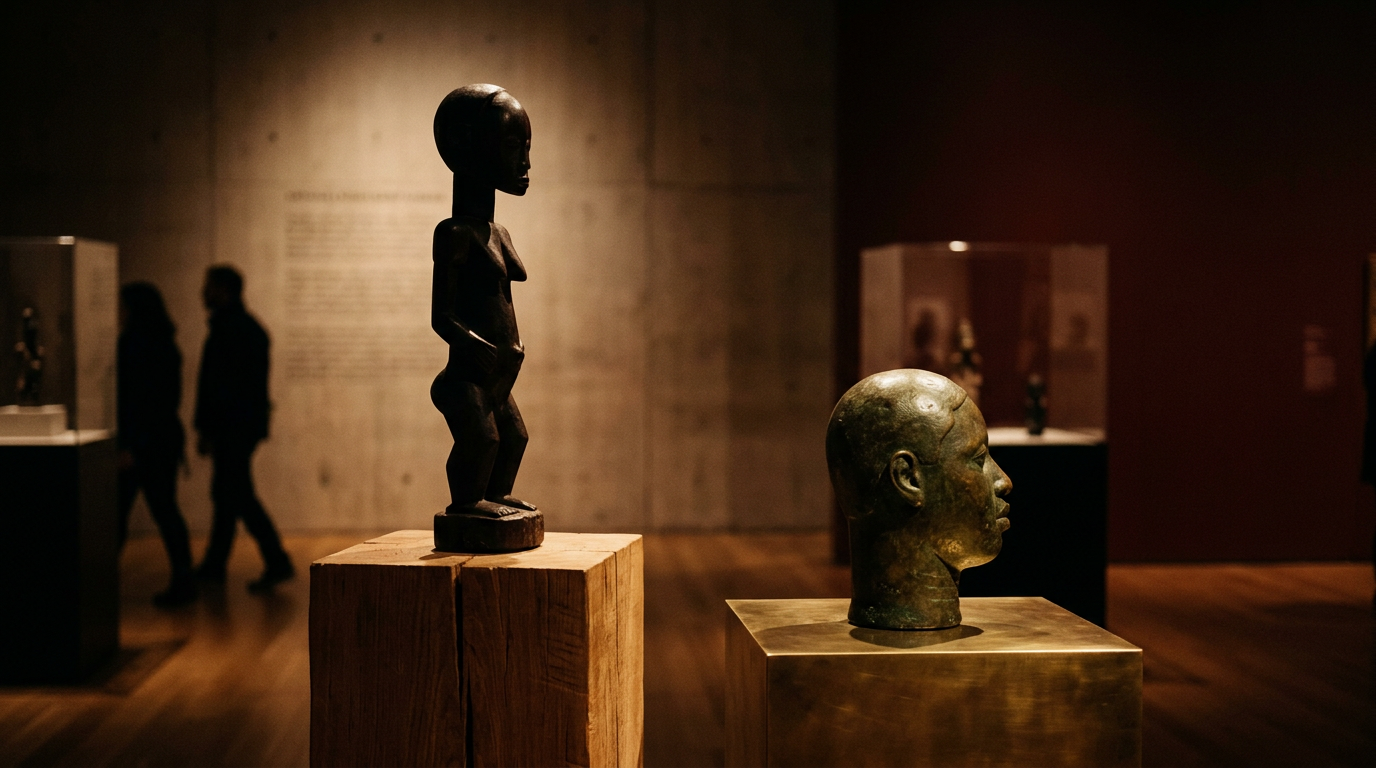
Exhibo Editorial
African Art, Explained
Named West, Central and southern African traditions in museum collections, from Nok terracotta to Benin brass and Kongo power figures.
African art, in the sense museums and survey courses use the phrase, names the sculpture, metalwork, ceramics, textiles, architecture and performance-related objects made by the many peoples of the African continent across millennia. The label is a teaching convenience. It does not describe one style, one religion or one timeline. A Benin brass plaque cast for an Edo palace, a Dogon wooden ancestor figure from the Bandiagara escarpment in Mali, and a soapstone bird from Great Zimbabwe answer different briefs for different courts and communities. Treating them as samples of a single “African look” flattens what makers and patrons cared about.
This article stays with historical traditions documented in archaeology and museum scholarship: court brass and terracotta in southern Nigeria, Yoruba shrine and palace sculpture, Kongo power figures, Dogon and Bamana wood carving, Akan goldweights, and southern African stone architecture. Dates lean on Metropolitan Museum of Art Heilbrunn and exhibition essays, British Museum collection histories, and related institutional catalogues. Contemporary biennial circuits, living studio careers and city art scenes sit outside this fence. Technique detail for metal casting belongs in the sibling guide to lost wax casting. Broader world-context reading sits in the World Art Traditions series hub; the survey of Japanese art carries another regional deep cut. Collections holding related material appear across the museums directory.
What the phrase “African art” covers
Museum departments that title themselves Arts of Africa mean visual cultures south of the Sahara, with ancient Nile valley material often housed under Egyptian or Sudanese programmes. The Metropolitan Museum’s Rockefeller Wing framing stresses oral transmission of knowledge, archaeological recovery and the study of roughly three thousand languages as routes into a past as layered as any Eurasian one. Rock paintings in southern Africa, Nok terracotta in central Nigeria, Swahili coral architecture on the Indian Ocean coast and Asante gold regalia in Ghana do not share a workshop grammar. They share a continent and a modern museum category built in the late nineteenth and twentieth centuries.
Western collectors and ethnographers coined the category under colonial rule. Early labels spoke of “primitive,” “tribal” or “negro art,” words that sorted objects by supposed evolutionary stage rather than by kingdom, guild or shrine. Those words still haunt older wall texts and auction catalogues. Current museum practice prefers named peoples, places and functions: Edo brass-casters of Benin City, Yoruba carvers for Ifa and orisha cults, Kongo sculptor and nganga pairs who activate minkisi. That shift matters for you as a reader. Attribution to a people and a use case is the starting point; a continental adjective comes second.
Survival bias shapes the gallery. Wood, fibre and hide decay in tropical climates. Brass, terracotta, stone and ivory travel better into European and American storerooms. Palace programmes that stored metal in quantity, such as Benin, dominate textbook images. Ephemeral masquerade costumes and mud architecture survive as photographs, reconstructions or living practice rather than as the same object you meet behind glass. When a handbook says sculpture is central to “African art,” it often means sculpture is what colonial collecting and climate left most visible.
Conditions that produced these arts
Trade and state formation funded many of the works now in museums. From the eighth century CE, Saharan caravans moved gold, ivory and captives between West African interiors and Mediterranean markets. Camel routes linked the Niger bend to North Africa and southern Europe. Coastal Atlantic trade after Portuguese landfalls in the fifteenth century reoriented gold, ivory, pepper and, later, enslaved labour toward European forts such as Elmina on the Gold Coast. Indian Ocean monsoon routes tied Zimbabwean plateaus to Kilwa, the Persian Gulf and Chinese ceramics. Court workshops sat on those flows. Brass entered Benin partly as Portuguese manillas; Akan goldweights measured dust for internal and coastal exchange.
Iron technology underwrote settlement density in parts of West Africa centuries before many European viewers assumed metallurgy arrived from outside. The Frankfurt Nok Project dates Nok culture in central Nigeria from around the mid-second millennium BCE into the last centuries BCE, with iron furnaces attested by the first millennium BCE and large terracotta production peaking roughly 900–400 BCE. Later city-states at Ile-Ife and Benin City built on older metallurgical and figurative habits even where direct workshop continuity remains debated. In southern Africa, Mapungubwe and then Great Zimbabwe (eleventh to sixteenth centuries in Metropolitan Museum teaching ranges) channelled gold, ivory and cattle wealth into dry-stone capitals linked to Indian Ocean ports.
Religion and kingship gave objects jobs. Commemorative brass heads in Benin honour predecessors of the oba. Yoruba shrine sculpture houses or mediates orisha presence. Kongo minkisi hold medicines that a ritual specialist activates for healing, dispute or protection. Luba royal stools and lukasa memory boards encode lineage and political knowledge for specialist readers. Dogon figures and masks participate in funerary and association rites on the Bandiagara cliffs. Form follows brief: a figure’s abdomen may carry a mirror pack because the medicines sit there; a Benin head’s coral-bead collar signals rank more than likeness.
Violence and extraction also shaped what you see. The British punitive expedition of 1897 against Benin City removed thousands of palace objects that now sit in more than a hundred institutions. French and Belgian campaigns in Central Africa filled European ethnographic museums with Kongo and Luba sculpture. Missionaries bought or confiscated masks as converts left older associations. The Met’s Africa galleries place Atlantic slavery and colonial occupation beside trade admiration. Any honest survey has to hold both: high technical achievement and the plunder or coerced sale that stocked Western collections.
Materials, workshops and how objects worked
Wood remains the most familiar African sculptural medium in Western galleries: relative softwoods carved with adzes and knives, surfaces darkened by oil, smoke or handling. Hardwoods take finer detail. Many figures leave the carver incomplete until a ritual specialist adds medicines, nails, cloth, beads or pigment. Museum labels that credit only “artist” miss that second author. The Met’s Kongo nkisi entries name sculptor and nganga as collaborators.
Clay supports both utilitarian pottery and ambitious figurative programmes. Nok and Ife terracottas show that fired earth carried elite and ritual imagery long before metal editions. Women often dominate pottery traditions in Yoruba and related societies; men work wood, stone and metal in many regions, though collaborative casting teams mix skills. Metalwork ranges from lost-wax brass and bronze to forged iron and hammered gold. Benin and Ife casters built wax models over clay cores, invested them, burned out the wax and poured molten alloy. For process stages, chase work and foundry logic, see How a Bronze Sculpture Is Made, which treats Benin brass beside Mediterranean and modern European practice.
Ivory, beadwork, textile appliqué and coral entered court display as prestige materials. Asante stools blackened with soot become ancestral seats. Dahomey palace bas-reliefs in earth and fibre, and Yemadje family appliqué banners, recorded royal history on walls and cloth. Architecture belongs in the same conversation: adobe mosques at Jenne and Timbuktu, coral-stone Swahili houses, and Great Zimbabwe’s dry-stone enclosures are designed environments, not backdrops for portable art.
Masquerade complicates the static object. A wooden face in a case once sat on a dancer’s head with raffia, costume, music and restricted sightlines for initiates. Bamana Ci Wara headdresses, Dogon masks of the Awa association and many Yoruba gelede or egungun ensembles only complete their meaning in motion. Museums can show carving quality; they cannot reconstruct the night.
West African court and city sculpture
Southern Nigeria concentrates several of the traditions Western textbooks cite first. That concentration reflects archaeology, palace archives and the density of metal and terracotta survival, not a claim that West Africa stands for the continent. Tin mining, colonial photography and post-independence national museums made Nok and Ife visible to global scholarship earlier than many forest or highland arts farther afield. Benin’s 1897 dispersal then flooded European cases with brass that teachers could photograph and compare. The sequence below runs from early terracotta through Ife naturalism to Benin court brass and Yoruba shrine carving as documented before and during the colonial era. Read each block as a local system of patronage and belief. Trade with the Sahara and later with Atlantic forts funded workshops without turning every court into a copy of its neighbour. Dates and attributions follow Metropolitan Museum and British Museum teaching ranges where those institutions publish them.
Nok terracotta and Ife heads
Tin miners in Kaduna State rediscovered Nok terracotta in 1928. Early finds went to Nigeria’s National Museum. Frankfurt radiocarbon and pottery work revised older mid-first-millennium BCE brackets: an early Nok phase from about 1500 BCE, a main figurative and iron-using phase around 900–400 BCE, then decline toward the turn of the Common Era. Human figures show triangular eyes with perforated pupils, elaborate coiffures and beadwork. Animals and hybrids appear too. Scholars read many deposits as linked to burial practice. Outside Egypt, Nok is the earliest large figurative sculptural tradition yet established in sub-Saharan Africa. Later Ile-Ife workshops may have drawn on related habits of clay skill even without a continuous named school.
Ile-Ife, sacred city of Yoruba tradition and centre of a powerful city-state between roughly the twelfth and fifteenth centuries, produced terracotta and a smaller corpus of copper and brass heads of startling naturalism. Vertical facial striations on many pieces may mark scarification. Crowns and beadwork signal royal or elite status. The British Museum’s brass head from the 1938 Wunmonije Compound find (often dated 1300–1450) shows a calm, idealised ruler type. Early European reactions refused African authorship and floated Greek or Atlantis fantasies; those claims have collapsed under archaeology. Kimbell Art Museum and Metropolitan Museum essays treat Ife terracotta as a first medium for the naturalistic style later transferred to metal. Women clayworkers and male metalworkers may have collaborated on cast pieces.
Benin brass and the palace programme
The Kingdom of Benin (Edo, in present-day southern Nigeria) maintained a brass-casting guild, the Igun Eronmwon, under royal patronage. From the fourteenth-century dynasty still claimed by Benin City’s court, each new oba commissioned commemorative heads for his predecessor. Heads idealise kingship: coral-bead collars, crowns and facial conventions matter more than unique likeness. Emma George Ross’s Met chronology essay tracks a sequence from thin-walled early heads toward heavier, more stylised later examples as wealth and coral regalia increased, partly through Portuguese trade after about 1500. Plaques once lined palace pillars with court scenes, Portuguese visitors and hierarchical scale. Ivory tusks, altars and bells completed the ensemble.
Most of the metal and ivory now famous as “Benin Bronzes” left the palace in the British expedition of 1897. The British Museum cares for over nine hundred related objects and displays a rotating selection; Digital Benin maps more than five thousand pieces across 136 institutions. German museums transferred ownership of large holdings to Nigeria in 2022; the Horniman Museum returned objects in 2022; the British Museum’s core holding remains constrained by statute and contested diplomacy. Most pieces are brass rather than bronze. Lost-wax skill drew colonial admiration even from writers who denied African modernity elsewhere. Felix von Luschan’s comparison of Benin casts to Cellini still circulates, and still needs its Berlin museum context. For how the wax, core and pour work, use the lost wax casting guide rather than repeating foundry steps here.
Yoruba shrine sculpture beyond Ife
Yoruba-speaking peoples across southwestern Nigeria and neighbouring regions developed dense systems of orisha worship, Ifa divination and royal display that continued to commission wood sculpture into the colonial and post-colonial periods. Twin figures (ere ibeji) commemorate deceased twins. Shrine figures for Eshu, Shango and other deities carry attributes readable to initiates. Veranda posts and palace doors narrate status. Gelede and egungun masquerades use carved heads within full costume ensembles. Attribution on museum labels should name workshop regions (Oyo, Egbado, Ekiti and others) when known; “Yoruba” alone is a language family and cultural sphere, not a single atelier.
Portuguese and later European contact registered in beads, firearms imagery and trade cloth without erasing older visual languages. Dahomey to the west adapted Fa divination under Oyo pressure and filled Abomey palace walls with bas-reliefs of royal history; those programmes are Fon and related, not Yoruba, yet they show how neighbouring courts answered Atlantic-era politics with distinct media. Keep ethnic labels tight. A museum case that mixes an ibeji with a Benin plaque without captions teaches confusion.
Central African power figures and royal arts
Across the Lower Congo and inland kingdoms of the Democratic Republic of the Congo and neighbours, sculpture often served as an active agent rather than a passive likeness. European dealers and officers who shipped these works north often called them fetishes and stripped medicinal packs, nails or beads that completed their social life. Restoring those missing elements in scholarship changes how you read the wood that remains. Kongo minkisi and Luba kingship arts are the two traditions Western collections cite most often, and both entered museums through colonial military, missionary and dealer networks in the late nineteenth and early twentieth centuries. They belong to different political theologies: one centres activated medicines and dispute resolution, the other sacred kingship, memory boards and association checks on rulers. Treat the two sections as parallel deep cuts, not stages of one Congolese style.
Kongo minkisi
A Kongo sculptor carves a wooden body. A nganga packs medicines (bilongo) into cavities, often at the abdomen behind a mirrored pack, and may drive blades or nails into the figure each time its powers are called. Glass eyes, white clay (mpemba) on the face, dogs, riders and reflective surfaces signal vigilance and access to ancestral realms. The Met’s male nkisi (1990.334) and smaller seated examples with dog and rider document that collaboration. MacGaffey and Harris’s Astonishment and Power and Thompson and Cornet’s Four Moments of the Sun remain standard English-language references for meaning. Without the medicines, the sculpture is a container. With them, it was a social tool for healing, oath-taking or punishment.
Colonial officers and missionaries often stripped or destroyed medicinal packs, then displayed the wood as “fetish.” That word collapses ritual specificity into Christian polemic. Current labels that restore nganga agency and warn about incomplete activation are closer to the object’s life. Provenance for many minkisi still runs through Belgian and French Congo collecting decades; treat ownership histories as part of the work’s biography.
Luba seats, staffs and memory boards
Luba political arts of southeastern Congo visualise sacred kingship and the mbudye association that checks and advises rulers. Caryatid stools (lupona) are metaphorical seats of office, not daily chairs; female figures support the seat as vessels of spiritual power. Ngongo ya Chintu (once anonymised in Europe as the “Buli Master,” active mid-to-late nineteenth century) carved stools with enlarged hands, undercut coiffure and intense facial modelling; the Met holds an attributed example (1979.290). Ceremonial staffs map dynastic journeys in stacked motifs. Lukasa memory boards, studded or incised, store historical and spatial knowledge that only high-ranking mbudye members can read in full. Beads, copper wrapping and iron studs advertise long-distance trade control.
Female imagery here is political theology, not genre portraiture. Filed teeth, coiffure and scarification mark cultivated beauty as a metaphor for civilised rule. When you meet a Luba stool in a gallery, ask who was authorised to see it in the palace, not only who carved it.
Sahel, forest and gold: Dogon, Bamana, Asante
North and west of the Congolese kingdoms, savannah and forest societies built different sculptural and metal languages around initiation associations, farming rites and gold economies. Three museum staples illustrate the range without exhausting it.
Dogon communities of the Bandiagara escarpment in Mali settled cliff villages from about the fifteenth century, referring to earlier cave users as Tellem. Sculpture houses ancestral presence in family shrines. Masks of the Awa association, worn by young men, manage the dead’s passage; Britannica’s survey notes dozens of types, including tall sirige projections and the Great Mask, renewed on a long cycle and not worn in ordinary dances. Blacksmiths hold distinct status. European collecting in the early twentieth century prized elongated figures that fed modernist taste in Paris; that reception history is real and separate from Dogon ritual use.
Bamana (Bambara) communities of the middle Niger kept nyama (vital force) at the centre of practice even where Islam was present. Ci Wara headdresses, danced in pairs, honour a culture hero linked to agriculture; antelope forms abstract horns, bodies and zigzag motifs into wearable sculpture. Portable altars (boliw) accumulated sacrificial matter. Segu’s eighteenth-century state religion and later Tukulor Islamic conquest show how political change could destroy or displace such objects. Museum Ci Wara often lack their full costume and musical context.
Akan-speaking Asante and related goldfields societies treated gold as earthly counterpart to solar life force. Lost-wax brass goldweights, geometric or proverbial animals, measured dust for trade; the Met and Museum of Fine Arts, Boston hold extensive series. Geometric patterns overlap textile and shrine-wall designs. Figurative weights encode sayings about vigilance, kinship or greed. By the early twentieth century, many weights were cast for European collectors as gold-dust currency faded. The Golden Stool remains the nation’s spiritual seat in Asante political memory; blackened ancestral stools occupy shrine rooms. British destruction of Kumasi in February 1874 and colonial seizure of regalia parallel Benin’s later shock in different media.
Four works that repay close looking
Named objects beat abstract lists. A period or regional label only becomes usable when you can test it against pieces with findspots, dates and current homes. The four below sit in major public collections or site museums with published catalogue literature. Each trains a different skill: reading naturalism against ritual use at Ife, tracing palace hierarchy and Atlantic contact in Benin brass, recognising collaborative activation on a Kongo nkisi, and placing soapstone carving inside Great Zimbabwe’s capital fabric. None of them stands for “Africa.” Together they show how court metal, ritual wood and monumental stone answer separate briefs. Use them as rehearsal for any gallery visit: ask what job the object had, who was allowed to see it, and which colonial or archaeological path brought it into view.
Ife brass head (British Museum)
Cast copper alloy, height about 35 cm, dated about 1300–1450, from the Wunmonije Compound discoveries at Ile-Ife. Parallel scarification lines cross the face; the expression stays measured. Holes around the hairline may once have held a beaded crown or veil. Function remains discussed: commemorative royal head, ritual surrogate or shrine presence. What is firm is technical control of thin casting and surface modelling that stunned 1930s European viewers. Stand this head beside a Benin commemorative head of later centuries and you see two related but distinct court languages: Ife’s soft naturalism versus Benin’s regalia-forward ideal. Attribution to Yoruba cultural history at Ife is secure. Naming a specific ooni from facial features alone remains beyond the evidence.
Benin plaque with Portuguese figures (British Museum / Digital Benin network)
Rectangular brass plaques from the palace, sixteenth to seventeenth century in many stylistic datings, show court officials, animals and European visitors in hierarchical scale. Portuguese traders appear with guns, manillas and distinctive dress, proof that Benin’s artists recorded Atlantic contact as court spectacle. Background patterns and coral-bead conventions locate rank. After 1897, plaques were split among London, Berlin, Vienna and American museums; Digital Benin’s database lets you reassemble neighbours that once shared a pillar. Looking at one plaque in isolation understates the architectural programme. Looking at a set restores the wall.
Kongo nkisi nkondi (Metropolitan Museum of Art)
The Met’s large male power figure packed with blades (1990.334) shows activation as visible history. Each iron insert marks a petition or oath. Glass eyes and open mouth stage alertness; the abdominal pack once held the medicines that made the sculpture operative. Compare a stripped tourist carving sold as “nail fetish” with this dense surface and you see why provenance and ritual completeness matter. The object teaches that African sculpture can be cumulative: time adds metal the way European painting sometimes adds varnish, except here the additions are the point.
Great Zimbabwe soapstone bird (National Museums and Monuments of Zimbabwe)
Eight soapstone birds on tall columns were recovered from enclosures at Great Zimbabwe, the Shona capital flourishing roughly from the eleventh to sixteenth centuries. Forms mix avian and human traits: lips instead of beaks, five-toed feet. Six came from the Eastern Enclosure of the Hill Complex. Scholars read them as emblems of royal and religious authority. Colonial removal scattered birds into southern African and European holdings; restitution campaigns have returned pieces to Zimbabwean custody, and the site museum remains the proper first context. Pair any bird with the dry-stone walls and you correct a colonial myth that denied African authorship of the ruins. The sculpture is capital art, not ethnographic curiosity.
Comparative map of traditions in museums
The table below is a viewing aid, not a complete census. Dates follow common museum teaching ranges; workshop continuity and exact reign attributions often remain debated. Holdings shift as restitution agreements move objects.
| Tradition / region | Approx. dates (teaching range) | Characteristic media | Typical function | Example holding |
|---|---|---|---|---|
| Nok (central Nigeria) | c. 1500 BCE–turn of era; figures peak c. 900–400 BCE | Terracotta | Burial-linked figurative sculpture | National Museum, Nigeria |
| Ile-Ife (Yoruba, Nigeria) | c. 12th–15th centuries | Terracotta, brass, copper | Royal and shrine imagery | British Museum; Nigerian museums |
| Benin Kingdom (Edo, Nigeria) | c. 14th century–1897 palace corpus | Brass, ivory | Commemorative and palace display | British Museum; Digital Benin network |
| Yoruba shrine arts (wider) | Ongoing into colonial era (historical focus here) | Wood, beadwork | Orisha, twins, masquerade | Met; many US and European museums |
| Kongo (Lower Congo region) | 19th–early 20th c. museum corpus; older roots | Wood, iron, glass, medicine packs | Activated minkisi | Met Rockefeller Wing |
| Luba (SE Congo) | Mid–late 19th c. named masters; older kingship arts | Wood, beads, metal | Seats, staffs, lukasa | Met (incl. Ngongo ya Chintu stool) |
| Dogon (Mali) | From c. 15th c. settlement; collected 20th c. | Wood | Ancestor figures, Awa masks | Musée du quai Branly; Met |
| Bamana (Mali) | 18th–20th c. documented corpus | Wood, sacrificial matter | Ci Wara, boliw | Met; Smithsonian NMAfA |
| Asante / Akan (Ghana) | Goldweights c. 15th–early 20th c. | Brass weights, gold regalia, stools | Trade measure, kingship | Met; MFA Boston; Ghana museums |
| Great Zimbabwe (Zimbabwe) | c. 11th–16th centuries | Soapstone, dry stone | Royal emblems, capital fabric | Site museum / NMMZ |
Use the rows to plan gallery visits. A single afternoon cannot cover the continent; it can cover two rows with attention.
Colonial collecting and how Western taste formed
European admiration and European seizure arrived together. Sixteenth-century Portuguese accounts praised ivory and metal skill along the Guinea coast. Nineteenth-century travellers still bought and commissioned work. The scramble for Africa then filled ethnographic museums through military loot, punitive fines, missionary confiscation and dealer networks that paid elders under economic pressure. Benin 1897 is the clearest documented palace stripping. Comparable dispersals hit Asante Kumasi, Abomey and Congolese polities under Belgian and French rule.
Modernist artists in early twentieth-century Paris and Dresden encountered African sculpture in Trocadéro-style ethnographic displays and dealer shops. Picasso, Matisse, Kirchner and others studied masks and figures as formal lessons in abstraction and frontality. That episode belongs to European modernism’s history; it does not define the objects’ original jobs. Museum education that still introduces “African art” only as a source for Cubism repeats a one-way story. Better wall texts name the people, the function and the colonial path into the case, then may note modernist reception as a later chapter.
Scholarship since the mid-twentieth century rebuilt regional art histories: William Fagg and later Edo and Nigerian scholars on Benin and Ife; Wyatt MacGaffey on Kongo minkisi; Mary Nooter Roberts and Allen Roberts on Luba; Suzanne Preston Blier on Amazons and Dahomey; Rowland Abiodun and Babatunde Lawal on Yoruba aesthetics. Restitution debates since the 2010s, accelerated by the Sarr-Savoy report (2018) and German transfers, force museums to treat provenance as ethics, not footnote. Digital Benin models shared documentation even where physical return stalls. You benefit when catalogues state expedition numbers, dealer names and contested title instead of a vague “collected in Africa.”
Critics of the continental label argue for dissolving “African art” into national or ethnic surveys. The counter-argument for survey essays is pedagogical: students search the phrase, encounter commercial print sites and museum homepages, and need a map that refuses sameness while still answering the query. This piece takes that second path.
What these traditions leave for a museum visit
Walk in expecting plurality. Give each case a people, a date range and a use. Ask whether the object is complete or stripped of medicines, costume or architectural setting. Check whether the label mentions 1897, missionary collecting or a named workshop. Compare brass surface: colonial varnish once darkened many Benin pieces; Met conservation essays show red clay residues from casting investment that later cleanings reinterpreted.
Connect outward without collapsing series fences. Lost-wax process detail sits in lost wax casting. Other regional deep cuts in this programme include Japanese art and the rest of the World Art Traditions cluster. Use the museums directory to find institutions with strong Africa holdings near you: National Museum of African Art (Smithsonian), the Met’s Rockefeller Wing, British Museum Africa galleries, Musée du quai Branly, and national museums in Lagos, Accra, Kinshasa and Harare where travel allows.
Historical African arts remain living reference points for makers and communities; this article stops before contemporary market and biennial scenes by design. The objects already in older collections are enough work for one sitting if you refuse the habit of seeing one mask as stand-in for a continent.
FAQ
Search results for African art mix museum primers, shopping pages and classroom worksheets. The questions below answer the informational cluster that fits this historical fence: definitions, named examples, Benin materials, collecting history and how to look without collapsing the continent into one style. Commercial “where to buy” queries belong to dealers and market guides outside this series. Classroom prompts about “four types” often invent tidy taxonomies that makers never used; the replies here prefer named peoples and functions instead. Answers stay short enough to scan and long enough to correct the usual textbook shortcuts before you walk into a gallery.
What is African art?
In museum and textbook usage, African art means the historical visual cultures of the African continent, often with emphasis on sub-Saharan sculpture, metalwork, ceramics, textiles and related architecture. It is a category of convenience covering many peoples and periods, not a single style.
What are traditional forms of African art?
Common museum genres include figurative terracotta (Nok, Ife), court brass and ivory (Benin), wood sculpture for shrines and associations (Yoruba, Dogon, Bamana), activated power figures (Kongo minkisi), royal seats and memory devices (Luba), goldweights and stools (Asante), and monumental stone architecture with emblematic carving (Great Zimbabwe). Masquerade costumes and adobe religious architecture belong in the same historical field even when cases preserve them less often.
Are Benin Bronzes actually bronze?
Most are brass (copper-zinc alloys) of varying composition, with some bronze, ivory and other materials in the wider palace corpus. “Benin Bronzes” is a popular name fixed in English; museum labels increasingly say brass.
Why do so many African sculptures live in European museums?
Colonial military expeditions, occupation administrations, missionaries and dealers moved vast numbers of objects to Europe and North America between the late nineteenth century and the mid-twentieth. Benin’s 1897 dispersal is the best-documented case. Restitution and shared custody arrangements are ongoing and uneven by country.
Did African artists use lost-wax casting?
Yes. Ife and Benin casters produced hollow copper-alloy sculpture by lost-wax methods of high precision. Akan goldweights use the same logic at miniature scale. Process steps are covered in Exhibo’s lost wax casting article.
Is there one African artistic style?
No. Naturalistic Ife heads, hierarchical Benin plaques, nail-studded Kongo minkisi and geometric Asante weights answer different briefs. Regional naming is the accurate habit.
What should I look for first in a gallery?
Read the people and function before the formal adjectives. Note whether medicines, beads or iron are original. Check provenance language for expedition or dealer history. Compare two neighbouring cases from different regions to break the single-style reflex.
How is this different from contemporary African art?
This survey stops at historical court, shrine and community traditions as documented in archaeology and older museum corpora. Living artists, biennials and national modernisms are separate subjects with their own institutions and markets.
Related reading
Sharjah Biennial 17 Unveils Curatorial Vision and Opening Schedule
Angela Harutyunyan and Paula Nascimento frame the 2027 edition around archival residue and spatial memory
The seventeenth iteration of the Sharjah Biennial runs from January to June 2027, presenting a dual curatorial methodology that examines historical legacies and infrastructural critique across multiple emirate locations.
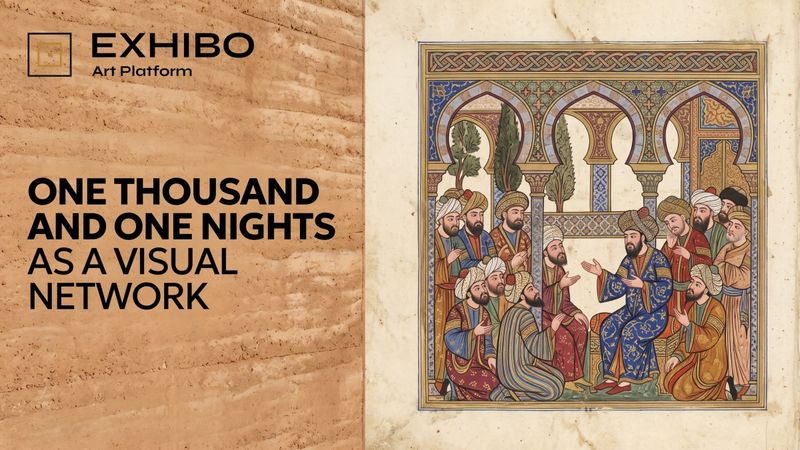
One Thousand and One Nights as a Visual Network
The book that taught Europe to picture the East arrived with no pictures at all. Three centuries of illustrators — Dutch, Egyptian, Persian, French, German, Iraqi — each gave it a face, and every face was a self-portrait.
Open Galland's Thousand and One Nights, the edition that conquered Europe, and there is nothing to look at: no genie, no lamp, not one illustration. The most visually imagined book in the world began blind — and because its text was never fixed either, no picture of it could ever be a copy.
Curating Tomorrow's Archive: Hamburger Kunsthalle Seeks Contemporary Collections Lead
A new permanent appointment will steer the museum's post-1960 holdings across paper, photography, and media formats.
The Hamburger Kunsthalle is inviting applications for a senior curatorial position focused on contemporary acquisitions, exhibition strategy, and digital collection management. Applications close October 2026 for a January 2027 start.