
Exhibo Editorial
How a Bronze Sculpture Is Made
Lost wax from wax positive and ceramic shell through pour, chase and patina, with Greek, Benin and modern foundry practice on named works
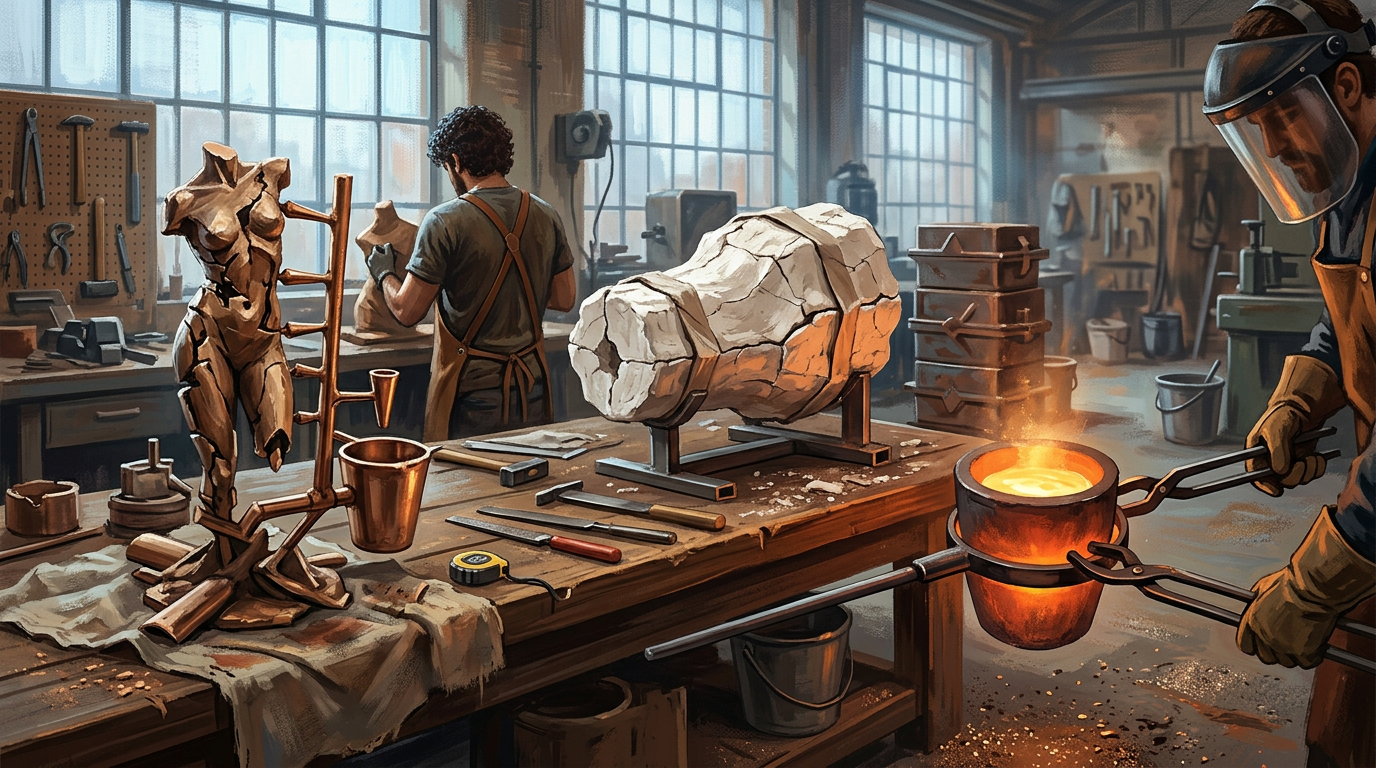
Lost wax casting (French: cire perdue) is the dominant method for turning a sculptor's model into a hollow bronze. The artist or foundry builds a wax replica, coats it in a refractory ceramic shell, burns the wax out in a kiln, pours molten metal into the cavity, breaks away the shell, then chases, joins and patinates the metal until it matches the intended surface. The same sequence runs from Benin brass plaques to Greek warriors and from jewellery flasks to a Rodin Thinker edition.
You can carve marble or weld steel and skip wax entirely. When the brief asks how a bronze sculpture is made, the answer is usually this five-stage chain: wax, ceramic shell, pour, chase, patina. Sand casting and direct metal fabrication belong to the same family of sculpture methods but follow different mould logic; the hub article on sculpture materials and methods (S20-02, pending) sorts those categories. Collecting, edition numbers and certificate fields sit in the editorial stream (E03). This page stays with making. The cluster hub is Art Techniques and Materials. Museum holdings cited below appear in the museums directory.
What lost wax casting is
In workshop speech, "lost wax" names the moment wax disappears. Foundries also say "investment casting" when the refractory coat around the wax is the investment, or "precision casting" in industrial catalogues. All three phrases describe one logic: a sacrificial pattern defines an internal void that metal fills once the pattern is gone.
Tate's materials glossary treats bronze as a copper alloy, typically with tin and sometimes zinc or lead, cast into a hollow form. The Cantor Foundation's account of Rodin's foundry practice, still standard in museum education, lists the same outline the Romans and Renaissance bronze founders used: model, mould, wax gap, sprue network, ceramic coat, burnout, pour, chase, patina. Techniques and shell materials have shifted (gelatin moulds gave way to silicone; plaster investment partly yields to colloidal silica mixes), but the causal order has not.
The method suits complex surfaces because nothing has to slide out of a rigid mould sideways. Undercuts, drapery folds and incised inscription survive as long as the wax carries them and the shell holds. The price is labour and failure rate. A large hollow cast can demand weeks of skilled work and still fail at the pour if a sprue blocks or a shell cracks. That is why most living sculptors send work to a foundry rather than casting alone in a studio.
English-language search traffic splits between jewellers explaining ring trees and engineers listing turbine blades. Both are lost wax. This article follows the sculpture foundry line because the assigned title asks how bronze sculpture is made, not how a dental crown is cast. The chemistry overlaps; the scale, alloy and chase standards do not.
Bronze alloys and what "bronze" means on a label
Museum labels often say "bronze" when the object is a copper alloy that may include zinc, tin, lead or small amounts of other metals. Foundries choose alloy for colour, hardness, fluidity and cost. Traditional statuary bronze in European practice is often about 90% copper with tin and zinc adjusted for castability. Benin court brass is a copper-zinc alloy whose tone can read reddish or golden depending on composition and polish.
Modern analysis complicates nineteenth-century foundry publicity. A 2011–2012 study of a Hébrard Thinker gave roughly 82.5% copper, 8.8% zinc, 8.0% tin and traces of lead, not the silver-heavy recipe one period journalist claimed for Hébrard casts. The lesson for readers is practical: "bronze" on a plinth is a family name, not a single formula. Conservators identify alloys by sampling; art historians treat foundry consistency as part of an edition's identity.
Hollow casting keeps weight and metal cost manageable. A life-size figure cast solid would be impractically heavy and expensive. The wax stage therefore sets wall thickness: founders scrape a clay core or control wax depth so the finished bronze skin might be a few millimetres to a centimetre thick, depending on scale and structural needs.
From model to wax positive
Every cast starts upstream of wax. The sculptor models in clay, plaster or a digital mesh that foundries print in resin or machine in foam. The foundry's job is to translate that surface into a wax shell of controlled thickness around a core or void. Small jewellery pieces may cast almost solid; monumental work is hollow with an internal armature or core left in place or removed after casting.
The translation passes through moulds. For edition sculpture, workshops take a flexible mould from the artist's plaster original, then build a fire-resistant core slightly smaller than the final bronze section. When the core sits back inside the rigid mould, a gap opens between core and mould wall. Founders pour hot wax into that gap, producing a wax layer whose thickness will become bronze thickness. Rodin's Musée Rodin technical note describes the same gap logic for cire perdue: a core reduced by the intended metal skin, wax poured between core and mould, then the mould opened and the wax positive finished by hand.
Modelling, enlargement and the Collas machine
Rodin's enlarged Thinker (about 1903–04) passed through Henri Lebossé's mechanical pointing device, a nineteenth-century pantograph that transferred measurements from a maquette to a full-size plaster. Enlargement is not casting, but it shapes what wax must carry. A coarse enlargement shows up in the bronze unless chasers spend days refining the surface. Moore's late reclining figures grew in scale across the 1960s; Noack foundry crews segmented plasters before any metal touched the mould.
Digital workflows today skip some plaster stages but not the wax gap. A printed resin pattern can be invested directly in small shops, or rubber-moulded and wax-filled in edition foundries. The material changes; the requirement for uniform wall thickness and vent paths does not.
Wax working, signatures and edition marks
Foundry wax is not candle wax. It is formulated to carve, hold detail and burn out cleanly. Assistants weld wax rods (sprues and gates) onto the positive so metal can enter and air can escape. They incise the artist's signature, cast number and foundry seal into the wax before investment. Giacometti bronzes from Susse often carry stamped foundry marks reading CIRE PERDUE on the base or underside, alongside edition numbering enforced by the artist's estate.
Wax repair at this stage is cheap. Wax loss after burnout is catastrophic. Foundry foremen inspect positives for cracks, thin spots and trapped air bubbles before shell work begins.
Ceramic shell, sprues and burnout
Once the wax positive carries its sprue tree, the shell stage starts. In classical cire perdue, foundries dip or brush fine refractory slurry onto the wax, build coarser layers until the coat can survive molten metal, then dry and fire the assembly. Industrial investment casting uses the same principle with controlled chemistry. Sculpture foundries may speak of "ceramic shell" when they mean a silica-based coat; older texts say "investment mould" for a plaster-and-silica mix around a fireproof core.
The Cantor Foundation's step-by-step account, written for Rodin's process, has the wax model covered in granulated ceramic until thick, then heated so wax flows out through sprues. What remains is a negative cavity the shape of the sculpture, plus channels for metal flow. Benin casters in the Igun Eronmwon guild apply clay over a wax model formed on a clay core, heat the assembly to melt wax through a narrow channel, then pour molten brass. The Art Institute of Chicago's documentation of Benin City practice in 2003–06 describes that sequence as still living craft, not a museum reconstruction.
Sprue design and why trees matter
Sprues are not decorative. They are plumbing. Metal must reach thin extremities ( fingers, spear points, lips) before it freezes. Air must exit ahead of the melt. Founders angle multiple wax rods from the positive to a central cup or basin. Jewellery casters mount several rings on one "tree" for a single flask pour. Monumental sculpture uses thicker gates and sometimes external risers to feed shrinking metal.
Poor sprue layout yields misruns: cold shuts where two metal fronts meet too late, porosity, or unfilled toes. Experienced founders read failed casts at the shell break-out and adjust the next wax tree.
Burnout temperature and core removal
Burnout kilns hold moulds at temperatures high enough to vaporise wax and carbon residue, often above 500 °C for the wax phase and higher for shell sintering, with exact profiles set by investment manufacturer data. If wax residue remains, metal can trap gas and pit the surface. If the shell heats too fast, it cracks.
Many European figure casts use an internal clay core that survives burnout and stays inside the bronze until chasers break it out through hidden openings. Greek fifth-century bronzes such as the Riace warriors were built with clay cores whose slabs and vents scholars mapped during conservation in the 1990s. Benin cores used iron-rich clay; Met conservators identified fired investment residues on some Benin surfaces as hard red-brown layers once mistaken for mere soil from the 1897 British looting of the palace.
Pouring molten bronze
When the shell is hot and wax-free, founders pour alloy near 1,100 °C for typical bronzes (exact temperature depends on composition). Small workshops use centrifugal casters that sling metal into the cavity; large foundries pour from crucibles with gantry assistance. Vacuum and pressure aids appear in jewellery plants; public monuments may use continuous feed through multiple gates.
Timing matters as much as temperature. Metal that sits too long in the crucible picks up gas and slag. Shells that cool before the pour arrive cause misruns on thin lips and fingers. Foundry foremen watch colour in the melt and sound at the mould cup. Apprentices learn those cues before they touch a ladle. Film footage of modern pours makes the moment look brief; preparation behind it is not.
The pour is single-shot for each section. Bronze cannot be paused and resumed cleanly in the same mould the way a welder adds metal later. That constraint drives segmentation: Moore's Locking Piece (Tate) was sand cast at Hermann Noack in Berlin in roughly fifty sections because crucible size and handling limited each pour, then welded. The same physical limit applies to lost wax sections on other large works; only the mould material differs.
Quench, breakout and raw cast condition
After pouring, founders cool the mould, then break or dissolve the investment to free rough bronze. Water quench softens some plaster investments; ceramic shell may need pneumatic hammers and grit. What emerges carries sprue stubs, casting flash and shell texture. The surface looks nothing like gallery bronze yet.
Foundries radiograph or tap-test critical commissions for hidden voids. Museums sometimes document weld repairs and patches visible decades later: Tate's research on Locking Piece notes rectangular repair patches and seams that re-emerged as dissimilar metals reacted.
Chasing, assembly and patina
Chasing (French ciselure, distinct from repoussé raising) is the hand-finishing that removes sprue scars, welds joins and aligns the surface with the artist's model. Files, chisels, burrs and abrasives replace wax texture with intended skin. Rodin sometimes left brazing lines visible so a viewer could see assembly; most public bronzes hide joins entirely.
Chasers read the artist's fingerprints in metal. A Giacometti cast keeps knife-like furrows; chasing there is selective, not smoothing. A Moore outdoor piece may require uniform file work across welded planes so rain runs evenly. The Cantor Foundation notes that chasing on Rodin casts could take as long as the shell work because public bronzes are judged at arm's length under raking light. Indoor table bronzes tolerate tool marks gallery visitors never see.
Large works are cast in sections, then welded or brazed. Interior clay cores come out through access holes, which are closed and chased. Only when assembly completes does patina begin.
Patina is not rust on an accident. Founders heat or chemically treat the surface to produce stable coloured oxides: browns, greens, blacks. The layer protects and aestheticises. Moore's long collaboration with Noack from 1958 to 1986 included polished highlights and golden-brown tones the foundry developed with him; Noack's Hermann Noack III recalled selective polishing that Moore adopted on later casts. Benin court brass was kept bright on altars according to Met accounts of palace practice; museum objects now carry aged surfaces, burial accretions or deliberate historical patination from conservation.
Patina maintenance is conservation, not studio technique. Outdoor bronzes cycle through waxing programmes; salt air pits green patinas differently from dry museum air. Detailed conservation ethics for altered surfaces belongs with the patina article (S20-08, pending), not here.
Lost wax casting stages at a glance
Use the table as a foundry checklist, not a shopping list. Steps compress or split depending on scale.
| Stage | Primary materials | Main operator | What success looks like | Typical failure modes |
|---|---|---|---|---|
| Model | Clay, plaster, foam or digital print | Artist / studio | Correct form at intended scale | Scale drift; undraftable undercuts without segmentation plan |
| Wax positive | Foundry wax, core, flexible mould | Foundry moulder | Even wall thickness; sharp detail | Wax cracks; thin fingertips; lost inscription |
| Sprue tree | Wax rods, cups, vents | Founder | Metal path to extremities; air escape | Cold shuts; unfilled sections; gas porosity |
| Ceramic shell / investment | Silica slurry, plaster, grit coats | Shell technician | Durable mould; clean burnout | Shell cracks; incomplete wax removal; inclusions |
| Burnout | Kiln, controlled atmosphere | Founder | Empty cavity; sintered shell | Wax residue; core expansion cracks |
| Pour | Copper alloy melt, crucible | Founder / pour team | Full fill; sound metal | Misrun; cold shut; shell breach |
| Breakout | Hammers, water, grit | Foundry crew | Rough cast free of investment | Surface gouges; warped thin sections |
| Chase | Chisels, files, welders | Chaser | Seam hidden; texture matched | Over-filing; visible repairs; misaligned joins |
| Patina | Oxides, heat, wax seal | Patineur / artist | Stable colour; intended highlight | Uneven colour; premature outdoor weathering |
Ancient Greece: hollow warriors and the indirect option
Greek large-scale bronze statuary of the Classical period relied on hollow lost wax casting, replacing earlier methods that hammered sheet bronze over armatures. The Riace bronzes (Statue A and Statue B), recovered from the sea in 1972 and housed in Reggio Calabria, are among the few surviving full-size Greek originals. Istituto Centrale per il Restauro examination in the 1990s concluded that most sections were cast by the direct method: wax modelled over a clay core, then invested. Front sections of the feet and replacement arms on Statue B show indirect casting from piece moulds.
Direct casting suits a sculptor who models wax by hand over a prepared core. Indirect casting suits repeated elements and sharp replication from a master model. Roman founders used both. Greek workshops joined sections by cast-on welding, planning joints at necks, limbs and feet where later finishing could hide seams. Scholars still debate provenance of core clays; compositional studies point to Greek manufacture rather than Italian copies, with Argive regions among candidates.
What survives for visitors is metal, not wax. Every Greek bronze in a museum is the end of a chain that destroyed the wax and usually the core. Understanding the process explains why so few ancient large bronzes exist: they were valuable scrap when regimes shifted.
The Riace statues stand about two metres tall and weigh roughly 160 kg each, dimensions that only hollow casting makes feasible at Classical scale. Inlaid copper lips, silver teeth and calcite-and-glass-paste eyes on Statue A show how founders planned assembly after metal cooled: chasing included setting non-bronze materials, not only filing alloy. Roman marble copies of lost Greek bronzes preserve poses; they cannot preserve the hollow skin technology that made the originals possible.
Benin brass and the Igun Eronmwon guild
The Kingdom of Benin (Edo peoples, present-day Nigeria) produced brass and bronze court sculpture for centuries before the 1897 British punitive expedition looted the palace and dispersed works to European museums. British Museum and Met collections document plaques, commemorative heads, altar groups and regalia cast under royal patronage. The casters' guild, Igun Eronmwon, worked within palace society at the Oba's commission.
Benin lost wax practice builds a detailed wax model over a clay core, coats it with clay investment, fires to remove wax, pours molten metal, then chips investment away. Oral and archaeological debate continues over how early the technique arrived and whether Ife precedents taught Benin specialists; William Fagg and later Edo scholars argued for indigenous development and refinement rather than import as the sole story. What is not debated is technical sophistication: Felix von Luschan, writing in colonial Berlin, compared Benin casts favourably with Renaissance Europe, a comment often quoted and rightly reread with its imperial context.
Plaques could be cast remarkably thin (about three millimetres in skilled periods, according to tradition recorded in scholarship). Met conservation on works such as the Horn Player identified iron-rich fired clay residues on surfaces, evidence of investment rather than mere dirt from storage. Benin metal was polished on altars; museum darkness and oxidation now dominate what visitors see.
Casting here is political as well as technical. Commemorative heads honoured past Obas; plaques recorded court ritual and conflict. Technique and state power intertwined. Restitution debates around Benin works in Western museums do not change how the objects were made; they change who keeps them. This article does not map collecting law; for acquisition and markets, see the editorial collecting guide (E03).
Modern foundry workflow from wax to delivery
A contemporary edition bronze typically moves through contracted stages over weeks or months. The artist delivers an approved plaster or resin original. The foundry moulds it, pulls wax sections, gates them, shells them, pours, chases, patinates, and sometimes applies a protective wax for transit. Photographic records at each stage support authentication disputes decades later.
Quality foundries number editions strictly, destroy or mark surplus moulds according to contract, and store rubber moulds cold so they do not distort. Artists visit for "metal chase" approval before patina. Large public commissions add structural engineering for armatures, seismic bases and installation bolts hidden in plinths.
Health and safety regulation now governs silica exposure, molten metal handling and ventilation. Renaissance founders faced the same hazards without modern respirators. The craft gained precision, not innocence.
Digital scanning allows remote supervision: a sculptor in London can approve a wax in Berlin by video. The foundry still touches every square centimetre that metal will occupy.
Contract paperwork now travels with the object: mould ownership, destruction clauses, allowed edition sizes and foundry certificates listing alloy, cast date and patineur. Those documents do not change the wax-to-shell sequence, but they explain why two visually similar bronzes from different posthumous casts are not interchangeable in catalogues. Authentication disputes start at the chase marks and foundry stamps, not at the artist's clay.
Rodin, Giacometti and Moore: three casting stories
Reading named works through the process clarifies why founders matter as much as sculptors. A museum label gives artist, title and date; it rarely lists sprue layout or chase hours. The three cases below span nineteenth-century Paris, mid-century Switzerland and post-war Britain. Each artist relied on foundry choice as a material decision, not an afterthought. Rodin split sand and lost wax by edition size. Giacometti's estate standardised Susse lost wax for rough surfaces. Moore scaled up through sectional sand casting at Noack while keeping smaller lost wax pieces in play. None of them mistook the foundry for a copy shop. Each negotiated surface, deadline and cost at the wax tree stage.
Rodin and the Hébrard lost wax Thinker
Auguste Rodin (1840–1917) used many founders. Most lifetime bronzes, including most Thinker casts, were sand moulded at foundries such as Alexis Rudier's, a faster and cheaper method for editions. Adrien-Aurélien Hébrard opened a lost wax foundry in Paris in December 1902 and cast Rodin's enlarged Thinker after Lebossé's enlargement, with Rodin also ordering a Rudier sand cast for comparison. UvA doctoral research on Rodin's bronzes records Hébrard delivering the large lost wax Thinker in late 1903, with surface finishing and patination by the Limet brothers before the 1904 St Louis fair.
Musée Rodin holds plaster sequences for The Gates of Hell and related figures where Rodin recombined motifs. Lost wax preserved undercut texture from plasters that sand moulding could blur. Rodin did not pour metal himself; he chose methods per scale, deadline and surface priority. When you stand before a Hébrard Thinker, you are looking at chased lost wax bronze where wax carried plaster detail into alloy.
Giacometti and Susse cire perdue
Alberto Giacometti (1901–1966) modelled heads and figures in plaster and clay, constantly scraping back to armature. Susse Frères in Paris cast many posthumous editions in lost wax because broken, knife-marked surfaces suited cire perdue better than sand moulding, which favours smoother edition skins. Time magazine's 1964 foundry visit described Susse reviving classical lost wax for moderns such as Giacometti and Germaine Richier.
Auction catalogues for casts such as Buste d'homme (Diego) stamp Susse Fondeur Paris and CIRE PERDUE on the bronze. The wax stage preserved aggressive texture that chasing only partly softens. Edition ethics after the artist's death are a legal topic; technically, each legitimate cast still repeated the wax-shell-pour cycle under estate supervision.
Henry Moore and sectional casting at Noack
Henry Moore (1898–1986) sent most bronzes to Bildgiesserei Hermann Noack in Berlin from 1958 until his death, producing around a thousand casts in foundry records. Noack uses lost wax and sand casting; Moore's monumental pieces often went sand cast in sections because crucible capacity and handling favoured sand moulds for very large joins. Tate's material study of Locking Piece (1963–64, cast c.1964–67) documents sand casting in about fifty parts, 6 mm wall thickness, 1,800 kg assembled weight, welded seams chased and partially visible on the surface.
Moore's Large Arch (1971) for Columbus, Indiana, was sand cast at Noack, welded, then approved when Moore saw it erected in Berlin's Tiergarten. Lost wax still informed smaller Moore bronzes and studio pieces where one-piece hollow casting made sense. The artist's quote, relayed in the Henry Moore catalogue, praises Noack's reliability and skill; the technical split reminds you that "bronze sculpture" in the twentieth century was often a welding project after many pours.
When you visit bronzes in the museums directory, ask whether you are looking at lost wax, sand cast or mixed fabrication. Labels do not always say.
Lost wax versus sand casting today
Sand casting presses moulding sand around a model, removes the model, joins sand mould halves and pours. It is faster and cheaper for editions and massive sections. Lost wax wins on fine detail and complex undercuts. Nineteenth-century Paris foundries competed on both methods; Susse shifted toward lost wax for artist-led editions as taste turned against mass sand reproductions around 1900.
Rodin's dilemma between cire and sable is documented in foundry archives. Moore's large works show sand's scale advantage. Giacometti's surfaces show wax's texture advantage. A sculptor today may prototype in 3D print, cast a single artist's proof in lost wax, and sand cast a public monument in segments. The printmaking types sibling explains edition logic for works on paper; bronze editions parallel numbering but add foundry certificates and destructive mould wear differently.
What bronze casting costs today
Foundries quote by scale, alloy, section count, patina complexity and edition size, not by a public price list. Order-of-magnitude figures help students calibrate expectations. Small lost wax table sculptures in Western Europe and North America often start in the low thousands of pounds or dollars per piece at professional foundries once mould, wax, one pour, chase and patina are bundled. Life-size figurative work reaches five figures per cast. Monumental public bronzes run into six or seven figures when engineering, transport and installation join foundry fees.
Material costs track copper markets. Labour dominates. A foundry month waiting on artist approval still bills storage and queue time on busy schedules. Cheap online "bronze" offers are often resin cold-cast or offshore shortcuts with unclear alloys. This page does not price a commission; it marks the gap between a wax tree in a flask and a museum-grade patina.
Frequently asked questions
What is lost wax casting in simple terms?
Lost wax casting builds a wax copy of a sculpture, coats it in heat-resistant ceramic, melts the wax out to leave a cavity, pours molten metal into that cavity, breaks the ceramic away, then finishes the metal by chasing and patinating. The wax is lost; the bronze takes its place.
What is another name for lost wax casting?
French workshops say cire perdue. Industrial catalogues say investment casting or precision casting. Foundry stamps on modern bronzes, such as Giacometti casts marked CIRE PERDUE, use the French term.
Is lost wax casting still used?
Yes. Contemporary art foundries, jewellery workshops and aerospace manufacturers all use investment casting logic. The scale and alloy change; the wax-shell-pour sequence remains.
How is lost wax casting different from sand casting?
Lost wax uses a sacrificial wax pattern encased in ceramic or plaster investment. Sand casting packs sand around a model, removes the model and pours into the sand void. Sand casting suits large editions and big sections; lost wax suits fine detail and complex undercuts.
What wax is used for lost wax casting?
Foundries use dedicated casting waxes formulated to carve, hold detail and burn out cleanly, not household candle wax. Jewellery and sculpture suppliers sell wax blocks, sheets and injection waxes with different melting points.
What are the downsides of lost wax casting?
Lost wax is slow, labour-intensive and vulnerable to failure at pour if sprues or shells are wrong. Each hollow cast destroys the wax pattern. Large works require multiple sections and welds. Costs exceed sand casting for the same volume of metal in most edition scenarios.
How accurate is lost wax casting?
Lost wax reproduces fine surface detail faithfully because metal fills the exact void wax occupied. Shrinkage occurs as metal cools; founders compensate in wax scale and core design. Chasing still adjusts surfaces after pour.
Did ancient Greeks and Benin artists use the same method?
Both traditions used lost wax logic for hollow metal sculpture, but materials and steps differed. Greek Classical bronzes such as the Riace warriors used clay cores and section welding documented by conservators. Benin brass casters in the Igun Eronmwon guild built wax over clay cores and fired clay investment in court workshops. Parallel technique, distinct social organisation and alloy preferences.
Where does patina fit in the process?
Patina comes after chasing and assembly. Founders apply chemical or heated oxide layers to colour and protect the surface. It is the last making stage before installation or delivery, distinct from outdoor weathering that happens later.
Does this article cover buying or collecting bronze sculpture?
No. Edition authentication, market history and certificate checks belong in the editorial collecting guide (E03). For sculpture categories beyond casting, see the materials hub (S20-02, pending).
Related reading
Curating Tomorrow's Archive: Hamburger Kunsthalle Seeks Contemporary Collections Lead
A new permanent appointment will steer the museum's post-1960 holdings across paper, photography, and media formats.
The Hamburger Kunsthalle is inviting applications for a senior curatorial position focused on contemporary acquisitions, exhibition strategy, and digital collection management. Applications close October 2026 for a January 2027 start.
Whilst We Are Savages: Colonial Constructs and Atlantic Dialogues
A critical survey at TEA Tenerife exploring how colonial frameworks shaped identity, territory, and knowledge across Europe, Africa, and Latin America.
William Morris Gallery Reopens With Intimate Restoration and New Focus
A comprehensive overhaul at the Walthamstow venue explores the designer's contradictions through newly displayed archives and a domestic curatorial approach.