
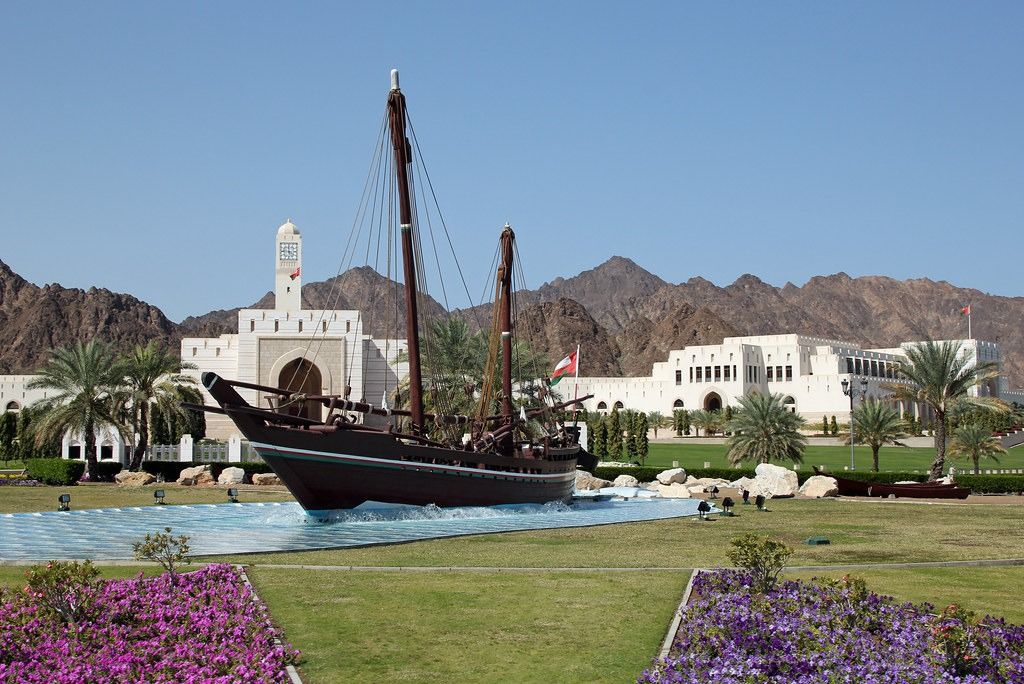
Sindbad's ship
In the middle of the Al Bustan roundabout, on the coast road south-east of Muscat, sits a full-size wooden ship. This is the Sohar, a replica of a 9th-century Arab trading dhow. In 1980 and 1981 it sailed from Oman to China, following the route of the medieval Arab and Persian merchants who traded across the Indian Ocean as far as Canton. Their journeys are thought to lie behind the tales of Sindbad the Sailor.
Sewn, not nailed
The voyage was the idea of the British explorer and writer Tim Severin, who wanted to test whether the Sindbad stories were rooted in real voyages. The Omani government, under Sultan Qaboos bin Said, decided to sponsor the project. The ship was named after Sohar, the old port on Oman's Batinah coast that was one of the great harbours of the medieval Indian Ocean.
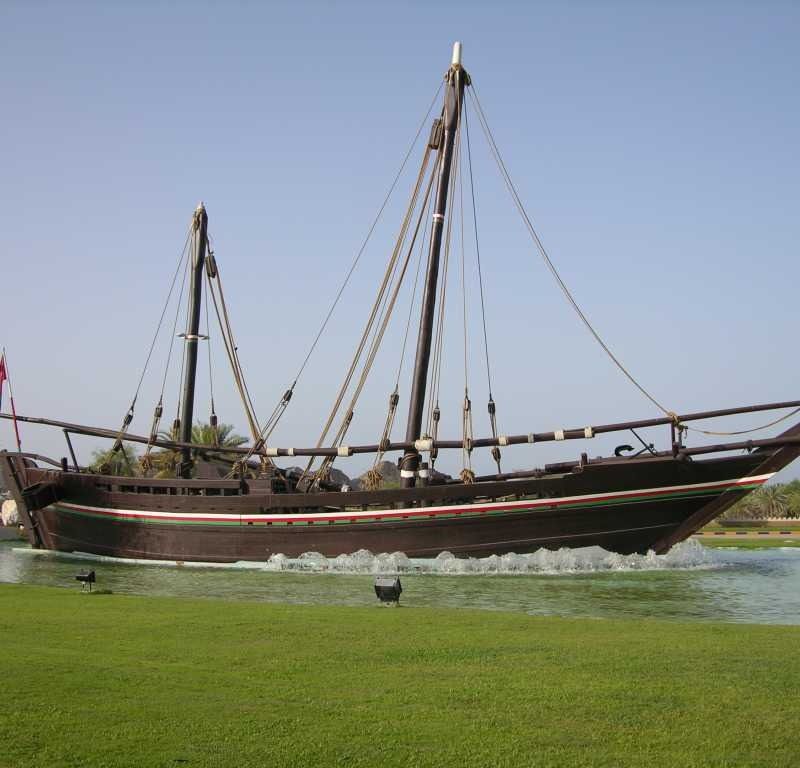
Severin had the dhow built at Sur, the shipbuilding town on Oman's eastern tip, by Omani shipwrights and craftsmen from the Laccadive Islands off India, where the old methods still survived. The keel was laid on 1 January 1980. Timber for the hull came from the forests of southern India. Not a single nail was used. The planks were sewn together with coconut-fibre rope, the way Arab ships of the period were built. About 640 km of coir cord was needed for the ship.
Oman to Canton
The Sohar set sail in November 1980 with a crew of about 25, most of them Omani sailors. The crew navigated with medieval instruments. The route ran across the Arabian Sea to India's Malabar Coast, where the first landfall was Calicut just before Christmas 1980, then on across the Indian Ocean to South-East Asia and the South China Sea. On the way the ship was becalmed for weeks, lost a spar and was nearly run down by tankers. On 1 July 1981 the Sohar reached Canton, today Guangzhou, after a voyage of about 9,600 km lasting more than seven months.
Back in Muscat
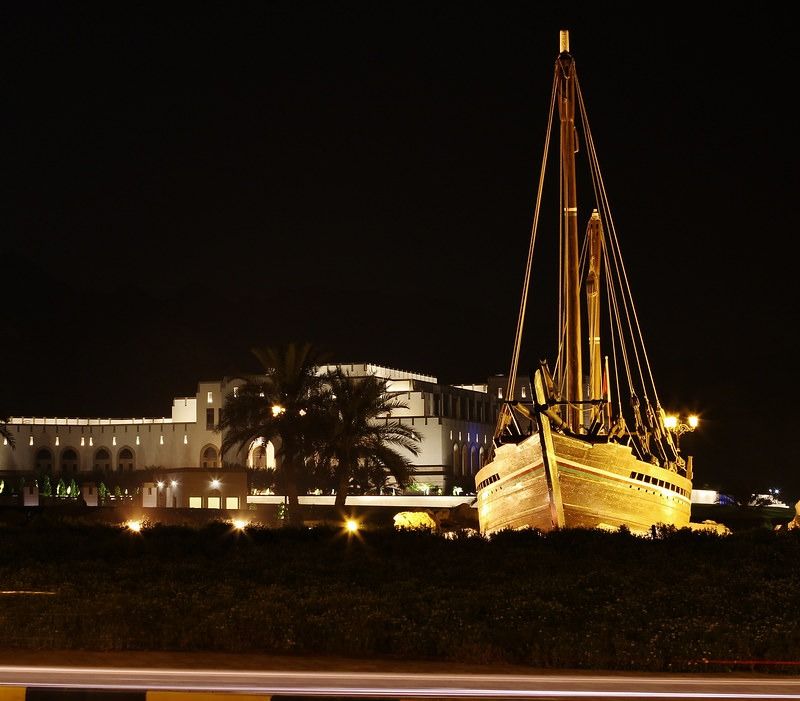
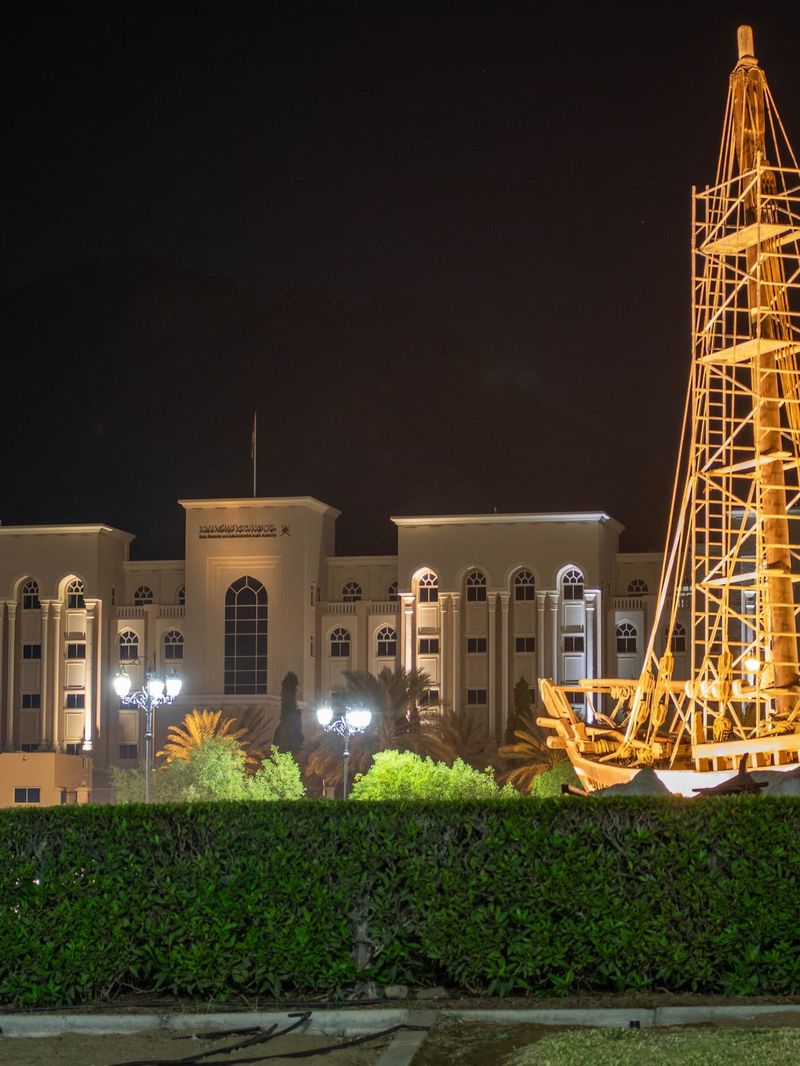
After the voyage the ship was brought home to Oman. It now stands in the roundabout outside the Al Bustan Palace hotel, near the buildings of the Council of Oman, set in a pool with lawns and flowers. At night it is lit up. A model of the Sohar is in the maritime collections of the National Museum of Oman.
Exhibo editorial
It is one of the great small jokes of Muscat urban design: a medieval ship parked on a roundabout, with traffic circling it instead of waves. Yet the joke has a serious point. Oman was a seafaring nation long before it was an oil state. This ship proved that its sailors could have reached China with wood, rope and the stars.
Pull over on the coast road and look at the hull up close. Every plank is stitched. It is hard to believe it crossed two oceans.
Gallery
How to find it
The Sohar stands in the centre of the Al Bustan Roundabout on the coast road between Muscat and Al Bustan, next to the Al Bustan Palace hotel. It is best seen from the pavements around the roundabout. Take care with the traffic; there is no crossing to the ship itself.
News by Exhibo
Editorial coverage on Exhibo
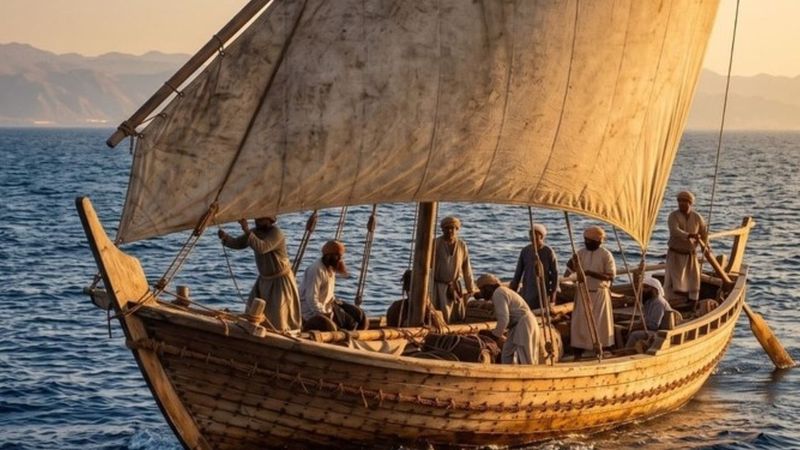
Sinbad and the Real Trade Routes of Oman and Basra
A ninth-century ship sewn together without nails, a hold of Chinese porcelain, and the sailors’ yarns of Basra, Siraf and Sohar: the real sea behind the fantasy.
In 1998, sea-cucumber divers off an Indonesian island found a ninth-century ship stitched together with coconut cord and loaded with some sixty thousand pieces of Chinese porcelain — the only Arab-built vessel then known from Southeast Asian waters. Sinbad’s voyages are fiction.
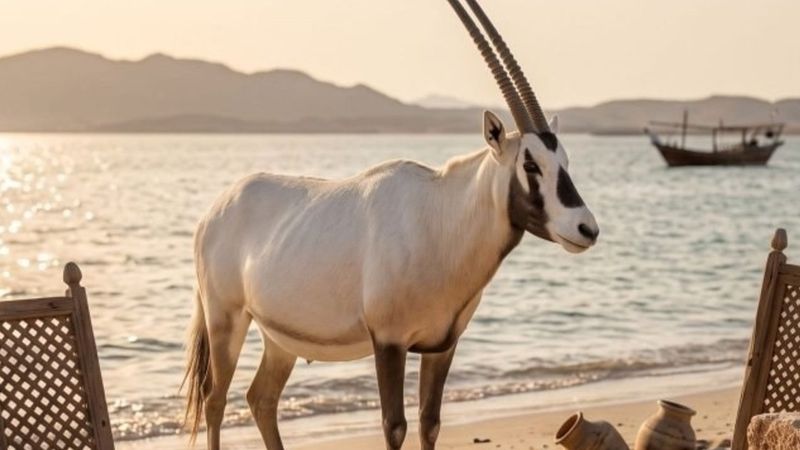
The Animal We Drew Everywhere Once It Was Gone
From Neolithic rock to airline tailfin — how the Arabian oryx vanished from the desert, came back from nine animals, and multiplied everywhere as a symbol in the very decades it was gone.
The last wild Arabian oryx was shot in 1972. By then it was already a picture — carved on Bronze Age tombs, mistaken by the ancients for a unicorn, praised by poets as the eyes of the beloved. This is the story of an animal that went extinct in the wild and was brought back from nine survivors, and of the strange gap between the creature and the emblem it became: fast, sharp and ascendant on a nation's tailfin, while the animal itself survives by standing still in the shade.
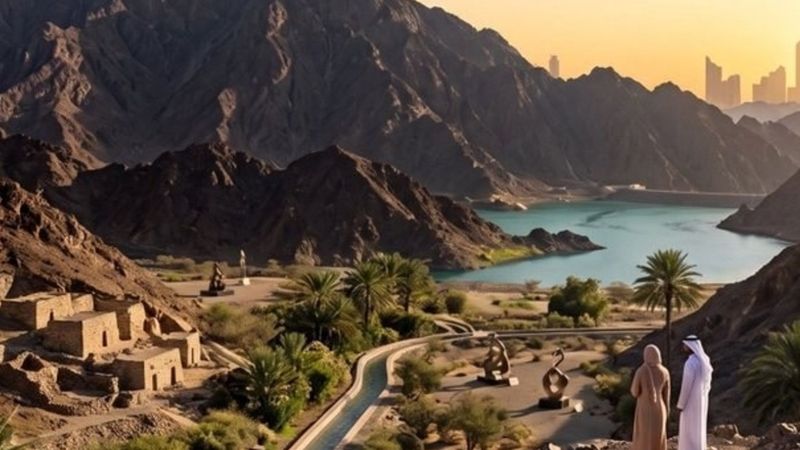
Hatta: The Valley That Changed Hands
Ninety minutes from Dubai, a mountain town where the same water has shaped human settlement for four thousand years.
Most guides to Hatta list its fort, its dam and its trails. This is the valley told differently — through the single physical problem that has shaped every era of its life. From Bronze Age tombs sited by the water to a mosque timed by shadow to a hydro plant that answers Dubai in ninety seconds, one question runs through four thousand years: where does the water go, and whose turn is it?