
Exhibo Editorial
Prehistoric and Cave Art
A period survey of prehistoric art: Ice Age conditions, parietal and portable media, major sites, and debates over meaning.
Prehistoric art is the body of images, marks and shaped objects made before writing systems took hold in a given region. In practice that means painting, engraving and modelling on cave walls and rock shelters; small sculptures in stone, ivory and clay; beads and ochre-stained tools; and, later, pottery decoration and megalithic architecture. The phrase covers tens of millennia and many continents. European Upper Palaeolithic caves dominate school textbooks, yet African ochre workshops, Australian rock shelters and Indonesian hand stencils sit inside the same broad conversation about when and how people began to make lasting images.
This survey treats prehistoric art as a period of practice rather than a ranked list of “firsts.” Absolute ages keep shifting as laboratories refine radiocarbon, uranium-thorium and optically stimulated luminescence dates; claims about the earliest artwork therefore need caveats and dual sourcing. What follows maps the Ice Age conditions that favoured deep-cave decoration, the media and visual habits that define the material, key Franco-Cantabrian sites and portable figurines, how image traditions mutate into Neolithic monumentality, and how scholars from Henri Breuil to recent dating debates have argued about meaning. For the later Nile-valley sequence that inherits symbolic image-making under very different political conditions, see Ancient Egyptian Art. The wider European period sequence lives on the Periods of Art History hub.
Ice Age conditions that made images possible
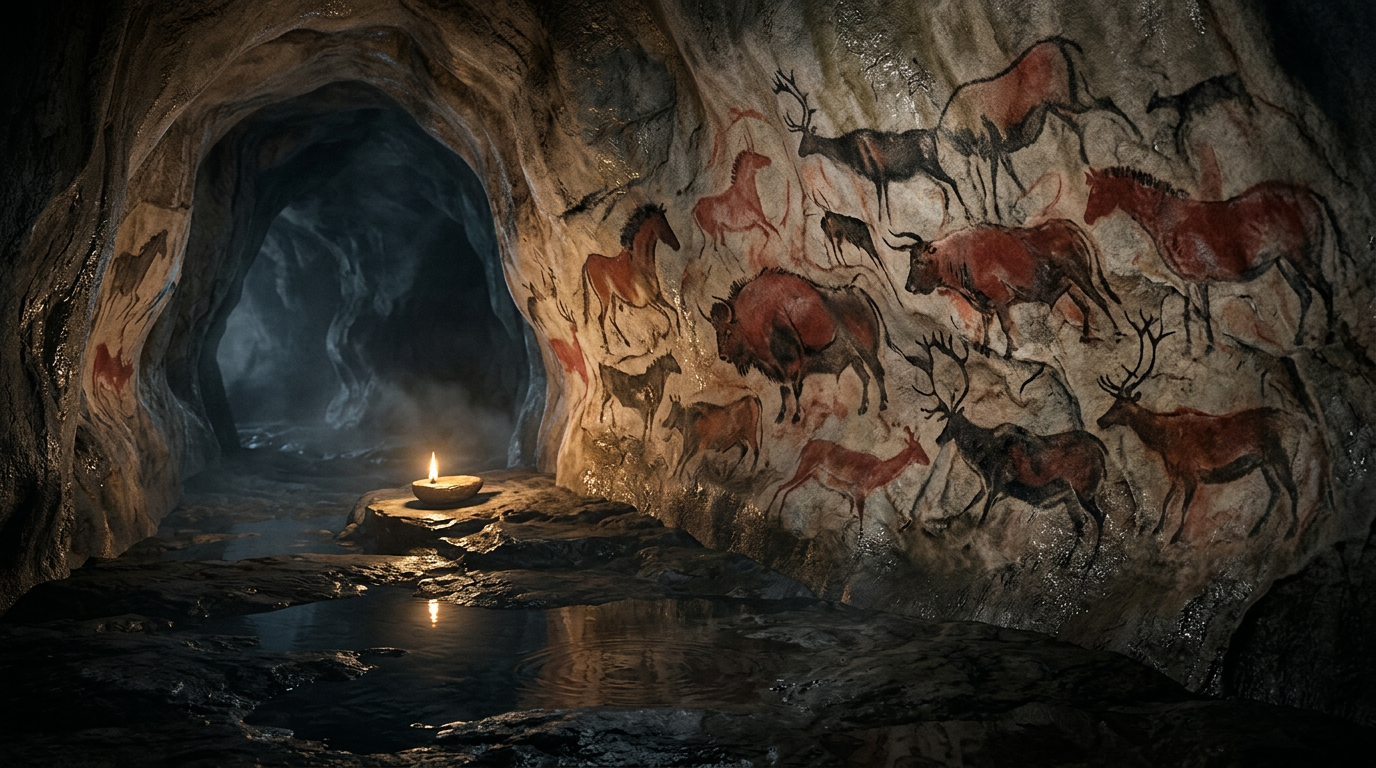
Upper Palaeolithic communities in Europe lived through repeated glacial advances that reshaped coastlines, plant cover and animal ranges. Mammoth, woolly rhinoceros, cave lion, bison, aurochs, horse and reindeer moved across steppe-tundra landscapes; people followed those herds with stone, bone and antler toolkits. Karst limestone belts in the Franco-Cantabrian region (south-west France and northern Spain) offered deep, stable caves that held constant temperature and humidity once sealed from outside weather. Those chambers became studios, sanctuaries and refuse floors at once.
Stable interiors matter for survival of paint. UNESCO’s brief on the Vézère Valley notes that the association and density of Palaeolithic sites there supported a chronological framework for European Ice Age cultures, with occupations stretching, across the property’s deposits, from roughly 400,000 to 10,000 years ago. Deep galleries at Altamira and related Cantabrian caves stayed isolated from external climate, which is why polychrome ceilings still read with clarity when you meet them through replicas or controlled visits. Rockfalls sometimes sealed entrances for millennia. Chauvet-Pont-d’Arc stayed closed by collapse for about twenty thousand years before its 1994 rediscovery; that accident preserved footprints, bear hollows and wall drawings with unusual completeness.
Pigment chemistry rode the same geology. Iron oxides supplied reds and yellows (hematite, goethite); manganese oxides and charcoal supplied blacks. The French Ministry of Culture’s Lascaux materials pages stress that only mineral pigments have survived in that cave’s paintings, and that Dordogne blacks are typically manganese-based while charcoal dominates in some other French regions. People ground these minerals, mixed them with binders that rarely survive, and applied colour with fingers, pads, brushes and blown spray. Animal-fat lamps lit the dark. None of this requires a single “invention” moment; it requires communities with spare labour, shared motifs and places worth marking repeatedly.
Portable art travelled with bodies. Ivory, soft stone and fired clay move more easily than a cliff face. Gravettian figurines such as the Willendorf figure (Naturhistorisches Museum, Vienna) show that image-making also happened at camp scale. Music leaves thinner traces: bone flutes from European Palaeolithic contexts and later Chinese sites remind you that dance and sound likely accompanied wall programmes even when the instruments themselves decayed. The Met’s Laura Anne Tedesco essay (2007) treats poetry, music, dance and material arts together under the umbrella of prehistoric creativity, while warning that archaeological survival favours stone and bone over leather and wood.
What “prehistoric art” means in practice
“Prehistoric” is a relative label. It marks the absence of writing in a region, not a universal calendar date. Smarthistory’s teaching gloss applies the term mainly to works before about 2000 BCE in many survey contexts, yet writing arrives at different times in Mesopotamia, Egypt, China and Mesoamerica. African rock art, Australian Aboriginal traditions and many American traditions continue long after European writing begins; calling them prehistoric can flatten living cultures. For this article the focus stays on Ice Age and early Holocene image systems that lack contemporary written commentary, with later rock-art traditions noted where they correct a Europe-only map.
Within that frame, archaeologists sort the material by support and technique. Parietal (wall) art covers painting, drawing, engraving and relief on cave walls, ceilings and rock shelters. Portable (mobiliary) art covers figurines, engraved plaquettes, decorated tools and ornaments. Petroglyphs cut into open rock; pictographs add pigment. Hand stencils, dots, grids and abstract signs sit beside figurative animals. Survey courses often collapse these into a short list of “types”; the more useful habit is to ask what support, pigment and placement each case uses.
Visual habits you can recognise
European Upper Palaeolithic painters favour large herbivores and dangerous carnivores over landscapes or plant life. Horses, bison, aurochs, deer, mammoths, rhinoceroses and big cats fill chambers; human figures appear less often and often look schematic beside the animals. Artists use the rock’s natural bulges as belly, shoulder or muzzle. Overlapping outlines create herds in motion. At Chauvet, UNESCO notes skilful shading, combined paint and engraving, anatomical precision and an impression of volume and movement. At Lascaux, UNESCO’s Vézère description stresses hunting scenes with roughly a hundred animal figures notable for observational detail, colour richness and lively rendering. Scale can jump: a tiny engraved horse sits near a monumental bull.
Signs and hands complicate any pure “animal picture gallery” reading. Finger flutings, rows of dots, tectiform (roof-shaped) signs, claviforms and hand stencils recur across sites. Some scholars treat them as clan marks, hunting tallies or shamanic maps; none of those readings is settled. Gendered bodies appear in portable figurines with emphasised breasts, bellies and hips, and in rare painted or engraved “sorcerer” composites that mix human and animal traits. You should refuse easy labels such as “fertility goddess” unless a specific excavation context supports ritual deposition or associated finds.
Dating methods and why ages keep moving
Direct radiocarbon dating works when charcoal pigment remains. Uranium-thorium dating of calcite crusts over or under pigment yields minimum or maximum ages for the mark beneath or above the crust. Optically stimulated luminescence dates sediments that bury floors. Stylistic seriation once dominated the field: André Leroi-Gourhan and others ordered motifs by supposed evolutionary stages. Chauvet’s early radiocarbon results (around 32,000–30,000 BP for black drawings) overturned Solutrean stylistic expectations and forced a rewrite of how “sophisticated” Aurignacian art could look. A 2016 PNAS Bayesian model integrating hundreds of dates places two human activity phases at Chauvet roughly 37,000–33,500 and 31,000–28,000 years ago. UNESCO’s World Heritage text still summarises the figurative drawings as Aurignacian, about 30,000–32,000 BP; both statements can sit in one article if you name the source and the method.
Contested Iberian U-Th dates published in 2018 claimed minimum ages older than about 64,800 years for red motifs and hand stencils at La Pasiega, Maltravieso and Ardales, which would imply Neanderthal authorship if the chemistry holds. Critics in later responses have questioned uranium leaching and sample context; the debate remains open. Treat “Neanderthal painters” as a live hypothesis, not a textbook fact. Sulawesi hand-stencil minima reported in Nature in 2025 (about 67,800 years for one Muna Island stencil) likewise push Island Southeast Asia into the early conversation; those ages are minimum constraints from overlying calcite and will attract further testing.
Media: walls, lamps, ivory and ochre
Parietal programmes needed planning. Painters scaffolded into high ceilings, prepared surfaces by scraping, and returned to the same panels over generations. The French Lascaux materials research describes a narrow warm palette of black, dark brown, red and yellow, with rare mauve in one checkerboard motif. Application methods include spraying pigment through hollow bones for soft edges around hand stencils. Engravers cut fine lines with flint points; bas-relief at Cap Blanc (Vézère) pushes horse forms out of the rock face itself. Floors hold charcoal, bone refuse and footprints that show how people moved through the dark.
Portable sculpture answers different needs. Soft limestone, mammoth ivory and fired loess clay take detailed carving. The Willendorf figure stands about 11 cm high, carved from non-local oolitic limestone and once coated with red ochre that still lodges in crevices of the hair or headdress. Naturhistorisches Museum research dates the piece around 29,500–30,000 years ago within Gravettian layers. Micro-CT work published in Scientific Reports (2022) matches the oolite closely to deposits near Lake Garda in northern Italy, which implies long-distance movement of stone or finished objects before the Last Glacial Maximum. Beads from shell and ivory, engraved bone spatulas and decorated spear-throwers extend the same craft skill into tools that people carried.
Ochre is both pigment and symbolic medium. At Blombos Cave on South Africa’s southern Cape, excavators recovered an ochre-processing workshop about 100,000 years old: abalone shells holding a liquefied ochre-rich mixture, with grindstones and hammerstones (Science, 2011). Engraved ochre pieces with cross-hatched geometries from levels about 75,000–100,000 years old sit earlier than Europe’s famous painted caves. The Met essay treats African ground red ochre markings around 100,000 BCE as among the earliest artistic representations currently visible in the record, while noting that archaeology’s survival bias may hide still earlier work. Those African finds belong in a period survey as contexts and media, not as trophy entries on an oldest-artwork leaderboard.
A working chronology of sites and media
Absolute dates remain provisional. The table below gathers public museum and UNESCO baselines you can cite, with method notes where disputes matter. Ranges are approximate; “BP” means before present (1950) in radiocarbon convention, while “years ago” follows recent Bayesian summaries.
| Site / corpus | Region | Approx. age | Main media | Notes on dating / access |
|---|---|---|---|---|
| Blombos ochre workshop & engraved ochre | South Africa | c. 100,000–75,000 years ago | Processed ochre; geometric engraving | OSL and associated MSA layers (Science 2011; Henshilwood et al.) |
| Sulawesi hand stencil (Liang Metanduno) | Indonesia | ≥ c. 67,800 years (minimum) | Pigment stencil on cave wall | U-series on overlying calcite (Nature 2025); ages under active review |
| Iberian red motifs (La Pasiega et al.) | Spain | Claimed ≥ c. 64,800 years | Red linear motif; hand stencil; painted speleothem | U-Th on crusts (Science 2018); authorship and chemistry contested |
| Chauvet-Pont-d’Arc | Ardèche, France | Human phases c. 37–33.5 ka and 31–28 ka | Charcoal & red drawings; engraving | PNAS 2016 Bayesian model; UNESCO WH; closed; replica open |
| Willendorf I figurine | Lower Austria | c. 30,000–29,500 years ago | Oolitic limestone; red ochre traces | Gravettian find 1908; NHM Vienna |
| Altamira & Cantabrian caves | Northern Spain | Flourishing c. 35,000–11,000 BCE (UNESCO frame) | Polychrome ceiling; engraving | Discovered 1879; WH property extended 2008 |
| Lascaux | Dordogne, France | Magdalenian (commonly cited c. 17,000 years; stylistic/radiocarbon debate continues) | Mineral polychrome animals; signs | Found 12 Sept 1940; closed 1963; Vézère WH 1979 |
| Ubirr & related Arnhem Land shelters | Northern Australia | Tradition extending many millennia (Met cites possible deep antiquity) | Rock painting refreshed over time | Living Aboriginal traditions; protocols apply |
Read the table as a map of evidence types. African Middle Stone Age ochre work and Island Southeast Asian stencils expand the geography of early mark-making. Franco-Cantabrian caves dominate the figurative Ice Age canon because limestone preservation, nineteenth- and twentieth-century discoveries, and intensive dating programmes concentrated there. Australian shelters remind you that “prehistoric” can name a continuous practice still governed by traditional owners.
Four sites and works that repay close looking
Textbook montages flatten Chauvet, Lascaux, Altamira and Willendorf into a single slideshow of “cave art.” Each site answers a different question once you slow down. Chauvet tests how early complex figurative painting can sit in Europe’s Upper Palaeolithic. Lascaux shows what twentieth-century mass tourism did to a Magdalenian masterpiece and how replicas absorbed the crowd. Altamira holds the historiographic shock of 1879, when a Cantabrian ceiling forced scholars to admit Ice Age painters existed. Willendorf shifts the scale from chamber to palm and proves that Gravettian image-making also travelled as portable stone.
Taken together, the four cases cover parietal and portable media, discovery ethics, dating arguments and museum afterlives. You can study them through UNESCO dossiers, ministry catalogues, 3D scans and authorised facsimiles without needing unrestricted entry to fragile originals. The readings below stay inside period-survey territory: context, technique and scholarly stakes. They are not a countdown of oldest masterpieces, and the order follows pedagogy rather than a contested absolute chronology.
Chauvet-Pont-d’Arc: sealed Aurignacian walls
Jean-Marie Chauvet, Éliette Brunel and Christian Hillaire entered the Ardèche cave in December 1994. UNESCO inscribed the Decorated Cave of Pont d’Arc (Grotte Chauvet-Pont-d’Arc) in 2014, citing more than a thousand inventoried images, four thousand faunal remains and human footprints, all held in near-pristine condition after a rockfall sealed the entrance around 20,000 years BP. The bestiary leans toward animals that were hard to approach: cave lions, rhinoceroses, mammoths, bears, bison and aurochs. Red and black drawings share panels with engravings. Soft stump blending (estompe) builds volume on horse and feline heads.
Early stylistic judgment placed the art in Solutrean or Magdalenian time. Direct dates on charcoal drawings pulled it back into the Aurignacian. The 2016 multidisciplinary model (more than 350 dates, including 259 radiocarbon results) argues for two discrete human visits separated by millennia, with cave bears using the chambers until about 33,000 years ago. That chronology matters for art history because it shows complex figurative painting early in the European Upper Palaeolithic, not only at the end. The original cave stays closed; climate monitoring forbids tourism. The Chauvet 2 facsimile and interpretation centre carries the public experience, much as Lascaux’s replicas do in the Dordogne.
Lascaux: discovery, bestiary and conservation shock
On 12 September 1940 Marcel Ravidat returned with Jacques Marsal, Georges Agnel and Simon Coencas to a shaft above Montignac. The French Ministry of Culture’s discovery narrative follows them into the Axial Gallery’s bestiary and down an eight-metre shaft to the scene of a bird-headed man confronting a bison. Henri Breuil, already a towering figure in prehistoric research, viewed the cave soon after their teacher Léon Laval. UNESCO later folded Lascaux into the Vézère Valley World Heritage property (inscribed 1979), describing hunting scenes of about a hundred animals as a landmark for the history of prehistoric art.
Lascaux’s Hall of the Bulls and Axial Gallery organise aurochs, horses, deer and the enigmatic “unicorn” (a multi-horned composite) across prepared white calcite. Painters exploited wall contours; blacks in this region run manganese-rich. The cave opened to visitors in 1948. By the mid-1950s, heat, carbon dioxide and humidity from heavy traffic damaged the microclimate; fungi and lichens followed. Authorities closed the cave in 1963. UNESCO’s integrity text records later biological crises around 2000 and stresses that State acquisition, monitoring and the International Scientific Council now limit access to research needs. Facsimile centres (Lascaux II and later Lascaux IV) absorb public demand. When you “visit Lascaux” today, you almost always visit a carefully built double.
Altamira: the ceiling that forced a rewrite
Marcelino Sanz de Sautuola and his daughter María noticed polychrome bison on the ceiling of Altamira, Cantabria, in 1879. UNESCO’s synthesis for the Cave of Altamira and Palaeolithic Cave Art of Northern Spain treats that find as the first recognition that Palaeolithic people painted deep caves. Sceptics initially called the paintings modern forgeries; only after parallel French discoveries did the European academy accept Ice Age authorship. Altamira’s Great Hall ceiling layers bison, horses and signs across a low, undulating surface that painters treated as a living field rather than a flat canvas. The wider Cantabrian property now includes seventeen other decorated caves that share Franco-Cantabrian themes and techniques across Asturias, Cantabria and the Basque Country, framed by UNESCO between about 35,000 and 11,000 BCE.
Access follows the same conservation logic as Lascaux. The Museo Nacional y Centro de Investigación de Altamira manages a preventive conservation plan; most visitors experience a replica. Standing under that reconstructed ceiling still teaches the bodily fact of parietal art: you crane your neck, lamps once flickered, and the animals seem to press out of the rock. Altamira also anchors historiography. Without Sautuola’s stubborn defence of Palaeolithic skill, later Vézère and Ardèche finds would have faced a slower path into museums and textbooks.
The Willendorf figure: portable bodies on the move
Johann Veran recovered the Willendorf I figurine on 7 August 1908 during excavations led by Josef Szombathy with Hugo Obermaier and Josef Bayer near Willendorf in the Wachau. The Naturhistorisches Museum in Vienna holds the 11 cm limestone woman with faceless head, patterned coiffure or cap, heavy breasts and belly, and ochre traces in recessed lines. Museum research places her around 29,500 years ago. Because oolite of this type does not occur at Willendorf, raw-material studies have long pointed elsewhere; the 2022 micro-CT comparison favouring northern Italian sources sharpens the picture of Gravettian mobility.
Portable figurines travel through museum cases more easily than cave walls, which is why Willendorf became a global shorthand for “Venus” Palaeolithic art. That nickname is a modern imposition. Nothing in the find labels the figure as a goddess. What you can say from the object is narrower and stronger: someone selected exotic stone, carved a standardised female body type shared across Gravettian Europe, applied red colouring, and deposited or lost the piece in a riverside camp. Compare her with wall animals and you see two scales of prehistoric art sharing one Ice Age world: chambers for communal or restricted viewing, and palm-sized sculptures for intimate handling.
How image traditions spread and mutate
Franco-Cantabrian caves form a dense regional network, not a single workshop. Painters at Lascaux, Font-de-Gaume, Rouffignac, Niaux, Altamira, El Castillo and Ekain share animal preferences, sign vocabularies and pigment habits while differing in style and species mix. Magdalenian art toward the end of the Ice Age often looks more narrative and densely signed than early Aurignacian panels; whether that records cognitive change, social complexity or sampling bias remains argued. As ice retreated, people decorated shallower shelters and open rocks. Mesolithic traditions in Europe thin the deep-cave habit and favour smaller game and geometric designs in many regions.
Outside Europe the mutation paths differ. The Met notes Ubirr in northern Australia as part of a rock-art tradition that may reach tens of millennia and that Aboriginal painters have refreshed across generations. San rock art in southern Africa builds dense painted narratives of animals and trance-related figures on shelter walls. Saharan pastoral scenes shift subjects as climate and herds change. Indonesian and Bornean caves now yield early figurative animals and hand stencils dated by U-series minima that rival or exceed many European ages. None of these traditions is a delayed copy of Lascaux; each answers local animals, rituals and stone.
The Neolithic turn reorganises labour and durable media. Pottery carries pattern across households. Plastered skulls, figurines and wall paintings at Near Eastern sites such as Çatalhöyük (outside this article’s close readings, but part of the same long arc) move imagery into houses. Megalithic monuments in Atlantic Europe (passage tombs with carved kerbstones, stone circles) make landscape-scale statements that UNESCO and English Heritage interpret through astronomy, ancestry and territorial claim. Prehistoric art here mutates from hidden chamber to visible architecture. If you track the series forward into dynastic Nile art, Ancient Egyptian Art shows how writing and state cult lock images into a different permanence.
Critics and scholarship then and now
Nineteenth-century viewers struggled to believe Ice Age artists existed. Altamira’s early rejection shows the prejudice: “primitive” hunters, in that worldview, could not paint bison with such control. Once French caves confirmed the phenomenon, Abbé Henri Breuil dominated interpretation for decades. Breuil read many scenes as hunting magic: paint the animal to secure the kill. That functional story fitted ethnographic analogies popular in his day and still appears in museum labels, though usually with softer wording.
Mid-twentieth-century structuralism shifted the question. André Leroi-Gourhan and Annette Laming-Emperaire mapped caves as organised systems of signs, pairing animals and abstract marks according to gendered or mythic dualities rather than simple hunt tallies. Their charts treated the cave as a symbolic book. Later critics noted that structural grids can overfit sparse data and that radiocarbon has scrambled purely stylistic timelines. Jean Clottes and David Lewis-Williams advanced trance and shamanic readings, linking cave imagery to altered states and spirit animals; supporters cite ethnographic parallels from southern Africa, while sceptics warn against stretching those parallels across twenty millennia and multiple continents.
From hunting magic to cognitive archaeology
Cognitive and evolutionary approaches ask when Homo sapiens (and possibly Neanderthals) gained the working memory and social networks that sustain shared symbols. Blombos beads and engraved ochre feed that debate by pushing evidence for conventional marks deep into the African Middle Stone Age. Genomic and archaeological work on Neanderthal ornament and Iberian U-Th claims keep authorship questions open. Conservators and hard-science dating teams now share the stage with iconographers: a charcoal date or calcite crust can overturn a stylistic chapter overnight, as Chauvet showed.
Museum education has changed tone. Early twentieth-century displays marvelled at “masterpieces” in a Renaissance key. Current UNESCO language still uses “creative genius,” yet site management texts dwell on microclimates, visitor breath and replica ethics. The scholarly afterlife of prehistoric art is as much about humidity sensors as about myth.
Open disputes you should name
Three disputes belong in any honest survey. First, chronology: stylistic ages versus radiocarbon versus U-Th minima do not always agree; report the method beside the number. Second, meaning: hunting magic, structural myth, shamanism, teaching aids and social signalling can all leave similar pigment on stone; most caves lack the associated organic offerings that would decide among them. Third, authorship at the earliest Iberian and Island Southeast Asian edges: Neanderthal painters and very early Sulawesi stencils are active research fronts. When two recent papers disagree, name both rather than crowning a winner for click appeal.
Afterlife: replicas, museums and looking now
You rarely enter the original painted chambers. Lascaux closed in 1963; Chauvet never opened; Altamira limits access under a preventive plan. Facsimiles and digital scans carry public encounter. That substitution is itself part of prehistoric art’s modern history: twentieth-century tourism nearly destroyed what nineteenth-century archaeology had proved authentic. UNESCO Vézère and Chauvet texts make conservation the price of Outstanding Universal Value.
Museum collections hold the portable half of the story. Vienna’s Naturhistorisches Museum keeps Willendorf; national museums of prehistory in France and Spain hold plaquettes, lamps and engraved bones; the British Museum and others display comparative Ice Age ivories and tools. For planning visits around originals and casts, browse Exhibo’s museums directory beside site-specific heritage pages. Replicas raise their own questions: how much reconstruction fills gaps, which lighting mimics fat lamps, whether a perfect double risks making the fragile original feel disposable. Those questions belong to heritage ethics as much as to art history.
Popular culture keeps recycling the images. Documentaries linger on Chauvet’s lions; classroom posters crop Lascaux horses; designers borrow hand stencils without the caves’ ritual density. The afterlife also includes Indigenous protocols. Australian rock art is not a free image bank; traditional owners control photography and interpretation at many sites. A responsible modern viewer treats open-access European caves as a special conservation case, not a universal licence.
Prehistoric art leaves later periods a double inheritance: technical confidence with pigment and line, and the problem of images that work without texts. When Egyptian, Mesopotamian and later Mediterranean cultures add writing, they inherit a much older habit of making animals, bodies and signs stay present on hard surfaces. That habit begins here, in ochre, charcoal, limestone and dark air.
FAQ
These questions follow People Also Ask patterns for prehistoric art: what counts, which sites matter, how old the images are, and how to visit without damaging caves. Dates stay hedged where laboratories disagree. This page is not a ranked list of the oldest artworks.
What counts as prehistoric art?
Prehistoric art covers images and shaped objects made in societies without writing, or before writing appears in that region. Cave paintings, rock engravings, portable figurines, beads, decorated tools and later megalithic carvings all sit inside the category. Dates vary by continent. Use the term carefully for living rock-art traditions that still have traditional custodians.
What are the main types of prehistoric art?
A practical split is parietal (wall) versus portable. Within those, you meet paintings, drawings, engravings, reliefs, hand stencils, abstract signs, figurines and ornaments. Some popular pages list four “Stone Age types”; archaeologists usually prefer describing support, pigment and technique for each site rather than forcing every find into a fixed quartet.
Why did Palaeolithic people paint caves?
No surviving text explains the brief. Scholars have proposed hunting magic, mythic or structural storytelling, shamanic vision, teaching, territorial marking and social ritual. Different chambers may have served different uses. Soft caveats beat confident single answers: most caves preserve paint without the organic offerings that would settle function.
Is Lascaux the most famous prehistoric painting site?
Lascaux is among the most famous European decorated caves, discovered in 1940 and now known mainly through replicas after the 1963 closure. Altamira holds priority as the first Palaeolithic cave art accepted into scholarly debate after 1879. Chauvet rivals both for early dates and preservation. Fame tracks discovery history and media as much as intrinsic quality.
How old is the oldest cave art?
Ages depend on method and definition (figurative painting, stencil, or abstract mark). African engraved ochre and pigment processing reach around 100,000 years at Blombos. Claimed Iberian U-Th minima older than about 64,800 years remain disputed. Sulawesi stencil minima published in 2025 push Island Southeast Asia deep into the early range. European figurative programmes at Chauvet fall in the mid-to-late 30,000s years ago on recent models. Avoid treating any single find as a permanent record-holder.
Did Neanderthals make cave art?
Possibly, if the 2018 Iberian U-Th dates and their archaeological contexts hold. Critics question uranium mobility and urge independent checks. Neanderthal use of ornaments and pigments is a wider debate. Keep Neanderthal authorship labelled as contested until multiple methods converge.
Where can you see prehistoric art today?
Visit authorised replicas (Lascaux IV, Chauvet 2, Altamira Museum), museums that hold portable pieces (for example the Naturhistorisches Museum for Willendorf), and a limited number of caves that still allow controlled tourism. World Heritage and national heritage pages list current access rules. Conservation closures change; check before travel.
How does prehistoric art connect to later ancient art?
Ice Age and early Holocene image-making supplies techniques (pigment processing, engraving, relief) and the social habit of keeping animals and bodies present in durable form. Later state societies add writing, monumental architecture and named gods. Egyptian art, surveyed in this series’ sibling piece, shows how a literate cult culture reorganises that older visual impulse under pharaonic religion.
Related reading
Van Lévé: Sovereign Caribbean Visions Take Shape at Harvard
A transnational survey charts twenty-five years of Creole and Maroon artistic practice across the French Caribbean and Amazonia.
Harvard's Alain Locke Gallery presents a landmark survey tracing contemporary production from Guadeloupe, Martinique, Guyane, and Haiti since two thousand and one.
Gustave Fayet: Collector—Artist Designer
A comprehensive survey at the Fondation Louis Vuitton reuniting collected masterpieces with the designer's own studio practice.
The Paris institution expands its patronage series with a dual-focused examination of Gustave Fayet, bringing together hundreds of acquired works and restored creations to chart his impact on early modernism.
Mohammad Alfaraj: The Heart Is a Bird's Nest, the Brain Is a Spider Web
First European institutional solo explores cross-species kinship and domestic ecologies
Mohammad Alfaraj's latest showcase at the Delfina Foundation merges multimedia installations with regional folklore to reimagine shared habitats.