
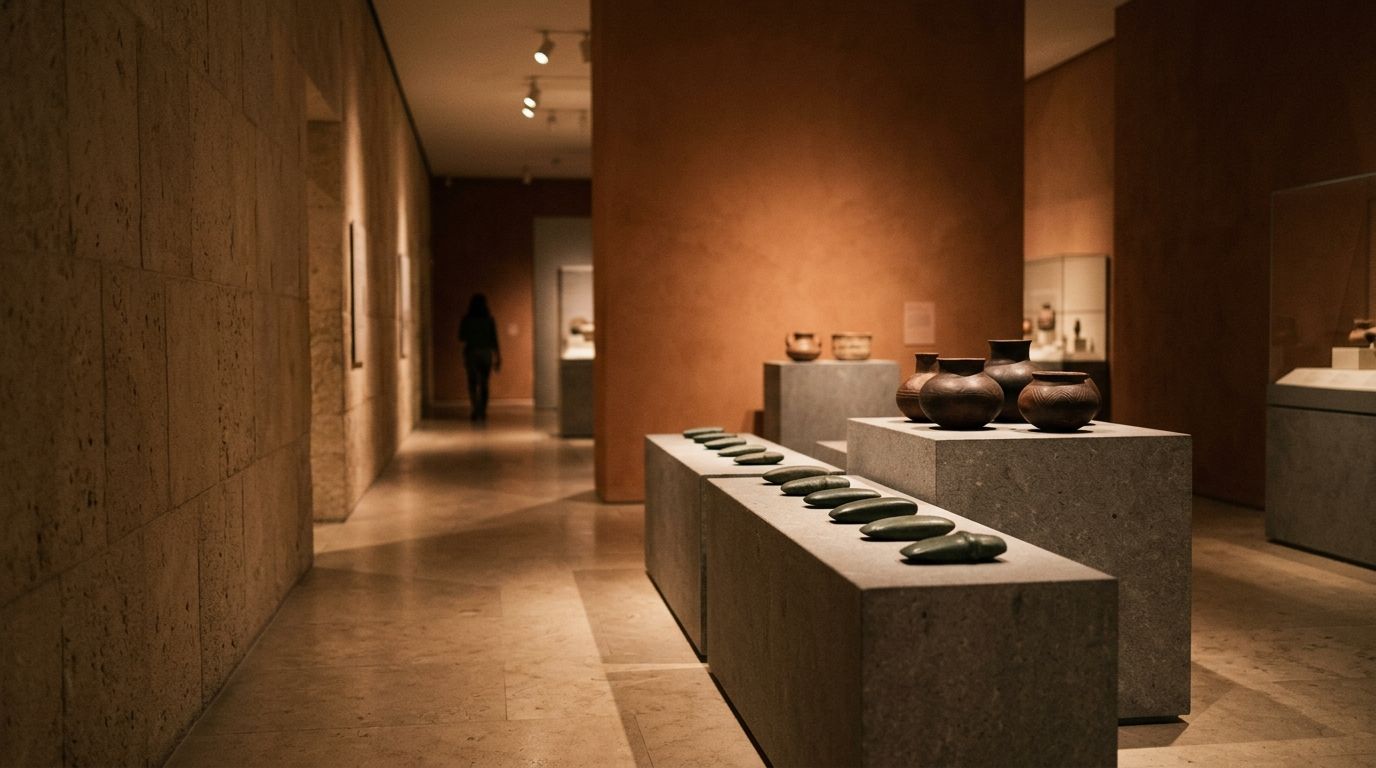
Exhibo Editorial
Pre-Columbian Art
Olmec jade and basalt, Maya court carving, Mexica Tenochtitlan stone, and Andean clay, metal and fibre before European contact
Pre-Columbian art names the visual cultures of Indigenous peoples across the Caribbean, North, Central and South Americas before, and at the first decades of, sustained European contact after 1492. The label is a Western convenience. It groups societies that never shared a single style, language or empire. In practice, museum education and search use it for two dense art histories: Mesoamerica (roughly central Mexico through the Maya region of Guatemala, Belize and neighbouring states) and the Andes (highland and coastal Peru and adjacent zones), with related traditions in the Intermediate Area between them. Makers worked in basalt and jade, painted ceramics, woven fibre, hammered gold and silver, carved bone and shell, and painted architecture that few walls still hold.
This guide stays inside that historical frame: conditions that produced the art, how scholars define and debate the term, close work on Olmec, Maya, Mexica (Aztec), Chavín, Moche and Inca objects with museum locations, and the colonial collecting that moved so many pieces into European and North American galleries. Twentieth-century Mexican mural programmes and later Latin American modernisms borrow Indigenous motifs; those afterlives belong to sibling pages on Mexican muralism and Latin American modernism. The series hub is World Art Traditions. Collections named below also appear in the museums directory.
What “Pre-Columbian” means in museums and scholarship
Curators and archaeologists still use Pre-Columbian (or pre-Hispanic, Ancient Americas, Arts of the Ancient Americas) because catalogues and auction houses long sorted objects that way. The Met’s Michael C. Rockefeller Wing, Dumbarton Oaks in Washington, the Museo Nacional de Antropología in Mexico City, the Museo Larco in Lima and the Museo Chileno de Arte Precolombino in Santiago all organise galleries under related headings. Robert Woods Bliss, who built the Dumbarton Oaks Pre-Columbian Collection between 1912 and 1962, pushed dealers and museums to treat these works as art rather than as ethnographic specimens for natural-history halls. That shift matters for how you meet a jade mask or a Moche bottle today: under spotlights, with wall labels about patronage and ritual, not only under glass cases of “primitive” craft.
The term also carries problems. Columbus did not invent the Americas, and 1492 did not end Indigenous making. Descendants of Maya, Nahua, Quechua, Aymara and many other peoples kept carving, weaving and painting under colonial rule and after independence. Scholars therefore prefer culture names and periods when they can: Olmec Formative, Maya Late Classic, Mexica Late Postclassic, Moche Phase III, Inca imperial. Pre-Columbian art remains useful as a search umbrella and as a museum floor plan. Treat it as a map key, not as proof that every object shares an aesthetic.
Contact itself was staggered. Spanish armies reached Tenochtitlan in 1519–21 and Cusco in the 1530s; Portuguese and other European forces hit other coasts on different clocks. Art made “at contact” includes Mexica sculpture still in production when Cortés arrived, Inca textiles woven under imperial workshops that Spanish officials later redirected, and Caribbean works documented in early colonial inventories. This article stops at those thresholds. It does not turn into a survey of colonial Cuzco painting or twentieth-century indigenismo.
Two geographies, two visual logics
Maize agriculture in Mesoamerica and potato-and-camelid economies in the Andes supported cities, temples and specialist workshops on different calendars. In the Gulf lowlands of Veracruz and Tabasco, Olmec centres at San Lorenzo and La Venta rose between about 1200 and 400 BCE. Classic Maya cities such as Tikal, Palenque and Yaxchilan concentrated power between roughly 250 and 900 CE. In the Basin of Mexico, Teotihuacan dominated the Early Classic with apartment compounds, talud-tablero temples and mural programmes that influenced distant courts; centuries later the Mexica built Tenochtitlan into the capital that Spanish witnesses described in 1519. Along Peru’s north coast, Moche polities flourished from about the first to eighth centuries CE. In the highlands, Chavín de Huántar drew pilgrims centuries earlier; the Inca state then knitted an empire across Andean roads in the fifteenth and early sixteenth centuries.
Art followed those political geographies. Mesoamerican elites prized greenstone, especially jadeite from Motagua sources in Guatemala, and they carved narrative relief on limestone and volcanic stone. Courts painted polychrome ceramics for feasting and burial. Ballgame equipment in stone and ceramic marks a shared ritual sport from Olmec times through Mexica festivals. In the Andes, fibre carried prestige that European viewers often missed: cumbi cloth, featherwork and knotted khipu recorded status and administration beside gold and silver. Coastal deserts preserved ceramics and textiles that highland rains would have destroyed. Museum cases therefore over-represent durable media. You see more stone and clay than painted adobe, more gold than the cotton that once wrapped it.
Trade and pilgrimage moved styles across long distances. Olmec-period ceramics appear in highland Mexican villages far from the Gulf. Chavín imagery travelled on textiles and metal ornaments far beyond Ancash. Later Maya rulers kept heirloom Olmec jades in tombs as proof of deep ancestry. Mexica priests buried an Olmec mask in an offering at the Templo Mayor of Tenochtitlan, two millennia after the mask was carved. Continuity of sacred objects across centuries is part of the art history. The Intermediate Area of lower Central America and northern South America linked the two zones with goldwork and jade exchange; Dumbarton Oaks and other collections treat that corridor as a third gallery story beside Mesoamerica and the Andes.
Mesoamerica: Olmec, Maya and Mexica
Mesoamerica is the densest English-language search cluster under pre columbian art. School curricula and museum blockbusters lean on colossal Olmec heads, Maya hieroglyphic lintels and Aztec stone deities. Those three traditions deserve separate focus, and they still leave out Zapotec Monte Albán reliefs, Mixtec painted manuscripts, West Mexican shaft-tomb ceramics, Classic Veracruz ballgame sculpture and Teotihuacan’s apartment compounds and murals. A single article cannot equal a regional handbook. The three clusters below organise most museum floors and exam syllabi; treat them as doors into denser site literature.
Shared habits recur across the region even when styles diverge. Ballcourts, blood offerings, maize symbolism and ruler portraits travel in different visual dialects from the Formative Gulf to Late Postclassic Tenochtitlan. Greenstone remains a prestige constant. Writing systems mature at different speeds: Olmec and epi-Olmec marks stay sparse; Maya hieroglyphs become a full historical script; Mexica manuscripts combine image and glyph in ways Spanish friars later copied and burned. When you walk a Mesoamerican gallery, ask which of those habits the object serves: plaza display, bodily adornment, tomb furniture, temple warning.
Olmec: first monumental style on the Gulf Coast
Between about 1200 and 400 BCE, communities in Olman (“place of rubber,” in later Nahuatl) built earthen platforms at San Lorenzo and, later, La Venta. The Met’s Olmec essay by James Doyle (2017) stresses two signature media: colossal basalt sculpture and portable jade. Sculptors hauled basalt from distant sources to carve individualised helmeted heads, some over two metres high, still among the most recognisable faces in American art history. Most of those heads remain near their Gulf Coast findspots or in Mexican regional museums; international collections hold more jade masks, celts and ceramic “baby” figures.
Jadeite from the Motagua valley reached Olmec centres in quantity by the La Venta period. Carvers cut greenstone into axes, standing figures and faces with downturned mouths, almond eyes and cleft heads linked to maize and rain symbolism. A jadeite Face in the Met (acc. 1977.187.33, c. 900–400 BCE) shows the polished, mask-like intensity that twentieth-century collectors prized. Dumbarton Oaks holds related Olmec jade that Robert Woods Bliss began buying after he saw a jadeite figure in Paris in 1912. Ceramic arts from San Lorenzo and highland imitators at Tlatilco, Tlapacoya and Las Bocas show how style moved with trade long before writing systems matured.
Olmec makers left few deciphered texts. You read politics from labour: moving multi-tonne stones, burying massive greenstone offerings, staging rulers who emerge from cave-mouth thrones. Later Maya and Mexica elites treated Olmec objects as ancestral prestige goods. That afterlife inside Mesoamerica predates any European museum.
Maya Classic courts: lintels, vessels and hieroglyphs
Classic Maya art (c. 250–900 CE) binds image to writing. Kings and queens commissioned limestone lintels, stelae and painted ceramics that name dates, rites and patrons in hieroglyphs. Yaxchilan Structure 23’s Lintels 24 and 25, carved in the early eighth century for the reign of Itzamnaaj Bahlam III and Lady K’abal Xook, show royal bloodletting with costume detail sharp enough to study weaving patterns. Alfred Maudslay cut Lintels 24 and 25 from their doorways in the 1880s and shipped them to Britain; they now hang in the British Museum’s Mexico gallery. Lintel 26 stayed in Mexico and is shown at the Museo Nacional de Antropología. The removal is part of the objects’ modern biography as much as the bloodletting scene is part of their ancient one.
Painted vessels served as drinking cups for chocolate and as tombside companions. A Met ceramic Vessel with Seated Lord (acc. 1992.4, seventh–eighth century) carries a short name-tag text and a court figure whose elbow overlaps the glyphs, a reminder that Maya scribes treated writing as a living presence in the scene. Palenque’s Temple of the Inscriptions held the burial of K’inich Janaab’ Pakal; his jade mosaic funerary mask is displayed in Mexico City’s Museo Nacional de Antropología, while the carved sarcophagus lid remains at the site under conservation limits. Students meet Maya art as “glyphs and blood.” Walk a room of vessels and you also meet humour, court fashion and the craft of firing thin-walled polychrome clay.
Mexica (Aztec) Tenochtitlan: stone for empire
The Mexica capital of Tenochtitlan, founded in the fourteenth century and expanded through the fifteenth, produced the stone sculpture English speakers still call “Aztec art.” Coyolxauhqui, the moon goddess defeated by Huitzilopochtli, appears as a monumental disk excavated at the Templo Mayor and as smaller greenstone effigies. Harvard’s Peabody Museum of Archaeology and Ethnology holds an Effigy Mask of Coyolxauhqui (c. 1500 CE; acc. 28-40-20/C10108) that presents her severed head with cheek bells; the great Coyolxauhqui Stone itself stays in Mexico City as a centrepiece of Mexica cosmology and imperial warning. Coatlicue and related deity sculptures in the Museo Nacional de Antropología show the same hard, stacked symbolism: serpents, skulls, severed hands, earth as devouring mother.
Mexica artists also worked feathers, gold and manuscript painting. Spanish inventories and early colonial descriptions record feather shields and goldwork melted for bullion. What survives in stone is therefore a biased sample of a richer court culture. Templo Mayor archaeology since the 1970s has rewritten textbooks by recovering offerings that include older Olmec and other heirlooms, proof that Mexica priests curated deep time inside their own sacred precinct.
The Andes: Chavín, Moche and Inca
Andean art histories run on different clocks and media. Highland pilgrimage centres, coastal desert tombs and Inca state workshops each left distinct museum silhouettes. Gold draws headlines; textiles and ceramics carry most of the visual archive that drought and altitude allowed to survive. Nasca polychrome pottery and geoglyphs, Paracas embroidered mantles, Wari tunic designs and Chimú urban metalwork belong in any fuller Andean survey. This page stays with three nodes that structure teaching collections: Chavín as an early horizon of shared sacred imagery, Moche as a coastal ceramic boom, and Inca as the late imperial system Spanish invaders met.
Altitude and aridity shape what you see. Coastal tombs yield organic fibre and painted clay that highland rains destroy. Highland stone temples keep monoliths in place while portable gold travels into foreign cases. Spanish melting stripped many metal assemblages; museum gold is therefore a rescued minority of a larger lost inventory. Read Andean rooms with that bias in mind. A textile fragment can outrank a gold figurine in original prestige even when the spotlight favours shine.
Chavín de Huántar: pilgrimage image and stone sound
Chavín de Huántar, in Peru’s Ancash highlands, flourished as a ceremonial centre from the late Initial period into the Early Horizon (roughly first millennium BCE). The Lanzón, a granite monolith about 4.5 metres tall, still stands in an interior gallery of the Old Temple: a fanged, anthropomorphic deity with contour lines that read differently as your eye moves. Tenon heads once studded exterior walls, staging faces mid-transformation between human and animal. Canals channelled water through the platform so that galleries roared during ritual. Portable Chavín-style textiles, metal ornaments and ceramics spread the visual language across the Andes. Site museums in Chavín and national collections in Lima hold carved stones and related works; Dumbarton Oaks and other research collections preserve Chavín-period gold and silver that show how metalworkers translated the style into personal adornment.
Moche: portrait ceramics on the north coast
Moche societies of Peru’s north coast (c. 100–850 CE) left thousands of mould-made ceramic vessels. Stirrup-spout bottles carry fineline painted narratives of ceremony, warfare and myth; sculptural bottles render animals, plants and human faces with portrait particularity. Christopher Donnan’s research, archived in part at Dumbarton Oaks, mapped recurring individuals across vessels, arguing that some faces record known persons. Burial contexts complicate that reading: some scholars treat the heads as honouring the dead or staging ritual decapitation. A Met Portrait Head Bottle and peers in the Museo Larco (Lima) and Museo de Arte de Lima let you test both ideas in clay. Moche metalwork from elite tombs at Sipán, looted in the late 1980s and partly recovered through international cases, shows how tomb robbery still feeds the illicit market that museums and source nations fight.
Inca: empire in cloth, stone and metal
The Inca (Inka) state of Tawantinsuyu, expanding through the fifteenth century until Spanish conquest in the 1530s, organised art as administration. Ashlar masonry at Cusco, Machu Picchu and administrative centres fitted stones without mortar to earthquake-prone highlands; walls still show the bevelled joints tourists photograph. State workshops produced standardised polychrome ceramics and cumbi textiles whose patterns marked rank across a road network that moved goods and labour. Hammered gold and silver figurines, often found in capacocha mountain offerings, represent humans and camelids in spare, frontal form rather than Moche portrait particularity. Khipu cords recorded census and tribute data in knots; few museum visitors treat them as “art,” yet they belong to the same bureaucratic visual culture as the cloth. Spanish chroniclers described warehouses of textiles that outvalued metal in Andean prestige systems. Colonial melting destroyed gold; arid tombs and highland dry storage saved cloth that now fills museums from Lima to Washington. When you meet an Inca figurine under glass, ask what textile once accompanied it in the offering bundle.
Materials and making
Stone carving in Mesoamerica ran from Olmec basalt to Maya limestone to Mexica andesite and greenstone. Tools were themselves stone, wood and abrasive sand; polish on jadeite required patience measured in days, not hours. Drill holes on masks and pendants show string-saw and reed-drill methods that leave characteristic scars under raking light. Ceramic technology ranged from Olmec whitewares and blackwares to Maya polychrome slips and Moche mould production that could multiply a portrait face across a workshop. Andean metalworkers hammered, annealed and depletion-gilded surfaces centuries before European contact. They joined sheets with solder and raised relief without the lost-wax dominance European viewers expected. Featherworkers glued and tied iridescent plumage into shields and mosaics that Spanish observers ranked with gold.
Architecture was painted. Bonampak’s Classic Maya murals and fragments from Teotihuacan and Moche huacas prove that colour once covered walls visitors now meet as bare stone or adobe. Pigments included Maya blue (indigo fixed in palygorskite clay), cinnabar, hematite reds and carbon blacks. Mural fragments in museums are scraps of larger programmes; site visits still beat vitrine slices for spatial sense. Fibre arts in the Andes used camelid wool and cotton in tapestry, embroidery and openwork. Dyes from cochineal, indigo and local plants set the palette that later colonial workshops inherited.
Conservation labs now treat Pre-Columbian objects as chemically active: soluble salts in ceramics, bronze disease on copper alloys, light damage on textiles, and consolidants from older restorations that yellow or fail. Technique talk in galleries has shifted from “primitive craft” to workshop science. When a label names Motagua jadeite or north-coast clay, it is mapping trade as much as beauty.
Four works to read slowly
Named objects beat abstract period labels. Period essays teach systems; close looking teaches how a single workshop solved a problem of scale, costume or face. The four works below are public, photographed and stable enough for study notes. Two sit in European or United States museums because of twentieth- or nineteenth-century collecting; two keep their primary identity in Mexican institutions even when smaller cousins travel. That split is deliberate. You should practise reading form and reading custody on the same visit.
Confirm display status before travel. Loans, seismic upgrades and conservation closures move pieces off view without warning. Site museums near San Lorenzo, Palenque, Chavín and Sipán reward the extra journey when gallery versions feel thin. Use published accession numbers when you cite a Met or British Museum object; titles shift in translation more than catalogue numbers do.
Jadeite face and Gulf Coast heads
Stand an Olmec jadeite mask beside photographs of San Lorenzo’s colossal heads and you see one sculptural intelligence at two scales. The portable face concentrates downturned mouth and drilled features into a handheld presence that could travel in a bundle or on a costume. The basalt heads keep individualised helmets and fleshy cheeks at architectural scale, proof that Gulf Coast patrons funded both intimate regalia and plaza monuments. Museum jade often entered collections through twentieth-century dealers; the heads’ Mexican site contexts keep political geography visible. Read them together: hierarchy of materials, hierarchy of space.
Yaxchilan Lintel 24 (British Museum)
Look up into Lintel 24 as a doorway lintel once forced you to do. Lady K’abal Xook pulls a thorned cord through her tongue while Itzamnaaj Bahlam III holds a torch; blood falls toward a basket. Hieroglyphs and a sculptor’s signature (Mo’ Chaak) frame the act as dated court history. Costume edges show pearls and woven pattern. Maudslay’s saw cuts turned a Chiapas doorway into a London wall display. The carving remains a summit of Maya relief; its gallery label should also carry the story of removal. Compare Lintel 26 in Mexico City when you can: same Structure 23 programme, different modern custody.
Coyolxauhqui at the Templo Mayor
The Coyolxauhqui Stone presents the goddess dismembered, limbs arranged in a radial composition that Mexica viewers met at the base of Huitzilopochtli’s temple. Political allegory and cosmic myth share one disk: defeated moon, defeated enemy. Smaller greenstone heads, including the Peabody’s portable mask, carry the same identity for other ritual settings. Excavations that uncovered the stone in 1978 also recovered layered offerings that rewrote how scholars understand Mexica curation of older sacred art. Stand before the disk and you stand inside an imperial programme that used sculpture as public threat and theology at once.
Moche portrait bottle
Pick a well-published portrait vessel in the Met or Museo Larco. The face is asymmetrical enough to feel like a person: scar, lip shape, ear ornament. The stirrup spout turns the head into a functional bottle for liquid, likely for burial or ceremony rather than daily table use. Donnan’s corpus shows some faces repeating across moulds; Weismantel and others stress mortuary meaning over likeness. Either way, Moche ceramists treated the human head as a primary sculptural problem centuries before European portrait conventions reached Peru. Hold that against Inca frontal figurines: two Andean answers to representing persons under different political systems.
Cultures, dates and where to see them
Use the table as a study and visit scaffold. Dates are rounded consensus ranges; regional phases overlap. Confirm opening hours and whether key works are on view.
| Tradition | Rough dates | Core region | Signature forms | Where to see examples |
|---|---|---|---|---|
| Olmec | c. 1200–400 BCE | Gulf Coast Mexico (Veracruz, Tabasco) | Colossal basalt heads; jade masks and celts; ceramic figures | Site museums near San Lorenzo/La Venta; Met; Dumbarton Oaks; Mexican regional museums |
| Maya Classic | c. 250–900 CE | Southern Mexico, Guatemala, Belize, western Honduras | Limestone lintels and stelae; polychrome vessels; jade mosaics | British Museum (Yaxchilan lintels); Museo Nacional de Antropología; Met; Palenque site museum |
| Mexica (Aztec) | c. 1325–1521 CE | Basin of Mexico / Tenochtitlan | Deity stone sculpture; Coyolxauhqui imagery; temple offerings | Museo Nacional de Antropología; Templo Mayor Museum; Met |
| Chavín | c. 900–200 BCE (site peak debated) | Ancash highlands, Peru | Lanzón monolith; tenon heads; related textiles and metal | Chavín de Huántar / Museo Nacional de Chavín; Lima national museums; Dumbarton Oaks metals |
| Moche | c. 100–850 CE | North coast Peru | Portrait and fineline ceramics; elite goldwork | Museo Larco; Museo de Arte de Lima; Met; Sipán displays in Lambayeque |
| Inca | c. 1400–1530s CE | Andes (Cusco heartland to empire edges) | Ashlar architecture; cumbi textiles; gold/silver figurines; khipu | Cusco and regional site museums; Lima collections; Met; Dumbarton Oaks |
Collecting, display and colonial removal
Most Pre-Columbian objects in European and North American museums arrived through excavation, purchase, gift or seizure after contact. Spanish conquest melted gold and shipped codices and featherwork across the Atlantic; mendicant chroniclers both preserved and filtered Indigenous knowledge in text. Nineteenth-century explorers such as Alfred Maudslay cut Maya monuments for British collections under permits that today’s heritage law would refuse. Teobert Maler and others photographed and removed further sculptures in the same decades. Early twentieth-century dealers supplied Robert Woods Bliss, Nelson Rockefeller and parallel collectors while national archaeologies in Mexico and Peru were still consolidating export controls. Bliss’s insistence on aesthetic quality helped open art-museum doors at the National Gallery of Art and later at Dumbarton Oaks; it did not erase the extraction that filled those doors. Philip Johnson’s 1963 Pre-Columbian Gallery at Dumbarton Oaks staged the collection as crystalline art, a landmark of display history that still shapes visitor expectations.
National museums in Mexico City, Lima, Bogotá and Santiago now hold primary collections and claim interpretive authority. The Museo Nacional de Antropología (1964) and the Templo Mayor Museum made Mexica and Maya sculpture central to Mexican civic identity. Peru’s Museo Larco and national museums similarly frame Moche and Inca art for domestic and tourist publics. Repatriation cases continue: looted Moche gold has returned to Peru through US legal actions; Mexico pursues illicit market pieces abroad; Indigenous communities press museums on sacred items and human remains. UNESCO conventions and bilateral agreements since the 1970s changed the baseline for new acquisitions even when older holdings stay put.
Wall labels that once said only “Mexico, 800 CE” now more often name culture, site and acquisition path. You should read provenance lines as part of the art history. Dealer sites still rank high in search for pre columbian art; this page is a museum-education counterweight, not a buying guide. Authentication of pottery for private sale is a specialist forensic problem outside this fence. Forged “pre-Columbian” ceramics circulate widely; thermoluminescence and stylistic analysis belong to labs and reputable museums, not to a general explainer.
Continuity after contact, without leaving the fence
Indigenous makers kept working after 1492. Colonial workshops folded Andean weaving into church textiles and liturgical vestments; Nahua painters produced maps, land titles and manuscripts under Spanish patronage; Maya communities continued ceramic and textile traditions in highland Guatemala and Yucatán. Featherwork techniques survived in Christian contexts. Those continuities matter because they refute the idea of a clean break at contact. They also belong to colonial and modern Latin American art histories that this series covers elsewhere.
Rivera and his peers later put Mexica and Maya bodies on ministry walls as post-revolutionary pedagogy. That twentieth-century public programme is Mexican muralism, not Pre-Columbian art. Hemisphere-wide modernisms after independence, from Mexican School easel painting to South American avant-gardes, are Latin American modernism. Keep the chronological fence tight so each page can go deep. A Mexica Coyolxauhqui disk and a Rivera National Palace stair share iconographic ancestry; they do not share patronage, technique or audience.
Scholarship itself changed the field. Hieroglyphic decipherment since the mid-twentieth century turned Maya art from mysterious decoration into historical document naming rulers and rites. Templo Mayor archaeology revised Mexica religion from chronicler paraphrase to excavated sequence of offerings. Andean textile studies elevated fibre to equal status with metal in exhibition design. Gendered readings of Lady Xook’s lintels, queer readings of certain Moche ceramics, and Indigenous curatorial voices all shift what “masterpiece” means on a label. The objects stay; the questions move. For exhibition calendars and collection pages that track those shifts, use the museums directory alongside this guide.
FAQ
What counts as Pre-Columbian art?
Museums use the term for Indigenous visual arts of the Americas before, and at, early European contact. In gallery practice that usually means Mesoamerican and Andean objects from Formative through Contact periods, plus related Caribbean and Intermediate Area works. Prefer specific culture names when you can; keep Pre-Columbian as the umbrella that search engines and floor plans still use.
Is “Aztec art” the same as Mexica art?
English sources often say Aztec for the empire centred on Tenochtitlan. Specialists prefer Mexica for the people of that capital and use Aztec for the broader Triple Alliance system. In museum labels you will meet both. The Coyolxauhqui Stone and Coatlicue sculptures are Mexica works from the decades before Spanish conquest.
Where can I see Olmec colossal heads?
Most remain in Mexico, near Gulf Coast sites or in regional museums; they rarely travel. International museums more often show Olmec jade and ceramics. Pair a Met or Dumbarton Oaks jade face with published photographs of San Lorenzo and La Venta heads when you study scale.
Why are so many Maya lintels in the British Museum?
Nineteenth-century explorers removed several Yaxchilan lintels, including Lintel 24, and shipped them to Britain. They remain on display in London. Companion lintels from the same building are in Mexico. The split custody is a standard teaching case for colonial collecting ethics beside formal analysis of the carvings.
Did Andean cultures value gold more than cloth?
Spanish conquerors melted gold and wrote about it at length. Andean prestige systems ranked fine cumbi textiles and featherwork among the highest gifts and warehouse goods. Museum cases heavy with metal can mislead; textile galleries and khipu displays correct the imbalance when institutions give them space.
How does Pre-Columbian art relate to Mexican muralism?
Muralists in the 1920s and after cited Mexica and Maya imagery as national ancestry on public walls. That citation is modern political art, funded by post-revolutionary ministries. Study the older sculptures and vessels on their own terms here; follow the mural afterlife on the Mexican muralism page.
Are objects still being looted?
Yes. Archaeological sites in Mexico, Peru and elsewhere face ongoing looting that feeds private markets. Museums and source nations share databases and legal tools; private buyers who ignore provenance risk handling stolen heritage. This article points you to documented museum collections rather than to the trade.
What should I read or visit first?
Start with one Mesoamerican room and one Andean room in a single museum if you can: the Met’s Ancient Americas galleries, Dumbarton Oaks’ Pre-Columbian Gallery, or the Museo Nacional de Antropología. Add the British Museum’s Yaxchilan lintels or Lima’s Museo Larco when travel allows. One culture seen in depth beats ten cultures seen as postcards.
Related reading
Sharjah Biennial 17 Unveils Curatorial Vision and Opening Schedule
Angela Harutyunyan and Paula Nascimento frame the 2027 edition around archival residue and spatial memory
The seventeenth iteration of the Sharjah Biennial runs from January to June 2027, presenting a dual curatorial methodology that examines historical legacies and infrastructural critique across multiple emirate locations.
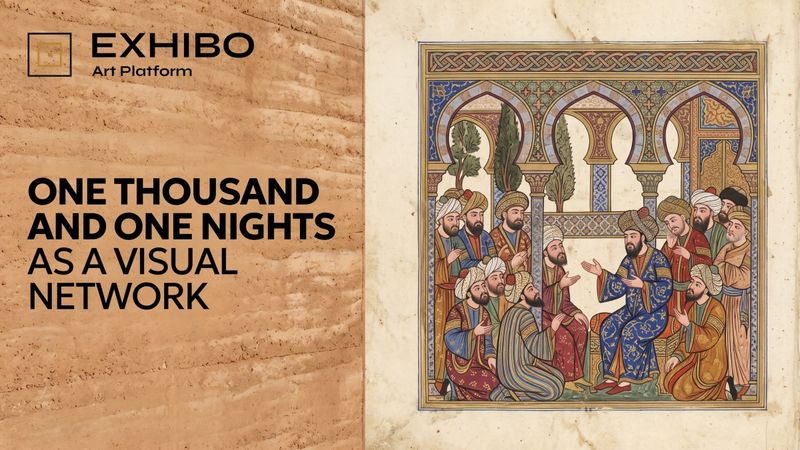
One Thousand and One Nights as a Visual Network
The book that taught Europe to picture the East arrived with no pictures at all. Three centuries of illustrators — Dutch, Egyptian, Persian, French, German, Iraqi — each gave it a face, and every face was a self-portrait.
Open Galland's Thousand and One Nights, the edition that conquered Europe, and there is nothing to look at: no genie, no lamp, not one illustration. The most visually imagined book in the world began blind — and because its text was never fixed either, no picture of it could ever be a copy.
Curating Tomorrow's Archive: Hamburger Kunsthalle Seeks Contemporary Collections Lead
A new permanent appointment will steer the museum's post-1960 holdings across paper, photography, and media formats.
The Hamburger Kunsthalle is inviting applications for a senior curatorial position focused on contemporary acquisitions, exhibition strategy, and digital collection management. Applications close October 2026 for a January 2027 start.