
Exhibo Editorial
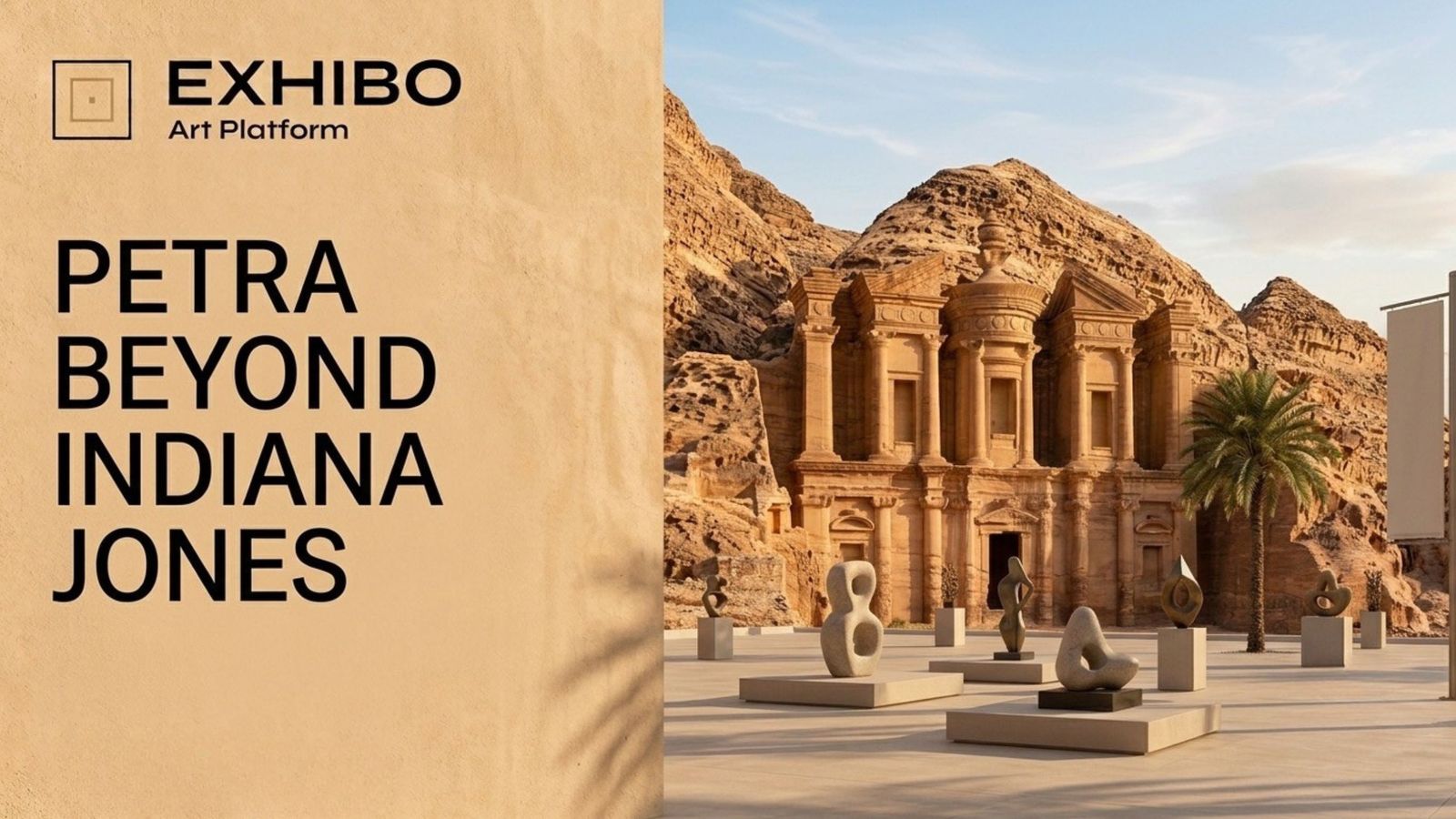
Petra Beyond Indiana Jones
The 1989 film gave Petra a façade and invented everything behind it. The real story is in the water systems, the aniconic sculpture, the painter who framed your photograph in 1839 and the families moved out so the world could come in.
Everyone knows the shot. Almost nobody knows the city behind it — the water engineering, the aniconic sculpture, the painter who framed your photograph in 1839, and the families who were moved out so the world could come in.
Here is the thing about the Grail temple in Indiana Jones and the Last Crusade.
There isn't one.
Spielberg's crew filmed in Jordan for a few days in 1988 — the horseback ride down the Siq, the reveal of the façade, the final shot of four riders going out into the light. Then they flew home, and production designer Elliott Scott built the interior on a soundstage at Elstree in Hertfordshire. He had to. The inside of Al-Khazneh is a plain undecorated chamber — a squarish room cut into rock, with two smaller side rooms. No columns, no traps, no knight. Nothing.
So the interior audiences remember as Petra was built in England, and the real one is an empty box in Jordan.
Sit with that for a second, because it is a perfect miniature of the whole problem. The film gave Petra a façade and then invented everything behind it. Visitor numbers roughly tripled in the years after the 1989 release, and the site now takes more than a million people a year, and the overwhelming majority of them walk twenty minutes down a gorge, photograph one wall, and walk back out.
The wall is real. The mystery behind it is not where the film put it.
It is under the ground, in the plumbing, in five reliefs carved by workmen for their own god, and in a village on a ridge four kilometres north where several hundred people are still arguing about a decision made in 1985.
This piece is about that.
The unexcavated majority
Start with the proportion that reframes everything else. Researchers working at the site estimate that a substantial majority of Petra remains unexcavated — buried under sand, collapse debris, and two thousand years of wadi flood deposits. Specific percentages circulate in press coverage without a clean primary citation, so the honest version is the qualitative one: most of this city has never been dug.
The global image of Petra is drawn from what is above ground. And not even from that: it is drawn from a single object within it, one façade among more than eight hundred carved monuments spread across an archaeological park of roughly 264 square kilometres.
Two corrections before we go further, both of which the film cheerfully ignored and both of which matter.
The Treasury was never a treasury. The name is a later Bedouin one, attached to a legend that a pharaoh's gold was sealed inside the stone urn on the upper storey. People shot at the urn to break it open. You can still see the bullet damage. The building itself is most likely a mausoleum, plausibly for King Aretas IV, carved around the first century AD.
The same applies to Ad-Deir, "the Monastery," and Burckhardt understood this in 1812. He wrote that el-Deir, "the convent," is a word often applied by Arabs to any ruined building in which they suppose that the priests of the infidels once resided.
The names on the map are guesses made by people walking past. We have been repeating them for two centuries and building films on top of them.
The tomb under the shot
In August 2024, a team from the University of St Andrews, Jordan's Department of Antiquities, and the American Center of Research ran electromagnetic conductivity and ground-penetrating radar in front of the Treasury.
They were not treasure hunting. They were assessing the ground for flood mitigation planning — the Siq floods, dangerously, and managing that is ordinary heritage work. The survey flagged probable underground chambers, and an excavation plan followed.
They found a tomb holding twelve complete skeletons with grave goods still in place: bronze, iron, ceramic.
Twelve intact burials, metres from where several thousand people stand every day taking the same photograph.
Pearce Paul Creasman, executive director of the American Center of Research, reached for the strongest phrasing available to him: in two centuries of archaeological investigation at Petra, he told Live Science, nothing like this had been found. Take that as an excavator's assessment of an unusual find rather than a settled ranking of Petra's discoveries — the site has produced other major results, and specialists would argue the order. What is not in dispute is the scarcity of the material itself. Professor Richard Bates, the St Andrews geophysicist who led the survey, told NPR that of all the tombs in the Petra area, only a few have ever contained human remains at all, and those were very fragmentary — whereas this one held twelve complete bodies. He called the find internationally significant, noting that very few complete early Nabataean burials have ever been recovered here.
Nabataean funerary practice is one of the largest holes in the record. We have the tombs. We have almost never had the dead. Now there is skeletal and dental material to run for diet, disease, and kinship — Bates noted that analysing the bones and teeth will reveal things about how these people actually lived. Tim Kinnaird of the St Andrews School of Earth and Environmental Sciences dated the sediments around the burials and the tomb enclosure, which fixed construction dates for the wall.
Then the part that belongs in this story rather than outside it, because leaving it out would be dishonest.
The dig was filmed for the season premiere of Discovery's Expedition Unknown, with presenter Josh Gates in the trench. One skeleton was found holding a ceramic vessel that Gates said looked nearly identical to the Holy Grail from the film. On closer examination it turned out to be the top of a broken jug.
Of course it did.
But notice the loop that closes there. A 1989 film invents a Grail chamber at Petra, on a soundstage. Thirty-five years later, a real excavation under the real façade is financed and narrated through that same film, and a genuine Nabataean sherd gets read for a moment as the prop. Creasman's own framing of the stakes is the honest version, and it is better than any of it: there is still so much we have yet to learn about the Treasury — when it was built, and why.
Gates, standing in front of the most photographed building in the Middle East, said the thing that should be printed on the ticket: even in front of one of the most famous buildings in the world, there are still huge discoveries to be made.
The Nabataeans were hydraulic engineers who happened to carve
Now leave the façade, because the actual achievement is behind you and above your head.
Walk back up the Siq and look at the walls instead of the end of them. There is a channel cut into the rock at about waist height, running the length of the gorge. Follow it. A few hundred metres on, it is above your head — the road drops sharply over that kilometre while the channel descends slowly and deliberately, holding its gradient, so that water arriving in the city centre still carries pressure.
Somebody calculated that. In a basin that receives perhaps 150 millimetres of rain a year.
The core scholarship here belongs to Charles R. Ortloff, a working hydraulic engineer who spent years applying computational fluid dynamics to Petra's archaeological remains — publishing in the Cambridge Archaeological Journal in 2005, the Journal of Archaeological Science in 2014, and the open-access journal Water in 2020. It is the rare case of an engineer reading an ancient city as a technical document, and the results changed the field.
Roman water engineering ran on pressure. Full pipes, closed systems, and a permanent war against leakage. The Nabataeans went the other way.
Ortloff's analysis found a system designed for partial flow — pipes deliberately not running full, held at critical velocity, the specific rate at which a channel carries its maximum possible volume. Sequential particle-settling basins purified the potable supply. Reservoir capacity was matched against pipeline capacity, and pipeline capacity against the actual seasonal yield of the springs. No pressurisation meant no pressure leakage, which in a desert is not an efficiency preference. It is the difference between a city and a campsite.
The Siq pipeline works in consecutive sections, each holding partial critical flow independently, keeping leakage low while throughput stays at maximum. The Wadi Mataha line was cut at precisely the angle required to draw the maximum rate from its reservoir.
Then the detail Ortloff describes as not previously reported in the literature. On the 'Ain Braq branch, an offshoot segment runs to a collection basin set alongside the main supply line and connected to it. Two steep pipelines fed a residential quarter. Steep pipelines generate downstream flow instability; instability sends surges back up the line; surges break things.
The basin absorbs them.
They built a surge tank — not the first people in the ancient world to reason about unsteady flow, and the claim worth making is not one of priority. Greek, Persian and Roman engineers all solved hard hydraulic problems, and Ortloff himself allows that Nabataean practice may incorporate knowledge gathered through contact with cities of the Mediterranean and the Orient. The claim is about conditions. Those other engineers worked with rivers, aquifers, and rainfall they could afford to lose. The Nabataeans were tuning surge behaviour in a basin where a ruptured line meant a quarter of the city went dry, and where the nearest replacement water was a day away.
Precision is easy when you have a margin. This was precision instead of one.
The small details are as good as the large. Ceramic pipe sections joined with tapered ends — a coupling solution European engineering arrived at maybe two hundred years ago. Hundreds of underground cisterns across the city. Barrages diverting flash floods, conduits and aqueducts moving spring water across kilometres of broken terrain, sealed cisterns for long storage. And beyond the city, agricultural runoff terraces in the eastern highlands, dated by Beckers and colleagues in 2013 using optically stimulated luminescence and radiocarbon.
Which means Petra is not a city with a water system. It is an engineered region with a city in the middle of it.
Ortloff's conclusion is worth quoting for its restraint: this demonstration of engineering capability indicates a high degree of cognitive skill in solving complex hydraulic problems, and may be posited as a key reason behind the many centuries of flourishing city life.
The picture is still being revised. A 2026 survey by Niklas Jungmann of Humboldt-Universität zu Berlin covered a 2,500-square-metre sector of the Jabal al-Madhbah massif where sections of the 'Ain Braq aqueduct survive, and found a more complex design than earlier work suggested — including lead piping. Lead points outward, toward Mediterranean and Roman technical contact, which complicates any tidy story of purely indigenous invention.
It should. Nobody engineers in isolation.
The part that is actually art
Now the move that makes infrastructure legible as culture.
They spent it.
Leigh-Ann Bedal's excavation identified a monumental garden and pool complex at the heart of the city — a Hellenistic paradeisos, the Persian-derived royal pleasure garden that gave English the word paradise. Baths. Fountains. Water features inside temples. The scholarship on the network notes that stored water served animals, agriculture and domestic use, but also decorative fountains and religious ritual.
Think about what that means as a gesture. You are in a desert basin. Every litre arrived through kilometres of hand-cut channel maintained by people who could not afford a mistake. And you take some of it, and put it in an open pool, in the sun, in front of an audience, where it will evaporate.
That is not waste. That is the most expensive sentence a Nabataean king could speak, and every caravan merchant arriving from the incense route understood it instantly.
Rome built aqueducts and then built fountains to prove the aqueducts worked. Petra did the same thing with a hundredth of the water and a thousand times the difficulty.
The Treasury is a façade. The pool was an argument.
Two visual languages, held at once
Nabataean sculpture is where the standard art-historical narrative fails most usefully — and where the film's instinct, that this is a Greek temple with something Christian inside, gets almost exactly backwards.
The Nabataeans worshipped their gods as betyls: aniconic stone blocks, from the Semitic bet-el, house of god. Rectangular and non-figural, sometimes with nothing but stylised eyes and a nose, in the manner of Aramaic and South Arabian face stelae. They appear in relief and in the round, alone and in groups, in niches cut across the whole site. You will walk past dozens without registering them.
The definitive survey — Merklein and Wenning, "The Betyls of Petra," BASOR 324 (2001) — did something better than cataloguing. Working from the Nabataean inscriptions attached to betyls, they established that the betyl indicates the divine presence of whatever deity is being represented, and is not restricted to Dushara and al-'Uzza. In Wadi as-Siyyagh there is an eye-betyl identified by inscription as the Syrian goddess Atargatis. Elsewhere, other names.
Which makes the betyl less like a statue and more like a grammatical marker. Not this is the god. Closer to the god is here.
The framing carries the other language entirely. At Sidd al-Ma'ajin, a niche is cut as a full aedicula: pilasters with bases and capitals supporting an architrave, a frieze, and a triangular pediment with acroterion bases. Inside that classical apparatus, in a deep recess framed by an arch — a plain rectangular block.
Mediterranean architecture, Levantine-Arabian content. That is worth stating precisely rather than loosely, because the Nabataeans do not sit tidily in either column: an Arab people who wrote in Nabataean Aramaic — the script from which written Arabic later descends — ruling a kingdom that ran from the Hauran through the Negev to Hegra in what is now Saudi Arabia, trading into Alexandria and Rome, and absorbing Hellenistic form without becoming Hellenistic. That combination is Nabataean art, and there is no better single object to explain it. It is also what Al-Khazneh itself is doing at monumental scale, which nobody in the film mentions.
For a long time the assumption was developmental: aniconic first, then Greco-Roman contact, then proper statues, progress. The evidence does not cooperate. Work on the Great Temple identifies eight relief panels dated across the first three-quarters of the first century CE that fuse Arabian, Near Eastern and Hellenistic-Roman traditions simultaneously — shaped, the argument runs, by political messaging and cultural exchange between roughly 87 BCE and 40 CE. Well-preserved limestone betyls sit in the same complex.
Not sequence. Coexistence.
The study of the Isis cult published in Syria pushes harder and lands the point: the idea that aniconic and anthropomorphic modes carried some kind of opposing significance cannot be maintained, particularly given the sculptural arrangement of the Isis sanctuary in Wadi Siyyagh. Rather than reducing the variety of forms and matching each to a known deity, the author argues, we should emphasise the variety itself and what it shows of personal devotion. The same paper notes that individual deities did not necessarily require a particular niche shape or type, and that orientation was determined largely by topography rather than doctrine.
Read that as a working artist would. There was no rulebook. There was a repertoire, and people chose from it according to place, purpose and private need.
Dushara headed the pantheon — associated with the kings, the sun, and the protection of the city, his cult attested from around 96/62 BCE, honoured at Qasr al-Bint and at sanctuaries across the kingdom. A late antique source preserved in the record describes his cult image: a black stone, rectangular, unhewn, four feet tall and two wide, standing on a base of gold, with the blood of sacrificial animals poured over it. Elsewhere he has a Hellenistic face, full of movement, fleshy and vivacious.
And one detail reorganises the entire category. All the statues set up during the Nabataean kingdom represent members of the royal dynasty.
So the figurative mode was not religious art. It was political portraiture. The gods stayed stone.
The masons had their own god
The best-kept secret in Petra's sculpture is not on any façade, and no camera has ever pointed at it.
Five rock-cut reliefs, set high on the walls of quarries and monuments, show a standing male figure with betyls. A related group is known as the "sword deity" figures. The contextual argument is that both types were carved by the Nabataean stonemasons themselves — a tutelary deity of the men doing the cutting, most likely Dushara, from whom they sought protection.
Not commissioned. Not sited for viewers. Placed where the work was, by the people doing it, above the quarry face.
Everything else in Petra was paid for by somebody. This was not.
If you want the human being inside the rock rather than the archaeologist in the hat, that is where to look.
A rose-red city, written by a man who had never been
The Nabataean kingdom was annexed by Rome in 106 CE under the governor Cornelius Palma and became the province of Arabia Petraea. The city carried on, then declined — earthquakes, trade routes shifting toward the sea, Palmyra taking the overland business. Byzantine churches were built and abandoned. Crusaders put a castle at al-Wu'ayra.
And then Europe stopped thinking about it for roughly six hundred years.
Not the region. Europe. The distinction gets flattened constantly, and the film flattens it hardest of all — the whole premise of a "lost" city waiting for a Western academic to arrive is doing colonial work whether or not anyone intended it.
The valley below is Wadi Musa, the valley of Moses. The mountain above holds Jabal Harun, the tomb of Aaron, a functioning Islamic pilgrimage site. There was never a gap in the sacred geography here. There was a gap in the European archive, and we have spent two centuries describing the second as though it were the first.
Which brings us to 22 August 1812, and to a young Swiss traveller who had spent years in Aleppo learning Arabic, taken an Arabic name and lived as a local well enough to pass. Johann Ludwig Burckhardt was working for the African Association, en route to Cairo to find a caravan to Timbuktu, and he kept hearing about a ruined city near the tomb of the Prophet Aaron.
He could not simply ask to see it. So he arranged to sacrifice a goat at Aaron's tomb — a plausible errand for a Muslim traveller — and got himself walked up the valley. He had roughly one day. He recognised what he was looking at from Roman accounts of Arabia Petraea, wrote it down, and left. Travels in Syria and the Holy Land appeared in 1822, five years after he died in Cairo at thirty-two.
Note the mechanics of the discovery. Burckhardt did not find an empty city. He was guided to an inhabited one by people who had always known it was there — early travellers, Burckhardt among them, recorded the Bdoul as guardians of the site. The discovery consisted of a European arriving, in disguise, and writing it down in a language European institutions read.
The first accurate drawings came in 1828, from Léon de Laborde and Linant de Bellefonds, published as Voyage de l'Arabie Pétrée. Laborde described the ascent to Ad-Deir: roads cut wide through the rock, cascades stripped of their ruggedness, a staircase running more than fifteen hundred feet.
Then, in Oxford, a man who had never left England wrote the sentence that would sell the place for the next two centuries.
John William Burgon's poem Petra won the Newdigate Prize in 1845 and contains the phrase every guidebook still uses: a rose-red city half as old as time.
Burgon assembled it from other people's pictures and other people's books. He did not see Petra until 1862 — seventeen years later — and by report noticed on arrival that the stone is not, in fact, rose-red. It runs ochre, cream, grey, purple, banded and streaked, and turns properly red only in certain light at certain hours. (That anecdote is well attested in secondary literature; I have not chased it to a primary source, and you should know that before repeating it.)
The image arrived before the experience, and then stood in for it.
Which is exactly what happened again in 1989. And once before that, in 1839.
David Roberts, or why Spielberg was shooting a lithograph
David Roberts (1796–1864), the Scottish Orientalist painter whose Near East plates became the standard Victorian image of the region, reached Petra in 1839. He is the reason you know what it looks like.
The Metropolitan Museum notes that he travelled as the first professional artist to visit the Near East without a patron, without a connection to a military expedition, without a missionary group. He worked through Egypt, Suez, Sinai, Petra, Gaza, Jerusalem, the Dead Sea, Baalbek and Alexandria. Back in Britain he spent 1842 to 1849 producing, with the lithographer Louis Haghe, some 250 plates published in instalments as The Holy Land, Syria, Idumea, Arabia, Egypt and Nubia. He and his publisher Francis Graham Moon raised the money by exhibiting the original watercolours to prospective subscribers. Queen Victoria became one.
Here is the fact that unlocks everything.
Before he was a topographical painter, Roberts was a house painter and then a theatrical scene painter — Drury Lane, opera at Covent Garden. He was elected president of the Society of British Artists in 1831. Turner, Constable and Landseer thought highly of him, and it was Turner who advised him to commit to fine art.
Booksellers' catalogues describe the plates in a phrase worth keeping: highly detailed and theatrical, enmeshing orientalist sentiment with architectural accuracy.
Set and survey, in the same image. That is the whole method.
A scene painter approaches a gorge that opens onto a monument as a wing-and-drop reveal, because that is his trade. The corridor is the approach. The façade is the drop. The tiny figures are placed for scale exactly where a designer would put them. His Ad-Deir made that monument popular with the public at large. His Al-Khazneh did something larger: it fixed the angle.
Line up a Roberts lithograph with a photograph taken this morning. Same vantage. Same slice of gorge framing the same portion of façade. Same figures for scale, now in trainers.
Then line both up against the film. Spielberg's crew used the 1.2-kilometre Siq, walls rising 80 metres either side, for the horseback approach, and cut to the façade on the reveal.
Corridor, then drop, then figures for scale.
They were not inventing the shot. They were shooting Roberts, a hundred and fifty years later, with horses.
And the sequence works on you for precisely the reason it worked on Victorian subscribers: because a Scottish set designer understood that this canyon is a proscenium arch, and because the Nabataeans, who cut the road and the water channel down that gorge, understood it first.
The theatricality is not Hollywood's. Hollywood was the third owner.
The people who live there
No honest piece about Petra can end on aesthetics, because the largest cultural question at the site is not about the Nabataeans at all.
It is also the part where it would be easy to write a villain, so set the terms first. Like many heritage sites worldwide, Petra presented an equation with no clean solution: preserve a fragile archaeological landscape under rapidly growing visitor pressure, while sustaining the lives and livelihoods built inside it. Every country holding a site of this rank has faced some version of that — Machu Picchu, Angkor, Venice, the Giza plateau — and none has solved it elegantly. Jordan faced it with a smaller budget than most and with a site more physically vulnerable than most.
What follows is not an indictment. It is what the equation cost, and who paid.
The Bdoul are one of several Bedouin tribes with territory in the Petra region. They trace descent from the Nabataeans and had lived in and around the caves and tombs as semi-nomadic pastoralists and traders for centuries — possibly since the 1500s, plausibly longer. They guided visitors, rented caves, sold food and water and potsherds. As Petra's fame grew through the twentieth century, that work grew with it.
Then the film tripled the traffic.
The first formal proposal to move them came from outside, and long before Spielberg. In 1968 the United States National Park Service, working on a Petra development plan funded by USAID, recommended relocating the Bdoul away from the principal monuments.
It took until 1985. In that year the Jordanian state took the Bdoul territory into the new Petra National Park ahead of the UNESCO World Heritage inscription, and moved the community to purpose-built housing on a ridge outside the new boundary: block-built houses with sewage and drainage infrastructure. The village was called Umm Sayhoun — mother of the wind.
Accounts from the community describe waking one night to the news, with no warning, that they were to be moved.
Cultural Survival's assessment, written from fieldwork, is careful and worth taking at its word: the village was a mixed blessing, bringing better access to education and healthcare while decreasing access to traditional pastoral and agricultural land and to the cash economy of tourism. Many resisted. As late as 1988, families were still living in caves, rock shelters and black tents, holding to the older life.
Two years after the move, the park authority demolished the visible architecture of the Bdoul cave dwellings — the walls and frontages that turn a cave into a house.
Some of those walls in front of the cave mouths have since been rebuilt. By the park authority.
Read that twice. Living vernacular architecture is removed as inauthentic accretion, and then a version of it is reconstructed, because visitors find the frontages evocative. The same instinct that built a Grail chamber at Elstree, applied to a real village.
The planning problems compounded. Analysts note the resettlement lacked a development component — economic, agricultural, urban — of the kind that accompanied other Bedouin sedentarisation projects in Jordan at the time. No replacement was provided for the commercial activity or agricultural land the Bdoul held inside Petra, and from the outset more than thirty families received neither house nor plot. The village has more than tripled in size since 1985, though all housing and buildable land was distributed in the original allocation. Some three to four hundred Bdoul are currently without homes, and the Petra Development and Tourism Region Authority has restricted residential and economic development there since 2014. Reporting notes that many houses lack electricity and water, while most residents earn their living from tourism inside the park.
The authority's position deserves stating fairly, because it is not unreasonable on its own terms. A spokesperson for the regional authority has framed relocation as intended to preserve the archaeological site and provide a better living environment. Conservation pressure at Petra is real and measurable — the University of Arkansas Petra Project, running since 1990, tracks deterioration rates in the limestone and sandstone alongside heritage-management and Bdoul community studies. Sandstone weathers under touch and footfall. The Siq floods. Managing a million-plus visitors inside a fragile site is a genuine problem with no costless solution, and Jordan has carried it with fewer resources than most countries facing anything comparable.
But the community's framing sits beside it and does not dissolve. We are the guardians of Petra, one resident told reporters. Our ancestors are buried here.
And a handful never left. Mofleh Bdoul grew up inside the site, scrambling up the rocky slopes with herds of goats among the tombs and temples, and at seventy-three still lives in a cave a stone's throw from the one where he was born. By his estimate, around 150 families lived inside Petra before Umm Sayhoun was built; now there are around ten, and he is the only one left in the centre of the park. UNESCO tried to persuade him to take a house. He refused. His reason, as he gave it: he likes it there — and if you live in the city, maybe you don't walk all day.
Here is the contradiction I cannot resolve and will not pretend to.
UNESCO inscribed Petra's stones as World Heritage in 1985, and that inscription was the instrument of the community's removal. In 2008, UNESCO inscribed the cultural space of the Bedu in Petra and Wadi Rum on its list of Intangible Cultural Heritage — the herding, the knowledge, the poetry, the way of living in that landscape.
Two instruments of the same body. One protected the rock by moving the people. The other declared the people's way of life a treasure of humanity.
Both were sincere. That is what makes it hard.
Amman, and the living end of the line
It would be a strange piece that treated Jordanian culture as something that stopped in the second century and resumed in 1989 with a film crew. So end where the work is still being made — three hours north.
Darat al Funun, one of Jordan's most influential contemporary art institutions and among the earliest in the Arab world dedicated to living artists, opened in 1988 in Jabal al-Weibdeh, founded to bring together and support artists from Jordan and the wider Arab world. It occupies six houses built in the 1920s and 1930s by Jordanian, Palestinian, Syrian and Lebanese families on one of the hills of ancient Philadelphia, renovated in the late 1990s by the Jordanian architect Ammar Khammash, who kept the buildings' historical identity intact. In the southern garden there is a cave and the remains of a sixth-century Byzantine church.
An art institution running out of Ottoman-era family houses with a cave and a Byzantine ruin in the garden. Nobody planned that as a statement. It is just what stratigraphy looks like in a city that never stopped being used.
The Khalid Shoman Collection held there was among the first dedicated to contemporary Arab art, with work by more than 140 artists. Darat has shown Adam Henein, Rafa al-Nasiri, Marwan and Mona Hatoum. From 1994 to 2000 it housed Jordan's first printing press for artists jointly with the National Gallery, with al-Nasiri directing the printmaking atelier. In 2000–01 it ran Journey through the Contemporary Art of the Arab World; in 2002, the centenary of Fahrelnissa Zeid.
Zeid is worth the detour. Born 1901, Turkish by birth, an Iraqi princess by marriage, resident in Amman in her final years, painter of enormous kaleidoscopic abstractions that hold their own against anything from post-war Paris. Tate Modern gave her a retrospective in 2017 — one of the rare occasions the Western canon made room for a Middle Eastern woman modernist, and late.
The Jordan National Gallery of Fine Arts was founded on 19 February 1980 under the Royal Society of Fine Arts, presided over by Princess Wijdan Ali. Its collection has grown past 3,700 works, and the interesting part is how it describes its own scope: modern and contemporary art representing countries from the Global South.
That is a curatorial position, not a filing category. It means collecting along lines of solidarity rather than the hierarchy that runs through Paris and New York. Princess Wijdan Ali's Modern Islamic Art: Development and Continuity (University Press of Florida, 1997) was among the first serious attempts to write the modern art history of the Arab world from inside it rather than as an appendix.
Two of the Gallery's programmes speak directly to everything above. Its Art and Nature forums take Jordanian artists into the country's natural, historical and touristic landscapes to work, run workshops with residents of the areas visited, and close with an exhibition of what was made there. And its International Sculpture Symposium, launched in 2000 for Arab sculptors and opened internationally from 2006.
A biennial sculpture symposium, in a country where sculpture has meant cutting into a rock face for two thousand years. Nobody has to say the connection out loud.
The scene fills in around them. Foresight32, Amman's first private gallery, opened 1991. Jacaranda Images showing Tariq Dajani and the late Mona Saudi — a sculptor who spent a career carving abstract vertical stone forms that stand, whether or not she framed it this way, remarkably close to a betyl. TIRAZ, Widad Kawar's home for Arab dress, holding the largest private collection of Palestinian and Jordanian costume and embroidery in the world — the one thread of material culture in this whole story that never broke. And the murals across Weibdeh, Jabal Amman, Sweifieh and Rainbow Street, thick enough that people call the city an open-air gallery.
Petra is what a culture built two thousand years ago. Amman is what it is building now. Only one of them has a film about it, and that is a marketing fact, not a cultural one.
Which is the thread running under all of it. Petra belongs to a longer story of cultural infrastructure across MENA — Nabataean water systems, the Umayyad desert palaces, the manuscript libraries, and now the museums, archives and cultural quarters going up from Amman to Sharjah to Riyadh. The monuments are what gets photographed. The systems underneath them — the channels, the collections, the institutions, the people who maintain all three — are what makes anything survive long enough to be photographed at all.
What to actually do with all this
Go. Obviously go. It is one of the most extraordinary places on earth and every superlative is deserved, and the fact that a film brought you there is nothing to apologise for. Half the discipline of archaeology got its recruits the same way.
But when you go, spend the film's twenty minutes differently.
Turn around in the Siq and find the water channel. Follow it until you notice it has climbed above your head while the ground fell away — that is the single best thing in Petra and it costs nothing to see.
Walk the forty minutes up to Ad-Deir, which is larger than the Treasury, up a staircase Laborde measured at more than fifteen hundred feet.
Look into the small carved niches you would otherwise pass: rectangular blocks in classical frames, Greek architecture with Arabian content inside it, the whole argument of Nabataean art at the scale of a shoebox.
Scan the quarry walls for the masons' figures — made by workers, for workers, unpaid, and pointed at by no guidebook.
Find the pool complex, and think about evaporation as a form of speech.
And buy the tea from the stall by the tombs, and understand that the family selling it may have lived in that rock until 1985, and that their removal and the site's heritage listing were the same administrative act.
Then take the photograph. Everybody does. You should.
Just know that a Scottish scene painter framed it for you in 1839, that a poet who had never seen the place named its colour four years before that, that Spielberg inherited the composition and built the inside of it in Hertfordshire — and that the real work, the thing that made a city possible in a basin with no water, is running under your feet and always was.
The Grail was never in there.
The engineering was.
Museums mentioned

Artworks mentioned
Related reading
Gladiator and Game of Thrones: Inside Aït Benhaddou
The earthen ksar that has played Rome, Jerusalem and Yunkai survives only because people keep rebuilding it. What cinema films as eternity is, wall by wall, a work of constant repair.
Nasreddin: The Trickster Everyone Claims
A padlocked gate with no walls, two rival graves, and stories told among two dozen peoples: how the wise fool of the Islamic world became a shape every culture fills with itself.
Sharjah Biennial 17 Unveils Curatorial Vision and Opening Schedule
Angela Harutyunyan and Paula Nascimento frame the 2027 edition around archival residue and spatial memory