
Jeddah · Saudi Arabia
How Vision 2030 Rewired Saudi Arabia's Art World
In a single decade, the Kingdom built a contemporary art ecosystem from almost nothing — ministries, biennials, museums, a market. Here is how it happened, what it has produced, and the questions that remain.
In January 2026, a 1968 café scene by the late Safeya Binzagr — a Jeddah-born painter who staged one of Saudi Arabia's first exhibitions by a woman, in the same year the work was made — sold at Sotheby's in Diriyah for $2.06 million, more than ten times its high estimate and outpacing a Picasso in the same room. Ten years earlier, the idea of a Sotheby's evening sale in Saudi Arabia would have read as fantasy: the Kingdom had no Ministry of Culture, no biennial, no commercial gallery scene to speak of, and cinemas had been banned for three and a half decades. The distance between those two facts is the subject of this piece. Vision 2030 did not simply fund some exhibitions; it rewired the institutional plumbing of an entire art world, and did so fast enough to unsettle the assumptions on which the Gulf's art map had been drawn.
The starting point: a near-blank slate
It is worth being precise about how little existed before. Until 2018, cultural affairs in Saudi Arabia were scattered across the Ministry of Information, a tourism-and-heritage commission and other bodies, with no unified strategy and no single point of accountability. There was a modernist generation — Abdulhalim Radwi, Mohammed Al-Saleem, Safeya Binzagr and their peers, working from the 1960s onward — but their careers had unfolded with limited institutional support, and their histories had never been gathered or canonised at scale. The first modern Saudi work to appear at a Christie's auction, a 1959 Radwi still life, carried an estimate of $10,000–15,000 as recently as 2008.
What changed was not a gallery opening or a single commission but a structural decision: in April 2016, Crown Prince Mohammed bin Salman launched Vision 2030, a framework to diversify the economy away from oil — a finite resource, on current export rates, with a horizon measured in decades rather than centuries. Culture was named a pillar of that diversification, not a decorative afterthought. The reasoning was explicit and threefold: economic (build a creative economy that contributes to GDP and employment), social (renegotiate a more open national life), and reputational (project soft power and attract tourists). Everything that followed is downstream of treating art as infrastructure.
The machinery: a ministry and eleven commissions
The decisive institutional move came in June 2018, when culture was given its own ministerial portfolio for the first time in the Kingdom's modern history, under Prince Badr bin Abdullah bin Farhan Al Saud. The Ministry of Culture's most consequential design feature is its structure of eleven specialised commissions — Visual Arts, Museums, Film, Music, Performing Arts, Architecture and Design, Fashion, Culinary Arts, Heritage, Libraries, and Literature/Publishing/Translation — each with a defined mandate, dedicated funding and performance targets.
This matters more than it might sound. By giving each discipline its own budget line and KPIs, the model builds institutional depth that is meant to survive shifts in political attention and budget cycles — culture embedded as policy rather than patronage. The Visual Arts Commission, established in 2020, is the body now driving exhibitions, the Art Week Riyadh platform, and the research that has begun to write Saudi art history into the record (its two-year survey of Saudi modernism, Bedayat, opened at the National Museum in Riyadh in 2026).
The scale of capital behind this is substantial. The Ministry of Culture has reported cultural-infrastructure investment exceeding $21.6 billion (SAR 81 billion) since Vision 2030 launched, spanning museums, galleries, heritage restoration, training facilities and production centres. The stated target: culture contributing roughly 3% of GDP — about SR180 billion ($48 billion) — by 2030, up from a sector worth a fraction of that in 2023.
What the money built
Abstract budgets become legible through the institutions and events they produced. The landscape below did not exist a decade ago.
Pillar | What it is | Status |
|---|---|---|
Diriyah Contemporary Art Biennale | Riyadh's flagship contemporary biennial, run by the Diriyah Biennale Foundation; alternates yearly with the Islamic Arts Biennale | Editions since 2021; 2026 edition major |
Islamic Arts Biennale | Held in Jeddah's Western Hajj Terminal; the world's first biennial dedicated to Islamic arts | Established 2023 |
Desert X AlUla / Wadi AlFann | Open-air land-art exhibitions in the AlUla desert; Wadi AlFann is a 65 sq km permanent sculpture park with commissions from Turrell, Mater, AlDowayan | Desert X since 2020; Wadi AlFann rolling |
SAMoCA | Saudi Arabia Museum of Contemporary Art, a 77,000 sq m flagship in Diriyah, funded by a $490m grant | New flagship announced 2026 |
AlUla Contemporary Art Museum | Designed by Lina Ghotmeh, advised by Paris's Centre Pompidou | Opening 2027 |
Diriyah Art Futures (DAF) | Digital-art-focused institution within the $63bn Diriyah giga-project | Opened |
Red Sea Museum, Jeddah | Historical and contemporary art on the west coast | Before 2030 |
Noor Riyadh | One of the world's largest light-art festivals; part of the Riyadh Art public-art initiative | Annual; millions of visitors |
Misk Art Institute | Residencies, education and grants for Saudi artists | Operating |
Two patterns are worth drawing out. First, the strategy is distributed across cities — Riyadh (Diriyah, JAX district, SAMoCA), Jeddah (Islamic Arts Biennale, Athr, Hayy Jameel) and AlUla (Desert X, Wadi AlFann, the forthcoming museum) — rather than concentrated in a single capital. Second, it is deliberately anchored in heritage: the Diriyah biennial sits beside At-Turaif, a UNESCO World Heritage site and birthplace of the First Saudi State; AlUla's contemporary commissions unfold among Nabataean tombs. The contemporary is being built on top of the ancient, by design.
The market follows the institutions
Institutions create context; markets follow. The clearest signal of the second came when Christie's and Sotheby's both opened in Riyadh, with Sotheby's staging the Kingdom's first international art auction, Origins, in February 2025. The trajectory across two editions is telling: the inaugural sale made $17.28m (with fees) from 140 lots at a patchy 67% sell-through; the leaner Origins II in January 2026 made $19.58m (with fees) from 67 lots at a far healthier 89% — bringing the combined two-year total above $32 million.
More instructive than the headline figures is what sold. At Origins II, all nine works by Saudi artists found buyers, together making $4.3m and eclipsing their high estimate — while several blue-chip international names (a Picasso, an Andy Warhol, an Anish Kapoor) landed at or below estimate. The energy is regional, not borrowed. As Sotheby's specialist Ashkan Baghestani framed the strategy, the aim is to bring international collectors to Saudi Arabia and give them exposure to Saudi artists, especially the pioneers — a two-way exchange rather than a one-way import of global names. Roughly a third of lots went to buyers inside the Kingdom; collectors from more than 40 countries took part.
This sits atop a broader regional shift: Middle Eastern collectors now account for an estimated 23% of global demand for contemporary works priced above $1 million. A new generation of Saudi names — Ahmed Mater, Manal AlDowayan, Dana Awartani, Abdulnasser Gharem — has moved from local recognition to international museum and auction visibility within a few years.
The honest caveats
A serious account cannot stop at the success story, and the most credible voices in the region don't.
The market is still thin beneath the headlines. The records are real, but depth is not yet there. By one advisory's reckoning, Saudi private wealth exceeds $2.4 trillion, yet Saudi buyers account for around 0.01% of high-value art purchases — and family offices in the Kingdom allocate roughly 1% to art, against a 7% global norm. As one Saudi advisor put it bluntly, the money is not moving because nobody has packaged the opportunity properly. Secondary-market depth, art financing and formal collecting infrastructure remain early-stage.
Public spending is the engine, and engines can throttle back. The ecosystem is overwhelmingly state-funded — through the Ministry, the General Entertainment Authority and PIF-backed ventures. By early 2026 there were credible reports of the Kingdom scaling back spending on several PIF projects; even Sotheby's has been non-committal about whether its sales will remain in Diriyah long-term. The open structural question, true across the whole Vision 2030 cultural programme, is whether these institutions and events could survive a withdrawal of government underwriting — that is, the transition from subsidised cultural expansion to a commercially self-sustaining creative economy.
And the ethics are contested. Critics and human-rights campaigners argue that the cultural build-out functions, in part, as "artwashing" — using the prestige of art to soften scrutiny of the Kingdom's human-rights record, including its use of capital punishment. This is a real and live debate in the international art world, and any honest map of Saudi art in 2026 has to hold it in view alongside the genuine opportunities the ecosystem has created for artists.
None of these caveats erases the transformation. They define its frontier.
Why it matters for the region
For a decade, the Gulf's art conversation was dominated by Dubai and Doha. Vision 2030 has, in a remarkably short time, made Riyadh a third pole — and AlUla a category of its own. For artists, the Kingdom has gone from a place with almost no platform to one with biennials, museums, residencies, public-art commissions and an auction market actively seeking out regional names. For collectors, it has opened a market that is early, occasionally volatile, and unusually rich in pioneer-generation work that is only now being canonised. For the wider MENA art world, the lesson is structural: an art scene can be built deliberately, institution by institution — provided the political will, and the funding, hold.
The next test arrives in 2027, when the Pompidou-advised AlUla Contemporary Art Museum and the new SAMoCA flagship are due to open. Whether they mark the maturing of a self-sustaining ecosystem, or the high-water mark of a state-funded surge, is the question the rest of the decade will answer.
Galleries mentioned

Museums mentioned


Related reading
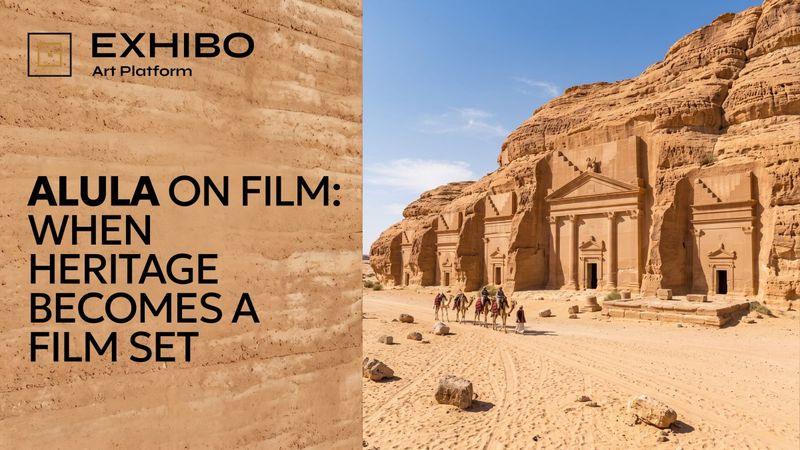
AlUla on Film: When Heritage Becomes a Film Set
Hollywood came to AlUla to build Iraq and Afghanistan. Saudi Arabia is using the same landscape to build AlUla itself — destination, museum, cultural stage — and the old stone is being asked to say something new.
Hollywood built Iraq and Afghanistan in AlUla; Saudi Arabia is building AlUla into itself. On carved kings, a warning old as scripture, a mirror the size of a building, and who gets to author a place.
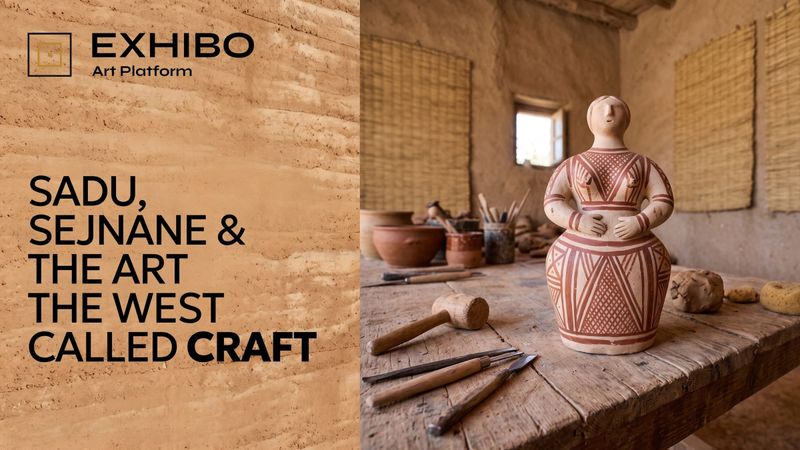
Women Makers: Sadu, Sejnane and the Art the West Called Craft
How the women of Sejnane and the Sadu tents made a world of geometric art the museum system had no shelf for — and how it is finally being called by its name.
Two women's traditions — the clay of Sejnane in Tunisia, the woven tents of the Arabian Peninsula — share no bloodline, only a rhyme: the same spare geometry, held and passed down by women, in whatever material their world gave them. This is the story of the visual knowledge the West filed under "craft," the makers it kept downstairs, and the contemporary artists now carrying it back up into the room where "art" is defined.
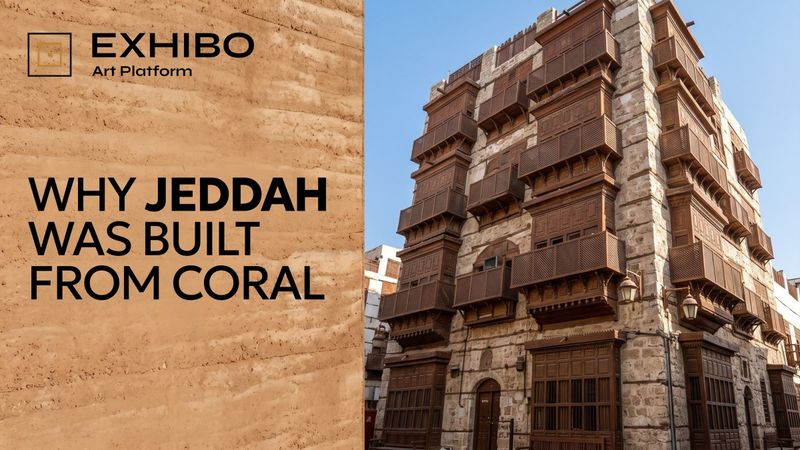
Why Jeddah Was Built From Coral
A treeless port with no stone quarried its whole city out of the reef offshore — then oil and concrete let it walk away from the sea that built it.
Jeddah's old town isn't decorated with coral. It's made of it — reef cut soft from the water and hardened into towers. The strange part is what happened when the city no longer needed the sea.